Sufism
Muslims have sometimes described the shari‘a, or Islamic law, as the “outer” way to God because it regulates a person’s “outer” existence: how he or she should handle relationships with other people, how he or she should live in a community, and how he or she should worship.
For many Muslims, however, there is also an “inner” way to God. This is the mystical tradition of Islam, which is known as Sufism. Like traditions of mysticism in other religions, the goal of a follower of Sufism, a Sufi, is to draw close to and personally experience God. However, unlike mystics of other religions, Sufis base this spiritual quest on the sources of Islam, namely, the Qur’an and the example of Muhammad.It is likely that Sufism arose in the years after the death of Muhammad as a response to the worldly excesses and materialism of the Umayyad Dynasty. Many early Sufis were ascetics who taught that a simple way of life was in keeping with the way Muhammad lived. One famous eighth-century Sufi was Hasan of Basra. (Basra is a city in Iraq.) He was known for preaching asceticism and for his constant weeping out of fear of God. A renowned early female Sufi was Rabi'a al-‘Adawiyya, also of Basra. Rabi'a was known for her almost giddy happiness in the love of God. There are many wonderful stories about Rabi'a. In one, she criticized Hasan of Basra by telling him that his constant weeping and fear of God drew the focus to himself rather than to God. This theme is echoed in another story, in which she walks through the streets of Basra carrying a pitcher of water and a flaming torch. When asked why she was doing this, she explained that she wanted to set paradise ablaze and put out the fires of hell so people would love God solely for the sake of God—not out of hope of paradise or fear of hell.
After Rabi'a’s time, this ideal of intense love for God became a primary focus for Sufis.
Love is often expressed in Sufi poetry, which is one of the premier art forms in Islamic history. The following poem, by the great thirteenth-century Sufi poet Jalalludin Rumi, describes the beauty of submitting to God. Those who love and submit to God are compared to a moth who is drawn to a candle’s flame.Love whispers in my ear,
“Better to be a prey than a hunter, Make yourself My fool.
Stop trying to be the sun and become a speck!
Dwell at My door and be homeless.
Don’t pretend to be a candle, be a moth, so you may taste the savor of Life and know the power hidden in serving.”15
Sufis ground their belief and worship practice in the teachings of the Qur’an. Sufi readings of the Qur’an have often searched for the inner, or hidden, meaning. This approach to interpreting the Qur’an often focuses on God’s love for creation and God’s closeness to humanity. Sufis often emphasize the teachings of the hadith qudsi, which focus on these themes.
Like all Muslims, Sufis consider Muhammad the ideal human, and they strive to emulate the way he lived his life. Sufis emphasize the story of the miraculous night when Muhammad journeyed from Mecca to Jerusalem and from there ascended to heaven to meet God. The ascension to heaven is known as the miraj. Muslims believe that the Angel Gabriel came to Muhammad one night while he was sleeping and took him to Jerusalem. From there, Muhammad ascended upward through the many levels of heaven. He met earlier prophets like Jesus and Moses. Eventually, Muhammad came into the presence of God. God gave him significant blessings and special spiritual knowledge that he later passed on to his companions, particularly ‘Ali. Because Muhammad is believed to have personally experienced the presence of God, Sufis consider him to be the first Sufi and the source of the special spiritual knowledge they seek. In East Africa and the Middle East, Muslims learn of the miraj through epic poems, which are recited on special occasions like Maivlid al-Nabi.
Because Muhammad ascended to heaven from Jerusalem, it is recognized as a holy city for Muslims, along with Mecca and Medina.The night journey is mentioned in the Qur’an (17:1) and the hadith literature and is considered by many Muslims to be the greatest of all Muhammad’s spiritual experiences. Because Muhammad ascended to heaven from Jerusalem, the city holds a special place in Islam, and it is one of the three Muslim holy cities, along with Mecca and Medina. In the year 691 ce, the beautiful shrine known as the Dome of the Rock was built over the spot from which Muhammad ascended to heaven. The Dome of the Rock is located on the place known as the Temple Mount, where the ancient Jewish temples were located. It is therefore easy to understand why this place in the center of Jerusalem is special to both Muslims and Jews. This is one of the primary reasons that the status of Jerusalem is so central to the Arab-Israeli conflict today: practitioners of both faiths (as well as Christians) consider the city to be holy and long to have unfettered access to it.

The Dome of the Rock in Jerusalem.
Most Sufis agree that an individual needs guidance along the spiritual path to God. As a result, a master-disciple relationship is very important in Sufism. The shaykh, or master, directs the spiritual training of the novices. In the early centuries of Islam, respected shaykhs would guide several pupils, and as a result a number of Sufi orders, known as tariqas, developed around particular Sufi masters. Each order traces a spiritual lineage of learned leaders back to Muhammad and from Muhammad to God. Muhammad is believed to have passed on his special religious knowledge to his companions, who then passed it down through the generations from master to disciple.
Although members of all the orders have the same goal—personally experiencing God—they emphasize different meditation techniques and spiritual practices.
Some orders are widespread and have members all over the world. Others are limited to a particular region. The most well-known order in the Western world is perhaps the Mevlevi order, which is based on the teachings of Jalalludin Rumi.Sufi orders emphasize the necessity of some type of dhikr. The term means “recollection” and refers to Sufi meditation in which the believers strive to “recollect” God so completely that they forget themselves. Dhikr can take many forms and varies from order to order. Sometimes dhikr is as simple as the recitation of the shahada, and sometimes it is much more elaborate. The Mevlevis have an elaborate dhikr. In the West, they are often called the “Whirling Dervishes” because their dhikr involves controlled whirling. For all Sufis, the goal of dhikr is to lose the sense of self entirely in complete remembrance of God.
Not all Sufi practice takes place in the formal context of the orders. In many parts of the world, Muslims may participate in Sufi practice without affiliation to an order. A good example is the practice of saint veneration. Many Sufis venerate shaykhs or saints who were well known and respected for their religious learning and spirituality. In some areas, such as Pakistan and northern India, the tombs of deceased shaykhs have become places of pilgrimage. At the tombs, people seek blessings from the saints. Tomb visitation is very common in South Asia, when the celebration of the saints’ death date can draw thousands of pilgrims. Many pilgrims are not affiliated with a Sufi order, and some are not even Muslim; people of all faiths may recognize the power of a saint.
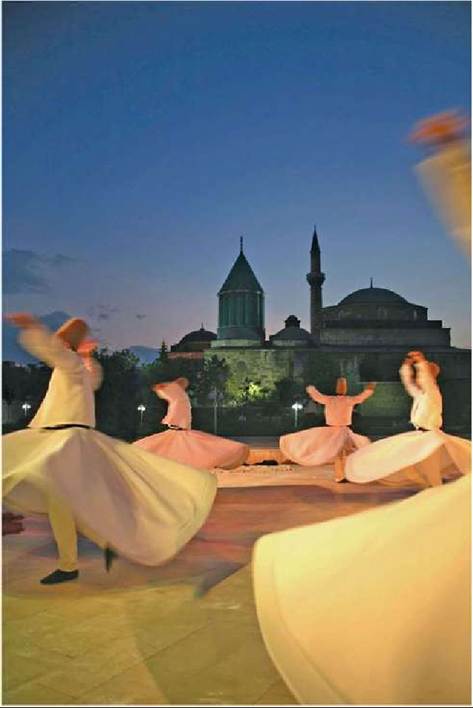
Mevlevi dhikr; Mevlevis are sometimes known as Whirling Dervishes.
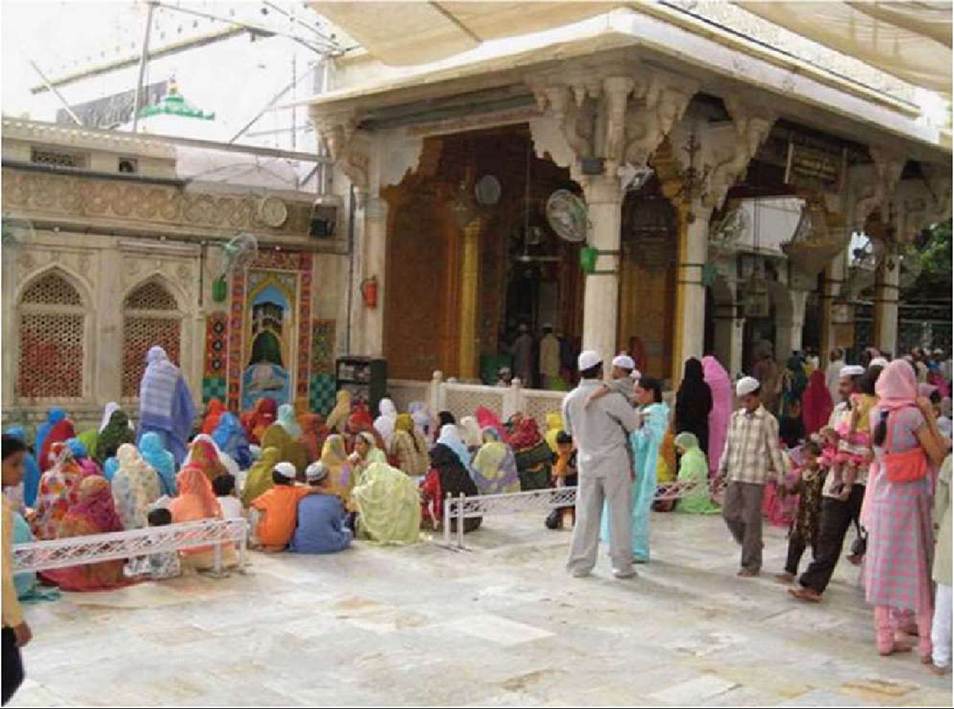
Pilgrims at the shrine of Hazrat Mu‘in ud-Din Chishti in Ajmer (Rajasthan), India.
Throughout Islamic history, occasional tension has arisen between Sufis and other Muslims.
For example, the practice of saint veneration has drawn criticism from some, who argue that the celebration of saints compromises the oneness of God by raising mere mortals to the level of the divine (recall al-Wahhab’s criticism of saint veneration). Of course, those involved in saint veneration do not regard saints as divine. Rather, they view saints more as close friends of God, who are filled with blessings that can be transferred to others. Historically, Sufis have sometimes been criticized by other Muslims for neglecting the five pillars in favor of more esoteric religious knowledge and practice. Some early Sufis rejected adherence to the sharfa on the grounds that the technical laws merely served to veil God from the believer, not draw him or her closer. However, this was not a majority opinion among Sufis. Indeed, some Sufis, especially the eleventh-century scholar al-Ghazali, have made a specific effort to reconcile the shari'a and Sufism. In his writings, al-Ghazali established Sufism as a branch of formal learning in the Islamic sciences.
More on the topic Sufism:
- Policing the Boundaries of Orthodoxy in the Seventeenth Century
- The Muslim Tradition12
- Islam in India
- Islamic Movements and Organisations
- 22 Islam in Iran
- 20 Early Islam
- Islam in Africa and African Islam: An Overview
- INDEX
- Contents
- Bibliography