Muslims in North America
Today, about 3.5 million Muslims live in the United States, and about 1 million live in Canada. Both populations are growing rapidly, primarily through immigration. American Muslims are making social contributions in both their home communities and regional and national politics.
Many Muslims live in large urban areas, but significant populations also live in smaller towns and more rural areas. The Muslim population in the United States is not limited to one particular city or even one particular region. Muslims live everywhere, from Los Angeles to Salt Lake City to Dearborn, Michigan, the city that has the largest Muslim population in the United States.The African American Muslim population grew significantly in the twentieth century. Scholars estimate that from 10 to 30 percent of the Africans who were enslaved and brought to the United States from the seventeenth to the nineteenth centuries were Muslims. Once in the United States, however, many enslaved people were not permitted to freely practice their religion, although some were literate in Arabic and tried to maintain their religious practice. Many were also forced to convert to Christianity or converted by choice.
In the twentieth century, African Americans were attracted to Islam and converted for a variety of reasons. For example, many people regarded Islam as the likely religion of their African ancestors. Thus, Muslim religious leaders often stressed these ties to Africa; some claimed that Islam was a more “authentic” religion for African Americans, for Islam was not the religion of the European American slave owners. Today, about half of the Muslims in the United States are African Americans.— The Nation of Islam has played an important role in the US Muslim community. However, the majority of African American Muslims are not members of the organization. The Nation was founded by a man who was known by several different names, among them Wallace Ford and Wall D.
Fard. In the 1930s, Fard established the Temple of Islam in Detroit, Michigan, and he preached that all Black people were originally Muslims. Eventually, a student of his named Elijah Muhammad succeeded him as the leader of the Nation of Islam. The Nation differs significantly from mainstream Islam on several key teachings. Most significantly, followers regard Fard as God incarnate, and Elijah is considered his prophet. The Nation of Islam has been controversial in the United States because of teachings that suggest the natural supremacy of Black people and encourage the rejection of white society. Despite its controversial nature, the Nation has been active in improving the lives of Black Americans.When Elijah Muhammad died in 1975, the Nation of Islam split. One group, led by his son Warith Deen Muhammad, moved away from the teachings of the Nation toward mainstream Sunni Islam and became known as the American Muslim Mission. This is the largest organized group of African American Muslims today. Louis Farrakhan, a radical preacher who is very controversial for his espousal of Black supremacist ideas and politics, has led the other group, which retained the name Nation of Islam, for many years.
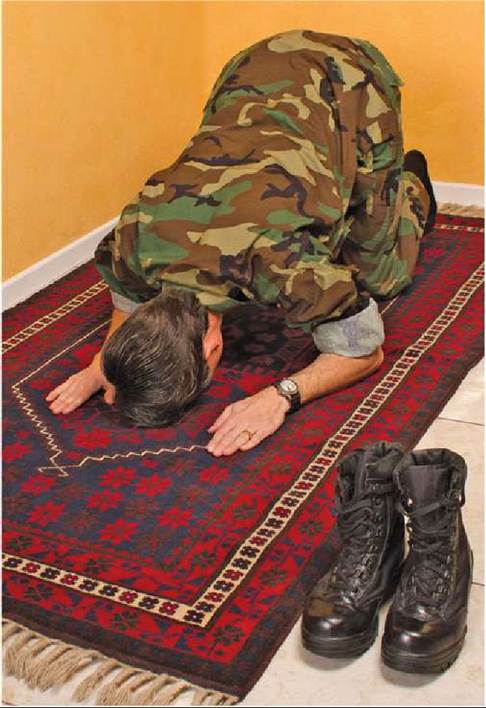
An American Muslim soldier praying.
Malcolm X, a leader in the Black Power movement of the 1960s, was perhaps the most famous American Muslim and the most famous member of the Nation of Islam. He was raised a Christian with the name Malcolm Little and converted to Islam while serving a prison sentence. He took the name X as a statement decrying his “slave name” of Little, in reference to the historical practice of enslaved people being given the surnames of their masters. He eventually took the name Malik al-Shabazz. Malcolm X was affiliated with the Nation of Islam for several years and became an influential public figure. However, after he made the hajj to Mecca in the 1960s, he moved toward mainstream Islam and eventually separated himself from the Nation. In his autobiography, he movingly describes the sense of harmony and unity he felt while on hajj with Muslims of all colors, ethnicities, and cultural backgrounds.13
More on the topic Muslims in North America:
- Muslims in North America
- Brodd Jeffrey, Little L., Nystrom B., Platzner R., Shek R., Stiles E.. Invitation to World Religions. 4th edition. — Oxford University Press,2022. — 1196 p., 2022
- THIRTEEN Future trends and predictions
- Homosexuality, L’cwat
- WHAT APOSTATES FROM COMMUNISM AND ISLAM CAN TEACH THE WEST
- Indigenous Religions of Africa
- Precedents: the Mayflower Compact and the colonization
- About the Authors
- AMERICAN CONSTITUTIONALISM
- Algeria