Varieties of Islam: The Sunni and the Shi‘a
Most of what we discuss in this chapter is applicable to both major branches of Islam, the Sunni and the Shi‘a. Although the essential beliefs of the two branches are the same—notably, the oneness of God, the Qur’an as the word of God, and Muhammad as the messenger of God —there are some important differences between them.
Who Are the Sunni?
Sunnis make up the majority of Muslims worldwide, about 85 to 90 percent, and the Shi'a make up about 10 percent of the global Muslim population. As you learned earlier, the Sunni and Shi‘a split began over the leadership of the Muslim community after the death of the Prophet Muhammad. The majority of Muhammad’s companions thought that he had not chosen a successor, and so they supported Abu Bakr as the next leader. However, Sunnism did not develop into a distinct branch of Islam until about 300 years later. At that point, certain scholars emphasized that Muslims should primarily follow the example of the Prophet Muhammad, the Qur’an, and the opinions of earlier scholars with regard to engaging in rationalist thought like that of the Mutazilites. The word sunni comes from this emphasis on the sunna of the Prophet.
One of the differences between the Sunni and the Shi‘a concerns the sources of Islamic law, which we discuss in more detail in a later section. In short, although both branches agree on the importance of the Qur’an and the sunna, in Sunni Islam an additional source is the consensus of the community. This became a source of law because of a hadith that reported the Prophet saying, “My community will never agree upon an error.” Of course, it is impossible to solicit the opinion of every Muslim on a particular legal question, so Sunnis have generally agreed that the community in question consists of the ulama, or legal scholars.
Who Are the Shi‘a?
The Shi‘a are in the majority in Iran and Iraq, and they form significant minorities in other countries, including Pakistan and India.
In addition to believing that Muhammad designated eAli to be his successor, the Shi‘a believe that Muhammad passed on special religious knowledge to his relatives through ‘Ali. Therefore, to the Shi‘a, only Muhammad’s family and their descendants should lead the Muslim community. This belief in a continuing spiritual leadership of the Muslim community through the line of successors is the most significant contrast between Sunni and Shi‘i Islam (the term Shi‘a is the plural form of Shi‘i; Shi‘i is also the adjectival form). For the Shi‘a, the rightful leaders of the Muslim community are known as imams, the same term used for someone who leads prayer. For the Shi‘a, the imam is both the political and the religious leader of the community, and he possesses the special religious knowledge that Muhammad passed on to the members of his family. ‘Ali is regarded as the first imam. It is important to note that, although the imam has a very prominent role in Shi'ism, he is not a prophet.The authority of the Shi‘i imams has a special role in Shi‘i law that we do not see in Sunni approaches to Islamic law. The Shi‘i schools do not recognize consensus as a source of law but instead focus on the infallibility of the imam. Islamic scholarship is highly important in the Shi‘i tradition. Also, although scholarship and learning are valued among Sunni Muslims, there is a more formal religious authority structure in Shi‘ism that we do not find in Sunni Islam.
Shi‘ism itself has several branches, which differ in how they trace the line of imams in descent from ‘Ali. The largest branch is known as the Twelvers, who make up the majority of Muslims in Iran and Iraq. The Twelvers believe that the line of imams went through several generations until the twelfth imam disappeared in the ninth century. This twelfth imam is considered to be in “occultation,” or hiding. Twelvers believe that he will eventually return. In the meantime, the Islamic scholars are considered responsible for the leadership of the Muslim community.
This idea was important in the new government set up in Iran after the 1979 revolution.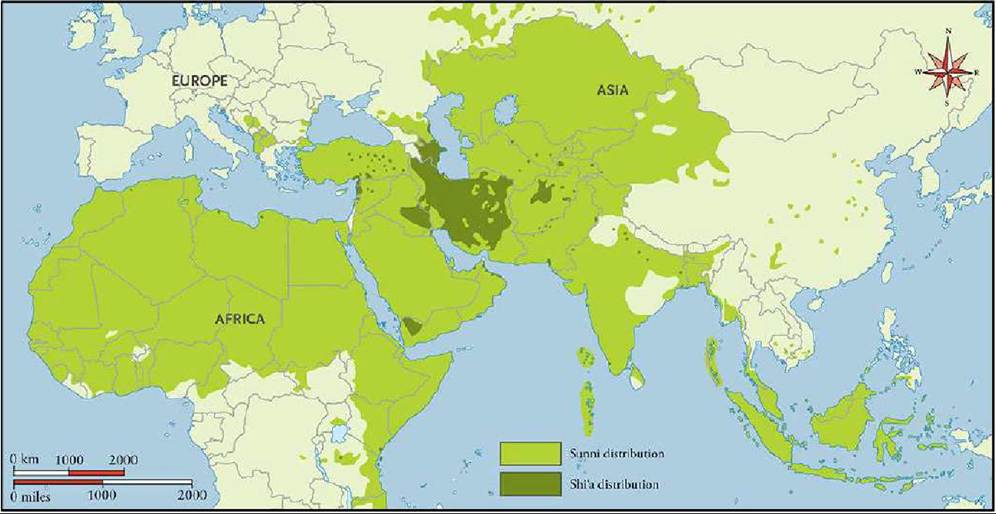
World Sunni and Shi'a distribution.
Another branch of Shfism, known as the Ismailis, believes that there has been an unbroken line of imams from ‘Ali until the present day. They take their name from the seventh imam, a man named Ismail, whom the Twelvers do not recognize as an imam.
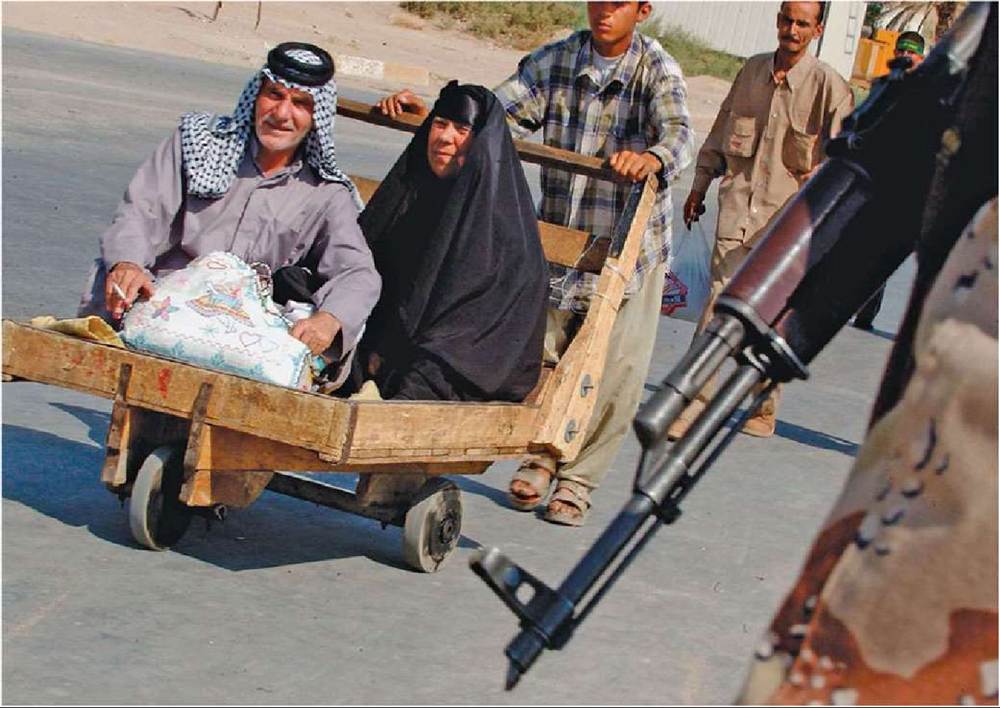
An Iraqi soldier stands guard as Shi'i pilgrims approach the holy city of Karbala.
The month of the Islamic calendar known as Muharram is especially significant to the Shi'a. This is because the martyrdom of Muhammad's grandson Husayn, discussed earlier in this chapter, is recalled on the tenth of the month. This date is called ‘Ashura, and the entire month of Muharram is recognized as an important and somber time. At this time of year, the death of Husayn is commemorated in many ways by the Shi‘a in places such as Iran and Iraq. Husayn’s story is retold through passion plays and street processions, called Ta'ziya, in which Muslims reenact the events of Husayn’s death.
For the Shi‘a, the tombs of the Prophet’s family are popular sites for pilgrimages. Through these pilgrimages, Muslims commemorate and honor the Prophet’s family. Karbala, where Husayn was martyred and is said to be buried, is an important pilgrimage site in Iraq.
More on the topic Varieties of Islam: The Sunni and the Shi‘a:
- Sunni Ali Ber
- The Shari'a: Islamic Law
- Fundamentalist Islam: Afghanistan and the Taliban
- 22 Islam in Iran
- 20 Early Islam
- Twelver usul
- The First Gulf War
- Bibliography
- The Islamic Empire: From Political to Cultural Unity
- 39 Nations Afloat