PRIESTS AND POLITICS
Several types of priests and priesthoods existed in Roman religion and it is impossible to give a single definition of a Roman priest. The sources mention, however, certain social and physical requirements associated with the recruitment of members to the various priesthoods.
A potential candidate had to be a Roman citizen, freeborn and free of physical defects. Even though no other social criteria or norms for admission to the priesthoods are explicitly mentioned, it is fairly clear that religious offices throughout Roman history were held by men from the wealthiest and most powerful group in Roman society, the noble families that made up the city’s social and political elite.In one of his speeches where he defends his own interests in a conflict over an enemy’s consecration of the site of his destroyed house, Cicero (De domo sua [On his House] 1.1) begins his address to the Roman college of pontifices by defining an ideal religio-political relationship regarding Roman priests:
Among the many things, gentlemen of the pontifical college, that our ancestors created and established under divine inspiration, nothing is more renowned than their decision to entrust the worship of the gods and the highest interests of the state to the same men - so that the most eminent and illustrious citizens might ensure the maintenance of religion by the proper administration of the state, and the maintenance of prudent interpretation of religion. And if ever a case of great importance has depended on the judgement and authority of the priests of the Roman people, then surely this case before you now is of such magnitude that the whole prestige of the state, the well-being of all citizens, their lives, their liberty, their altars, their hearths, their household gods, their property, their prosperity, their homes - all of these things seem to have been entrusted and made over to your good sense, your impartiality, your authority.
One must naturally recall Cicero’s objective in this speech: he is appealing passionately to this very group of people to reach a verdict where property and ritual came into conflict, and the likelihood of rhetorical exaggeration is obvious. Nevertheless, the religio-political ideal is clearly expressed: from a Roman perspective, coinciding religious and political roles are desirable. Having the same group of people in magistracies and in priesthoods is considered a prestigious combination of religious and political responsibilities and positions. Handling religious affairs and safeguarding the interests of the state are closely intertwined activities, and this line of reasoning is also demonstrated by the fact that all important political decisions had to be confirmed by the taking of auspices (see below).
At the top of the hierarchy was the rex sacrorum (“king of rites”) who took over the ritual duties from the king when the Roman kingship was replaced by the Republic. He was a member of the college of pontifices, whose elected leader, the pontifex maximus, in time became the most powerful priest in the Roman religion. The pontifices had a wide range of functions. The Senate could consult them in various religious matters and they were, among other things, responsible for the calendar and some of the most important festivals of the city. The pontifices also registered various religious and social events in annual records. Another important college of priests consisted of the augures, who were experts in interpreting the will of the gods by means of a procedure known as taking the auspices (auspicid). Such interpretations, expressing the gods’ favour or disfavour, involved the observations of the flight and behaviour of certain species of birds as well as of thunder and lightning, and the demarcation of sacred space. Taking the auspices was a standard part of public procedure in connection with religious and political activities in Rome, such as the building of temples, the passing of laws, the holding of elections, meetings in the Senate, and so on.
Since each meeting was preceded by the taking of the auspices, augural interpretations could, in fact, block a political assembly or annul a decision, and thus played a very important and powerful role in ruling Roman society. This is also clearly emphasized in Cicero’s De legibus [On the Laws]: according to the rules of the ideal state, described by Cicero, those in charge of negotiations must observe the auspices and obey the public augur (Cicero On the Laws 3.11; cf. 3.43).A third powerful college of priests was the duoviri sacris faciundis (“the two men for sacred actions”), later increased to ten and then to fifteen members. These priests guarded and consulted a collection of Greek oracles, the Sibylline Books, which could be consulted on the request of the Senate in cases of public portents (the prodigies). According to Dionysius of Halicarnassus (Antiquitates Romanae [Roman Antiquities] IV.62) the Sibylline Books came to Rome during the reign of King Tarquin the Elder (conventionally dated to 616-579 BCE). A foreign woman approached the king and offered to sell him nine books of Sibylline oracles. Tarquin refused to buy at her price, so she burned three of them and offered him the remaining six for the same price. He laughed and refused again, so she destroyed three more and offered him the last three still for the same price. Tarquin, now becoming curious, sent for the augures, told them what had happened and asked them what he should do. The priests realized that what he had rebuffed was a gift from the gods and advised him to pay the woman the whole price for the remaining three. Tarquin at last paid the price and these three were the books kept in Rome, guarded and consulted by a prominent college of priests. It is worthy of note that many cultic innovations were incorporated into Roman religion by the instructions of the Sibylline Books, for example the Greek cult of Aesculapius and the Phrygian cult of Cybele.
A Roman priest could also be devoted to the service of a specific god, such as the three important priests (famines') of early Rome: the flamen Dialis (of Jupiter), the flamen Martialis (of Mars) and the flamen Quirinalis (of Quirinus) (see Fig.
16.3). The priesthood of Jupiter was one of the earliest priesthoods at Rome, and this office was surrounded by a number of special taboos. For example, there was a rule against the flamen Dialis riding a horse; he was not allowed to see the army equipped for battle outside the pomerium of the city; only a freedman should cut the hair of the flamen Dialis; and his hair trimmings and nail parings should be buried under a fruit-bearing tree; he must not touch or even name a she-goat, raw flesh, ivy or beans; the feet of the bed in which he sleeps must be smeared with a thin layer of clay; and he must not sleep away from that bed three nights in a row; nor was it lawful for anyone else to sleep in that bed; the marriage of a flamen Dialis could not lawfully be dissolved; and if his wife died, he must resign from his office; he never entered a place where there was a tomb; and he never touched a dead body (cf. Aulus Gellius, Noctes Atticae [Attic Nights] X.15.1-25).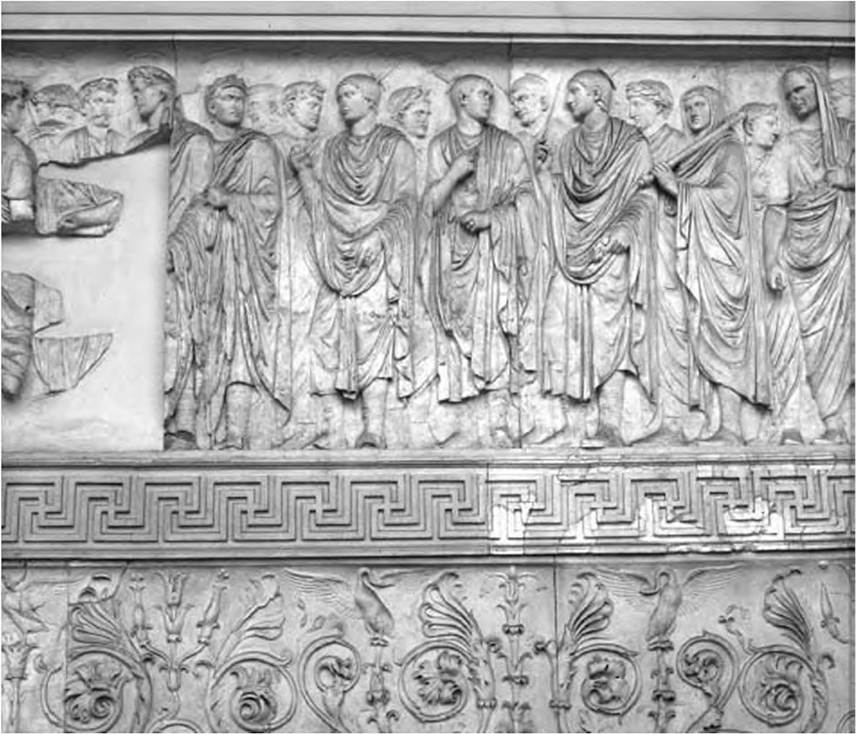
Figure 16.3 An important group of Roman priests was the flamines, distinguished by their head-gear (apex), a bonnet with a projecting baton of olive-wood. Scene from the Ara Pacis in Rome. Photo: Niels Hannestad, reproduced with permission.
Furthermore, Etruscan priests, the haruspices, were involved in Roman religion in connection with the interpretation of public portents and expiation ceremonies where necessary. The haruspices were employed by the Romans to interpret both the entrails of victims and the prodigies. Unfortunately, however, the picture we can piece together from the sources is by no means clear or consistent. An inscription dating from the early empire (OIL VI 32439) bears witness to a gathering of sixty haruspices, but it is not known whether this was a local or a more general organization. Different groups of haruspices may have coexisted, or perhaps different religious functions were performed by the same group.
The sources usually speak of them in the plural, but without providing names or numbers. According to Cicero (Epistulae ad familiares [Letters to Friends] VI.6.3; cf. De divinatione [On Divination] 1.92) the haruspices were recruited from Etruscan aristocratic families, and they are generally portrayed in the sources as a prestigious group. The knowledge and practice of Etruscan divination was handed down from one generation to the next by means of the libri haruspicini. These books supplied the Etruscan priests with detailed technical and interpretative knowledge and various ritual instructions with the purpose of ensuring the destiny of mortals and the welfare of society (cf. Cicero On Divination 1.72; 11.49; Rasmussen 2003: 117-48; Rasmussen & Rasmussen 2008: 259-65). However, one particular group of haruspices stands out among the others: the wandering “street-corner” haruspices, apparently self-styled practitioners of divination specializing in private portents. Cicero (On Divination 1.132, 11.51) describes this group as simple charlatans, and it might be to this type that Cato - the guardian of tradition - was alluding with irony when he wondered how two Etruscan haruspices could avoid winking or smiling at each other when they met!
More on the topic PRIESTS AND POLITICS:
- RANKED PRIESTHOODS
- 15 Christianity in Latin America from the Sixteenth Century
- Did the Austrian Empire govern its Ukrainian lands differently?
- DISSATISFACTION WITH SCIENCE AND RELIGION
- Bibliography
- Domestic Politics
- References
- Easteal Patricia (ed.). Justice Connections. Cambridge Scholars Publishing,2014. — 322 p., 2014
- Bredholt Christensen Lisbeth, Hammer Olav, Warburton David. The Handbook of Religions in Ancient Europe. Acumen,2013. — 456 p., 2013
- Bibliography