SACRIFICES AND VOWS
Animal sacrifice was a key ritual element in Roman religion. The victim was carefully selected with regard to its species, sex, age and colour, depending on the deity and the cultic context in question.
A scene from Trajan’s column illustrates animals waiting to be sacrificed in a ritual purification of the Roman army before they were to attack the Dacians (see Fig. 16.2). A bull, a sheep and a pig (a sacrifice known as the suovetaurilia) are led in procession round the Roman camp. Behind the animals stand the scantily clad victimarii, who performed the killing of the victims. After the sacrifice, the entrails of the animals were examined, allowing the prediction of the outcome of the battle as the will of the gods. Within the camp the Emperor Trajan is shown performing another ritual: head veiled, he pours a libation over an altar.Although there were variations, the overall procedure of sacrifice included preparatory rites; a prayer was addressed to the divine recipient, and the placing of wine, meal and salt on the animal’s forehead sanctified the victim. The victim was then killed and its entrails were examined, with the purpose of interpreting the will of the gods. If the reading of the entrails was favourable, the animal was butchered, cooked and eventually eaten by the worshippers. There was a clear distinction, however, between those parts of the animal that were offered to the worshippers and the vital part, the entrails, which were burnt on the altar and offered to the gods. Offerings, especially in private cult, could also consist of the sacrifice of smaller and less expensive animals, such as geese or lambs, or simple gift s of cakes, flowers, incense, milk, honey, oil or water.
Moreover, within the private household the lares familiares (the gods of the house and its members) received offerings and prayers as protectors of the household’s safety and prosperity.
The lares were represented by means of paintings or small statuettes of bronze or terracotta, carrying a drinking horn and wine-bucket, standing in the lararium. This latter was a niche in the wall of the house, serving as the shrine of the household gods. The lararium was commonly found in the central court (atrium) of a house or sometimes in the kitchen. There is little firm evidence, but it is assumed that these shrines have functioned as the focus of family rituals and sacrifice conducted by the head of the household (paterfamilias).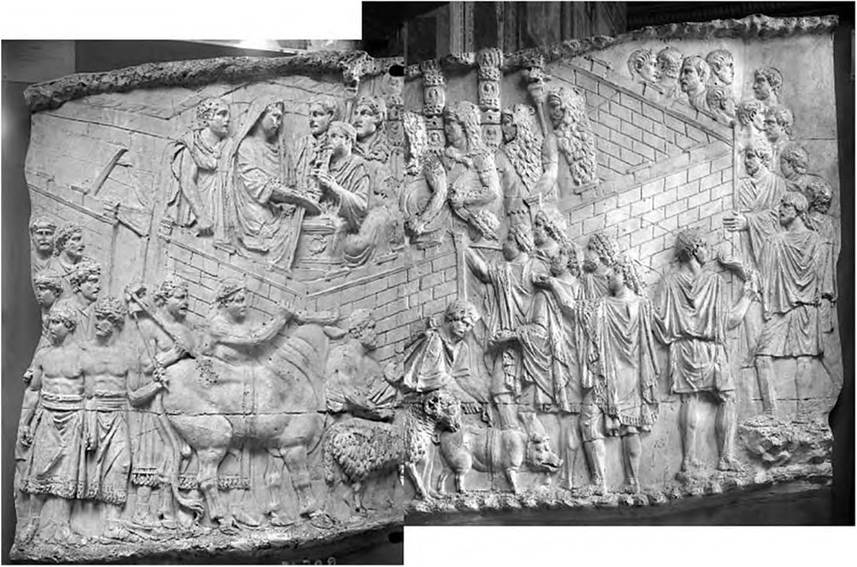
Figure 16.2 A scene from Trajan’s column in Rome showing the sacrifice suovetaurilia. Trajan’s Column, scene LIII, 133-4, Cast. Photos: Deutsches Archäologisches Institut, Rome, Inst. Neg. 31.322; 31.323. Reprinted with permission.
Furthermore, the religious vow (votum) played a central role in the communication and negotiation between humans and gods. A vow was a prayer by which one could ask a deity for help, promising an offering in return, that is, the Romans offered to perform acts of worship in return for divine benevolence. An example would be a Roman general asking a god or goddess for victory on the battlefield, promising in return to erect a magnificent temple to the deity. The gods could not be controlled, however; they were free to do as they pleased, and in case of a lack of divine benevolence no obligation existed on either side: no victory, no temple.
Various types of vows were used in various contexts. In times of war, for instance, an enemy god could be seduced to change sides and join the Romans. This could happen by way of an evocatio, meaning literally a “summoning away”. Before the Romans attacked a city, the Roman general would offer the patron deity of the enemy city worship in Rome. The first known example of such an evocatio was in 396 BCE when the patron deity Uni of the Etruscan city of Veil changed sides. She was installed in a temple on the Aventine hill in Rome under the Roman name of Juno Regina (Livy 5.21.1-7). In this subtle way, the enemy territory was deprived of its divine protection. In addition, the enemy god legitimated the Roman victory, and at the same time a new deity was incorporated into the Roman pantheon.
More on the topic SACRIFICES AND VOWS:
- B. Bread as an Element of Sacrifices
- ANCESTORS AND SACRIFICES
- Critical situations and human sacrifices
- Sacrifice: Animals and Other Foods
- Private Citizens and the inferiae for Lucius
- CHAPTER FOUR Town and Country Urban devotions and rural rituals
- The Chinese Buddhist Tradition and Violence
- Way of Life
- 11 HOPEFUL MONSTERS 1204–1453
- Conclusion
- The Scottish System
- THE DIVERSITY OF ETRUSCAN CULTS