11 HOPEFUL MONSTERS 1204–1453
The destruction of the greatest Christian city in the world by Christian crusaders was not universally welcomed even in western Europe. Pope Innocent III, who had called for the crusade to set out in the first place, denounced the soldiers of Christ for betraying their vows to liberate the Holy Land.
The savagery of their behaviour in the conquered city would only make them hated by their Orthodox co-religionists, he complained.1 Byzantines belonging to the educated elite, such as Niketas Choniates, or Anna Komnene before him, had been convinced from the start that the ultimate goal of the crusading movement had been not the Holy Land but the far richer pickings of their own. The events of the Fourth Crusade seemed to prove them right. And for many in the Greek-speaking world, thereafter, this view would become deeply ingrained.In reality, the crusaders and the Venetians had probably surprised themselves as much as anyone else by what they had done. Afterwards, the victors found themselves in a weaker position than they might have expected. The plans drawn up by the leaders in March 1204 had been for a division of the spoils, not a takeover of a functioning empire. Even Constantinople had to be divided—with Hagia Sophia and the ecclesiastical jurisdiction that went with it going to the Venetians, while a new ‘Latin’ emperor, the former Count Baldwin of Flanders, ruled from the Blacherna palace at the other end of the Golden Horn. Boniface of Montferrat, who had been the nominal leader of the crusade but missed out on the imperial title, became king of Thessalonica instead.
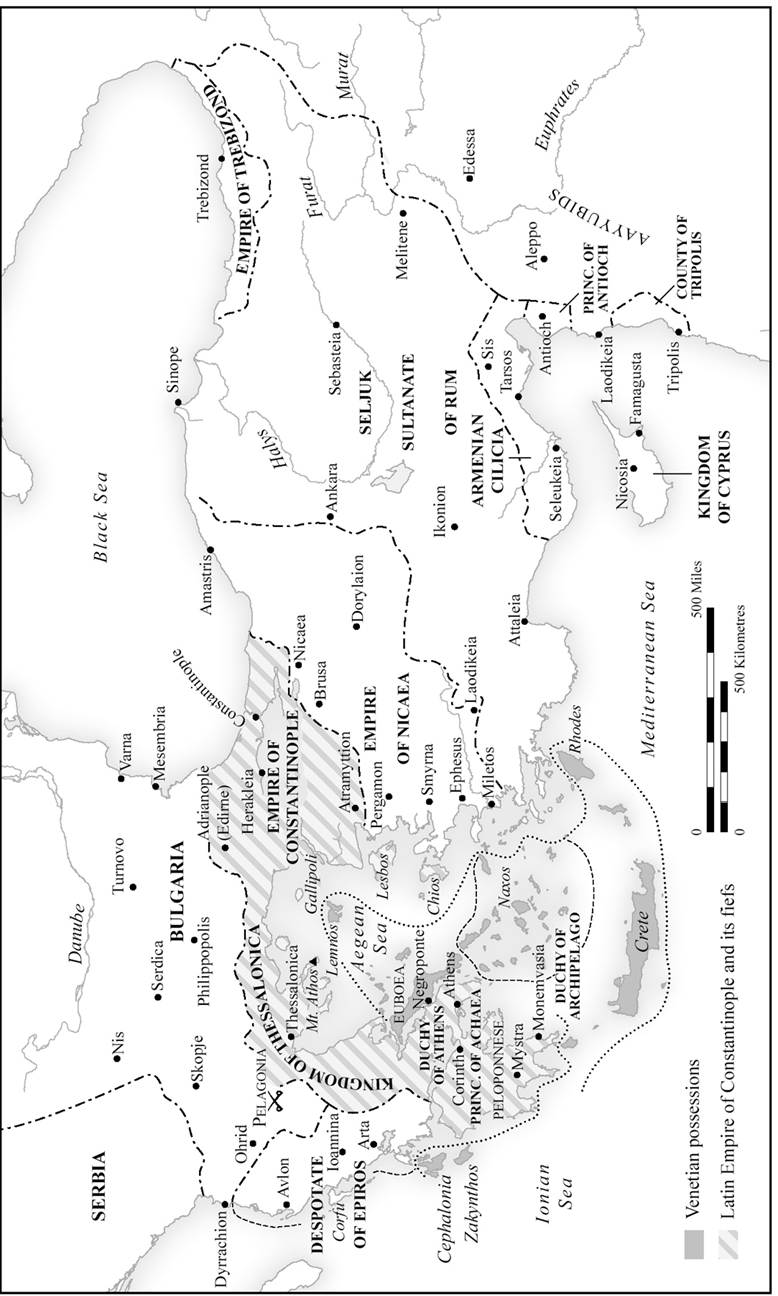
11. ‘A kaleidoscope of petty fiefdoms, principalities and kingdoms’, c. 1214
Within the next few years, the Venetians went on to secure their hold on islands and coastlines that would become the basis for a commercial, maritime ‘empire’ in the eastern Mediterranean.
Other islands, and parts of Constantinople itself, would fall to Genoa, Venice’s bitter trading rival. On the Greek mainland, former imperial provinces were parcelled out among leading crusaders, who then ended up fighting to claim them from the local inhabitants, or sometimes from each other. Wherever they succeeded, the new rulers went on to organise their territories according to the western, feudal system. In theory, this meant that each of them owed allegiance to their overlord in Constantinople. But in reality, the ‘Latin Empire’, as it came to be known, ended up as no more than a city-state consisting of the capital, its immediate hinterland in Thrace, and a small wedge of territory on the Asian side of the Bosphorus between the Black Sea and the Sea of Marmara. Its supposedly feudal vassals went their own way.The effect of all this was to shatter the highly organised, centralised Byzantine state into a kaleidoscope of petty fiefdoms, principalities, and kingdoms. Some of these would change hands, swap allegiances, and shift their boundaries many times, as the kaleidoscope continued to turn. During the next three centuries, Greek speakers living on the European side of the Aegean and on the islands, from the Ionian Sea to Cyprus, would find themselves under the sway of a bewildering variety of rulers at different times and in different places: French, Venetians, Genoese, Florentines, Catalans, Aragonese, Navarrese, and (recruited from all over western Europe) the Knights Hospitaller of Saint John.
Athens, for instance, would be ruled throughout the thirteenth century by a French baronial family from Burgundy, then for much of the fourteenth by the descendants of Catalan mercenaries who had briefly run amok through the Greek mainland before settling there, and finally in the fifteenth by Italian dukes from Florence. At some point during this time, the Parthenon was converted from an Orthodox church to a Catholic cathedral; the massive entrance gateway to the Acropolis, the Propylaea, into a ducal palace.
A hundred-foot tower was built to guard it, in the style of the towers that still define the skyline in Italian cities and towns such as Bologna and San Gimignano. The ‘Frankish tower’, as it became known, would remain the tallest building in Athens until it was demolished in the 1870s. This was the Athens that would find its way into the pages of the Decameron by Boccaccio (written in the 1350s), The Knight’s Tale by Chaucer, and Shakespeare’s A Midsummer Night’s Dream.2The duchy of Athens was just one among many such states left behind in the eastern Mediterranean as the tide of the crusades ebbed. Modern historians often see these states as the precursors of western European colonial ventures around the world in later centuries.3 From the perspective of colonial history this makes good sense—there are many continuities in the behaviours of the rulers. But, with the exception of the Venetians, the new masters were not acting in the name and interests of a colonial power. Rather, they were high-ranking adventurers setting up on their own account. Perhaps a better way to understand what was happening in much of the Greek-speaking world at this time is to compare it to developments in the home countries of the ‘colonists’, back in western Europe. There, during the same centuries, the foundations were being laid for what would later become national identities, as allegiances, identities, and political loyalties began to coalesce into the patterns familiar today.4 In the Greek-speaking east, while the remnants of the old Byzantine Empire broke apart, we can see comparable signs of new political and cultural identities being formed and tried out.
In evolutionary biology, mutations that never made it to become successful species are known as ‘hopeful monsters’. The eastern Mediterranean had its share of those during the centuries after 1204—and not only among the supposedly colonial western possessions. Even in those places where Greek speakers were still (or were once again) in charge, a very similar process seems to have been at work.
At the eastern end of what had once been the Byzantine state, facing the southeastern corner of the Black Sea, the port city of Trebizond and its hinterland had increasingly become cut off from the rest of the empire, both by geography and by political choice. Descendants of the Komnenoi had asserted their independence from Constantinople even before 1204. The mini ‘Empire of Trebizond’ had now become the endpoint of the silk roads that led overland all the way to China. By making their own arrangements with the Turkish Muslims to their south, and with the Venetian and Genoese merchants whose galleys connected Trebizond with the Mediterranean and western Europe, the canny Byzantines of this region would keep their state going until 1461.5
At the other end of the geographical spectrum lay Epiros, in the mountainous west of the Greek peninsula, beyond the formidable barrier of the Pindos mountains. Here, the grandiosely named Michael Doukas Komnenos Angelos made the most of his (illegitimate) descent from no fewer than three formerly imperial families to set up another mini empire, this time with its capital at Arta. In due course this was to become the ‘Despotate of Epiros’. The rulers of Epiros soon had some success against the Latins in the north of today’s Greece and in 1224 captured Thessalonica, bringing them within striking distance of Constantinople.6
Midway between these geographical extremes lay the largest swathe of their former territory that still remained to the Byzantines. Beginning a few kilometres east of the Bosphorus and some way south of the Sea of Marmara, this included much of the Aegean coastline of Anatolia, with its hinterland. Within this territory, a new provisional capital was established not far from Constantinople at Nicaea. Ironically, this was the impregnable fortress-city on its lake that Alexios I had retaken from the Seljuks, thanks to help from the First Crusade. It was there, in 1208, that a relative of the Angelos dynasty, Theodore Laskaris, was crowned emperor.
From that time on, the newly reconstituted imperial court at Nicaea would be single-minded in its aim: to recapture the capital city and reestablish the authority of the emperor as it had been before.7But in the fragmented Greek world of the thirteenth century, there could be no question of the three Byzantine successor states making common cause to achieve this. It is entirely characteristic that the decisive battle, whose outcome would determine the course of the empire’s final centuries, was fought not between Byzantines and Latins but between the rival Greek ‘emperors’ of Nicaea and Epiros over which of them was to repossess the imperial capital. The battle of Pelagonia was fought in July 1259 near the modern town of Bitola, in North Macedonia, between proxies for Michael II Doukas, based in Arta, and a new usurper who had been crowned in Nicaea, Michael VIII Palaiologos. The Nicaean side won. And so the way was open for the last great dynasty of Byzantine emperors, the Palaiologoi, to rule from Constantinople.8
By this time, it was evident that the capital was ripe for the taking. A Latin emperor, Baldwin II, still ruled at the Blacherna palace. But deprived of the revenues of its hinterland, cut off from all its previous sources of food and wealth, and without material support from western Europe, Constantinople was quite literally falling into ruin under its Latin rulers. The Greek-speaking Orthodox population had melted away. In the capital, streets and houses were deserted. The city authorities had been reduced to stripping timber and lead from the roofs of churches to raise cash. Baldwin II even had to sell off some of the most priceless assets of all in that intensely religious age: those relics of the saints that had not already been looted in the sack of 1204.9
The reconquest, when it came, was an anticlimax. A small expeditionary force sent out from Nicaea to keep watch on the city walls from the European side of the Bosphorus received a tip-off.
The Venetian fleet and most of the defending Latin troops had gone on a raiding expedition into the Black Sea. The city was practically undefended. With the aid of some local people, the Nicaean contingent was soon inside. Michael VIII Palaiologos was able to enter his capital city for the first time, in triumph, on the day of the Feast of the Assumption of the Virgin Mary, 15 August 1261.10For the next twenty years, it must have looked to many observers as though the old times were back. Everything could go on as it had before. Evidently, Michael Palaiologos thought so. And he had the personality and the ruthless determination to make it come true if anybody could. Michael did all the same things as the Komnenian emperors had done before him. The geopolitical situation he inherited, once the capital had been restored, though grave, was after all familiar. The Byzantine state was surrounded by actual or potential enemies: it had been ever thus, since the beginning. So Michael rebuilt the war fleet whose last remnants had been destroyed by the Venetians inside the Golden Horn in the summer of 1203. Taking to the seas once again, Byzantines began to regain control of the Aegean. Michael recruited mercenary soldiers and sailors from the ranks of rival powers—still a risky policy, as it had proved for Alexios I and his successors, but with the empire’s territory so diminished there was no alternative source of manpower or (in the case of the navy) expertise. He negotiated trade deals with the rising city-states of Italy, mainly Venice and Genoa, and exploited the bitter rivalry between them. This was an even riskier policy, as the sequel would prove; but it had worked in the past, and if the Byzantines were to keep the upper hand, it might work again.
Michael exercised the art of diplomacy as skilfully as any Byzantine emperor, before or after—indeed, so skilfully that no one has ever been able to determine how much of a hand his agents had in organising the massacre of French forces that had gathered at Palermo, in Sicily, for the purpose of destroying his empire in 1282. This was the episode known to history as the ‘Sicilian Vespers’. Like most of his predecessors, ever since the formal schism between the eastern and western churches, Michael VIII made overtures to successive popes. If the Orthodox Church were to accept the jurisdiction of the papacy, rival powers in the west would no longer have the excuse that the Byzantines were ‘heretical’ and therefore fair game. And once again it might be possible to recruit armies of western Christians to prop up the front against the Muslim Turks in the east. In this direction Michael went further than any of his predecessors. In the French city of Lyon, a Byzantine embassy signed an act of union with the western church at a council held in 1274.11
But the world had changed. Not one of these initiatives, that had worked so well in the twelfth century, proved sustainable in the new world of the thirteenth. It had taken nothing less than a ‘reign of terror’, waged against Orthodox churchmen at all levels of the Byzantine hierarchy, to force through the union between the churches. One of the first acts of Michael’s son and successor, Andronikos II, after his father died at the end of 1282, was to bow to near-universal pressure at home and repudiate it.12 The battle between supporters and opponents of church union would continue for as long as the Byzantine state lasted. And it would be fought with all the passions that had once fuelled the ‘battle over images’, iconoclasm. This time the issue was insoluble. On the one hand, the secular state depended for its survival on good relations with the rising powers of the west; on the other, to submit to the alien authority of the pope in Rome, even if only in matters of the spirit, was seen by most Orthodox, Greek-speaking ‘Romans’ as a betrayal of their very identity.13
In the meantime, more and more ground was being lost to the Turks in Anatolia. There should have been a golden opportunity for the Byzantines when the Seljuk sultanate collapsed during the second half of the thirteenth century under pressure from the Mongols in the east. But neither Michael VIII nor Andronikos II managed to capitalise on the chaos that ensued. Instead, a patchwork of new and unstable states emerged under rival Turkish emirs, who from this time began to encroach ever farther into former Byzantine territory. In its traditional heartland of Anatolia, there seems to have been little nostalgia for the Byzantine Empire among the Greek-speaking Christian population. Of those who found themselves newly subject to Muslim Turks, large numbers converted to Islam rather than resist, and they appear to have been willingly absorbed into these emerging Muslim societies. Why this should have happened, when elsewhere resistance to western Catholicism was so visceral and strong, remains to be explained. In these regions, too, hopeful monsters were emerging out of the mixing of Greek speakers and incomers. But since the converts would usually lose their language within a generation or two, they disappear from the historical record as Greeks.14
Then there was finance. The kind of diplomacy that Michael had deployed so effectively had always been expensive. So, too, was the work of restoring and rebuilding the capital, after the depredations and neglect of the crusaders. Revenues were drying up. Disastrously, Andronikos disbanded the Byzantine navy to save money. This not only left Constantinople undefended by sea; taken together with the concessions already made to Venetian and Genoese traders, it placed all maritime trade and the revenues that came with it in the hands of Italian entrepreneurs and bankers. By the time Andronikos died in 1328, the shrunken Byzantine state had once more plunged into a civil war that lasted on and off for seven years and weakened it still further.
The one sphere in which the Palaiologan restoration looked at all convincing was in the arts. The historians George Akropolites, George Pachymeres, and Nikephoros Gregoras followed one another in bearing eloquent and unflinching testimony to their times. The first of these, a confidant of Michael VIII Palaiologos who had led the Byzantine delegation at the Council of Lyon in 1274, also played a leading role in restoring the system of formal education in the capital. Highly educated theologians, called ‘philosophers’, continued to probe the boundaries between the interpretation of Christian doctrine and the ancient philosophical tradition. Beginning with the scholar and monk Maximos Planoudes during the second half of the thirteenth century, scholars in Constantinople, for the first time in seven centuries, learned to read what the greatest minds of western Christendom had been writing in Latin, from Saint Augustine in the fifth century down to Saint Thomas Aquinas in their own time.15
The art of mosaic church decoration made a spectacular comeback when the church known in Greek as the Chora (today the Kariye Camii) was redecorated at the personal expense of the polymath, author, and senior civil servant Theodoros Metochites, between 1315 and 1321. The cycle of images depicting the life of the Virgin Mary has been much admired since the mosaics were rediscovered in the twentieth century. But some art historians have detected the rigidity and artificiality of an overly self-conscious revival. The same can certainly be said of the education curriculum restored under the direction of Akropolites. Essentially, this was still the system that went back to the time of the Second Sophistic, more than a thousand years before. Elite Byzantine writers cultivated an unchanging form of Greek that was more remote than ever from everyday speech, since the spoken language had moved on during the intervening centuries.16
The artistic and intellectual quality of the ‘Palaiologan Renaissance’, as it is sometimes called, is all the more astonishing when set against the terminal impoverishment of the state that produced it. But its very qualities perhaps reveal a reluctance or inability to adapt to a changing world. A detail in the Chora mosaics gives a hint of this. In one panel, the donor, Metochites, is depicted on his knees, offering a miniature replica of the church as a gift to Christ, who is seated on a throne. The concept and the composition are entirely traditional. What is not is the donor’s hat, which has the appearance of a turban. The exotic piece of headwear is several times the size of the wearer’s head and slightly larger than the model church he holds in his hands. Court fashions evidently were changing, and it mattered enough to this highly placed official to have the dignity of his office recorded in its full glory by the anonymous artist. Among the splendours of a revived artform, that all round the walls of the church seems to look backwards, the hat is a rare breath of fresh air.
The greatest of all the failures of the restored empire was its inability to halt the breakup of the Greek-speaking world that had been the root cause of the disaster of 1204. Even after the restoration, it seems that wherever Greeks still ruled outside the capital, they no longer wanted to buy into the empire that their ancestors had helped to build. And where Latins ruled, despite intensely felt differences between their respective churches, some, at least, among their Greek subjects now looked to new beginnings rather than hanker after a lost past.
The Peloponnese, at this time better known by its colloquial Greek name, ‘the Morea’, had been awarded jointly to two French knights from Champagne in northern France: Geoffrey of Villehardouin and William of Champlitte. The story of how they conquered the territory and how Geoffrey ousted his partner to found a dynasty of Villehardouin princes was told a century later in a remarkable narrative called the Chronicle of the Morea. The tale would be retold and updated in several different languages over the next two centuries. But in its oldest version in Greek, the Chronicle breaks new ground. Unlike all previous histories, this one is written not in the ‘high style’ favoured in Constantinople but in a language much closer to the spoken Greek of today. To some extent this must reflect the way that people actually spoke in the Peloponnese at the time. And it is written in verse, in a style which may reflect a local tradition of oral storytelling.17
Running to almost ten thousand lines in its longest version, the Chronicle brings to life a world in which French-speaking ‘Franks’, adherents of the Latin, western church, make common cause with a portion, at least, of their Greek-speaking, Orthodox subjects. Near the beginning, the anonymous author seems to mimic an oral performer, who explicitly addresses both groups together:
Hearken all, both Franks and Romans [i.e., Greeks]
all ye who trust in Christ and bear the mark of baptism
gather round and hearken to a great matter.18
The Chronicle promotes a strong sense of a shared, regional identity. The two peoples and the two unreconciled branches of the Christian faith are brought together under the label ‘Moreots’—the people of the Morea. A key passage is the imagined speech of Prince William of Villehardouin to his knights on the eve of the battle of Pelagonia in 1259. They are about to fight alongside the Greeks of Epiros and against the Greeks of Nicaea (led by Michael VIII, who would soon restore Byzantine rule to Constantinople). The Morea, their homeland is far away, William tells them. But they must fight to retain their good name in the world. Entirely skipping over the awkward fact (for the many Greeks among them) that the forces ranged against them are those of the legitimate Byzantine emperor, William stresses instead that the Byzantine army is made up of mercenaries who speak a ragbag of different languages. A few lines later, he makes the contrast:
For even if we are few against them,
we all share a bond as men of one substance,
and so like brothers you all must love one another.19
The odd term that intrudes here, ‘substance’, seems to be borrowed from the language of theology, as indeed is the echo of the commandment in Saint John’s Gospel, to ‘love one another’. There is something almost sacred about the bond that unites these troops, loyal to their Peloponnesian homeland and its ruler, and that trumps any residual loyalty that some may have felt towards the resurgent Greek-speaking state of Byzantium.
It is hard to tell how accurate a picture the Chronicle gives of conditions in the thirteenth-century Peloponnese. Its author celebrates the great aristocratic families (both French and Greek), who lived in the castles that still dominate the landscape in many parts of the region today. But the local peasants and craftsmen whose labour must have built these castles are passed over in silence. So, as a rule, are the townspeople, foot soldiers, farmers, and herders on whom the whole system must have depended. Compared to the civic institutions of the Byzantine Empire, the world of the Frankish-ruled Morea, as portrayed by its anonymous chronicler, sounds more primitive, heroic, one might almost say Homeric.20
Indeed, the leading actors in that world seem positively to have relished their links to the legends of a long-distant age. Soon after the conquest, the first Villehardouin ruler adopted the title ‘Prince of Achaea’, resurrecting a name that went back to the Roman Empire, and before that to the ‘Achaeans’ of Trojan War fame. Stories woven around that legendary ancient conflict once again began to circulate in the Morea—and like the Chronicle, these, too, were written both in French and in the spoken Greek of the time. New tastes were being cultivated. Rulers and ruled alike, it seems, could find role models for themselves among the Greek and Trojan warriors of legend. In the Morea, until it all began to go into reverse in the second half of the fourteenth century, a distinct, hybrid Moreot culture and identity were emerging.21
At the eastern end of the Mediterranean, back in the 1180s, Cyprus had been one of the first Greek-speaking regions to break away from Byzantine control; in 1192 the island ended up under the rule of French crusaders even before the Fourth Crusade. By the time the Kingdom of Cyprus and Jerusalem, to give it its full title, came into existence, Jerusalem had already been lost to the crusaders for good. For just short of three hundred years after that, until 1489, Cyprus would be ruled by the French aristocratic family of Lusignan, which had previously ruled in Jerusalem. There, the Greek-speaking, Orthodox majority was more obviously treated as second-class citizens than in the Morea. But they were not persecuted; attempts to convert them forcibly to the Latin church were few, and successfully resisted.
During the centuries of Lusignan rule, Cyprus enjoyed a stable political system. New institutions emerged and new loyalties formed. Once again, local people must have been conscripted in huge numbers to build the Gothic cathedral of Nicosia, the abbey of Bellapais in the hills above Kyrenia, the towering castles of Saint Hilarion and Buffavento nearby, or ‘Othello’s tower’ in Famagusta, that would later be imagined as the setting for Shakespeare’s play. The great churches of late medieval Cyprus were all built and consecrated by the rulers for the western, Catholic faith; the native population had to make do with the humbler buildings whose exquisitely decorated interiors can still be admired in villages tucked into folds of the Troodos mountains in the island’s south.
Even in these less than favourable circumstances, Greek speakers had a role to play in Lusignan Cyprus at most levels below the very highest. By the time they found a voice that we can still hear, in the 1430s, the fragmentation of the Greek world had extended even to the language. For the first time since the post-Mycenaean dark age, Greek had once again split up into recognisably different regional dialects. A hundred years after the anonymous chronicler of the Morea had broken new ground by writing in a form of Greek that resembles the language of Greece today, Leontios Machairas in Cyprus began to write the history of his native island, in prose this time, and in a form of the dialect that still marks out Greek Cypriots from other Greeks.22
Machairas was an Orthodox subject of the Lusignan kings. By his own account, he had served as secretary to a local member of the French nobility. In July 1426, when King Janus Lusignan was preparing to defend Cyprus against a Mamluk force that had landed from Egypt on the south coast, Machairas found himself in charge of the provision of wine for the defending army. The battle that followed, at a place called Choirokoitia, on the road that leads inland from Limassol on the coast to Nicosia, the capital, marks a climactic point in the narrative that he would soon afterwards begin to write. The king was taken prisoner, his army was routed, and towns were pillaged. Once the invaders had left, the Greek-speaking Orthodox subjects of the kingdom rebelled. But the king returned after a ransom was raised for his release. The pretender Alexios, who had raised the standard of revolt, was executed on the same day. Writing of these events during the reign of Janus’s son, John II Lusignan, Machairas is clear about where his loyalties lie. The native Greek rebels had been ‘accursed peasants’, their actions ‘evil’; their leader, the self-proclaimed ‘King Alexios’, only merits a few lines in his narrative. For the historian writing in Cypriot Greek, the Lusignan kings are the guarantors of stability and the best interests of their subjects. Whenever there is dissension or rebellion, he comes down on the side of the king.23
But the word Machairas uses for ‘king’ is a recently coined one in Greek—regas, derived from the Latin rex. The older Greek title, basileus, he reserves for the emperor in Constantinople. By the time that Machairas was writing, the days of the imperial capital were already numbered; the Orthodox king-emperor (basileus) had precious little empire left to rule. But the historian writes with wistful respect of this remnant of an old order whose day is almost done. Just as the Chronicle of the Morea created a new category of people called ‘Moreots’, so Machairas, for the first time on the historical record, speaks consistently and with evident solidarity of ‘Cypriots’. Quite clearly, these Cypriots are made up of both rulers and ruled.24 It was the Cypriots, collectively and all together, who had suffered defeat and humiliation on the battlefield of Choirokoitia in July 1426—from King Janus Lusignan and his French-speaking knights, down past their wine steward and future chronicler, all the way through the ranks to the Greek-speaking peasants who would rebel in the aftermath. In its own way, although very different from the shorter-lived ‘Principality of Achaea’ in the Peloponnese, the Kingdom of Cyprus and Jerusalem, by the middle of the fifteenth century, had progressed even farther down a comparable evolutionary path.
These developments in different corners of the Greek-speaking world were perhaps not so very different from the gradual amalgam of peoples, cultures, and languages that a little earlier had been completed in England, two and three centuries after the Norman conquest of 1066. The Morea and Cyprus are the best documented examples of this process at work in the Greek-speaking world. But they are not the only ones.25 And the process would not be exhausted even by the fifteenth century. The most hopeful monster of them all, Venetian Crete in its heyday, was still some way in the future.
All this time, the little that was left of the Byzantine Empire was steadily whittled away. In 1347, the Black Death ravaged Constantinople on its way westwards to wipe out as much as a third of the population of western Europe. By then, only a handful of towns, islands, and disconnected stretches of coastline remained under Byzantine control. Almost the whole of today’s Greece was divided between Latins in the south and an expanded Serbian kingdom that had taken control of most of the north. Constantinople, with its Thracian hinterland, was once again in effect just another city-state, distinguished only by its massive city walls and an exaggerated sense of its own importance. But the truth was that the ‘queen of cities’ now lagged far behind Venice or Genoa in military or commercial strength.
The diminished nature of the prize proved no bar to rival candidates who on several occasions mustered armies to fight for the imperial title. In 1346, no fewer than three self-proclaimed ‘emperors of the Romans’ reigned simultaneously. That struggle ended in 1347 with a victory for John VI Kantakouzenos over the supporters of the underage John V Palaiologos, that would prove pyrrhic. When the new emperor was crowned in Constantinople on 21 May, the crown and the jewels in which he was invested were cheap fakes, because the real ones had been pawned to Venice by the opposite faction four years before. They would never be returned. Even Hagia Sophia was in such a state of disrepair that the coronation could not be held there, but in a church next to the Blacherna palace.26
Worse was to come. For several decades, now, successive emperors had tried to exploit the divisions among their neighbours to the east and south, the Turkish emirates. If there was no longer any serious prospect of regaining territory lost in Asia, Turkish troops could still be hired as mercenaries. One emir would be recruited as a tactical ally to help weaken a rival. John Kantakouzenos enjoyed a particularly warm relationship with Orhan, son of Osman, the emir of Bithynia, and had even given him his daughter in marriage. Orhan’s territory included the entire southern coast of the Sea of Marmara, which meant that his emirate was the closest of all to Constantinople. The emperor could not know to what heights the Osmanli, or Ottoman, dynasty would rise in times to come. But he should perhaps not have been surprised when, the next time he summoned Turkish mercenaries across the Hellespont to Gallipoli, to help him in a renewed bout of civil war in 1352, Orhan’s son Suleiman simply refused to go home afterwards. Suleiman’s occupation of a number of small towns on the Gallipoli peninsula in that year marks the first permanent Turkish settlement on European soil.
John VI Kantakouzenos, dubbed the ‘reluctant emperor’ by his only modern biographer, had unwittingly paid a high price for his ascendancy. It would bring him very little gain, either, as he would shortly afterwards bow to pressure and abdicate in favour of the rival he had previously defeated, John V Palaiologos.27 By the end of the century, the Ottomans had moved their capital from Bursa on the Asian shore of the Sea of Marmara to Adrianople in Thrace, and they had overrun the kingdoms of both Bulgaria and Serbia. Constantinople itself was placed under siege by the Ottoman ruler, Bayezid, who had in the meantime been elevated to the title of Sultan, in 1394.
Faced with these pressures, whole sections of Byzantine society, and individuals in a position to do so, turned in contradictory directions in a desperate search for solutions. One initiative came from monks and monasteries. During the fourteenth century, a movement began which combined mystical contemplation with private prayer and an attitude of resignation towards the things of the world. Hesychasm, as the movement became known, at least superficially shares common elements with the Sufi tradition in Islam, and in today’s terms with yoga and Transcendental Meditation. The word means more or less ‘the art of stillness’. In a world in which the political order was visibly failing, it could make sense to withdraw as far as possible. But politically, hesychasm was bound to breed a form of resignation, bordering on fatalism.28
A very different approach came from those more pragmatic members of the Byzantine ruling class who still pinned their hopes on saving the state. This was to work for a diplomatic compromise with the western church in return for military reinforcement from the west. To this end, in the course of a long reign after the abdication of his rival, John V Palaiologos paid a humiliating visit to the pope in Rome. He arrived there in October 1369 and stayed five months. The upshot was that the most a Byzantine emperor could promise was a purely personal submission to the authority of the pope. Whether from conviction, or more likely from a desperate attempt at expediency, John V was received into the Latin church. In ecclesiastical terms it was too little because he could not even pretend to bring the clergy of his own church along with him, as his predecessor Michael VIII had tried to do almost a century before. And strategically, even if he had been able to offer more, by this time there were limits to the power of a pope to mobilise a crusade in the way that Pope Urban had done back in the 1090s. So nothing practical came from John’s mission to Rome.29
His son and successor, Manuel II, tried a different tack. Manuel set out for the west in December 1399. The siege of his capital by Bayezid’s forces had still not been lifted. There had never been a more critical moment if the last bastion of Christendom in the east was to be saved. Manuel wasted no time with popes or ecclesiastical councils, and for once held out no promises of an elusive unification of the churches. Described as ‘an urbane and scholarly man with a finer and more commanding presence than his father’, this emperor traversed Europe to pitch his appeal for military support directly to Charles VI of France and Henry IV of England.
In the course of a tour that lasted three years, Manuel was received with honour in London at the end of 1400 and entertained to Christmas dinner and a tournament at Eltham Palace. Less than eighteen months had passed since Henry had deposed his predecessor, Richard II, and taken the crown for himself—a far less common occurrence in England than it was in Byzantium. Manuel would have been overjoyed to learn that his host had every intention of leading a crusade to the east, probably not realising that Henry was only hoping to distract attention from his own illegitimacy so as to quell dissent at home. In the event, as every student of Shakespeare and English history knows, Henry IV would spend the rest of his reign fighting civil wars in his own kingdom, while his son Henry V would direct his efforts against neighbouring France. Despite the raised hopes of Manuel, the crusading spirit in this corner of western Europe was dead.30
As things turned out, the reprieve for what was left of the Byzantine Empire came not from the west but from the east. In July 1402, while Manuel was still in Paris, in a battle fought outside Ankara in July 1402, a Mongol army led by Timur-lenk, known in English as Tamburlaine, defeated the Ottomans and took Sultan Bayezid prisoner. For the time being, the Turks were at the mercy of the Mongols. In Europe, and particularly in Constantinople, it looked as though the Ottoman state was about to fall apart, as the Seljuk sultanate had done before it. The effect, instead, was to grant the Byzantines another fifty years to argue among themselves about the means to their salvation.31
So far, at least explicitly, there had been only two broad strategies on the table—the one designed to uphold the integrity of the Orthodox Church; the other directed towards preserving the state and its institutions. But in the second decade of the fifteenth century came for the first time an explicit and highly articulate plea for a part of that state to go it alone, and in a way that was unprecedented in all the earlier Byzantine centuries. It originated from a provincial centre that had been steadily regaining ground during the past hundred years. This was the Morea, or Peloponnese. The Frankish Principate of Achaea was long gone. By 1430, the whole of the Peloponnese was once again in Byzantine hands. But in the spirit of the times, the ‘Despotate of the Morea’, as it was known, was ruled not directly from Constantinople but from the provincial capital at Mystra, the medieval town built on a steep hilltop overlooking the Eurotas valley and the long-abandoned site of ancient Sparta. The ‘despot’ was appointed by the emperor, usually from among his closest relatives, but was able to exercise a good deal of autonomy on the ground.32
Throughout the first half of the fifteenth century, the court at Mystra functioned as a political and cultural centre in its own right. The traces of this can still be seen in the ruined palaces and churches, some of them now restored, that rise in terraces punctuated by winding streets that afford sudden glimpses of the olive groves of Laconia in one direction and the rocky peaks of the Taygetos range in the other. It was here that one of the most brilliant and original thinkers of the day, George Gemistos, who preferred to be known by the name of Plethon, came up with nothing less than an entirely new way for Greeks to reinvent themselves in the new conditions of the time.
Not much is known for certain about Plethon’s life. He was born shortly before 1360, probably in Constantinople; he enjoyed the benefits of a Byzantine education at the highest level and went on to occupy a number of administrative positions, first in the capital, and then, from about 1400 onwards, at Mystra. Today, Plethon is best remembered for his attempt to rehabilitate the ideas of the ancient philosopher Plato, whose name he seems deliberately to echo in the choice of his own, and for his later influence on the Italian Renaissance. But the political programme he set out in two memoranda, one addressed to Despot Theodore II in Mystra and the other to the despot’s father, Manuel II Palaiologos in Constantinople, was also deeply grounded in the political realities of the Peloponnese at the time when he wrote them (probably between 1416 and 1418).
The Morea, Plethon argued, is large enough and fertile enough to produce enough for the needs of its people. Separated from the mainland except for the narrow Isthmus of Corinth, it is ‘simultaneously an island and a continent’ and ‘with minimal preparation has adequate means to defend itself’. Moreover, ‘It appears that this land has always been inhabited by Hellenes, who have been the same for as long as humans can recollect’. As Plethon put it to the emperor in an often-quoted line: ‘We whom you lead and over whom you rule are Hellenes by descent, as our language and our traditional education bear witness.’33
This was to reverse the terms that had been used by Plato’s contemporary Isocrates almost two thousand years before, in 380 BCE, and all but universally accepted ever since: that it was language and education, rather than ancestry, that defined a person as Greek. In Plethon’s formulation, language and education are still there, but ‘descent’, or kinship group (genos in Greek, the same word that Isocrates had used), now takes first place. Byzantines before Plethon had very occasionally revived the old term ‘Hellenes’ to describe themselves, but never as seriously as this. Plethon’s blueprint for the Morea in many ways anticipates the concept of national identity as it would develop in much of Europe in later centuries.34
Having established the case for a ‘Hellenic’ Morea, self-sufficient and effectively independent of Constantinople, Plethon went on to set out detailed proposals to reform its administration along lines derived from Plato. Some of this sounds distinctly totalitarian by our standards today. Plethon was an admirer not only of Plato but also of the ancient counterpart to Mystra, the corporate state of Sparta that had once flourished in the valley below. Private land, he writes to the emperor, is to be confiscated and redistributed to those most able and willing to cultivate it. Plethon reserves some of his harshest criticism for monasteries and monks (‘a swarm of drones’). Their wealth and the privileges accorded to them (this is also a sideswipe at the influence of hesychasm) uselessly drain the resources that should be available to the state and in this way benefit only the Turkish enemy.35
In political terms, Plethon’s proposal for the governance of the Peloponnese was by a long way the strangest of all the evolutionary dead ends, or hopeful monsters, thrown up by these centuries. But this one only ever existed on paper. Neither Despot Theodore nor Emperor Manuel took any notice. In his later years, released from the pragmatic necessity of persuading an imperial patron to adopt and implement his ideas, Plethon would extend his theoretical blueprint even beyond politics. His last book, the Laws, would be discovered after his death in the early 1450s. It seems that he had shared its contents only with a close circle of trusted friends and pupils at Mystra. In the Laws, Plethon parts company not only with the Byzantine Empire but with Christianity too, to propose a return to worshipping the ancient Greek gods, rather as Julian the Apostate had done a little over a millennium before. But this most radical experiment of all didn’t even survive on paper—except for a few tantalising passages, preserved only so as to show how heinous it was. The manuscript itself was publicly burned on the orders of the patriarch of the Orthodox Church.
By the second half of the 1430s, the survival of Constantinople once again hung by a thread. On the throne was Manuel’s son, John VIII Palaiologos. The only policy left to the Byzantine state to pursue was a full union between the churches. Even that might not succeed, and the emperor and his advisers were well aware of the strength of opposition at all levels of the Orthodox faithful. Everything seemed to be coming together when Pope Eugenius IV agreed to a long-standing Byzantine precondition that had never previously been met: only a council of the whole Christian church, with eastern and western branches fully represented, could finally settle the terms of union. Not on the table, of course, was the supremacy of the papacy. That would have to be conceded.
In March 1438, a delegation some seven hundred strong representing the entire Orthodox communion arrived in the northern Italian city of Ferrara for the promised ecumenical council. It was headed by the emperor and the patriarch. All the intellectual and ecclesiastical luminaries of Constantinople, its outlying territories, and the Despotate of the Morea seem to have been present. Plethon, now well into his eighties, was dutifully among them—even though secretly, in all probability, he had already turned his back on both the contending parties. The council dragged on at Ferrara until an outbreak of plague in the city forced a move to Florence instead. A modern historian describes ‘trained theologians on either side of the debate, brandishing their bones of contention with all the passionate intensity of obsessed academics’.36
Eventually, the formal union of the churches was proclaimed in Florence on 6 July 1439. The quid pro quo was that Pope Eugenius would now announce a crusade to save Constantinople from the Turks. And despite the changed political climate in Europe, an expedition did in fact set out, five years later. The Crusade of Varna would turn out to be the last. An expedition recruited from Burgundy and Venice in the west and from Serbia, Hungary, and Wallachia in the east was ignominiously crushed near the town of that name, on the Black Sea coast of Bulgaria, on 10 November 1444. The hope of some form of western military support for the Byzantines had not quite vanished. But there was little chance, now, of intervention on a comparable scale again. Constantinople stood alone.37
Two things made it inevitable, as the decade of the 1450s began, that the ‘city of the world’s desire’ would fall to the Ottomans: geography and gunpowder. Ottoman rule already extended through much of the Balkans, reaching hundreds of miles to the west and north on the European mainland. Protected by its immense walls, Constantinople was an island entirely encircled by an enemy intent on conquest. The walls that had been built in the reign of Theodosius II in the early fifth century had stood against any and every kind of assault for a thousand years. Provided only that the Byzantines kept control of the waterways that surrounded them and could keep an enemy out of the safe harbour of the Golden Horn, their city was impregnable. It had been taken only twice before: in 1204 after the Venetians had forced a way for their ships inside the Golden Horn, and then in 1261 while it had been practically undefended, allowing Michael VIII to oust the last Latin emperor.
But the young and determined Ottoman sultan, Mehmed II, known ever since in Turkish as Fatih, ‘the Conqueror’, had a new weapon. Once upon a time, the Byzantines had been ahead in military technology: the mysterious ‘Greek fire’ had saved them on numerous occasions in the past. This time, they had been left behind. Gunpowder, originally from China but now combined with the technology of cannon that the Ottomans had imported from the Christian west, became the clinching factor. As Mehmed assembled his forces in the autumn of 1452, fifth-century defences were up against the newest and most deadly invention of the fifteenth.
The final siege began on 6 April 1453. It was the week after Easter. Daily, Turkish cannon bombarded the walls. In overall command of the defence was Constantine XI Palaiologos. Forty-eight years old (more than twice the age of his adversary, Mehmed), Constantine had served his elder brother John VIII ably as Despot of the Morea before becoming emperor in 1449. The last ‘emperor of the Romans’ had received his title and regalia in Mystra but would never be formally crowned in his own capital. So visceral was the opposition of the Orthodox clergy to the union of the churches that no patriarch could be found to perform the age-old ceremony in Hagia Sophia. Indicative of the attitude of many among the defenders was the often-quoted assertion attributed to one of Constantine’s senior commanders, which may well be apocryphal: ‘better a Turkish turban than a popish mitre’.38
Despite this, the defence of the city was reinforced by contingents from Genoa and Venice. A war fleet from Venice was eagerly awaited. But by mid-May, a vessel that had broken the siege to reconnoitre returned to report that none was on the way. An official, sent to make a tally of the fighting men present in the city, would later record that he had personally counted 4,773 imperial soldiers and 200 foreigners. Other sources put the number of the defenders at somewhere between six and seven thousand, facing an Ottoman army at least eighty thousand strong.39
On 21 May, Mehmed sent an embassy offering terms of surrender. If it had been accepted, it would have saved the city from the traditional three days of plunder and massacre. Constantine rejected it out of hand. A final vigil was held in Hagia Sophia on the night of Monday the twenty-eighth. For once, everyone who could be spared from duty on the defences took part, Latins and Orthodox alike. The Turkish assault began before dawn the next day. The walls had been seriously weakened by weeks of cannon fire. Now, under cover of the Turkish guns, wave after wave of the Ottoman elite force, the janissaries, charged forward. By the time the sun rose, the first of them had scaled the ramparts. For hours there was hand-to-hand fighting inside the city. Many of the Venetians and Genoese managed to escape on their ships. The city’s inhabitants were left to their fate. Constantine himself was last seen fighting on the ramparts among the common soldiers. His body was never found. Later, the legend would circulate that the ‘immortal emperor’ had been spirited away by an angel to a secret place deep within the city walls and turned to stone, there to await the moment when he will emerge in triumph and reclaim Constantinople for the Orthodox faithful.40
Once the city had been taken, the killing and looting began. Some four thousand of the city’s inhabitants were probably cut down during the first twelve hours. As many as fifty thousand may have been taken as slaves. By early afternoon, Mehmed entered the city in a ceremonial procession. According to a Venetian eye witness, the sultan rode a white horse, while ‘blood flowed through the streets like rainwater after a sudden storm’. The procession made its way at once to Hagia Sophia, where the Christian liturgy had been celebrated for the last time the night before. A priest went up into the pulpit and chanted the Muslim call to prayer.41 Justinian’s great cathedral of eastern Christianity, that had already stood for the best part of a millennium, had now become the greatest mosque in the Muslim world.
From a Greek point of view, the second sack of Constantinople in 1453 is often seen as the culmination of a process of dissolution that had been set in motion by the crusaders and Venetians two and a half centuries before. But from a broader perspective, the consequence of the Ottoman conquest was actually to reverse that process. The imperial centre had been progressively sidelined from the late twelfth century onwards, as the Greek-speaking world fell apart, and the rump Byzantine Empire found itself increasingly left high and dry by the tide of history. Of all the speculative new political projects, or hopeful monsters, that had sprung up from small beginnings during the chaos of the thirteenth century, the one that finally made it to dominate the human ecology of the whole region turned out to have been the tiny emirate founded in Bithynia by Osman, that had been nurtured—and exploited—for his own ends by the Byzantine emperor John VI Kantakouzenos back in the 1340s and 1350s. Osman’s descendant Mehmed II, by his conquest, simply restored Constantinople to its former position, under the new name of Istanbul, as the capital city of a world empire, as it would remain for the best part of the next five hundred years.
More on the topic 11 HOPEFUL MONSTERS 1204–1453:
- Humility as hopeful attitude to self
- 10 ‘CITY OF THE WORLD’S DESIRE’ 1018–1204
- 12 BETWEEN TWO WORLDS 1453–1669
- Continuation in the East (ad 476-1453)
- 16 The Byzantine Empire (641-1453 ce)
- 35 The Russian Empire (1453-1917)
- CONTENTS
- Imperial Pageantry in Ottoman Kostantiniyye
- Religion, Statecraft and Conquest, circa 1400-1600
- 3 INVENTING POLITICS, DISCOVERING THE COSMOS c. 720 BCE–494 BCE
- Preface: Ghosts, Post-truth Despair and Brandolini's Law
- Contents
- ACKNOWLEDGMENTS
- Looking at the current practices, as mentioned in the early part of this chapter, there was a call by the government to examine restorative justice for the purpose of applying some, if not all, of its principles and practices.
- Two and a half billion people worldwide, most of them in desperately poor, rural communities, need a better way to save and borrow.
- ICONOCLASM
- The superpowers and the Third World
- Ukraine During the Second World War
- Yekelchyk S.. Ukraine: What Everyone Needs to Know. 2nd ed. — Oxford: Oxford University Press,2020. — 234 p., 2020
- WOMEN AND ISLAM IN BOSNIA-HERCEGOVINIAN SOCIETY