10 ‘CITY OF THE WORLD’S DESIRE’ 1018–1204
The medieval state that we call Byzantium was very close to the height of its power and extent when Basil II died in 1025. Only a few short-lived gains still remained to be made, in eastern Anatolia and in Sicily, over the next forty years.
Constantinople was now the largest and richest city in Europe, quite possibly in the entire world. Its population may once again have reached four hundred thousand, a level not seen since the onslaught of plague during the reign of Justinian, in 542. Controlling the land routes that led across Asia to China, emperors and their officials were enriched by the proceeds of worldwide trade. A Jewish visitor from Muslim Spain, Benjamin of Tudela, writing more than a century after Basil’s death, marvelled:The Greek inhabitants are very rich in gold and precious stones, and they go clothed in garments of silk with gold embroidery, and they ride horses, and look like princes. Indeed, the land is very rich in all cloth stuffs, and in bread, meat, and wine. Wealth like that of Constantinople is not to be found in the whole world.1
This reputation acted as a magnet to soldiers and traders from far and wide. The elite Varangian guard, which protected the imperial palace, recruited Russians, Vikings from as far away as Scandinavia and Iceland, Normans, and Anglo-Saxons. From Italy, merchants began arriving from the rival trading centres of Venice, Genoa, and Pisa. Soon, there would be so many of them that they would be granted their own quarter, where they could make permanent homes with their families, on the opposite side of the Golden Horn from the city proper, in the area known as Galata. The Byzantine capital that Benjamin saw must have been one of the most cosmopolitan places on earth. The scholar and teacher Ioannes Tzetzes, writing at about the same time as that visit, boasted of his familiarity with half a dozen languages that he would hear spoken daily in the streets around him: Latin, Persian, Georgian, Arabic, Slavonic, Hebrew, as well as his native Greek.
Eustathios of Thessalonica, the city’s bishop and famous for his commentaries on Homer, was struck by the exotic speech and costumes of visitors he encountered at the imperial court in the capital. From the names that Eustathios gives them, we can identify steppe nomads, Hungarians, Serbs, Turks, Armenians, Indians, sub-Saharan Africans, northern Europeans, and Italians—while others, he says, were ‘so remote and outlandish that even their names were unpronounceable’.2
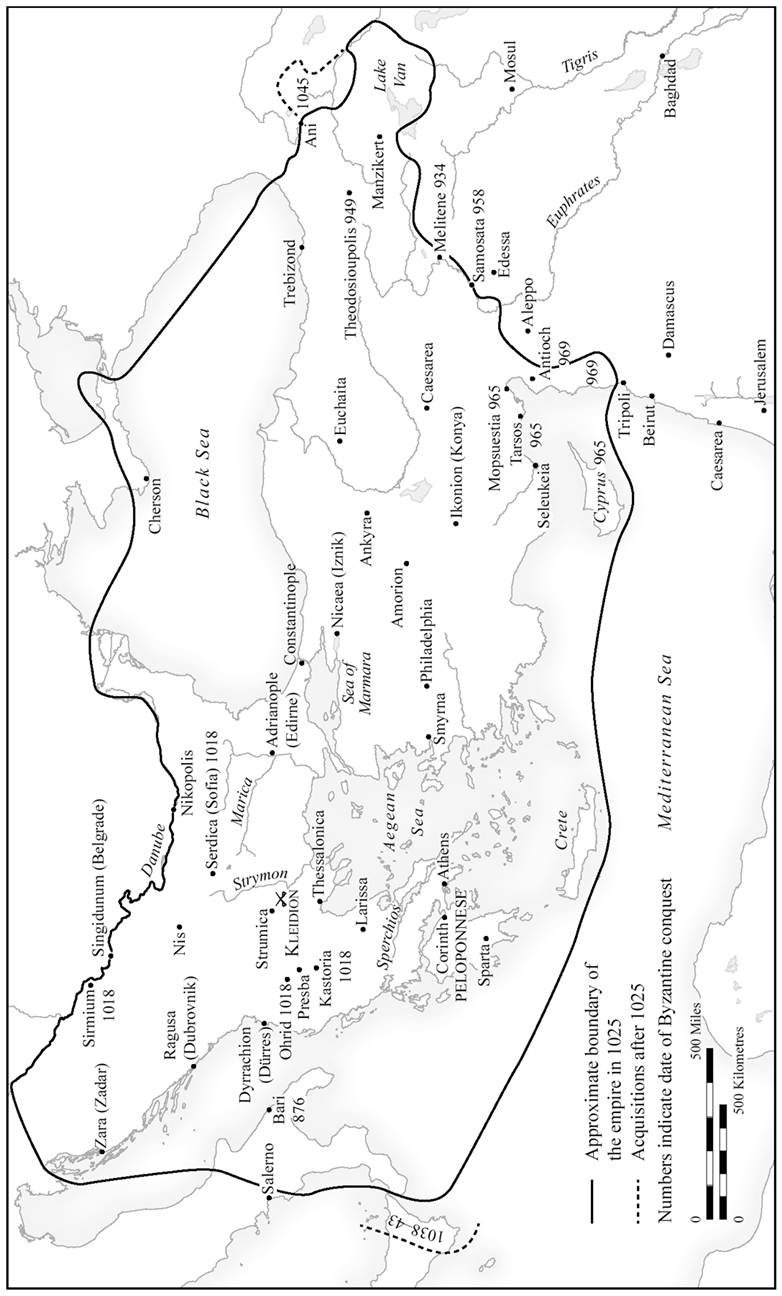
10. The Byzantine Empire in the mid-eleventh century
From the middle of the eleventh century until very nearly the end of the next, Constantinople was at the centre of a new flourishing of the arts and a renewed engagement with the intellectual achievements of the ancient world. The most brilliant all-round man of letters of the age was Michael Psellos. Born in 1018, Psellos served several emperors in high positions in the imperial bureaucracy and went on to write a scathing history of the fourteen reigns he had lived through, from the accession of Basil II in 976 down to the eve of his own death in 1078. The Chronographia, as this history is called in Greek, is full of psychological insights and the wry observations of an insider. Deeply versed in ancient Greek philosophy, Psellos also wrote treatises on many branches of science. More than five hundred of his elegantly written personal letters have survived. After a gap of many centuries, Psellos and several of his contemporaries wrote as self-aware individuals, anxious to explore (and indeed to promote) their own place in the secular world in which they found themselves. Psellos has often been called a forerunner of modern humanism. The remarkable explosion of literary creativity in Constantinople that followed during the century after his death has invited comparison with the better-known achievements of the Renaissance in the West that would not begin for another two hundred years.3
Secular genres that had been neglected or forgotten since the days of the Second Sophistic, under the Roman Empire, suddenly came back into fashion.
Novels (or romances) once again explored the redemptive possibilities of human love. Satires mocked the pretensions of real individuals or parodied well-known types from ancient literature. There was even an attempt at epic poetry based on oral narratives that must have circulated in the badlands of eastern Anatolia and Mesopotamia during the centuries of conflict against the Arabs. Freelance writers vied for commissions from the imperial family or other highly placed officials. To judge from the sheer volume of their work that has come down to us, there must have been careers to be made from reciting the praises of living patrons and the obituaries of their deceased relatives—even if those careers were also precarious.4Elegant, erudite, sometimes witty, and on occasion scurrilous, these new practitioners of the art of rhetoric could turn their hand to any literary style and write in any type of Greek, from the long-obsolete idiom of the Iliad and the Odyssey, via the ‘high style’ of classical Athens, to the plainer manner of everyday bureaucratic exchanges and even, for the first time since Aristophanes in the fifth century BCE, the language of the contemporary street. The most prolific poet of the twelfth century, Theodoros Prodromos, was also the most versatile. It is to Prodromos that we owe some of the earliest recorded cadences of the Greek language as it is still spoken today. We hear them in this famous rant, addressed to no less a person than the emperor himself. The poet’s skills have gone unrewarded for too long, he complains; now he has had enough:
Letters be damned, dear Christ, and all who’ve any truck with them,
damn the time and damn the day when I was sent to school
to learn my letters—fat chance, that, to earn a living!5
During the same two centuries, the building of new churches and monasteries went on as never before. By the time that Benjamin of Tudela visited, there was a church for every day of the year in the capital alone.
The huge monastery of the Pantokrator, overlooking the Golden Horn, was built in the 1130s to house the tombs of emperors, and it survives today as the Zeyrek Mosque. Contemporary rulers, who were often the Byzantines’ enemies, competed with one another to emulate the architecture and decoration of their churches and palaces, possibly also recruiting craftsmen trained in Constantinople for the purpose. Some of the best-preserved church interiors in the Byzantine style are to be found in Sicily, at Cefalù and at Monreale outside Palermo, where the Palazzo dei Normanni is also the nearest thing to a Byzantine palace that survives anywhere. All of these were commissioned by the island’s Norman rulers in the twelfth century. Churches of this period, designed and painted in the Byzantine style, can also be seen in today’s Ukraine and Russia, in Kiev and Novgorod.6These achievements are all the more remarkable when set against the political and military realities of the time. A mere forty years after the death of Basil II, Byzantium found itself faced with new and aggressive enemies on all sides during the 1060s: Seljuk Turks in the east, Normans in the west, and in the north the latest nomadic groups to arrive from the steppes, known as Pechenegs and Cumans. From this time on, every Byzantine emperor would be forced back to the policy of defensive imperialism that had been the hallmark of the first centuries after the Arab conquest: a combination of limited, defensive wars with proactive diplomacy on several fronts simultaneously.
After a period of messy court intrigue, described in forensic detail by Psellos, in 1068 the empire once again had a military man on the throne. Romanos IV Diogenes set out for eastern Anatolia to take the war to the Seljuks, who had conquered Baghdad in 1055. At first he seemed to be having some success. Then, in August 1071, at a place called Manzikert, close to Lake Van, a disastrous error of tactics led to the emperor being taken prisoner by the Seljuk sultan Alp Arslan (‘the Lion’).
The emperor was treated much more generously by his captor than he would be by his own people after his release. In the early stages of the ensuing civil war, that would last for almost a decade, Romanos was blinded and despatched to a monastery, where he died shortly afterwards. There were no rewards for failure in the Byzantine system.7The Seljuks pushed westwards to capture Smyrna on the Aegean coast and Nicaea (today’s Iznik), only ninety kilometres to the southeast of Constantinople. Anatolia, and not the European provinces, had long since become the heartland of the Greek-speaking world. Now, between 1071 and the mid-1090s, the centre of gravity of that world was forcibly shifted back to where it had started out, in the southern Balkans and the Aegean. On the Byzantines’ opposite flank, beyond the Adriatic, the Normans had come a long way from their small kingdom on the north coast of what is now France to become a powerful new force in the Mediterranean. In the same year as the battle of Manzikert, 1071, they captured Bari, the last remaining Byzantine possession in southern Italy. Over the next twenty years, the Normans went on to complete the conquest of Sicily from the Arabs, something the Byzantines had never managed to do. Ten years after that, a Norman expedition crossed the southern Adriatic to land on the west coast of Epiros. Led by Robert Guiscard, one of the most formidable soldiers of the age, this was a direct threat to the integrity of the Byzantine state in the Balkans. Meanwhile, on the northern frontiers, Pecheneg tribesmen were making repeated raids across the Danube.
In Constantinople, the civil war ended just in time for a robust response to these emergencies. On 1 April 1081, Alexios Komnenos, an aristocrat from a military family in Anatolia, seized the throne in a well-organised coup d’etat. For the first time in Byzantine history, this emperor would go on to establish his own family as a kind of ruling caste, to the point that in time the family name would come to signify a distinguished rank—much as the name ‘Caesar’ had once done in ancient Rome.
We are exceptionally well informed about the character and achievements of Alexios thanks to his daughter Anna, who several decades after his death would become the first female historian to write in Greek—indeed, quite possibly in any language. Anna’s account of her father’s reign is written in a revival of the grand style of Herodotus and Thucydides; as a stylist and historian, she makes a worthy successor to Psellos. But the title of her work gives due warning of her purpose: the Alexiad of Anna Komnene, with its overt nod towards Homer’s Iliad, also foreshadows the modern genre of celebrity biography.8The new emperor found formidable difficulties in his way. By this time the theme system that Nikephoros I had devised almost three centuries before had largely broken down. Local communities no longer contributed the manpower for their own defence. Instead, the Byzantine state had come to rely on mercenary soldiers, often recruited, like the Varangians, from outside its borders. The loyalty of these troops was not always reliable. And the money had to be found to pay them. Alexios inherited a treasury that was seriously depleted and a currency that had been repeatedly debased over the previous decades. Reading Anna’s history, and indeed modern accounts too, one wonders how so many foreigners could have continued to believe for so long in the fabulous wealth of Constantinople. Evidently, these things were relative. But establishing a new stable currency and filling the imperial coffers were among the first challenges to be faced by Alexios.
By the early 1090s, he had defeated Guiscard and the Normans in northern Greece and the Pechenegs in Thrace. On the Seljuk front in Anatolia, it looked for a time as though diplomacy, in the form of lavish gifts and hospitality, was going to be successful. But by the middle of the decade, a series of upheavals in the Seljuk sultanate turned all these plans upside down. The impregnable fortress of Nicaea, on its lake, remained in the hands of implacable enemies, while others controlled much of the hinterland of Anatolia. From his base in Smyrna, the emir Çaka, or Tzachas, was in control of the coast and harried Byzantine shipping in the Aegean. As one modern account puts it, ‘The situation facing Byzantium in the mid-1090s was not so much desperate as catastrophic.’9
From those unlikely beginnings arose an event that in its way would leave almost as great a mark on subsequent world history as the Muslim conquests of half a millennium before. We know it as the First Crusade, although the term would not become current until a good deal later. Among its long-term consequences would be the collapse of the empire that it had first been conceived to protect. What Alexios needed was manpower. In particular, given the very specific demands if Nicaea were to be retaken by force, he needed siege engines. The western kingdoms were ahead in this kind of military technology at the time. What Alexios seems to have had in mind was simply another call-up of mercenaries from abroad. But with money so short, they could be paid in a different currency—not cash but faith.
Envoys sent by Alexios caught up with Pope Urban II while he was attending a church council in the northern Italian city of Piacenza in March 1095. In the emperor’s name they begged the pope to raise troops in the western kingdoms for ‘the defence of this holy church, which had now been nearly annihilated in that region by the infidels who had conquered as far as the walls of Constantinople’. The pope was shrewd enough to see the benefits to his own office from taking up this diplomatic challenge. The ‘holy church’ of which the envoys spoke had been officially split for the past four decades—ever since the patriarch in Constantinople and the emissaries of a previous pope had excommunicated each other in 1054. Though it seems to have created little stir at the time, that event is still remembered as the ‘Great Schism’ that marked the irrevocable split between the churches that we now know as Roman Catholic and Eastern Orthodox.10
Four decades after the schism, the appeal by Alexios opened up the possibility not only of a reconciliation but also of papal authority being extended to the eastern church and its clergy. At the same time, a groundswell of anti-Muslim sentiment in western Europe had been growing, partly because the coming of the Seljuks had made it much more difficult for Christian pilgrims to make the journey to the Holy Land. The time was ripe to declare a holy war. Alexios, for his part, was seeking reinforcements to protect his empire from invasion by the Muslim Seljuks. But the clarion call that was heard in the west was the more symbolic one: to ‘liberate’ Jerusalem and the holy places of Christianity.
After a summer spent sounding out potential leaders, Urban formally announced what would become the First Crusade in the town of Clermont Ferrand in central France in November 1095. The response was beyond anything Alexios or his advisers could possibly have imagined. Noblemen and knights from all over western Europe rushed to join up. Urban had been determined to oversee an organised military expedition. And this was what Alexios was expecting. But once the torch had been lit, there was no way of controlling the fire. While preparations were still going ahead under Urban’s careful supervision, a spontaneous movement sprang up in northern France and parts of Germany. Inspired by a charismatic individual known as Peter the Hermit, but without any organised leadership, the ‘People’s Crusade’, as it came to be known, set out through Germany and the Balkans for Constantinople on their way to Jerusalem. Before they even reached Byzantine territory, they had begun their holy war by massacring or forcibly converting the Jewish populations of the German towns they passed through. Anna Komnene, who was writing with the benefit of half a century of hindsight, chose to suppress altogether the fact that the father whom she revered had brought this invasion upon his own head. She describes their arrival like this:
It was as if he [Peter the Hermit] had inspired every heart with some divine command. Kelts assembled from all parts, one after another, with arms and horses and all the other equipment for war. Full of enthusiasm and ardour they thronged every highway, and with these warriors came a host of civilians, outnumbering the sand of the seashore or the stars of heaven, carrying palms and bearing crosses on their shoulders. There were women and children, too, who had left their own countries. Like tributaries joining a river from all directions they streamed towards us in full force.
Adroitly, if cynically in the eyes of some western observers, Alexios had the whole contingent shipped over the Sea of Marmara to the advance base he had prepared for the main expedition on the Asian shore. Against his advice, they then went on to attack the nearby Turks with horrific ferocity, only to be butchered in their turn. Peter was one of the few to make it back to Constantinople—saved, according to Anna, by the timely intervention of her father.11
The arrival of the contingents that made up the main force was managed rather better. Alexios had laid elaborate plans to keep them supplied with provisions. He also sent military escorts to stop them plundering the countryside while they made their way overland to the Bosphorus from their various landing points on the western coasts of today’s Albania and Greece. Their numbers must have been far beyond anything that Alexios could have expected. Modern estimates suggest that as many as eighty thousand may have taken part in the First Crusade.12 It was never a unified army, and from the start Alexios was determined to keep it that way. He ensured that the troops were kept well away from Constantinople. Only their leaders were allowed inside the city and, so far as possible, he dealt with each of them separately.
Alexios’s objective was to extract from each an oath of allegiance. All cities and territories that the crusaders captured on their expedition were to be handed over to the emperor, as their rightful ruler. Many of the leaders demurred. The full panoply of Byzantine diplomacy, and the targeted channelling of ostentatious bribes in gold, had to be deployed. Alexios was playing for high stakes. But from his point of view, far from being recruited by the crusaders to serve their cause, he was recruiting them as a ‘Byzantine imperial army’. Whether they would ever make it as far as Jerusalem was not his concern: properly handled, these people were to be the means of restoring Anatolia to ‘Roman’ rule. It must have seemed worth it. And in any case, now that the crusaders were there, and in such numbers, Alexios had little choice.13
After several months of haggling in Constantinople, all the leaders agreed. Even Bohemond, the son of Robert Guiscard, who had fought against Byzantium before and would again, found it expedient to comply. By early summer 1097, all the crusader forces were in place, encamped outside Nicaea. Alexios himself crossed over the Bosphorus with a force of his own and two of his most trusted generals and directed operations from not far away. The ‘impregnable’ fortress fell on 19 June. But the manner of its taking explains a great deal about the different aims and methods of the Byzantines and the crusaders.
The westerners brought superior technology. The crossbow doesn’t seem to have played a role at Nicaea but was still enough of a novelty that the normally contemptuous Anna felt it necessary, half a century later, to give her readers an admiring account of how it worked and how deadly it was. Siege engines were built by both Byzantines and crusaders, and there seems to have been some disagreement about whose were the more effective. If the western advantage in this field had been Alexios’s first motivation in drawing them in, it was not directly decisive in the outcome.14 Nicaea was not taken by storm. It says something for the way sieges were conducted in this part of the world at the time that Alexios’s trusted aide and general, Manuel Boutoumites, was able to enter the city and negotiate with the defenders, not once but twice. On the second occasion, a relieving army sent by the sultan had just been wiped out by the crusaders; Alexios had arranged for a fleet of boats to be carried overland from the Sea of Marmara and launched on the lake in front of the fortress. The defenders could no longer be supplied by that route. Without these military pressures, no diplomacy could have been effective. But with them, in classic Byzantine manner, Alexios was spared the effort and expense of a debilitating siege.
The Turkish commanders agreed to surrender in return for a guarantee of safety, signed by Alexios himself, and the promise of money and honours if they would serve him in future. (Characteristically, Anna, who evidently relishes the story, tells us nothing about what was to happen to the rank and file.) But first, the crusaders had to be duped into thinking that the city had been won by force and that the decisive breakthrough had been made by the Byzantine army. So the defenders allowed an advance guard from a Byzantine siege tower to climb over the walls. Victory was proclaimed, and the Turks surrendered to Boutoumites. Only once the whole city was secure were any crusaders allowed inside—and then only in groups of ten, a precaution, according to Anna, against their overwhelming numbers and ‘their fickle nature and passionate, impulsive whims’.15
After that, the crusaders were to proceed to Antioch. The emperor would join them there, having in the meantime subdued the western parts of Anatolia—as his forces were now able to do, thanks to the terror instilled in the Seljuk defenders by the presence of the crusaders farther east. It was during the siege of Antioch, which was finally taken a year after Nicaea, that the alliance between the crusaders and the Byzantines began to fall apart when Bohemond seized the city for himself. In the meantime, Alexios’s generals campaigned successfully against the Seljuks in western Anatolia, but he himself remained in Constantinople. There could be no prospect of a reunion in Antioch now that Bohemond had gone back on his oath.16
From Antioch, the crusaders went on their way to Jerusalem to seize the city and massacre everyone in it on 15 July 1099. Against enormous odds, and at terrible cost in human life, they had won their ‘holy war’. Most of them, by that time, had become convinced that Alexios and the ‘Greeks’ were not to be trusted. These Greeks did deals with infidels. They failed to keep their promises—though this was a complaint heard only after large amounts of Byzantine gold had already changed hands.
The truth must be that both parties had quite distinct agendas in the first place. No Byzantine emperor, for hundreds of years, had ever seriously thought of trying to recapture Jerusalem. A crusade, from the Byzantine point of view, would make no strategic sense. The very idea of holy war, that had begun with Heraclius, had long ago become outdated in Byzantium. Alexios had been prepared, no doubt with great misgivings, to ride the tiger of crusader religious passions for pragmatic reasons. But he also recognised the danger he had unleashed. Before he died in 1118, he would exhort his son and chosen heir, John II, to
ponder and keep in mind the recent commotion from the West, lest there arise a time of need which will chasten and humble the lofty dignity of New Rome and the majesty of its throne.17
Alexios’s deathbed warning was to prove prophetic—but not for some time yet, thanks to the capable stewardship of his son and his grandson, whose reigns, together with his own, would add up to a full century.
In the event, John II would be spared another such ‘commotion’ during his reign. Instead, he had to find a way to deal with a proliferation of new Christian states in the Levant, that had been created in the wake of the First Crusade. Their rulers were Catholic princes who, like Bohemond before them, still refused to recognise the ‘emperor of the Greeks’ as their overlord. By 1143, John II had made up his mind to take control of the crusader states by force. But as his army was passing through southern Anatolia, the emperor was killed in an accident while hunting. Suspicions about the nature of this ‘accident’ have surfaced from time to time, not least because the campaign had to be immediately aborted. The new emperor, Manuel I, needed to have his army near the capital to secure his own position.18
If the crusader states in the east had been spared attack from Byzantium, they were now coming under a sustained onslaught from the Seljuks. The County of Edessa, which included a sizeable part of today’s Syria, fell in 1144. Three years later, a new crusade set out from western Europe to try to win it back. This time the expedition was led not by mere noblemen and minor royalty but by two of the crowned heads of western Europe: Louis VII of France and the German emperor, Conrad III. They passed by Constantinople in 1147 on their way east, and again the next year on their return, having failed to regain Edessa. The arrival of huge foreign armies, uninvited this time, outside Constantinople once again raised the same jitters as before. But Manuel dealt with the crusaders as his grandfather had done. He kept the rank and file of the soldiery well away from the capital, and his coffers were full enough that he could afford to lavish generous hospitality on the expedition’s leaders.
Both royal guests, as a result, spent several months in the vicinity of Constantinople. Although we know tantalisingly little about how they spent their time, their courtiers must have had plenty of opportunity to exchange ideas with their Byzantine counterparts. By the time they left again, without serious incident, it seems that mutual animosity between the western knights and the Byzantine elite was much less than it had been during the First Crusade, or would be again. It may even be that the literary genre we know as the ‘medieval romance’, that first began to flourish in French during the following decades, owed something to these encounters with the Byzantine court during the passage of the Second Crusade. In the early 1170s, in northern France, it was possible for Chretien de Troyes to devise a historical fiction in which a prince of Constantinople travels to Britain and saves the kingdom for King Arthur, while in the next generation, King Arthur himself prepares an expedition to defend the legitimate heir to the throne of ‘Greece’ in Constantinople.19
On the Byzantine side, too, attitudes were changing, at least at the very top. Manuel, throughout his long reign, was known to be pro-western. Both his first and his second wife came from western royal families and had been brought up in the Catholic branch of the Christian faith. Famously, Manuel imported from the west the sport of jousting—to the bemusement of conservative-minded Byzantine spectators.20 This was a far cry from the icy contempt of Anna Komnene, whenever she wrote about ‘Franks’, ‘Latins’, or ‘Kelts’, the names by which western Europeans were commonly known in Greek at this time. Whatever the rank and file of his subjects thought, here was an emperor who was prepared to take these ‘barbarians’ seriously. It was Manuel’s diplomacy, not force, that eventually brought the rulers of the crusader states in the east to accept Byzantine supremacy in the 1060s, even if it was only nominal. This was how long it had taken to fulfil the terms that Alexios had tried and failed to impose more than half a century before. Manuel worked hard, too, to advance the cause of union between the eastern and western churches—a prospect that once had been held out by Alexios but had stalled after the First Crusade.
By the 1170s, all this was beginning to provoke a backlash at home. Then in 1176, the Byzantine army suffered a catastrophic defeat at the hands of the Seljuks, at the battle of Myriokephalon in west-central Anatolia. Manuel’s prestige at home and abroad never recovered. He died on 24 September 1180, at the age of sixty-one. And from that moment, everything that had been achieved during the Komnenian century began to unravel. In the space of a little over two decades after Manuel’s death, the Byzantine Empire collapsed from within.
Historians ever since have struggled to explain what happened and why, and exactly what was its impact on the course of later history. But Niketas Choniates, who lived through these events and rose through the ranks to become head of the Byzantine civil service during the crisis years at the beginning of the thirteenth century, was merciless in his diagnosis of the symptoms of what today we can call ‘systems collapse’. Choniates is regarded as one of the most accomplished of all Byzantine historians. His position as an insider ensures that what he tells us is most likely to reflect the opinions of the Constantinopolitan elite at the time. His specific diagnoses sometimes reveal the prejudices of the man himself or his class. Choniates’s contempt for the ‘mob’, for instance, is as visceral as his dislike of Franks or Latins. And we must allow for the possibility that he and those who thought like him may at times have been part of the problem. But the facts speak for themselves.21
Once again, in 1180, a widowed empress was left as regent for an underage heir. But this time, infighting within the ruling Komnenos family, and between the Komnenoi and powerful aristocratic rivals, led to a power vacuum that would last for more than twenty years. Reigning emperors were deposed, and in most cases blinded, or murdered, or both, in 1182, 1185, 1195, and no fewer than four times in a little over a year, between 1203 and 1204. On each of these occasions, the populace of Constantinople played a noisy, and often violent, part. Indeed, it is worth wondering whether something rather like today’s populism was beginning to run out of control at the heart of the Byzantine body politic.22
In the course of the upheaval of 1182, seemingly spontaneous hatred of Latins spilled over into the streets. The communities of merchants from Italy—particularly, at that time, from Pisa and Genoa—living on the opposite side of the Golden Horn from Constantinople, were targeted, and hundreds were massacred. The killing was on nothing like the scale of the massacre of Roman settlers in Anatolia that had been organised by Mithridates more than a thousand years before. But the spectre of what a future age would term ‘ethnic cleansing’ was once again raising its head in the Greek-speaking world. Three years later, and partly in reprisal, the Normans of Sicily invaded the northern Greek mainland yet again. This time they succeeded in sacking Thessalonica before they were turned back. In 1189, a third crusade reached Constantinople in a doomed attempt to win back Jerusalem after the city had fallen to the Kurdish leader Saladin. The emperor Isaac II Angelos proved to be no match for the crusade’s leaders, in a battle of wits with the German emperor Frederick Barbarossa, King Richard (‘the Lionheart’) of England, and Philip II of France. There even came a moment when they threatened to turn on Constantinople itself.
Similar things had happened often enough before, and the empire had recovered. But now they all came on top of one another. And a new trend was gathering momentum in the closing years of the twelfth century. In the past, whenever a rebellion had broken out in the provinces, its leader would either end up being swept to power in Constantinople or his movement would be crushed. It had been all or nothing. But no longer. By 1200, local members of aristocratic families, including the Komnenoi, had set up separate fiefdoms in places as far apart as Cyprus, Trebizond, the city of Philadelphia in western Anatolia, and the Peloponnese. At the same time, the Slavs of the Balkans broke away to create the separate kingdoms of Serbia and Bulgaria, at a stroke undoing the conquests of Basil the Bulgar Slayer. The authority of the capital over the provinces had collapsed, just as imperial authority was collapsing in the city itself.23
At the same time, in the west, momentum was gathering for a new attempt to regain Jerusalem. Inspired by Pope Innocent III, who came to the papal throne in 1198, this would become known as the Fourth Crusade. Unlike previous expeditions, this one was to be undertaken by sea. Ships provided by the maritime republic of Venice would convey the knights to Egypt. The final assault on the Holy Land would be launched from there. The pragmatic Venetians were more interested in trading than crusading. The doge of Venice, the ninety-five-year-old Enrico Dandolo, agreed to the crusaders’ terms, on condition that they paid for the services of his fleet.
Led by the doge himself and Boniface of Montferrat, a relative of the French king, the expedition set out from Venice in October 1202. But almost from the first, it became evident that the crusaders had not enough money to pay the Venetians what they owed. A providential solution came in the form of a young Byzantine prince called Alexios. This was the son of Isaac II Angelos, who had been deposed back in 1195 when the throne had been usurped by his uncle, Alexios III. If only the crusaders would divert their expedition to Constantinople and restore him to his rightful position as emperor, the younger Alexios promised to repay them out of the imperial treasury with all that they needed.
Despite allegations that would first be made soon after the event and that have resurfaced frequently ever since, neither Pope Innocent nor the leaders of the crusade had any deep-laid plan to conquer Constantinople. Indeed, it seems to have been only at a late stage that it even occurred to them that they could. From accounts written by crusaders afterwards, it is evident that they looked with awe on the city, its defences, and the military might that the emperor could command.24 Along with those, of course, went the lure of its fabulous wealth, which nobody doubted would be enough to repay their debt to the Venetians and cover the costs of the crusade many times over. It was the Byzantines themselves who played into the crusaders’ hands, as the deepening power vacuum at the city’s heart inexorably drew them towards it.
The expedition arrived with the Venetian fleet in the Bosphorus in June 1203 and set up camp on the Asian shore. The pretender Alexios proved much less welcome among his own people than he had led the crusaders to expect. In a bid to enforce his claim, Venetian ships fought their way into the narrow waterway that gave access to the heart of the city, the Golden Horn. Once inside, they overwhelmed a much-reduced Byzantine navy and took control of the shoreline below the walls. In the face of this pressure, the desired regime change took place: the crusaders’ young protege was crowned in Hagia Sophia as Alexios IV Angelos. In the meantime, the Venetian ships stayed inside the Golden Horn. Others ferried the crusaders across the strait, from their camp on the Asian shore. The expedition was now ensconced right under the walls of Constantinople. In every previous emergency, the Byzantine fleet had kept control of the waterways that surrounded the city on three sides. Now, with their ships beached or captured, there was no chance of launching the deadly ‘Greek fire’ that had ensured Byzantine supremacy at sea for centuries.25
All that was needed, at this point, was for the imperial treasury to pay up, as the new emperor had promised, and the crusaders would be gone. But even at this moment, when the danger should have been obvious, the prevailing opinion within the city seems to have reverted to the traditional one, that went back to the time of Alexios I: these ‘Franks’ were barbarians. Their brute strength existed to be exploited to serve Byzantine ends; savage and unpredictable as they were, they could always be managed through the age-old diplomatic techniques of bribery and division. The more nuanced approach of Manuel I seemed to have been forgotten. Under the influence of this way of thinking, Alexios dragged his feet. Attitudes inside the city were hardening too—perhaps a further sign of the growing influence of populism on decision-making.26
By the start of the new year, 1204, the patience of the crusaders was wearing thin. But so was the anger on the streets of Constantinople. Alexios was overthrown on 25 January and murdered shortly afterwards. The new emperor was Alexios V Doukas, known by the nickname Mourtzouphlos (‘Bushy’, apparently because his eyebrows were joined in the middle). There was still time to buy off the crusaders. It was what any competent ruler in the centuries-old Byzantine tradition would have done. And apparently Mourtzouphlos did have the means to pay. It is not clear to what extent the emperor was a free agent; most likely, his hands were tied by powerful advisers or by the ever-growing power of the mob. Instead of paying, Mourtzouphlos haughtily handed down an ultimatum to the crusaders: he gave them just a week to sail away.27
The decision to take Constantinople by force seems not to have been reached until February. During March, plans were drawn up by Dandolo, Boniface, and the other leaders of the crusade for a division of the spoils. Then on the morning of Monday, 12 April 1204, the Venetian galleys inside the Golden Horn carried siege engines mounted precariously on their decks and brought them right up against the walls at their weakest point. The first groups of crusaders leapt onto the ramparts in this way. Others, under cover of the siege engines, broke through a bricked-up postern gate. Fighting continued in the streets for the rest of the day. Mourtzouphlos fled that night. Yet another emperor was chosen, but by the next morning no one was willing to fight on, and he too abandoned the city. Within twenty-four hours, Constantinople had been overrun. On 13 April, the never-silenced mob was back on the streets, this time chanting the name of Boniface as their basileus. But nothing, now, could stop the pent-up rage of the crusaders. As Choniates, who had experienced it, wrote shortly afterwards:
Thus it fell out that the fair city of Constantine, the shared delight of all peoples and famed by all, was blackened by fire and obliterated, conquered and emptied of all its riches, whether public, private or dedicated to God, by the scattered tribes of the west, a feeble rabble for the most part and without a name.28
What we now call the ‘Byzantine Empire’ would limp on for another two and a half centuries after this. But it would never again be a significant political force. And from that April day in 1204, the overwhelming majority of Greek speakers would have to get used to living under rulers who shared neither their language nor their religion, a state of affairs that would last until 1923.
More on the topic 10 ‘CITY OF THE WORLD’S DESIRE’ 1018–1204:
- 11 HOPEFUL MONSTERS 1204–1453
- 9 ‘THE EYES OF THE UNIVERSE’ 630–1018
- CITY OF GARDENS, CITY OF RAVINES
- 4.1 NEO-CONFUCIANISM AGAINST DESIRE?
- 10 Vagueness and Desire
- A Case of Unrequited Desire: Hermeias and Tigerous
- Chapter 7 Roxolana in Turkish Literature: Re-Writing the Ever Elusive Woman of Power and Desire
- The Greeks, the most humane men of antiquity, had a cruel trait, a desire for annihilation that made them like tigers... (Nietzsche, ‘Homer's Contest')1
- The City, colonialism and East Asia's industrialization
- From City-State to Empire