9 ‘THE EYES OF THE UNIVERSE’ 630–1018
Heraclius may have invented holy war, but it was the Arab successors of the prophet Muhammad who perfected it and for the first time gave it a name: jihad. The emperor had not long been back in Constantinople when far to the south, beyond the limits of his rule, Muhammad died in June 632.
For the past ten years, this charismatic leader had been uniting the tribes of Arabia in the name of a new monotheistic religion: Islam. Beginning in 635, a Muslim army led by Muhammad’s successor, Caliph Omar, swept through the entire region. Damascus was the first city to fall. The next year, an army sent out from Constantinople was decisively beaten at the point where the gorge of the River Yarmuk emerges into the plain of Galilee beneath the Golan Heights—today at the meeting point, and closed borders, of Jordan, Israel, and Syria. By 638, Jerusalem had a new master and was about to become a holy city of Islam, as well as of Judaism and Christianity.Heraclius’s hard-won victory over the Persians had proved, in so short a time, to have been the most hollow of triumphs. Modern historians have concluded that the age-old adversaries of the ancient world had fought themselves to a state of exhaustion. Both had become so weakened as to create a power vacuum throughout the Middle East. The Arabs simply seized their moment. Heraclius died in 641, just as news reached Constantinople that Caesarea, on the Mediterranean coast, had been taken. Alexandria was next. Within five years, all of Egypt was in Muslim hands. The once-mighty Persian Empire fared no better. By the start of the next decade, the whole of Persia had submitted to Arab rule. The three-hundred-year-old Sassanid dynasty was at an end. The entire Middle East became the Muslim Caliphate, ruled from its new capital in Damascus.
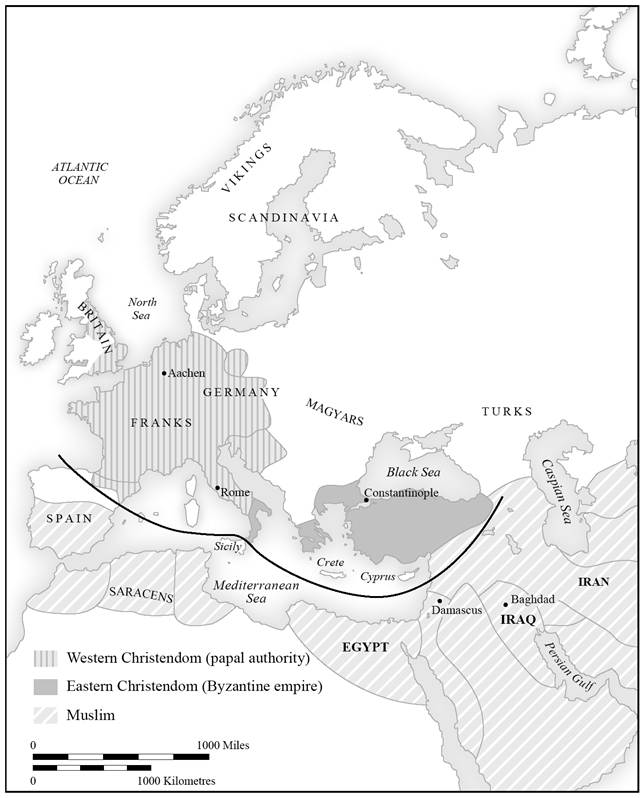
9.
The new geopolitics in the centuries after the Arab siege of Constantinople in 717–718. The solid line shows the division between Christendom and the Muslim world in the mid-eighth century.
Constantinople had lost ground before and bounced back. But this time, the changes would prove permanent. Islam had come to stay. So had the Arabic language, which eventually would take the place of Greek in all the conquered Roman provinces. Along with more than half the empire’s territory had gone the manpower, the tax revenues, and the greater part of the food supplies that had sustained its cities and their institutions for centuries. The remaining Greek-speaking heartland, in Anatolia, was now open to Arab raids from the south and east. Renewed outbreaks of plague would sweep through the region, roughly once in each decade. Under these continued onslaughts, cities that for centuries had been rich and populous shrank to a fraction of their former size. This was the case with Ephesus, where the Temple of Artemis had been counted as one of the Seven Wonders of the Ancient World, Pergamum, Ancyra (modern Ankara), Aphrodisias, and dozens more. Less well-known cities and smaller towns throughout Anatolia were abandoned altogether as the surviving population moved to smaller, defensible sites.1
In the Balkans the situation was even worse. Settlement by speakers of a Slavonic language seems to have begun in earnest in the southern Balkans during the 570s and 580s. While the nomadic Avars had been briefly powerful enough to mobilise the local Slavs and mount a full-scale assault on Constantinople in 626, they would disappear from the historical record soon afterwards. But the Slavs would remain, even if at first their communities were small and widely scattered. The Slavs were never an organised force at this time, rather a symptom of the fragmentation that was taking place. Then in the 680s a new group of Turkic-speaking Bulgars established their own state, the distant ancestor of today’s Bulgaria, more or less on Constantinople’s northern doorstep.
In most of what is now Greece, urban life all but disappeared during the seventh century. Thessalonica continued to hold out within its massive walls, a mere outpost reachable from Constantinople only by sea. Farther south, most of the great cities of classical times shared the fate of their counterparts in Anatolia. Athens somehow limped on as little more than a provincial town huddled at the foot of the Acropolis. Even in Constantinople, by the year 700 the population may have fallen from its peak of around four hundred thousand to just forty thousand. If that estimate is anywhere near correct, it matches the drop in population in southwest Greece after the Mycenaean palace of Pylos had burned down almost two millennia before, heralding a ‘dark age’ of several centuries.2
This period, too, is often described as another such dark age. Theophylact Simocattes, the last of the historians writing in the tradition of Herodotus and Thucydides, fell silent shortly after 630. The historical record does not pick up again until a monk by the name of Theophanes completed his Chronicle shortly before his own death in 818. No one any more was asking the kind of question that Procopius had asked about the causes and effects of the plague back in the time of Justinian. When everything is falling apart around you, you either concentrate on the immediate needs of survival—or you turn to faith in a better life beyond this one. That is what Greek writers did during those years, and indeed for long afterwards. Almost all that they wrote is devoted to religious topics, including hymns, the lives of saints, and the continuing disputes about Christian doctrine.3
Historians since the nineteenth century have become accustomed to label the civilisation that emerged at this time as ‘Byzantium’ and its people as ‘Byzantines’. In the language of today, the Greek-speaking Roman Empire after the death of Heraclius in 641 had turned into the Byzantine. Out of this process a new Greek civilisation was emerging.
From this point on, we, too, must bow to modern usage and call the people who created this new civilisation Byzantines—even though they themselves never did, and their descendants would continue to think of themselves as Romans for more than a millennium to come.4Throughout the second half of the seventh century and well into the next, successive Arab caliphs kept up the pressure on the Byzantine Empire. In 653, once again an enemy force pitched camp on the Asian shore of the Bosphorus. By this time, the Arabs had built a war fleet and launched it into the Mediterranean. Early the next year, their land forces facing Constantinople were joined by the first hostile navy to appear in the Sea of Marmara since long before the city had been founded. The threat was even greater than it had been in 626 because the attackers were able to move by sea as well as by land. This time it really was only an ‘act of God’ that saved the day. While the emperor ‘stripped off his purple [robes], put on sackcloth, sat on ashes, and ordered a fast to be proclaimed’, a sudden storm blew up and destroyed the enemy fleet. Without transport across the water, once again the attacking force was powerless and had to withdraw. A little over a decade later, they would be back. This time a new siege lasted for two years, from 667 to 669, with blockades in the Sea of Marmara continuing until 678.5
By 700, the Byzantines had been forced back upon the western regions of what is now Turkey, together with their capital and its immediate hinterland on the southeastern tip of Europe. Beyond that core, Constantinople still controlled scattered islands and strips of coastline in the Aegean, several pockets of the Italian mainland, including Ravenna on the Adriatic coast, and Sicily. It was on the last of these that the citizens of the capital had come to rely for their food supply (a further justification, in hindsight, for Justinian’s war of ‘reconquest’ almost two centuries before).
Once again, ships and the sea were proving to be the main lifeline for Greek speakers. Added together, these scattered territories barely made up a viable state, let alone an empire. Only one thing held them together, and that was the imperial city, with its centralised institutions. The key to survival would be Constantinople.6As Muslim forces advanced ever closer to the Bosphorus, emperors came and went with increasing rapidity. Most of these were military men, raised to the highest office by their fellow commanders and deposed again by the same means. Between 711 and 717 no fewer than five emperors held the imperial throne. Given little time to prove his worth while in office, a deposed ruler would be lucky to be allowed to retire to the obscurity of a monastery. Justinian II and his son were murdered in 711, Philippikos, who had ousted him, was blinded two years later—a new and effective way of ensuring that there could be no comeback. In such extreme circumstances, even loyalty could become expendable. In 716, Anastasios II appealed to the approaching Arab commander for help against the latest usurper in Constantinople, though the appeal received short shrift. This was collapse from within and from the top.
In March 717, after yet another rebellion in the military, the commander of the eastern division was crowned in Hagia Sophia with the imperial title of Leo III. The third and final Arab siege of Constantinople began five months later, on 15 August. Arab warships crowded into the strait of the Bosphorus. The following spring, a new fleet of transports from Egypt landed troops on the European shore. The city was surrounded, by land and sea.
We have no eyewitness account of the siege. It lasted for a whole year. Leo seems to have been an astute tactician and made the best use he could of his limited resources. His predecessors had prudently concluded an alliance with the Bulgar kingdom to the north. That meant there would no repeat of the siege of almost a century before, when the Persians on one side of the Bosphorus had come so close to linking up with the Avars and Slavs on the other.
Bulgar troops even joined with the Byzantines in mounting counterattacks against the enemy. And the defenders had a secret weapon. It had been invented, probably in the 660s, by a Greek called Kallinikos, from Arab-controlled Syria. Westerners would later call it ‘Greek fire’, but in Greek it was known as ‘liquid fire’. It seems to have been an early form of artillery. A lighted petroleum-based liquid was projected from a tube, to burn on the surface of the water and engulf an enemy ship. Its effects on the Arab fleet proved deadly—and the secret would be so well kept, down the centuries, that even today no one knows for sure how it worked.7After a year, it was the besiegers, not the besieged, who were starving. If Theophanes, writing almost a century later, is to be believed, the Arabs were reduced to eating their own faeces and the corpses of their comrades. Whether or not that was the cause, it does seem to be true that their ranks were decimated by disease. By August 718, a new caliph had come to power in Damascus and ordered his forces to withdraw. For centuries thereafter, in Muslim histories, the failure to take Constantinople in 718 would be reckoned as one of the greatest defeats for the forces of Islam. Muslim leaders from that time on would have to come to terms with the existence of the Byzantine Empire, which they continued to call ‘Rome’ (Rum in Arabic). It would not be until the coming of the Ottoman Turks, in the fourteenth and fifteenth centuries, that a Muslim army would once again set its sights on the ‘city of the world’s desire’.8
By the first half of the eighth century, the geopolitics of the entire western part of the Eurasian landmass had been transformed. From the Atlantic to the Hindu Kush, from the edge of the Sahara Desert to the Arctic Circle, the overriding division among the human population was no longer between east and west but between north and south. And for the first time in history, it was not a division between competing states (or between a centralised state and the absence of one beyond its borders) but between competing religions. On one side stood Islam, on the other an entity that had no single political existence but that now came to be known as Christendom.9
To the south of an arc drawn through the Mediterranean and extending to the Pyrenees in one direction and the Caucasus in the other, Islam was the official religion and Arabic the dominant language. For the time being, all political power across this vast region lay with the Arab Caliphate. North of that line, wherever Rome had once ruled and where Constantinople still did, Christianity was by now all but universal. The only exceptions were regions where incoming ‘barbarian’ peoples had settled in large numbers and had yet to be converted. This was the case at opposite ends of Europe: in the British Isles and in much of the Balkans, including large parts of today’s Greece. On the Christian side of the line, the long-standing division between a Latin-speaking west and a Greek-speaking east was now more marked than ever. Knowledge of Greek had disappeared from the west, knowledge of Latin from the east. In the west, Latin would continue to be the written language of western kingdoms for several centuries yet and remains to this day the official language of the Roman Catholic Church. East of the old line of division and allowing for intrusions by Slavonic and Arabic in particular regions, the equivalent language remained Greek—with the difference that, unlike Latin, Greek would also continue as the spoken language of the majority.
In the western part of Christendom, in the absence of any political centre of power, the bishops of Rome had already begun to acquire a spiritual authority that would not be seriously challenged until the sixteenth century. In Byzantium, on the other hand, the special status of the Pope, the official title of the bishop of Rome, was never recognised. There, because the political role of the emperor continued without a break, the highest ecclesiastical authority would remain the Patriarch of Constantinople, who was usually an imperial appointee. It was probably inevitable, given such fundamental differences, that sooner or later the two halves of Christendom would come into conflict, even while both fought to resist the expansion of Islam on their borders and to reverse it when they could.
After 718, the enemy had retreated from beneath the walls of Constantinople, but Arab raids deep into central Anatolia would continue for several decades. It was not until 740, the last full year of the reign of Leo III, that a Byzantine army scored a decisive victory, and the tide began to turn.10 During this time, the forces of the Caliphate were not the only existential threat, as Byzantium struggled to reassert itself. In the summer of 726, the subterranean volcano beneath the caldera of Thera exploded in what was probably the largest eruption since the one that had buried the Bronze Age town of Akrotiri more than two millennia earlier. Smoke, ‘as if from a burning oven, arose from the depths of the sea,’ wrote the chronicler Theophanes, who had not yet been born at the time. Out of the ‘fiery combustion’, ‘great lumps of pumice like hilltops’ were projected high into the air and fell on coasts hundreds of miles away. The ‘whole face of the sea’ was covered with floating pumice. By the time the eruption subsided, a new island had emerged from the seabed inside the caldera.
Other natural disasters followed. In 741, Constantinople was rocked by a severe earthquake. Churches and fortifications were damaged throughout Anatolia. Tsunamis swept the Aegean. Shortly afterwards, in 747, came another outbreak of plague. This was the worst since the first one, that had been described so vividly by Procopius, two hundred years before. The dead were piled high in makeshift wagons. Orchard gardens within the city walls were dug up to bury them. But there was not enough ground; corpses ended up in wells and cisterns, which can hardly have been good for public hygiene. After this, as it turned out, the plague would not come again until the Black Death of the fourteenth century. But, of course, no one was to know that at the time.11
Modern societies and governments, faced with threats like these, turn to ‘experts’—technologists and scientists. The experts who were in greatest demand in Byzantium in the eighth century were theologians. Christianity was now so deeply embedded that imperceptibly, in public consciousness, it had taken on something of the mantle of the old religion that it had replaced. Once upon a time, in the Greek-speaking world, success in war and protection from unpredictable forces of nature had depended on propitiating the gods. Ever since Heraclius had successfully mobilised his troops in a holy war against an enemy of unbelievers, that role had become attached to the Christian God. But there was a vital difference. If the whole universe was ruled by a single, all-powerful God, you had only the one chance to get it right. Constantinople had been saved in 718, but only just. What was it about the Muslim Arabs that made God seem to favour them and not the Christian ‘Romans’? If emperors and their subjects were being punished with pestilence, fire, and earthquakes, what could they possibly be doing wrong?12 So began a controversy that would occupy the best minds and the highest authorities of the Byzantine church and state for almost a century and a half and remains today one of the most lasting legacies of Byzantium to the modern world.
Today we call this controversy ‘iconoclasm’, which is Greek for ‘breaking images’. The Byzantines themselves called it, more accurately, eikonomachia, or ‘iconomachy’, which means ‘battle over images’.13 Much of the detail of what happened remains obscure and has been hotly debated by historians since the eighteenth century. All we can be sure of is that during two periods, totalling a little over sixty years, from 754 to 787 and from 815 to 843, it was forbidden throughout the empire to produce or to display images of Christ, the Virgin Mary, angels, or saints in human form. To do so, it was declared at a Church Council held in 754, was to violate the commandment in the Old Testament against worshipping ‘idols’ or ‘graven images’. The iconoclasts, as the champions of the change became known, had noticed that their Muslim enemies interpreted the same sacred text in this way, as indeed has been the practice in Islam ever since. Just as mosques contain no representations of human figures, so it was decided that Christian churches could be decorated only with the symbol of the cross. Anything else would be blasphemy and offensive to God. Unwittingly, the Christian empire had strayed into the sin of idolatry. No wonder its people were being punished.
This radical new policy provoked the first serious disagreement between the churches of Constantinople and Rome—since the western church saw no problem and pointedly refused to sign up either to iconoclasm or to the eventual solution that would be found to replace it. It is hard to tell how much artwork was actually destroyed. Examples have been found of mosaics in which the telltale signs of alteration can still be seen, with glass tesserae removed and replaced by others in the approved design—though this may not have happened as frequently as used to be thought. After it was over, lurid stories began to circulate in Greek about wanton desecration of holy pictures and the persecution, even martyrdom, inflicted on priests and monks who had stood up in their defence.14
The ebb and flow of the controversy can be mapped fairly precisely onto the fortunes of military campaigns to secure and stabilise the borders of the Byzantine state. Revival had begun in the last years of the reign of Leo III, who would later be remembered (probably wrongly) as an instigator of iconoclasm. It went much further under his son, Constantine V. During a reign that lasted from 741 to 775, Constantine made military gains in the east and in the Balkans, against Slavs and a now hostile Bulgar kingdom. Even his later detractors had to give Constantine the credit for restoring the water supply to Constantinople by repairing the fourth-century aqueduct (part of which still stands near the centre of Istanbul) that had been out of commission since the siege of 626. These are indications that the city’s population was once again on the rise, and resources were becoming available again for public works. When the first period of iconoclasm ended, in 787, the Byzantine throne was occupied by an empress, Irene, who held it as regent for her young son, Constantine VI. Irene’s reasons for reversing the policy on images have been much debated. Probably they were more political than religious. The empress may have seen it as a priority to patch up relations with the Church of Rome in the west.15
Irene went on to become the first woman to rule the Byzantine Empire in her own right after her son plotted against her and she had him blinded. But the experiment did not last long. In 802, she was ousted in a bloodless coup organised by her senior ministers and died shortly afterwards in internal exile. The new emperor was Nikephoros I, a former treasury official. Nikephoros seems to have been the architect of a far-reaching reform of taxation and military organisation known as the ‘theme’ system. This created incentives for local communities to take responsibility for their own defence, while saving precious resources for the central treasury. The logic behind the reform was surely defensive, and it would stand the Byzantine state in good stead for at least the next two centuries.
Not content with the defence of his realm, Nikephoros also went on the offensive. A series of campaigns during the first decade of the ninth century brought much of today’s Greece back under Byzantine control. By extending the theme system into the Greek mainland, Nikephoros ensured that the pagan, Slavonic-speaking communities, that had been scattered throughout the region for several centuries, would quickly be assimilated to become Christian, Greek-speaking ‘Romans’. The emperor’s name means ‘Victory-Bearer’. But Nikephoros’s run of victories was brutally cut short when he was killed in battle against the Bulgars in 811, and his skull allegedly used as a drinking cup by the Bulgar king.16
Two years later, another usurper, Leo V, needed urgently to consolidate his grip on the throne. The ‘breaking of images’ was back on the agenda. After the disaster at the hands of the Bulgars, the new emperor was not the only one to look back with nostalgic admiration at what had been achieved during the reign of the iconoclast Constantine V. Surely, God could not, after all, favour religious images and was punishing the empire accordingly? So a new Church Council, in 815, reversed the previous reversal. Images were prohibited for a second time.17
But a quarter of a century later, as the reign of the emperor Theophilos was coming to an end, evidence for divine favour was becoming harder and harder to find. Crete had been lost to Arab raiders from Spain in 827. The Arabs had begun their conquest of Sicily at the same time; inexorably, year by year, more ground was being lost there. What remained of Byzantine control in the southern Italian mainland was being whittled away. In 838, on land, an Arab army advanced far enough into Anatolia to sack Amorion, near today’s Afyonkarahisar in western Turkey. When Theophilos died in January 842, once again an empress, Theodora, held the throne as regent for their young son. This time, too, the motives behind what happened next have been much debated. The outcome was that, after yet another Church Council, on the first Sunday of Lent, 4 March 843, a solemn procession made its way to Hagia Sophia to celebrate what has ever since been commemorated as the ‘Triumph of Orthodoxy’. Iconoclasm was over, this time for good.
In a later icon which represents the scene, the painted image of the Virgin and Child has pride of place, with the holy figures represented to a slightly larger scale than the worshippers below them. The experiment of banning religious images had spectacularly backfired. If some among the theological ‘experts’ had thought the way to win God’s favour was to ape the rival Muslims, the latest gathering of bishops had resolved that the Christian state of Byzantium was going to be as different from them as possible. After this, the face of Christ would be displayed on every imperial coin minted.18 Every interior space in a Byzantine church would be covered with frescoes depicting holy figures and scenes from the Old and New Testaments. High above all would float the severe figure of Christ Pantokrator (Almighty) looking down from the central dome. The Greek word meaning ‘image’ (eikon or icon) came to be particularly attached to portable images of the saints that could be carried in procession and would be routinely kissed by the faithful on entering church.
A careful theological distinction had been devised to explain that the ‘veneration’ of images was not the same as worship, or idolatry. Under the firm guidance and control of the ecclesiastical authorities, sacred images were recognised as a precious channel of communication between the worshipper and the divine. ‘Holy images’ were ‘the eyes of the universe’, in the memorable words of the Patriarch Photios, the most learned man of his day, preaching in Hagia Sophia on Easter Saturday 867. And in the presence of the reigning emperor and his heir apparent, Photios called on God himself to:
protect [such images] like the pupil of an eye, keep them above any evil, make them seem terrible to their foes and keep them, as well as us, worthy of you and your endless and blessed kingdom.19
As the dangers to Byzantium and its citizens receded, so had the spectre of God’s displeasure. ‘Roman Christians’ could now take comfort, as their patriarch also assured them, in the knowledge that they were the divinely Chosen People, as the Israelites of the Old Testament had once been.20 Like the ancient Israelites, they might still be punished for their misdeeds. But once chosen, they could no longer be cast off entirely, as many must really have feared might happen to them while they endured the shocks of the first half of the eighth century.
With the end of iconoclasm, the Byzantine state had defined itself anew. But it was entirely characteristic of the novel way of thinking that no Byzantine, either then or later, would ever willingly admit just how new it really was. The Triumph of Orthodoxy was celebrated, and is still commemorated by the Orthodox Church today, as the vindication of beliefs and practices that supposedly go back to the very dawn of Christianity. Every Byzantine writer who refers to the controversy describes its conclusion as a ‘restoration’; the attempt to suppress religious images had been that most heinous of things, an ‘innovation’. But the theology that gave a special place to religious images as intermediaries between the human and the divine was not traditional at all. Challenged and honed by the intervening bouts of iconoclasm, it had been worked out in Constantinople over the two centuries that had passed since the start of the Arab conquests.21
Until the end of the battle over images, most emperors had been content to follow a policy that has been labelled ‘defensive imperialism’. Nikephoros I had been the exception; his fate, if anything, only reinforced the general rule. Throughout this time, the overriding priority of successive emperors was to consolidate within existing borders rather than to expand the state and lord it over others. Indeed, it has been argued that this was always the default option for the Byzantines and that they were not warlike by nature.22 Ever since the parting of the ways between the eastern and western empires at the end of the fourth century, the bureaucracy in Constantinople had developed its own distinctive approach to handling outsiders and rival powers—not by war but by diplomatic means.
Diplomacy had never been a strong point for the ancient Greeks; Rome, throughout its heyday, had been blunt in its dealings with outsiders. But the eastern empire, during its transition from Roman to Byzantine, had been well served by the subtle patience of its diplomats. At the heart of Byzantine diplomacy lay an assumption of innate superiority. The trick was to persuade foreign rulers that the emperor possessed riches and powers such as they could only ever dream of; in return for services to the Byzantine state, a token portion could be theirs. And for many centuries, it worked. More often than not, the inducement would take the form of official titles. These cost nothing to grant and no doubt sounded grand in the foreign languages of the recipients. More crudely, whenever the imperial treasury could afford it, potential enemies were simply bought off. In the most favoured cases—and in later centuries routinely—a marriage alliance into the imperial family might be brokered.23
Elaborate rituals were devised to impress ambassadors or princes from abroad. A manual of ceremonial practice, dating from the tenth century, describes the intricate hierarchy and dazzling spectacle of the Byzantine court that would be on display. Visitors would be cowed by the emperor’s apparent power to command even nature, seated upon a golden throne that could be raised up into the air, while mechanical lions roared and mechanical birds sang.24 It was no doubt because the Byzantines managed to flatter and bamboozle outsiders for so long that the adjective ‘Byzantine’ would acquire the connotations that it has today: of deviousness and bureaucratic impenetrability.
By the middle of the ninth century, ambassadors were being dispatched from Constantinople to states and kingdoms across vast distances, in every direction. To the east they had extensive dealings with the Chazars, who controlled much of central Asia, and farther south, with the Arab Caliphate, first in Damascus and later in Baghdad. The first embassy from Byzantium may have reached China as early as the mid-seventh century; in later Chinese accounts, Constantinople was called ‘Fu-lin’, equivalent to the familiar Greek abbreviation Polis or Poli (‘City’). In the opposite direction, Byzantine missions negotiated with popes in Rome and even, after some reluctance, with the German king of the Franks, known to history as Charlemagne, who on Christmas Day in the year 800 had been crowned by the pope to rule over a rival Roman empire in the west.25
In the case of the Slavs, the diplomatic offer took an unusual form, which is still with us today. Methodios and his younger brother Constantine grew up in Thessalonica, where their father was serving as a senior army officer. There, they learned to speak the language of the Slav settlements that surrounded the city. The linguistic talents of the pair were recognised early. While Methodios gained advancement through the church, Constantine was taken to Constantinople to receive the highest level of education available in his day. Before long, he was undertaking diplomatic missions to central Asia. In the 860s, when the Patriarch Photios devised a new mission to convert the Slavs of central Europe to Christianity and bring them into the orbit of Constantinople, he called upon the brothers for the task. Constantine devised a modified form of the Greek alphabet, that for the first time made it possible to write in Slavonic. Methodios went on to translate the Bible into this newly written language.
Even though the original mission failed, its longer-term consequence would be to convert most of the Slavonic-speaking populations of the Balkans, as well as the ancestors of today’s Russians and of many Ukrainians, to the eastern, Orthodox form of Christianity. The modern states formed by the descendants of these peoples still use the alphabet devised for the mission and named ‘Cyrillic’ after Cyril, the monastic name taken by Constantine after he became a monk in his last years. The conversion of all these previously pagan peoples was another achievement of patient diplomacy and ingenious innovation. This was in marked contrast to the wars of conquest that had brought about the spread of Islam in the seventh century or the practice of western rulers such as Charlemagne, who had imposed Christianity on the peoples of today’s Germany at the point of the sword in the last years of the eighth.26
But soft power had its limits. Byzantines were soldiers, too. And they still maintained a formidable navy, even if by the middle of the ninth century they had lost control of most of the Mediterranean except for the Aegean and the Adriatic. With the battle over images finally resolved and the Abbasid Caliphate in disarray, it would soon be time to match soft power with hard. The first signs of a decisive turn of the tide came with the arrival of a new emperor, and a new, unusually long-lasting dynasty, on the Byzantine throne.
The emperor and heir apparent who had been present in Hagia Sophia on that Easter Saturday in 867, when Photios delivered his sermon about holy images, were Michael III and Basil I. It was quite usual, by this time, for a reigning emperor to appoint his successor in his lifetime. The designated heir would share the imperial title but have no power or authority of his own. Normally, this would be a son or another close family member. But Michael had no legitimate children. Instead, he had chosen to elevate an older man to this coveted role. If, as seems probable, there was a sexual element to the relationship, this would have been strictly taboo in Christian Byzantium and would have had to be concealed.
Basil had risen from obscurity on the strength of his exceptional physique and his prowess at taming horses. Six months after that sermon in Hagia Sophia, the relationship had soured. Michael was apt to drink himself into a stupor. His public reputation was beginning to suffer as a result. And Michael could see that Basil was poised to take advantage of his role as heir apparent. By September 867, each was plotting to murder the other. Basil got in first. While the emperor was in his cups, Basil opened the imperial bedchamber to a gang of assassins who first hacked off Michael’s hands, then stabbed him fatally in the back.27
Under Basil’s rule, the Byzantine state began to expand once again. Its fleet regained control of the Adriatic and the southern Italian coasts. Although the Muslim hold on Sicily would prove too strong to break, the whole of the Italian mainland south of Naples was regained by the 880s. Two new military districts, or ‘themes’, were created in Italy and would last for close on two hundred years. The origins of the Greek-speaking communities that still exist in Calabria and Puglia are thought to lie in this period of Byzantine reconquest. At the same time, Byzantine land forces pushed farther east in Anatolia than they had been able to penetrate for more than a century. After Basil died in 886, his successors held on to the gains that had been made in the west and continued to push the bounds of the realm outwards in all the other directions of the compass.
To the south, beyond the Aegean, Crete was recaptured in 961. Four years later, Cyprus, which had been jointly administered with the Arabs for almost three centuries, became fully a ‘Roman’ possession once more. Byzantine armies had been reaching from Anatolia into Syria since the 930s. Antioch and Aleppo were regained in 969; once again the eastern frontier was pushed back to the old Roman line of the Euphrates. To the northeast, beyond the Black Sea, Georgia and much of Armenia were brought within the imperial fold, through a combination of hard and soft power that would continue to yield dividends into the 1060s. These lands were largely Christian, but their peoples spoke their own languages, as their descendants still do today (and Armenians were spread out across a much wider area than the republic that now bears their name).
It was to the north, and closest to their own doorstep, that the Byzantines experienced the greatest difficulties. The Rus, centred on the city of Kiev and the political forerunners of both modern Russia and Ukraine, would never accept Byzantine rule, even though their ruler Vladimir embraced Orthodox Christianity in 989. Neither would the Bulgars, whose kingdom had long since moved on from being a pliant ally during the last Arab siege of Constantinople. The original founders of the Bulgar state had been Turkic nomads from central Asia. But by the time of their greatest confrontation with Byzantium in the early eleventh century, the ruling Bulgars had long since adopted the Slavonic language of the majority. They, too, were now Christians and, like the Rus, celebrated the Orthodox liturgy using the Slavonic translation of the Bible by Methodios and the Cyrillic alphabet that had been devised for the purpose by his brother.
Basil II, whose reign from 976 to 1025 was the longest in all Byzantine history, made it his mission to conquer the independent Bulgar kingdom and bring its Slavonic-speaking people within the Byzantine fold. The campaign seems to have lasted, on and off, for almost twenty years. The decisive battle took place in 1014, in a narrow pass called Kleidion, today close to the meeting point of the borders of Bulgaria, North Macedonia, and Greece. After his victory, later historians would claim that Basil had ordered some fifteen thousand Bulgar captives to be blinded and sent back to their king in batches of a hundred, each led by an officer who had been spared the sight of a single eye for the purpose. When Tsar Samuel of Bulgaria saw his troops returning in this condition, the story goes on, he was himself struck blind and died of grief shortly afterwards. The truth of this horrific tale has been questioned. But, with or without this added atrocity, Basil’s victory earned him the bloodthirsty title of Boulgaroktonos—the Bulgar Slayer—by which he has been known in Greek ever since. By 1018, four years after the battle, the whole of the Balkans, to the south and west of the Danube, had been brought back under ‘Roman’ rule—something that for many of these regions had not been the case for five centuries or more.28
To celebrate this achievement, Basil II did something that no other emperor of Byzantium had done before or ever would again. He led his entourage on a long detour south to Athens. The depleted city had been a backwater for hundreds of years; it had no political or strategic importance to the empire. But the fifteen-hundred-year-old Parthenon, that the Athenians had dedicated to the patron goddess of their city, Athena Parthenos (the Virgin), had long ago been converted to a Christian church and dedicated to the Virgin Mary. Since the settlement of the controversy over religious images two centuries before Basil’s time, the interior walls would have been densely painted with images of the Virgin, Christ, and other holy figures. This was the setting that the emperor chose for his act of public ‘thanksgiving for his victory to the Mother of God’, whose church he also endowed with precious gifts.29 Once upon a time, the Athenian democracy, led by Pericles, had given thanks to the virgin protectress of the city for victory over the Persians, and the roof-high gold and ivory statue of Athena had dwarfed the viewer. Now a very different kind of Greek-speaking ruler made his devotions and gave his thanks to a different divine virgin for victory over a different enemy beneath the gaze of the ‘eyes of the universe’.
More on the topic 9 ‘THE EYES OF THE UNIVERSE’ 630–1018:
- 8 BECOMING CHRISTIAN 337–630
- 10 ‘CITY OF THE WORLD’S DESIRE’ 1018–1204
- THE LIVING UNIVERSE
- Theory of the Universe
- THE RADIUS OF THE VISIBLE UNIVERSE
- THE ANSWER TO LIFE, THE UNIVERSE, AND EVERYTHING
- THE VISIBLE UNIVERSE
- Eyes on the Prize
- Barfield Raymond C.. The Poetic Apriori: Philosophical Imagination in a Meaningful Universe. Ibidem Press,2020. — 172 p., 2020
- I. Imagination and Our Experience of the Universe
- Ansary Tamim. Destiny Disrupted: A History of the World Through Islamic Eyes. PublicAffairs,2009. — 416 p., 2009
- How many cast a nameless Pod Upon the nearest Breeze - Unconscious of the Scarlet Freight - It bear to other eyes -
- WHY PROPHECY AND OMEN DIVINATION BELONG TO THE SAME SYMBOLIC UNIVERSE
- Being a woman in Aceh at this time is not easy. Everywhere you go people’s eyes are on your dress and your head. They look at how you dress and how you cover your hair and from there they judge whether you are a good or a bad woman. (Interview, Banda Aceh, 20 December 2007)
- Where are your eyes, Hospodars of Moldavia and Wallachia? Where is your conceit and arrogance? Meanwhile, how greatly do your name and deeds exceed your outward appearance (dress), O Khmel! It is true that God is with you, He has Uppointedyouforliberation of the Chosenpeoplefrom bondage to the heathens, as Moses oncefreed the Israelitesfrom bondage to the pharaohs... with your sharp swords you destroyed the Liakhs (Poles).—SyrianArchdeacon of Allepo, 1654
- CONTENTS
- The One Ring of law-religion and the return to the Arab Girl (and ourselves)
- The Castes of Ancient India