12 BETWEEN TWO WORLDS 1453–1669
After the loss of Constantinople, Greeks remained in charge of their own destinies only in the Despotate of the Morea, with its capital at Mystra, and in the ‘Empire of Trebizond’ at the far end of the Black Sea.
Mehmed wasted no time in mopping up these last outposts. Mystra fell in 1460, Trebizond the year after. For the next three hundred years, everyone who spoke Greek as a first language would be a subject of either the Ottoman sultan or a western European, and usually Roman Catholic, administration. For most, it wasn’t a matter of choice but of where you happened to live. For those who did opt to leave the land of their birth, and had the means to do so, the choice was stark.Survivors of the imperial family and the Byzantine elite fled westwards to Italy, often by way of Crete or other islands that were still under Latin rule. But despite occasional heady talk of renewed crusades against the Turks, there was never any prospect of a political revival for the Byzantine Empire on foreign soil. The last emperor had died childless. The final descendant of the Palaiologoi with a legitimate claim to the Byzantine throne would wind up penniless in Rome. Having nothing else to live on, he would surrender all his titles, first to the king of France, and then to the Catholic Monarchs Ferdinand and Isabella of Aragon and Castile. Not even this would be enough to save Andreas Palaiologos from dying in poverty in Spain in 1502.1 The Greeks who would make their mark on western Europe during the decades after the fall of Constantinople were not soldiers or political leaders but scholars and men of learning. Through these fugitives, Byzantium, at the last, would bequeath to the rest of the world its highly prized system of education that was still based on a thorough knowledge of Homer and the classic Greek authors of the fifth and fourth centuries BCE.
This was the gateway through which knowledge of the Greek language and access to ancient Greek thought returned to western Europe after an absence of almost a thousand years.
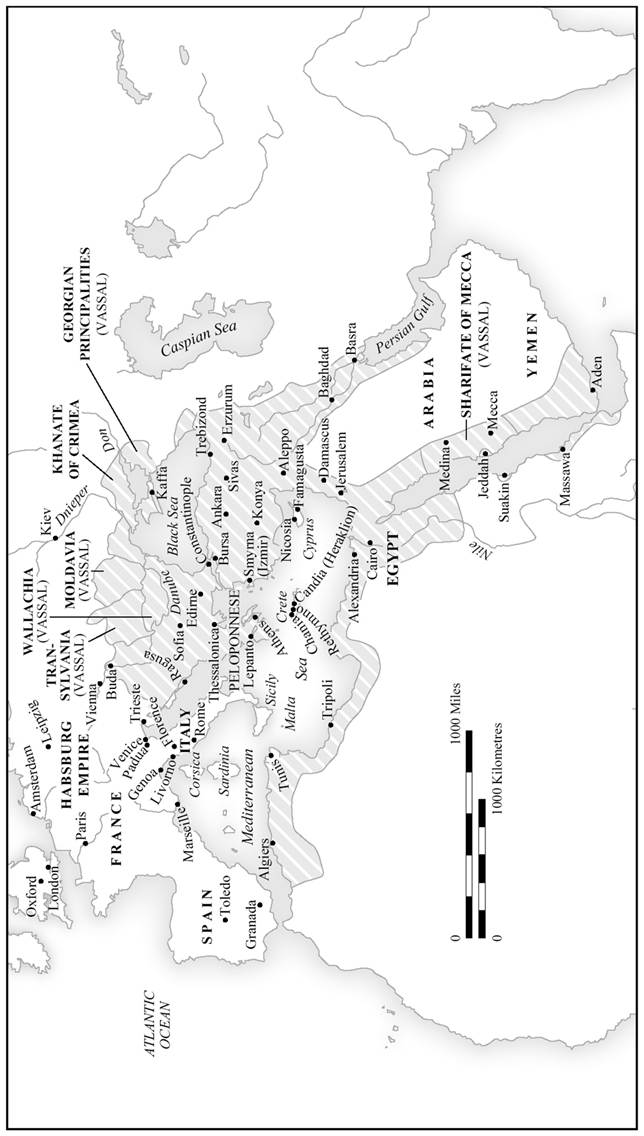
12. The Ottoman Empire at the time of the death of Süleyman I (‘Süleyman the Magnificent’) in 1566
The ground had been well prepared, not least during informal encounters that had taken place on the fringe of the church council in Ferrara and Florence back in 1438 and 1439. More lasting in its effects than any of the council’s resolutions would prove to be a series of fringe encounters between individuals on the opposing sides. The maverick ideas of a Plethon or the manuscripts of ancient Greek history, poetry, and philosophy assembled by Plethon’s pupil Bessarion, who would go on to become a cardinal in the Roman Catholic Church, would prove to be of more interest in intellectual Italian circles at the time than any amount of argument about the procession of the Holy Spirit.
This was because, for some time before this, enquiring minds in Italy had been seeking out the lost or forgotten arts and ideas of antiquity. The intellectual and artistic movement that reached its peak during the decades after the fall of Constantinople is now known as the Renaissance.2 Naturally enough, the rediscovery had begun with ancient Rome. But as soon as Italians once again were reading and rereading ancient Roman authors such as Cicero, it became obvious how much they, in their turn, had learned from the Greeks. If the ancient Romans had been ‘held captive’ (in the often-quoted line of the poet Horace, in the first century CE) by the Greek civilisation they had conquered, so too could Italians, a millennium and a half later.
Elite immigrants from Constantinople or Mystra, steeped in the classical Greek education they had acquired there, were eagerly made welcome by their Italian hosts.
The city-states of the Italian peninsula were, after all, republics. Just like the ancient Greek poleis, they were constantly in a state of war against one another. Their leaders were more than ever preoccupied with the questions of governance and civic responsibility that had first been debated in the ancient Greek city-states and had found a permanent record in the pages of Plato and Aristotle. Italians, and in due course other Europeans, too, were avid to find out firsthand what these long-lost treasures, hitherto known only through summaries and comments preserved in Latin, had to say on issues that were pressing in their own time and place. In this way was born the political philosophy now conventionally known by the name of ‘civic humanism’—a very specific legacy of the ancient Greek polis, that came via the Italian Renaissance to the modern world.3During the second half of the fifteenth century, university chairs in Greek began to proliferate at Italian universities. Many of the first and second generations of professors were Greek emigres—provided they were willing to part company with their own Orthodox Church and adopt Roman Catholicism. In Rome, Pope Nicholas V began to establish a collection of Greek manuscripts in the Vatican Library in 1448; for the rest of the century, Rome would become a centre of Greek scholarship, attracting many more high-profile Byzantine converts. These highly educated migrants can never have been very numerous. Nor were they the originators of the Renaissance; they were more like a catalyst that made it possible. And essential though their contribution undoubtedly was, what counted with their hosts was their knowledge of the ancient language and its treasures, from the poems of Homer and Hesiod down to the sermons of the Fathers of the Church, written in the fourth and fifth centuries CE. Few western Europeans in the fifteenth century wanted to learn to speak the Greek of their own time, still fewer to learn about the recent past or future prospects of the communities their teachers had left behind.
On the other hand, the impact of these teachers and the learning that they brought with them went well beyond secular scholarship and the arts. Before long, the skills acquired through a humanist education, and particularly the knowledge of Greek, would exercise a profound influence on the course of Christianity in the west. For the first time in many centuries, churchmen in western Europe could learn to read the original Greek text of the New Testament. Erasmus of Rotterdam, one of the leading figures in the Protestant Reformation in the early sixteenth century, had studied Greek at the University of Padua. This was what enabled Erasmus and others to challenge the authority of the ‘Vulgate’, the Latin translation of the Bible on which the western church had always had to rely. After that, it was not long before Protestants were translating the Christian scriptures directly from Greek and Hebrew into the modern languages of Europe—and the full fury of the Reformation, the Catholic Counter-Reformation, and Europe’s ‘wars of religion’ would be unleashed.
In a very different sphere, among the newly rediscovered books translated from Greek was the Geography of Strabo, that had been written in the first century CE. It was from two passages in this work that the Genoese explorer Christopher Columbus learned that it must be possible to sail westwards from Europe to reach India, at least if we accept the later testimony of his son. Ironically enough, according to the Byzantine system of reckoning historical time, the year 1492, when Columbus made his first voyage across the Atlantic, would have marked the end of the seventh millennium since the Creation. Generations of Orthodox Christians had been brought up to believe that the Last Judgement and the end of the world would come about in the year 7000.4 In Constantinople, the apocalypse had been premature, but only by a matter of a few decades. As one world ended, another was about to begin. Just at the time when the political self-determination of Greek speakers had been extinguished in their own lands, an outward movement was beginning that would spread their language, together with the ideas that had once been expressed in it, not just to the rest of Europe but right around the world.
For the vast majority, though, the realities of daily life meant accepting the new conditions in which they found themselves. One of these was peace. Ever since the Byzantine Empire had begun to break up two and half centuries before, wars had been fought more or less continually in most of its former territories. Some modern historians speak of a pax ottomanica, the equivalent of the pax romana that had once been imposed by Rome. The Ottoman state was Islamic and theocratic, but at the time of the conquest, Muslims still made up only a minority of its subjects. Ways had to be found to bind the subject Orthodox population into the new status quo.
Constantinople had been a ghost city when Mehmed first declared it his imperial capital. Almost at once, he set about repopulating it. It seems to have been a deliberate policy to import Greek families, forcibly moved from other conquered regions, so as to fill the empty streets and houses. Twenty-five years after the conquest, almost a third of the city’s approximately sixty thousand inhabitants were Orthodox Greeks. This was a far cry from the heyday in the time of Justinian, when it had been home to some four hundred thousand. But it was a start. And as the city grew over the centuries to come, so would the number of Greek-speaking Orthodox Christians.5
The contrast is often drawn between the apparent tolerance of the Ottomans towards their non-Muslim subjects and the religious persecutions that were notorious in the west at this time and for long afterwards. There was to be no equivalent, as the Ottoman Empire expanded, to the expulsion of Jews and Muslims from the Iberian peninsula after the last Muslim kingdom in Spain fell in 1492, or to the excesses of the Holy Office, or Inquisition, in Catholic Europe during the centuries that followed. Matters of private conscience were of no interest to the Ottoman authorities—any more than they had once been to the Romans back in the early years of Christianity.
What mattered was loyalty to the state. Mehmed’s masterstroke was to turn the Orthodox Church into an institution of the Islamic Ottoman Empire.His choice for the man to run it was a monk by the name of Gennadios Scholarios. Known as an outspoken critic of the Latins and a leading figure among those Byzantine clergy who had stood out against the abortive union of the churches, Scholarios could be expected to steer the Orthodox faithful away from any lingering nostalgia for the rival religious authority of the papacy or for military interference from the west. It had taken some trouble to find him, because the monks of his monastery had already been sold off as slaves. Eventually, Mehmed’s agents ran him to earth where he was working in a household in Edirne and brought him back to Constantinople. There, Scholarios was duly invested by the sultan as Gennadios II, Ecumenical Patriarch of the Orthodox Church, according to the ritual that had been performed by Byzantine emperors for centuries.
From that time on, the highest office of the Christian church in the Ottoman state would be in the personal gift of the sultan. The arrangement was as much as anything a financial one: the patriarch and his officials were given responsibility for the collection and payment of taxes by the Christian community (a role that of course they had never been called on to fill before). Given how numerous were the sultan’s Christian subjects, this was a far more lucrative proposition than persecution would have been. These policies had little to do with what a later age would term tolerance. Mehmed had made a political calculation. And it worked. As early as 1466, the sultan was being addressed in Greek by the old Byzantine title of ‘Basileus of the Romans’. And at about the same time, Kritovoulos of Imbros, one of the last Greek historians to write in the Byzantine tradition, flattered his new sovereign by comparing him favourably to ‘Alexander the Macedonian’.6
On the other hand, there was no getting away from the fact that Greeks, in common with all other non-Muslims, were second-class citizens. They had to pay discriminatory taxes. An institution that was much feared by Christian families throughout the rural districts of the empire’s European provinces was the notorious devshirme. This was a regular levy that forcibly removed Christian male children from their homes to be converted to Islam. Forbidden to marry, they would be pressed into a lifetime of service in the elite corps of janissaries. Not all of these recruits ended up as soldiers. Some would be selected for high-ranking positions in the civil administration or the personal service of the sultan. In this way, for all its arbitrary cruelty, the system did bring spectacular opportunities to some of the poorest of the empire’s subjects. And paradoxically, the devshirme could not have existed without the Christian communities to keep it supplied with young recruits. At an early stage, Ottoman administrators had concluded that these converts, who by definition could have no family loyalties to compete with their loyalty to the sultan, would be more trustworthy than the high-born Muslims who vied with one another for status at the imperial court.7
These were some of the mechanisms that enabled Greek-speaking communities, and therefore the Greek language, to survive in their homelands after the Ottoman conquest. But inevitably, the initiative lay with the conquerors. Greeks themselves had no say. This is why it is not enough to repeat the commonly heard assertion that Greeks were held together during the centuries of Ottoman rule by their language and their church. Yes, they were—but only because the political self-interest of the Ottoman state made it possible. The fate of the Jews and Muslims of Spain is a stark reminder of what could have been.
That said, Greek individuals and whole communities were not slow to make the most of the opportunities that the system allowed them. One route to preferment was always conversion, whether forced, as in the case of the devshirme, or voluntary. And some Greek converts to Islam could become very powerful within the Ottoman state. Before the end of the fifteenth century, at least two grand viziers (a role roughly equivalent to the sultan’s prime minister) had started out as members of the Byzantine elite before the conquest.8 But in most areas of the empire, and certainly in the capital, those who converted would soon be lost to the Greek language. It was as Christians that Greeks continued to be a visible and fully accepted presence in the Ottoman Empire. Non-Muslims could be employed in many different roles, without being expected to convert. Ottoman armies, for instance, recruited large numbers of Orthodox Greeks and allowed them the privileges that went with their rank. This meant that, over the years, probably as many Greek speakers fought within the Ottoman ranks as fought against them in the armies of western-ruled Christian states.9
For several centuries after the conquest, there was little sign of Greek resistance or active defiance. Revolts were rare, local, and swiftly put down. Even the phenomenon of ‘neo-martyrs’—Christians who refused to convert and who died for their faith, as the early Christian martyrs had once done—was small in scale, though their stories also bear harrowing witness to the brutality of Ottoman punishments. More often than not, the victims were former Christians who had at first given in to pressure and converted to Islam and later reverted—thereby calling upon themselves the traditional Islamic penalty for apostasy.10 For the great majority of Greeks who were Ottoman subjects throughout the sixteenth century and beyond, it made sense to find an accommodation with an empire that was vigorously expanding in all directions, gobbling up both Muslim and Christian states in its seemingly unstoppable progress.
During the reign of Selim I, between 1512 and 1520, the Ottomans defeated the Mamluk rulers of Syria and Egypt, extended their power right through the Arabian Peninsula as far as Yemen, took control of the Muslim holy sites of Mecca and Medina, and made inroads against the newly established Safavid dynasty of Persia. The Ottoman sultan was in a position to claim the title of Caliph, the supreme ruler over Muslims, wherever they might live. The next sultan, Süleyman I, was poised to inherit all the riches that came with control of the trade routes of the Mediterranean and the Middle East and would extend the empire’s conquests even farther afield. Remembered in the west as ‘the Magnificent’ and by Muslims as ‘the Lawgiver’, Süleyman pushed farther into the European continent and farther west into the Mediterranean than any sultan had done before him.
Belgrade fell in 1521, followed by much of Hungary and today’s Romania, Moldova, and Ukraine. In 1529, Süleyman’s forces laid siege to Vienna, though the Habsburg capital would prove to be a prize too far. In the meantime, in the Greek-speaking world, the Knights Hospitaller of Saint John had been forced to surrender their stronghold on the island of Rhodes in 1522. During the next two decades, the Ottoman fleet for the first time outstripped that of Venice, to become the strongest in the Mediterranean. By 1540, almost all the islands of the Aegean were under Ottoman control. Then in 1565, the fleet laid siege to Malta, the new headquarters of the Knights of Saint John, but failed to take it. Süleyman died the next year on an abortive campaign into Hungary. Even if Ottoman power was no longer quite invincible, Süleyman’s forces still managed to take the island of Chios from the Genoese in the spring of 1566.11
That left the ‘Most Serene Republic of Venice’ as the only rival to the Ottomans in the eastern Mediterranean. Venice had acquired control of Cyprus when the last Lusignan king died in 1489, leaving his kingdom to his widow, who happened to be a Venetian. Since then, the chief bulwarks of Venetian power abroad had been Cyprus and Crete. It was on Cyprus that the next sultan, Selim II, set his sights. In the summer of 1570, a massive Ottoman force landed on the south coast of the island, not far from today’s Larnaca. The capital, Nicosia, was besieged and sacked in September. A Venetian garrison held out in Famagusta for almost a year longer, but soon the whole island was in Ottoman hands. For the local Greeks, there was gain as well as loss from the change of masters: one of the first acts of the new Ottoman administration was to abolish the Catholic hierarchy and allow the Orthodox Church to appoint its own bishops again. This was a calculated policy, and it was applied wherever the Ottomans supplanted a Catholic administration: the Catholic church they saw, not wrongly, as a political arm of the papacy and the powerful courts of western Europe, while the Orthodox hierarchy was under their own control.12
In the battle for Cyprus in 1570 and 1571, there must have been many Greeks in arms fighting on both sides. This would be the case once again only a few months after the fall of Famagusta, when the Ottoman fleet came up against the combined ships of Venice, Spain, and the Papal States at the entrance to the Gulf of Patras, off the fortified town of Nafpaktos, also known by the Italian name of Lepanto. The Ottoman fleet, 230 galleys strong, was almost completely destroyed. The battle of Lepanto, fought on 7 October 1571, can be seen in hindsight as the decisive turning point that halted the expansion of the Ottoman Empire into Europe by sea.13 But from the point of view of most Greeks, it merely consolidated a reality that their parents and grandparents had been living with for more than a century. After 1571, apart from isolated coastal garrison towns, the only places left where Greeks still lived under western, Venetian rule were the Ionian Islands off the west coast of the Greek mainland and Crete. And it is only after the loss to the Venetians of Cyprus that the story of Venetian Crete really comes into its own.
Crete was a late developer among the hybrid cultures, or hopeful monsters, that had sprung up in the wake of the Fourth Crusade. This was because Venice had begun by imposing a strictly colonial system on its overseas possessions. Policy was made and directed from the metropolitan centre. The highest officials, including the Provveditore Generale, who reported directly to the Venetian Senate, were sent out for tours of duty that lasted only two years at a time. In the beginning, land, property, and privileges in Crete had been handed out to settlers who belonged to Venetian noble families. A rigid separation had been created between these Venetian nobles and the native Cretans of all classes, including the local aristocracy who claimed descent from a nobility that went back to Byzantine times. And at least in theory, this segregation would be maintained for several centuries, based on the religious divide. The very rigidity of the system fuelled a series of rebellions, and these continued into the sixteenth century. All of them were put down with a ferocity more usually associated in Greek collective memory with the Ottoman Turks. But their effect over time was to win some limited concessions from the Venetian authorities for the Orthodox population.14
Even in such a polarised society, and despite repeated efforts emanating from Venice, the permanent settlers soon began to ‘go native’. Intermarriage between Venetians and the local aristocracy was frequent. Although those on the highest rungs of the social ladder were obliged to reaffirm their Catholic faith in each generation as a condition of renewing their titles, many minor branches of the same families soon quietly adopted Orthodoxy, or at least reached an easy accommodation with the majority religion. This came the more naturally because everyone who lived permanently in Crete had taken to speaking Greek within a few generations after the Venetians’ arrival in 1211. In Crete, as elsewhere during those centuries, a regional dialect soon began to diverge from the Greek spoken elsewhere, in this case incorporating words and some characteristic sounds from the Italian spoken in Venice.15 By the middle of the fifteenth century, poets were cultivating a written form of their regional dialect of Greek as a medium for sophisticated literary expression, the equivalent of Dante’s Italian, Chaucer’s English, or the Spanish of Cervantes.
The decisive change came around the middle of the sixteenth century. The threat from the Ottoman Turks was growing. After the fall of Cyprus, it became acute. The Venetian state was determined to invest heavily in strengthening this last bastion of its maritime empire abroad. At the most literal level, this meant a drastic reinforcement of the fortification walls surrounding the capital, known at the time as Candia or Kastro, today’s Heraklion. One of the greatest military engineers of the age, Michele Sanmicheli, was drafted in from Venice to create a system of bastions, earthworks, and carefully cleared fields of fire to proof the town against the heaviest artillery that might be brought against it. Venetian Crete would be defended by the very latest technology that was available; there was to be no risk of Candia going the way of Constantinople in the previous century. The outlay for the Venetian treasury must have far exceeded any direct revenues that could have been expected to flow in the other direction. Modern historians see a transition at this time from a colonial relationship to one between a capital city and a province.16
The investment didn’t stop at stones and mortar. The Venetians also set about, belatedly, winning over hearts and minds. The results would be spectacular—but of course, in Venetian Crete, just as in the Ottoman Empire, there were no Greeks in the very highest positions of power. The initial push came from above, from the rulers, even though it would be Greeks, for the most part writing and working in their own language, who would create the little-known miracle that today we call ‘Renaissance Crete’.
Religious segregation was no longer enforced. The proselytizing Catholic order, the Society of Jesus (also known as the Jesuits), was expelled from the island shortly before 1600, once the authorities understood how far their activities were alienating the native population. A growing middle class in the thriving Cretan towns—Candia, Rethymno, and Chania—was gaining an ever greater share of overseas trade, which until this time had been jealously reserved for merchants from Venice. Education was largely in the hands of private tutors, rather than a matter for the state. But there seems to have been no lack of suitably qualified teachers in the Cretan towns. Legal documents that survive in the Venetian archives testify to an impressive level of literacy, for the time, among the island’s townspeople.17
In this new climate, Cretan painters in the sixteenth and seventeenth centuries cultivated a subtle fusion of traditional Byzantine religious imagery with new elements, such as perspective, learned from Renaissance painters in Italy. Their work travelled far beyond the island to monasteries and churches in the Ottoman Empire and sometimes even to Venice. Domenikos Theotokopoulos, born in Candia in 1541, learned the art of painting in his native island and was already earning eyewatering prices for his work there before he left to seek his fortune in Italy. First in Venice, and then in Rome, Theotokopoulos developed his own idiosyncratic version of the high Renaissance style. But people found his name too much of a mouthful, so they called him ‘il Greco’ (the Greek) instead. Adapted to the hybrid Spanish-Italian form ‘El Greco’, this would become the name by which one of the greatest of all the religious painters of the Renaissance would become known to posterity, after he moved in 1577 to the city of Toledo in Spain. From the contents of his library, we know that El Greco had acquired a sound education in ancient Greek, as well as Latin and Italian. And to the end of his life, he would sign his works, in Greek script, with his given name, to which he would add ‘the Cretan’.18
But to appreciate the fullest extent of the cultural fusion between east and west that was taking place in Venetian Crete around the turn of the seventeenth century, one has to turn to the poetry and drama written in the contemporary Cretan dialect of Greek. Plays had not been regularly performed in Greek anywhere for more than a thousand years. Now, new works were being written and staged in Candia, from at least the 1580s until the very last years of Venetian rule, when the town was under siege and Turkish cannonballs were falling inside Sanmicheli’s fortification walls. Many of these works have been lost because no one ever thought to bring a printing press from Venice. Most of them circulated only in manuscript. Only a handful made it as far as the metropolis to be published there. But from manuscripts that survive, we learn yet another curious aspect of that fusion. Instead of writing in the traditional Greek script, authors who wrote in the contemporary Cretan dialect used the roman alphabet, giving the letters the same sound values as they have in Italian. Words on the page look at first sight like Italian, but as soon as you hear them spoken you recognise the distinctive sounds of Cretan Greek, as they can still be heard in Crete today.
The dramatist Georgios Chortatsis was only a few years younger than El Greco. His plays were probably written and first performed during the 1590s, at the very time when his younger contemporary, William Shakespeare, was embarking on his career in London. In Chortatsis’s tragedy Erophile, a king’s daughter falls in love with one of her father’s courtiers and they are married in secret. The king, balked of his ambition to marry her off to royalty and in this way to establish a blue-blood dynasty, takes a terrible revenge. Pretending forgiveness, he invites Erophile to open the wedding present he has prepared for her. It turns out to contain the dismembered body of her beloved. By the end, almost everybody is dead—even the king, who in a rather daring move on the part of the dramatist is despatched, onstage, by the chorus of Erophile’s serving maids.
Cretan comedies, by Chortatsis and others, follow conventions that had been revived by the Italian Renaissance and that go back, via Roman comedy, to the New Comedy of fourth-century-BCE Athens. Thwarted lovers overcome implausible obstacles, long-lost family members are reunited, and stock characters raise predictable laughs.19 One of those is the schoolmaster, who in several plays has a lewd eye for his young male pupils and constantly shows off his proficiency in Italian and Latin. In Katzarapos by Chortatsis, and Fortounatos, written by Markos Antonios Foskolos half a century later in the 1650s, this character’s learned utterances are constantly mistaken by other characters for hilariously inappropriate, or even obscene, statements in Greek.
For readers today, these word games are not merely a source of recondite amusement; they give us the best clues we could hope for to the background that these dramatists must have shared with their audiences. In the imagined world of Cretan comedy, just as in reality, Italian is the language of the highest social class, Latin of the educated. But it has been pointed out that not a single joke of this sort plays on ancient Greek.20 Cretan dramatists seem to know of the ancient Greek world and its achievements only through the medium of Italian and Latin—that is to say, filtered through the prism of the Renaissance, which had already reinterpreted them in its own way. Plenty of Cretans in Chortatsis’s day were capable of reading Aristotle or Aeschylus in the original, and we know that works by these authors were in circulation in Crete. But it seems that those who had been educated in the ancient language moved in different circles from the writers who brought the fresh air of the vernacular into an age-old tradition—exactly as Shakespeare and his contemporaries, also with a limited classical education, were doing at the same time in England.
The literary masterpiece of Venetian Crete, the romance, or novel in verse, Erotokritos by Vitsentsos Kornaros was probably completed within a few years either side of 1600. The author’s name reveals him as one of the very numerous Cretan descendants of the famous Venetian aristocratic family of Correr. Sometimes wrongly called an ‘epic’, Erotokritos is a story of romantic love stretched out to some ten thousand lines and divided into the equivalent of the five acts of a stage play. It is at least as good as The Old Arcadia by Sir Philip Sidney, written at almost exactly the same time in Elizabethan England, and which it rather resembles. But unlike Sidney’s prose romance, Erotokritos has never ceased to be read. Not only that, but from the seventeenth century to the twentieth, the poem would enjoy an afterlife that its author could surely never have imagined—sung all over the Cretan mountains by ‘rhymesters’ of little or no education, who have kept favourite passages alive as part of the oral tradition of the island. Today the name of the poem’s male protagonist, Erotokritos, is revered in Crete as much as that of King Minos. There is probably still scarcely a Cretan alive who cannot recite, or at least recognise, the lines in which the hero bids farewell to his beloved Aretousa through the bars of her prison.21
The story is set ‘in times of old, when Hellenes ruled’, before the coming of Christianity; the action takes place:
in Athens which was the nursemaid of learning,
the throne of power and fount of knowledge.
Whatever Kornaros actually knew about ancient Athens, he is content to leave it at that. The characters worship the sun and moon rather than any actual ancient gods. But it soon turns out that the imagined world of Erotokritos is not so remote from the author’s own time and place after all.22
In the second ‘act’, a tournament (still at that time a popular sport in Crete, and of course imported from the medieval west) brings together contestants from all over the contemporary Aegean. Among them are a ‘prince of Byzantium’ and a Cretan, who between them steal much of the action until eventually the prize in the contest goes to the story’s hero, as it must. Charidimos, the Cretan, is pitted against a ferocious Turk who, we are told, ‘was like a wild beast… and had great enmity toward the isle of Crete’. The rules of chivalry are cast aside as these two fight to the death. All in the crowd hold their breath, fearing for the life of the Cretan, whose ‘virtue and wisdom and grace of speech’ make him everyone’s favourite.23 Supposedly taking place in ancient Athens, the mortal combat between the Cretan and the Turk, and the bloody victory of the Cretan, seem to reflect in microcosm the conflict between Venetian Crete and the Ottoman Empire. The sympathy of the crowd for the knight Charidimos in turn implies solidarity between the Greek speakers for whom the story was written and the Venetian state in its struggle to survive.
For many Cretans, particularly those who lived in the towns or owned property in the country, that solidarity was evidently real and deep. Writing when it was all over, in exile in the Italian city of Padua, one of their number recalled at length the world he had known for the first fifty years of his life. Zuanne Papadopoli (Ioannis Papadopoulos in Greek) came of a landowning family of possibly Byzantine origin, which had at some point converted to Catholicism. He himself had served as an official in the Venetian administration. He writes in Italian, for the benefit of his new countrymen—who, he expects, will find much that he has to tell ‘extraordinary’, if not ‘pure fiction… even though everything described… is perfectly true’.24
The Crete that Papadopoli remembers is a land of plenty. He fondly recalls the great variety of fish and meat, available in all seasons. Even turkeys were farmed in Crete, he tells us—evidently an early import from the New World—‘as large and as fat as pigs’, while snails were so plentiful that no one would sell them, and the poorest had available to them an abundance of a delicacy that is still much appreciated by Cretans today.25 Malmsey wine, so called after the Malevizi winegrowing district close to the capital, was in demand as far away as England. So many sweet things were exported from Crete at this time that the name ‘Candia’, often used for the whole island as well as for the town, is the origin of the American English word ‘candy’.
Papadopoli’s nostalgia is evident and understandable; but he was well aware of the cracks beneath the foundations of the society that he so lovingly describes. At the top of the social pyramid, the blue-blooded descendants of the original colonial families he remembers as lazy, incompetent landlords who sat on their vast, accumulated wealth and made poor use of the yield of their estates. Their hired bodyguards, known as bravi, were notorious for the murders committed in the service of their masters, more often than not with impunity. Papadopoli’s account of hot summer evenings in the capital, when bands of musicians sang and played and noble youths strutted around with their armed gangs, all too often looking for a fight, sounds exactly like a scene out of Shakespeare’s Romeo and Juliet.26
At the base of the pyramid, and far more serious, was the plight of the rural peasants:
The death-warrant for peasants in the Realm was galley service, because the villagers were obliged to be ready to serve as rowers, each time the Provveditor Generale wished to equip galleys by order of the Senate. For this purpose they would make a roll or census of all the villagers, drawing by lot two or three per village.27
This was no more humane than the Ottoman levy, the devshirme. Life expectancy of those taken for this service, again according to Papadopoli, would be no more than two or three years. And unlike those taken to serve the sultan, there was no chance of preferment, even for a lucky few. A century earlier, in Crete, similar levies had been used to raise the manpower needed to build the fortifications for the towns. One enlightened Provveditore Generale had warned his masters in Venice, back in 1589, that ‘these unfortunates raise with their sweat and their blood those very walls which will shut them out in time of need and they will be left to the disposal of the enemy’. The same observer had also made the point that in Cyprus the Ottoman invaders had only been helped by the disaffection of a peasantry that had nothing left to lose.28
The warning would prove prophetic. But even though the Venetians were aware of the problem, neither the Senate in Venice nor the authorities in Candia would ever find a way to overcome it. The Venetians desperately needed the manpower drawn from the peasants of Crete. Although they had eventually conceded rights and privileges to the higher levels of Cretan society, it seems never to have occurred to their legislators to do the same for the peasants. Or perhaps they were simply afraid to put weapons into the hands of people whose forefathers had so often in the past risen up against them. As a result, the largest part of the population, outside the fortified towns, was not only deprived of protection but also of any incentive to buy into the state system. This was the fundamental reason why this most hopeful of hopeful monsters, which had far outstripped every previous attempt at fusion between Greek east and Latin west, was doomed, like all the others, to extinction.
By this time, Greeks were on the move again—probably more than they ever had been since ancient times. Beginning in the fifteenth century, many had made new or temporary homes in Venice. In 1478, already some four thousand Greeks had settled in the city. A century later, that number had almost quadrupled. These were nearly all of them much humbler people than the professors who had brought the benefits of a Byzantine education to the west. Among trades recorded as being exercised by Greeks in Venice in the early sixteenth century, we find tailors, swordsmiths, barbers, carpenters, and builders, as well as mercenary soldiers, seamen, and merchants. Women are represented in the records by seamstresses and wet nurses, as well as, inevitably, ‘housewives’.29
Arriving in such numbers, these artisans and traders were able to form their own community. Solitary teachers had been obliged to embrace Catholicism in order to practise, but this much larger group successfully petitioned to be allowed to build an Orthodox church for its members. After many delays, San Giorgio dei Greci opened its doors to its first congregations in 1573. Today, its belfry leaning slightly towards the canal that flanks it, the Greek church remains a well-known landmark in the Castello district of the city.
In an age when Europeans were setting out by ship to explore the entire globe, for some Greeks Venice served as a springboard to adventures much farther afield. Pedro de Candia, as his name suggests, came from Crete and was one of the thirteen companions of Francisco Pizarro who conquered Peru in the 1530s. Ioannis Phokas, born on the Venetian-ruled island of Cephalonia in the same decade, also took service with a king of Spain, Philip II this time. Phokas served on several voyages of exploration, sailing east by way of the Cape of Good Hope, across the Indian Ocean to China and then across the Pacific to the western seaboard of the Americas. Known in Spanish as Juan de Fuca, he was apparently the first European to navigate the channel that separates Vancouver Island, in Canada, from the northwestern tip of Washington State in the USA and which bears his name today.30
When the exceptionally well-travelled Nikandros Noukios, from Corfu, arrived in England in 1545 as part of an embassy from the Holy Roman Emperor Charles V to Henry VIII, he thought he was breaking new ground—and it is true that Noukios was the first Greek to record an account of a visit to the British Isles that we can read today. But not the least impressive aspect of his narrative is his encounter with a squad of Greek mercenaries serving in the English army, whose leader, one Thomas of Argos, he befriended. In the high-flown style that Noukios borrows from Herodotus, he attributes to his friend these rousing words as he prepared to lead his troop, in the service of the English king, into battle against the French:
We are sons of Hellenes and do not fear a swarm of barbarians.… Let everyone say that men from Greece, finding themselves in the remotest parts of Europe, showed themselves valorous in combat.
This speech is most unlikely ever to have been made, and certainly not in such terms as these. But Noukios shows a certain dogged determination in trying to revive the two-thousand-year-old distinction between ‘Hellenes’ and ‘barbarians’—and to put it into the mouth of an army captain rousing his compatriots to fight for one lot of ‘barbarians’ (the English) against another (the French) in a distant land.31
These were evidently exceptional individuals—though it seems that mercenaries like the ones encountered by Noukios could be found in armies all over western Europe in his day. By far the greatest number of new journeys made by Greeks, during the sixteenth and seventeenth centuries, were trading voyages. The epicentre of this new burst of activity was not Venice, nor even Candia, but Constantinople. By the early 1600s, the total population of the Ottoman capital had risen to something between two and three hundred thousand. Of those, it has been estimated that a remarkable 40 per cent were Greek Orthodox. Constantinople was once again ‘the capital of the Greek world’.32
At the very time when enterprising Greeks living under Venetian rule were winning the right to own their own ships and to buy and sell their own cargoes, their compatriots in Constantinople had acquired a near monopoly on seaborne trade in the Ottoman Empire. The Ottomans had long ago cancelled the privileges that the Byzantines had given away to their Italian commercial rivals. Steadily, ever since, it was Greeks who had moved in, to fill the vacuum left behind. New trading networks were being established by highly mobile Greek families, whose branches would spread out so as to straddle the great divide between east and west, between Islam and Christendom. Merchant houses based in Constantinople would work with family members strategically placed in Venice, Candia, or Corfu to control the exchange of goods over great distances. On the Aegean coast of Anatolia, the rise of Smyrna (today’s Izmir) to become one of the great commercial centres of the eastern Mediterranean began spectacularly during the first decades of the seventeenth century, with a huge influx of Greeks, along with Armenians and Jews, who among them ran the burgeoning European trade. The time would come when Orthodox Greek speakers would outnumber the Muslim population of the city nicknamed in Turkish ‘infidel Smyrna’.33
While the ‘Cretan Renaissance’ was enjoying its heyday under Venetian rule, Greek trading networks were once again spreading out across the Mediterranean and the Black Sea. Once more the Greek language could be heard from end to end of the maritime trade routes that had first been opened up some two thousand years before by the pioneer founders of Greek city-states during the ‘age of experiment’. Greeks were learning to find advantages to living between two opposing worlds. And in the process, the foundations for the great Greek shipping dynasties of the nineteenth and twentieth centuries were already being laid.
The final act for Venetian Crete began almost by accident. In the summer of 1644, an Ottoman ship carrying pilgrims on their way to Mecca was captured in the Aegean by a flotilla sent out from Malta, the headquarters of the Knights of Saint John. The Ottomans were determined to punish this act of blatant piracy. But the last time they had sent a fleet against Malta, almost a century before, it had ended badly. Malta, lying so far to the west, would be of little use to them in any case. Crete, on the other hand, was much closer and had long been coveted. Technically, the Venetian authorities in Crete were implicated, since the prize and its captors had stopped off briefly at Candia on their way home. No one in either Crete or Venice was expecting it when the Ottoman fleet put ashore a huge fighting force in western Crete at the end of June 1645. Chania capitulated after a siege that lasted two months. Rethymno was next, the following year.34
Exactly as wiser counsels had predicted, there was little resistance to the invaders on the part of the local peasantry. As a result, by 1648, the whole island, with the exception of Candia and a handful of fortresses, was under Ottoman control. The new rulers moved swiftly to install an Orthodox archbishop and an Orthodox hierarchy. At a stroke, the restrictions that the Venetians had maintained for four and a half centuries were swept away. For the Orthodox peasants who had resented for so long the ‘popish mitre’, the ‘Turkish turban’ was definitely to be preferred. There were some who went even further: so great was their pent-up hatred of the Venetians that many Cretan villagers embraced Islam and chose to fight alongside the invaders who now laid siege to Candia, and against their former masters. According to one contemporary western account, by 1657, sixty thousand Cretans had converted—almost a quarter of the island’s total population before the war, and far more than had ever been prepared to give up their Orthodox traditions for the rival Catholic branch of their own religion.35
Everywhere outside the capital, the ‘Cretan Renaissance’ was already at an end. But the fortifications of Candia, that had been reinforced by Sanmicheli in the previous century, were proving their worth. For twenty-one years, every assault failed. And since the Ottoman navy was never able to impose an effective blockade, the defenders could be supplied by sea, even though they were completely cut off from their own hinterland. By the end, most of the Catholic powers of Europe had rallied to the defence of this last outpost of western influence in the eastern Mediterranean. Spain sent money and supplies; several French contingents arrived at different times and were either killed or departed again. At one point the Venetians even entertained hopes of help from Protestant England. Mercenary ‘soldiers of fortune’ from all nations, including English and Scots, found their way to Candia to aid the cause.36
Native Cretans fought bravely alongside them. Overwhelmingly, these were the townspeople, those who had most fully invested in the Veneto-Cretan way of life. The chronicler of the war, Marinos Tzane Bounialis, writing up the story in verse in Cretan Greek shortly afterwards, went out of his way to emphasise the loyalty of those native ‘Romans’ (Orthodox Greek speakers) who made common cause with the ‘Franks’ (Catholics, whether Venetian or from elsewhere). But even he could not gloss over the defection of some highly placed individuals as the pressures of the siege took their toll. And the besiegers evidently found it worth their while to invest large sums in bribes to encourage more.37
The final act was not a battle but a negotiation. The Turks could not break through the walls. The defenders had just been weakened by the departure of the latest contingent that had recently arrived from France. They had had enough. At the end of August 1669, two representatives from each side met in secret to hammer out terms of surrender. In command of the defence was the last Provveditore Generale, Francesco Morosini; the besiegers were led by the formidable grand vizier, Fazil Ahmed Koprülü. Representing Morosini were a Scotsman and a Greek from the local Cretan aristocracy; representing the vizier were a Turk and another Greek, this time from Chios, by the name of Panagiotis Nikousios.
Sharing the same language and interpreting between the Scotsman (presumably in Italian) and the Turk, the two Greeks seem to have done their utmost to advance the interests of their respective sides. Without that bridge of language and the negotiating skills that had been honed by generations of doing business right across the divided Mediterranean, there could have been no peaceful end to the siege. What the Greek speakers representing each party thought of those on the other is much harder to gauge. Bounialis, for instance, has nothing but contempt for those on his own side who defected to the enemy. But he writes with the greatest respect of the Greek representative of the Ottomans at these negotiations (‘Panagiotakis the Roman’, he calls him), even while he harbours not the slightest doubt that this fellow Greek is the bitterest of enemies.38
And so, in the last days of September 1669, the Venetians sailed away in their galleys. With them went the foreign fighters who had remained and most of the population who had stayed in the town to the last. Many would find new homes in the Ionian Islands, in Venice itself, or elsewhere in Venetian territory in Italy, as Zuane Papadopoli did in Padua. The Greek Orthodox population of Venice would grow yet again, by many thousands. The boundaries between the Islamic east and the Christian west had shifted. Greek speakers remained as deeply embedded as ever in each of those opposing worlds and would soon find new ways to exploit their unique facility for moving between them.
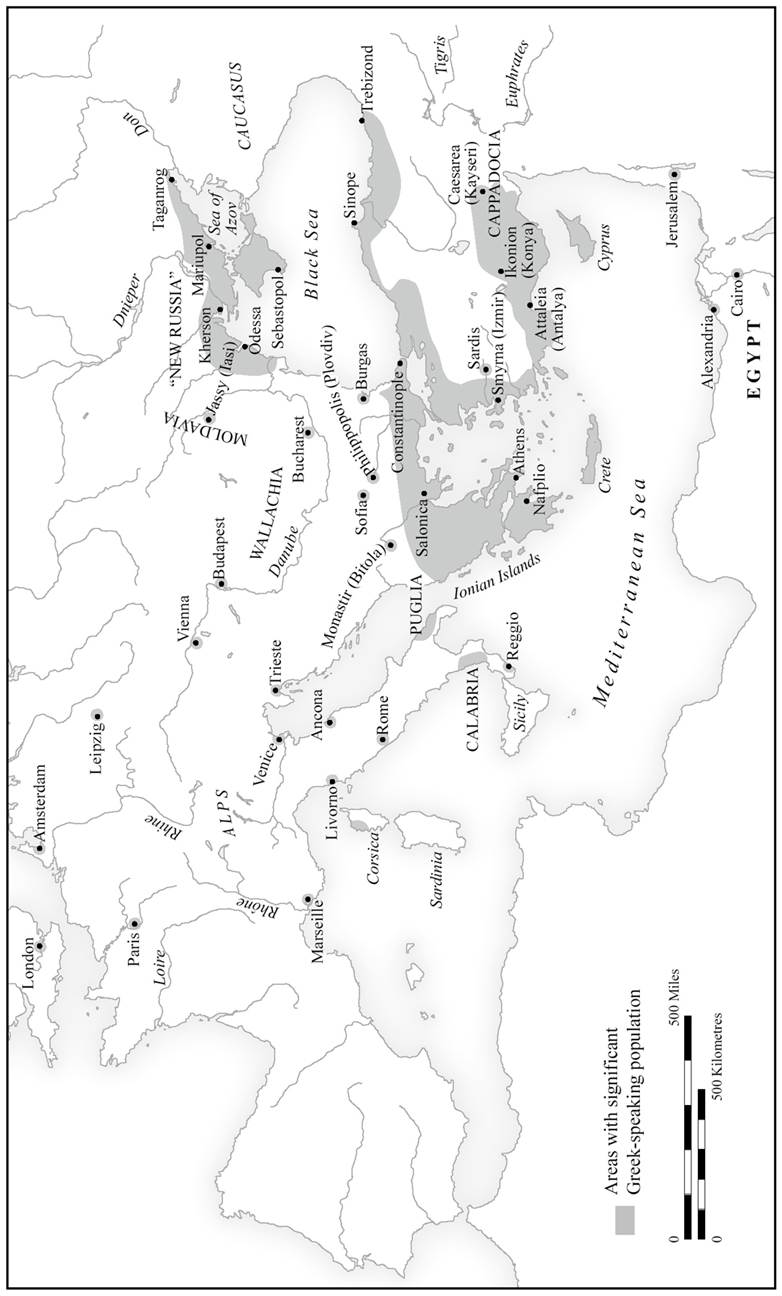
13. The Greek world in the late eighteenth century
More on the topic 12 BETWEEN TWO WORLDS 1453–1669:
- PHYSICAL WORLDS AND SPIRITUAL WORLDS
- 13 ‘GREEK REVIVAL’ 1669–1833
- Continuation in the East (ad 476-1453)
- 16 The Byzantine Empire (641-1453 ce)
- 35 The Russian Empire (1453-1917)
- 11 HOPEFUL MONSTERS 1204–1453
- Truth conditions and possible worlds
- 20 New Island Worlds
- The Various Genres and Worlds of Violence
- Trade-offs and Possible Worlds