Sacraments
Like worship, the special rituals known as sacraments are central to Christian life. Understood as visible symbols of God’s grace, the sacraments infuse believers with spiritual nourishment and impart a sacred character to transitional moments in their lives.
The Greek word for sacrament, musterion (“mystery”—the term preferred by Orthodox Christians), helps to explain the significance these rituals have for Christians. Making use of ordinary elements such as bread, wine, water, and oil, they bring the individual into an experience of something extraordinary—the mystery of God’s love. Roman Catholic and Orthodox Christians celebrate seven sacraments. Protestants acknowledge only two: baptism and the Eucharist.The first sacrament celebrated in the life of a Christian is baptism, a cleansing of sin that marks the beginning of a new spiritual life in which one is united with Christ and sanctified by the Holy Spirit. Baptism can take the form of complete immersion in water or a sprinkling of water on one’s head. However it is performed, the priest or minister always follows the instruction of Christ to baptize “in the name of the Father and of the Son and of the Holy Spirit” (Matthew 28:19).
After baptism, a Christian is entitled to participate in the Eucharist, also known as Holy Communion and the Lord’s Supper. As we have seen, the Eucharist commemorates Christ’s Last Supper with his disciples before his crucifixion. On that occasion, Christ identified the bread and wine they shared with his body and blood:
While they were eating, he took a loaf of bread, and after blessing it he broke it and gave it to them, and said, “Take; this is my body.” Then he took a cup, and after giving thanks he gave it to them, and all of them drank from it. He said to them, “This is my blood of the covenant, which is poured out for many.”
—Mark 14:22-24
Historically, most Christians have taken these words to mean that Christ is truly present in the Eucharist.
Only with the Reformation of the sixteenth century did some Protestant groups adopt the view that the bread and wine are mere symbols of Christ’s presence. Although those who believe in the “real presence” have sought to explain it in various ways, most acknowledge that it is ultimately a mystery. In a sense, it is similar to the gestures we use to communicate inward feelings in everyday life. For example, most of us believe that the love we feel for someone else can be conveyed by a hug or a kiss, but we would find it difficult to explain in precise terms how our love is present in the gesture. We can understand the Eucharist as a kind of sacred gesture in which God offers grace to human beings. Although Christians have different ways of explaining how this happens, they agree that their participation in the ritual meal of bread and wine brings them into closer union with God and each other.A third sacrament is confirmation. In the Roman Catholic Church, confirmation is administered to adolescents who have completed formal instruction in the faith. Because they understand its teachings, they are recognized as fully responsible members of the Church. In the Orthodox tradition, confirmation usually occurs when an infant is baptized in order that, nourished by grace, he or she might grow into a mature understanding of the faith and share in the work of the Church.
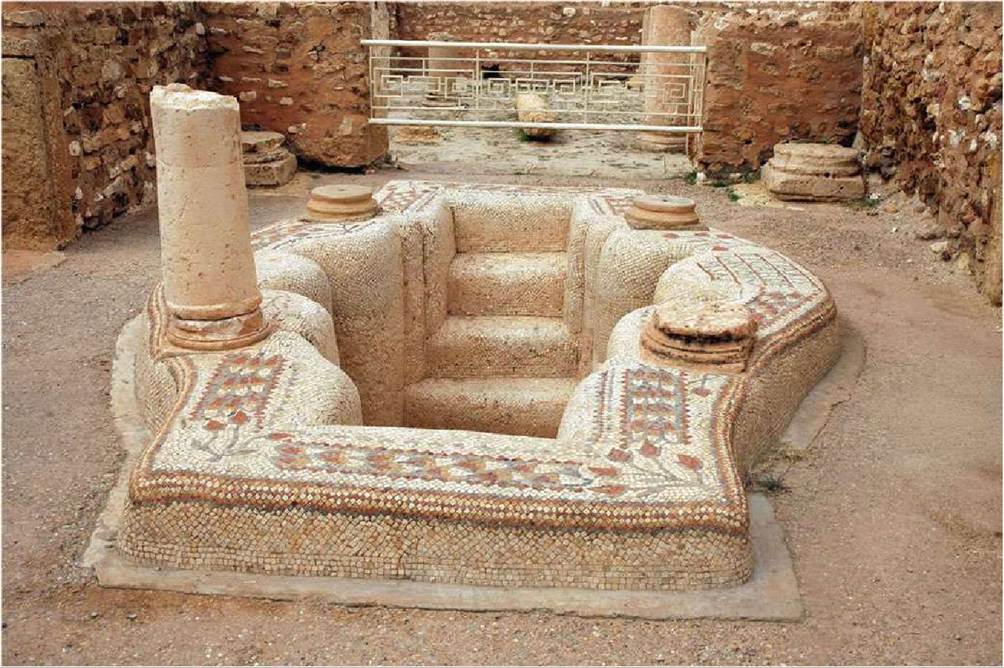
This baptistery basin was built in the sixth century as part of the Basilica of St. Vitalis in what is now Sbeitla, Tunisia. Candidates for baptism were led down the steps and then baptized by full immersion in water.
The four remaining sacraments are essentially the same in Catholicism and Orthodoxy. Holy matrimony gives a sacred character to marriage. For men who feel called to become priests, the sacrament of holy orders confers a grace that enables them to be effective leaders in the Church. Penance, also known as confession and reconciliation, involves confessing sin to a priest in order to receive his assurances of God’s forgiveness and his prescription for the performance of an act of penance or reparation for the sin committed. The final sacrament, anointing of the sick, is meant to strengthen those who are in immediate danger of death.
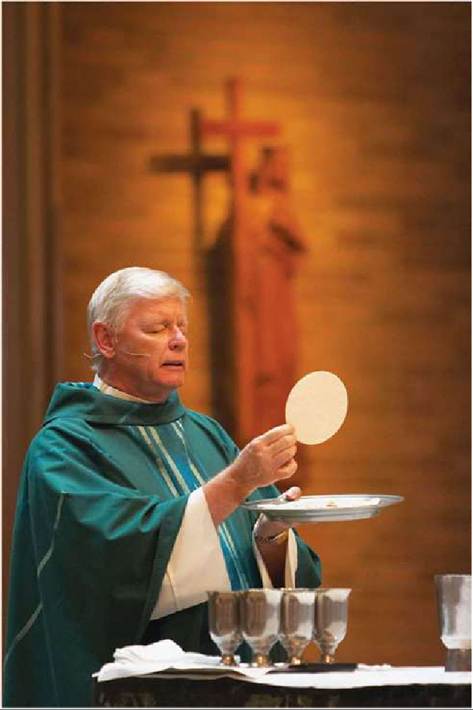
In this celebration of the Eucharist, a Roman Catholic priest prays over a wafer of bread and chalices of wine, which are believed to become the body and blood of Christ.
Video: Baptism
More on the topic Sacraments:
- Sacraments
- The Liturgical Year
- Eastern Orthodoxy in America
- Church Interiors: Sacred Space
- The Afterlife
- Ritualised Violence in Amerindian Rebellions
- Why the Godmother? Liminality and Mediation
- Lutheran and Reformed Groups
- What Might an Anthropology of Secularism Look Like?
- The Platonic tradition from Aristotle to Pseudo-Dionysius