The Liturgical Year
Just as the life of every Christian is punctuated by the sacraments, each year in the life of the Church is organized around celebrations of holy days and observances of religious seasons that make up the liturgical year.
Built around the two great feasts of Christmas and Easter, the cycle of the liturgical year draws believers into the experience of Christ, allowing them to relive in a vicarious way the events in his life through which God brought salvation to the world.The first great season of the liturgical year is Advent, a time of preparation and looking forward to the “coming” (Latin, adventus) of God into the world. Advent culminates in Christmas, a celebration of the birth of Christ on December 25, when expectation turns into rejoicing. The Christmas season ends on January 6 with a celebration of Epiphany (from the Greek epiphaneia, “manifestation”), which recalls the manifestation of Jesus’s divinity as an infant (emphasized in the West) and at his baptism (emphasized in the East).
After Epiphany, the liturgical year moves forward to Easter, a springtime celebration of Christ’s resurrection. Easter is preceded by the season of Lent, when many Christians practice self-denial as a way of participating vicariously in the suffering of Christ. Awareness of Christ’s suffering is heightened during Holy Week, the last week of Lent, when most days have special significance. Palm Sunday recalls Christ’s triumphal entry into Jerusalem, when enthusiastic crowds placed palm branches on the road before him. Maundy Thursday marks Jesus’s institution of the Eucharist at the Last Supper. Good Friday commemorates the crucifixion of Jesus. Holy Week concludes with Easter, the most important Christian holiday because it is in Christ’s resurrection that Christians see his triumph over death and the promise of eternal life. Easter is a truly joyous holiday, filled with signs and symbols of new life.
In Orthodox countries, Easter mornings resound with the cry, “Christ is risen!” and the response, “He is risen indeed!” Rejoicing continues through the following weeks as Christians celebrate the ascension of Christ into heaven and the coming of the Holy Spirit at Pentecost. After Pentecost, the liturgical year moves into six months of “ordinary time” that ends with Advent, when the annual cycle begins again.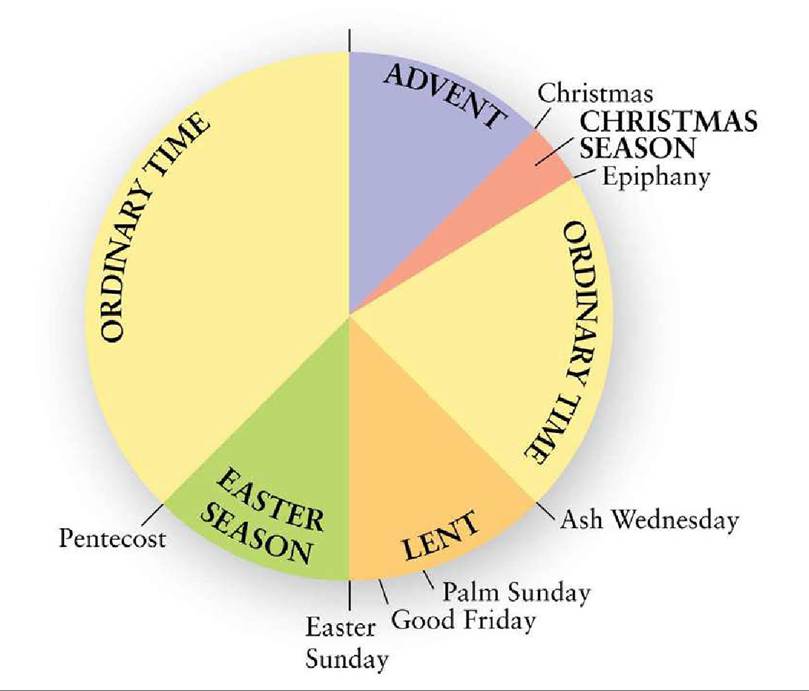
The liturgical year is an annual cycle of holy days and seasons that re-create events and times during the life of Jesus.
Video: Easter East and West
Veneration of Saints
Like the members of any group, Christians have always had their heroes. Known as saints (“holy ones”), they are spiritual role models who have shown how the Christian life should be lived. The greatest of saints is Mary, the virgin mother of Christ, who is considered the foremost example of what God can do in sanctifying a human life. Those who honor Mary point to her virtues of gentleness, humility, and submission to God’s will and recall her expression of joy on learning that she had been chosen to bear the Christ: “Surely, from now on all generations will call me blessed” (Luke 1:48). According to Roman Catholic teaching, Mary was unique in being conceived without sin (the doctrine of the Immaculate Conception) and in being taken up bodily into heaven at her death (the doctrine of the Assumption). Orthodox Christians honor Mary with the titles Theotokos (“God-bearer”) and Panagia (“Allholy”).
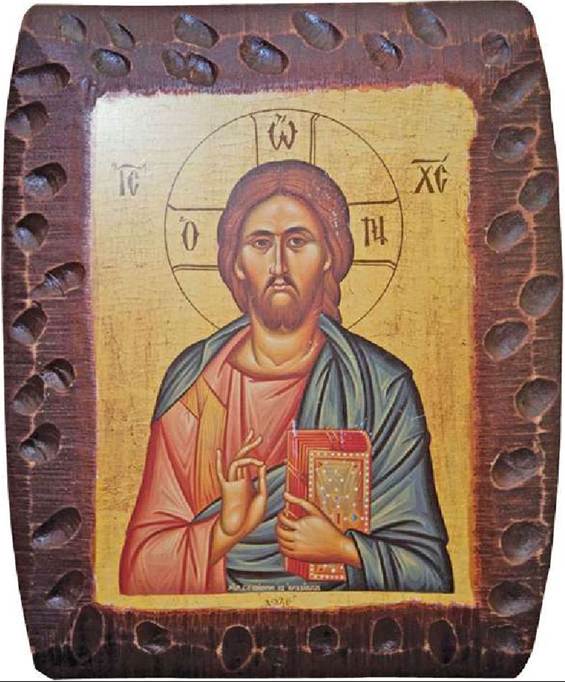
This Greek icon depicts Christ holding the scriptures and raising his right hand in a sign of blessing. The Greek letters outside his halo identify him as Jesus Christ. The letters inside the halo identify him as God.
For Protestant Christians, the significance of the saints lies almost exclusively in the inspiring examples they have set for others.
In Roman Catholicism and Orthodoxy, the saints have greater significance. These traditions emphasize the eternal participation of the saints in the Church, for though they now exist in heaven, they remain within the mystical communion of believers that is “the body of Christ.” Catholic and Orthodox Christians believe that Paul made this point when he wrote that Christians are “citizens with the saints and also members of the household of God” (Ephesians 2:16).Just as the living pray for the welfare of their fellow Christians, the saints are thought to intercede for them in prayer as well. Belief in the intercession of saints is evident in early Christian literature and in ancient epitaphs found on sarcophagi and grave markers. These implore both saints and departed family members to pray for the living. “Pray for us,” says one inscription, “that we may be saved.” On the sarcophagus of their little boy, his mother and father wrote: “To our son Philemon, who lived happily for two years with his parents: Pray for us, together with the saints.”9 Belief in the intercession of saints remains an important part of Roman Catholicism and Orthodoxy. Strictly speaking, one does not pray to the saints, but with them. Saints are not worshiped. Instead, they are venerated with a reverential respect that recognizes their holiness.
The veneration of saints takes a variety of forms. Traditionally, Catholic and Orthodox Christians are given a saint’s name at baptism, and their churches are usually named after saints. Many believers honor saints on their feast days. In addition, the physical remains of saints, known as relics, are objects of veneration. Preserved in special containers known as reliquaries, relics are found in many churches, where they bring a sense of the sacred to those who pray in their presence. The relics are often brought out for special observances or processions on the saint’s feast day. If this practice seems a bit strange to you, it might be helpful to consider how you might be affected by a more secular “relic.” For example, a photograph or keepsake from a loved one you have lost can provide a sense of that person’s presence.
In some mysterious way, it seems, something of that person’s essence remains within the item itself. So it is with the saints, whose holiness is thought to remain in the relics they have left behind.Images of saints also produce a heightened awareness of holiness. In Roman Catholicism, images take the forms of paintings and statues whose lifelike quality is meant to underscore the experience of earthly existence that the saints share with all other believers. Meditating on a painting or statue, believers are encouraged in the spiritual life by knowing that the saint it represents once experienced the same challenges they experience. The icons of the Orthodox, who make no use of statues, are meant to have just the opposite effect. These highly stylized paintings are not intended to be lifelike. Their purpose is to represent not earthly reality but the reality of transfigured and perfected humanity in heaven. Gazing intently at their observers and communicating through symbolic gestures, the saints depicted in icons offer a glimpse of the higher, spiritual realm that is the ultimate goal of every Christian.
More on the topic The Liturgical Year:
- The Liturgical Year
- Late Antiquity and Modernity
- Religious Observances Throughout the Year
- Christianity, Gender, and Inclusion
- Sacraments
- How can one evaluate President Zelensky’s first year in power?
- Kernerenko’s Second Advent
- NEW YEAR IN KIEV
- The Ukrainian National Awakening in the Austrian Empire before 1848