Prayer
For Christians, Jesus provides the ultimate example of the importance of prayer. The gospels describe him as praying frequently, often for hours and with great fervency. On one occasion, he taught his disciples to pray in this way:
Our Father in heaven, hallowed be your name.
Your kingdom come.
Your will be done,
on earth as it is in heaven.
Give us this day our daily bread.
And forgive us our debts, as we also have forgiven our debtors.
And do not bring us to the time of trial, but deliver us from the evil one.
—Matthew 6:9-13
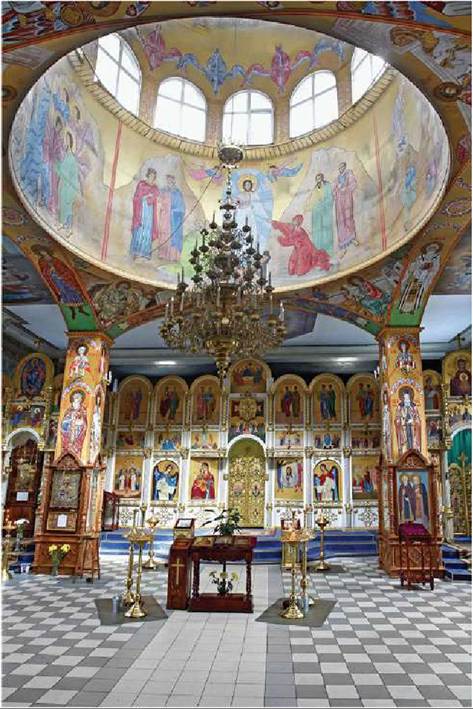
The interior of an Orthodox church in Odessa, Ukraine. Note the iconostasis, or “icon screen” at the far end of the aisle. In Orthodox churches, the altar is always located behind the iconostasis. Images of Christ and the saints on the interior of the dome remind worshippers of their spiritual communion with heavenly personalities.
This prayer, known as the Lord’s Prayer, is just one of many forms of prayer in Christianity. In the early Christian centuries, additional prayers were created and formally integrated into the liturgy. Of course, from the beginning, Christians also prayed privately, informally, and silently. Today, it is customary for Christians to offer a prayer of thanksgiving before meals, on rising in the morning, and before going to bed at night. When the troubles and concerns of daily life arise, they ask God for guidance, forgiveness, and peace. In the face of sickness and death, they find in prayer the assurance of God’s loving presence.
Most Christian traditions include specialized forms of prayer practiced by those who wish to deepen their spiritual lives. For example, the interior walls of Roman Catholic churches display fourteen images of the passion, or suffering, of Christ during the final hours of his life. During Lent, the period before Easter, Catholics visit these Stations of the Cross in order, reciting prayers and meditating on each incident as a means of coming to a deeper understanding of Christ’s suffering.
Another form of Catholic devotion is praying the rosary. This involves recitation of a series of prayers counted on a string of beads while meditating on important moments in the lives of Jesus and his mother, Mary.For instruction in prayer, Orthodox Christians turn to the Philokalia, a collection of mystical texts written between the fourth and the fifteenth centuries. Containing the words of Orthodoxy’s greatest sages, the Philokalia is considered a treasury of wisdom concerning the practice of contemplative prayer. Whereas meditation centers on the intellect, contemplative prayer is a “prayer of the heart” in which it is not just the mind but one’s whole being that reaches out to God. Its most common form is the Jesus Prayer: “Lord Jesus Christ, Son of God, have mercy on me.” Ideally, the Jesus Prayer is recited continually, whether one is driving to work, standing in line, or attending to any other matter. In time, it embeds itself in one’s being, and its repetition becomes as natural and effortless as breathing. According to one Orthodox saint, “even when [the practitioner] is immersed in sleep, the perfumes of prayer will breathe in his heart spontaneously.’- In recent years, the Jesus Prayer and other forms of Orthodox contemplation have become increasingly popular among Catholics and Protestants, who share with Orthodox Christians a yearning for communion with God not only at certain times but throughout the course of each day.
What similarities do you see between the aims and practices of Christian contemplative prayer and the Hindu recitation of mantras?
More on the topic Prayer:
- The Military
- THERE WERE SUCH GREAT TAILORS
- FOURTEEN Conclusion
- Violence against the Self, State Violence and Interpersonal Violence
- Conclusion
- CONCLUSIONS
- Conclusion
- Reburial: Fromelles Military Cemetery
- Kanem-Borno and Hausaland
- The Sokoto Caliphate