The emergence of temples
A second major illustration of “Hindu” culture in the south was the emergence of the temple as a cultic and social center. Under the Pallavas (seventh to ninth centuries ce) temple construction received a significant impetus, first in the form of monolithic structures carved from rocks - such was the form of the shrines carved at Mahabalipuram, the Pallava seaport, in honor of the Pandava brothers, those heroes of the Mahabharata.
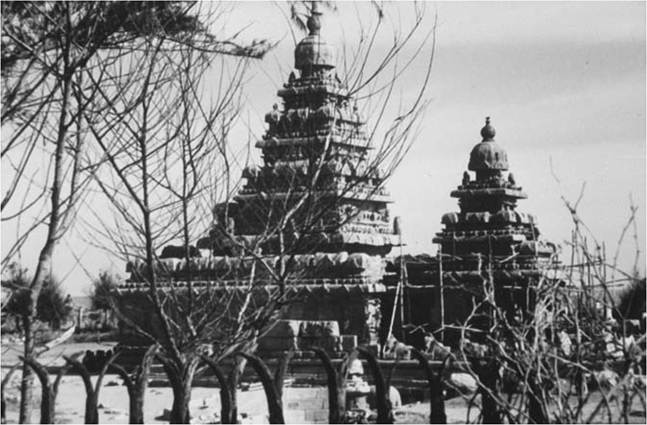
Figure 2 The Shore Temple at Mahabalipuram, port city of the Pallavas. Photograph by Rob F. Phillips.
These were followed by temples constructed “from scratch,” such as the carved shore temple at Mahabalipuram or those at Karicipuram, the Pallava capital. These later temples had come to reflect much of the imagery of brahmanically “orthodox” temples - the tower (vimana) was Mt. Meru or the hiranyagarbha and its parts were named as though it were a human torso. One entered an “omphalos” to reach the inner sanctum or “womb house” (garbhagrha). At the same time, the temple served as a center of a town (Ur) and reflected the social and political reciprocities of its elites. For example, in the royal temples, kings, veilalas (landowners), and brahmans expressed their political-social reciprocities in the ritual life of the temple. Donations were made by landowners and royalty, both male and female; honors were afforded these patrons and the gifts and/or land were redistributed. In effect, the temple became an economic as well as a social and cultural space.8
By the time the Colas had gained hegemony in the South (ninth to thirteenth centuries ce), with their capital in the Kaveri basin, the temple had become a major institution. Architecturally, by the twelfth century the kopuram (Skt: gopura - entrance way) came to be the dominant tower on the temple precincts, thanks to the donations of nobility and wealthy patrons, though, in some temples, such as at Citamparam, the central tower (vimana) was gilded in gold.
The Colas were patrons of Siva, but in an effort to incorporate rural areas under their hegemony, local village goddesses were made part of the royal cultus, the goddess thus serving as the consort of Siva. Under the Colas, iconography, especially bronze castings, became both an art form and a focus of ritual. Among the representations of the divine that became noted during the Cola period was a bronze casting of Parvati, Siva’s consort, cast in the image of a Cola queen. Even more enduring was the representation of Natarajan, the dancing Siva, the presiding deity at Citamparam. Natarajan’s symbology was complex: he had four arms, signifying omnipotence; in one hand he held a drum, promulgating the rhythm of the universe; his two dancing legs suggested both the standing and the moving of the cosmos. He danced within a circle of flames, representing the tradition of sacrifice, but also the circle of the universe, life, and dharma to which Siva was thought to give coherence. He stood on a dwarf, emblematic of malevolence, evil, “chaos.” Around him a snake was entwined, suggesting creativity, fertility, and primordiality were controlled by the dancer.The temple structure itself was made congruent to the human body, not only vertically but also horizontally. Built by silpis who practiced the rules of temple construction, the temple’s ritual space became a microcosm, known as the vastupurusamandala (a space which is congruent to human and cosmic form). Temples had become the arenas for the enacting of a complex festival and ritual life. Ritual sequences followed a complex chronometry, combining solar, lunar, and constellational markings. The solar year, for example, had its light half (from winter to summer solstice) and its dark half, with the light half thought to be most auspicious. The lunar cycle, similarly, was thought to be most auspicious in its waxing half. The sun was believed to pass through twelve constellations in a year and the moon through twenty-seven constellations (naksatras) each month.
Similarly, the day was congruent to the solar year and had “sacred hours,” three before dawn, equated to the period before the winter solstice; six sacred hours occurred between dawn and noon and were homologized to the six months of the sun’s “light half.” After noon, there was a period of inauspiciousness and ritual abstinence, just as in the three months after the summer solstice, temple festivals were rare. Finally, three hours occurred after dusk and were equated to the period immediately after the fall equinox. Not least important, the career of the deity was “grafted” onto the solar and daily calendar. Each year festivals enacted events in the life of the deity but also occurred at the appropriate juncture of the solar calendar, the full moon, and the lunar constellation (naksatra). Each temple kept its own festival calendar. In the Citamparam Temple, for example, at least by the eleventh century, two festivals had assumed major significance: an anointing festival in December-January (markali) and a festival immediately after the summer solstice in June to July (ani).9 By the fourteenth century in that temple a full annual festival cycle was in place.10Similarly, each day, in fully brahmanized temples, the deity embodied in its icon would be awakened, brought to full empowerment, whence it would give out its energies to devotees, then would be retired at night. The rituals addressed to the icon in a given day could include:
1) anointing (abhiseka) with water, milk, fragrances, etc;
2) dressing (vastra) the icon;
3) adornment (alaiiknram·. Skt: alamkara) with jewelry, garlands, etc. At this point in the ritual, the icon was thought to be fully sacralized. The rituals that followed may include praising with the deity’s 1,000 names (laksarcana); offerings and gift-giving (arccanai; Skt: arcana); and the showing of lights in adoration of the deity (aratanai).
More on the topic The emergence of temples:
- The emergence of temples
- THE DEVELOPMENT OF FORMAL SANCTUARIES AND TEMPLES: VEII
- Sanctuaries and temples
- Shrines and temples
- Gods, temples and cities
- “CANONICAL” TEMPLES AND ALTARS
- Temples and Icons
- The Emergence of Universalist Religious Thought
- The temples of Egypt are peppered with images of the pharaoh as a victorious leader, a great man, chosen of the gods.
- Worship and Devotion