The History of Christianity
Christianity in the Roman World
Christianity spread rapidly throughout the Roman Empire. As it did, Christians met with criticism and persecution that continued until Rome’s emperors became Christians themselves.
Also, as the Christian movement grew during these early years, it became necessary to define basic doctrines and to adopt a form of church government capable of uniting Christians and promoting uniformity of belief and practice among them.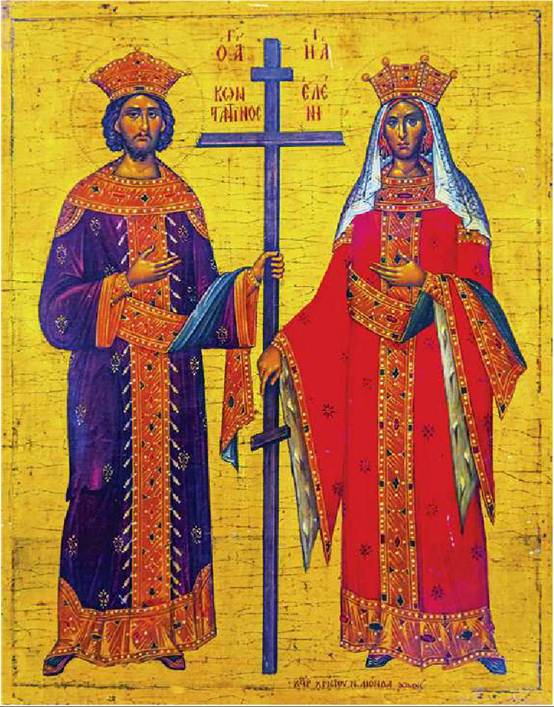
The first Christian emperor of Rome, Constantine the Great promoted the spread of Christianity throughout the Roman Empire and founded a new capital at Constantinople (modern Istanbul) in 330. He is represented here with his mother, Helena.
Conflict with the Roman State The Roman world was often hostile to Christians. Many suspected Christians of disloyalty to Rome because they refused to recognize its gods or participate in public events that involved pagan rituals. Localized persecutions began in the first century and expanded into empirewide assaults in the third. Despite the terrors of mass arrests and executions, persecution failed to check the growth of Christianity. A dramatic turning point came in 312, when the Emperor Constantine (r. 306-337) defeated a rival after seeing a vision of a cross in the sky. Convinced that the God of the Christians had given him the victory, Constantine decreed religious freedom for Christians and began to promote Christianity by building churches and extending privileges to church leaders.
When Constantine transferred the imperial capital from Rome to Constantinople (modern Istanbul) in 330, he did so in the hope that it would be a truly Christian city free of paganism. Decades later, Theodosius I (r. 379-395) made Christianity the official state religion of the Roman Empire and began the suppression of other religions and schools of philosophy.
Diversity in the Early Church
During the first five centuries ce, Christians formulated many important doctrines, thereby establishing a standard of orthodoxy, or “correct belief.” However, some early Christian groups challenged the emerging mainstream Church on issues as basic as the nature of God, the humanity of Christ, salvation, and ecclesiastical (Greek ekklesia, “church”) authority.
Gnostic Christians produced mysterious gospels and other texts that did not come to light until the late nineteenth century. Many Gnostic Christians believed that Christ’s body had been a mere illusion; therefore, he could not have atoned for sin by dying a physical death upon the cross. Salvation came instead from secret knowledge (Greek gnosis) that Christ gave only to a select group of gnostics (“knowers”), who had passed it down to others. Because Gnostic Christians saw all material reality as evil, they understood salvation as the liberation of souls from human bodies rather than as liberation from sin. Gnostics claimed that the Christianity preached publicly in churches was incomplete, as they alone understood the higher teachings of Christ.
A second group was founded by Marcion (c. 85-160 ce), a theologian who had been expelled from the church at Rome for teaching that there are two Gods: the God of the Jewish Scriptures, whom Marcion described as the unjust creator of an evil world, and the supremely good God revealed by Christ. According to Marcion, it was this good God who had sent Christ to rescue human souls. Seeking to cut Christianity off from its Jewish roots, Marcion rejected the Jewish Scriptures and all Christian texts that seemed dependent on them.
A third form of Christianity, known as Montanism, began with Montanus, a charismatic prophet of the late second century who claimed to be the mouthpiece of the Holy Spirit. Montanus prophesied that Christ would soon return to a “new Jerusalem” that was about to
appear in southern Asia Minor. The greatest difficulty posed by Montanus was his claim that he preached a new prophecy.
This raised two critical questions. First, would Christian teaching require ongoing revision in order to accommodate every new group and its revelations? Second, did claims of prophetic inspiration give charismatic figures like Montanus an authority greater than that of church leaders?Defining Orthodoxy
Resolving questions related to correct belief, scripture, and the authority of the Church was one of the great themes in the early history of the Church. In order to establish its authority and define orthodox belief, the Church created a canon of scripture, formulated creeds, and implemented a system of ecclesiastical government that put authority into the hands of bishops.
We have already seen that a canon of scripture consisting of the Old and New Testaments was in place by the end of the fourth century. Texts widely believed to have been written by the apostles were included, as were writings from the apostolic era that were widely used in public worship. Because the Old and New Testaments were regarded as having a unique authority, they constituted a standard against which the orthodoxy of any new teaching could be judged.
The creeds developed by the early Church were formal and concise statements of essential Christian beliefs. In fact, the word creed itself comes from the Latin credo, which means “I believe.” Creeds such as the Apostles’ Creed and the Nicene Creed served two functions. (1) They proclaimed orthodox doctrine on the incarnation, suffering, and death of Christ, as well as his resurrection and ascension into heaven; and (2) repeated recitation of the creeds by Christians throughout the empire promoted uniformity of belief within the Church.
Finally, the early Church established a form of government that concentrated power in the hands of bishops, who had jurisdiction over large territories called dioceses. According to the doctrine of apostolic succession, bishops were the successors of the apostles, who had been commissioned by Christ himself to lead the Church.
Claiming to have received both their offices and correct belief through direct lines of transmission, they held an authority that Gnostics, Montanists, and Marcionite Christians found difficult to challenge. Bishops were assisted by priests, who were responsible for individual churches, and every church was served by deacons (Greek diakonos, “servant”) who assisted priests.Gradually, the bishops of Rome and Constantinople emerged as the leaders of the churches of the Western and Eastern halves of the empire. Known as “popes” (Latin papa, “father”), the bishops of Rome were said to be the successors of the Apostle Peter, the “rock” (Greek petra) upon whom Christ had said he would build his Church (Matthew 16:18-19). They claimed the same authority Christ had given to Peter. Other bishops—including the great patriarchs of
Constantinople, Alexandria, Antioch, and Jerusalem—acknowledged the bishops of Rome as “first among equals” but without recognizing the right of popes to rule over them.
Early Christian Thought
The success of the early Christian movement was due in part to the work of Christian writers who produced carefully reasoned statements of Christian belief. These texts gave Christianity intellectual respectability in a world accustomed to the high standards of Greek philosophy and tended to encourage a search for commonalities linking Christian and pagan culture.
For example, theologians such as Clement of Alexandria (c. 150-215) and Origen (c. 185-254) taught that God had long been at work among the Greeks and Romans, preparing them for the coming of Christ. Just as God had given the Torah to the Jews, said Clement, he had given philosophy to the Greeks as a kind of “schoolmaster” in order to “bring the Greek mind... to Christ.”4 Like many thinkers of his time, Clement held that all truth comes from the divine “Word,” or logos. Thus, truths found in scripture and philosophy were compatible. However, since the logos had become incarnate in Jesus Christ (John 1:18), said Clement, it was only in Christ that seekers of truth would find it fully revealed.
Controversies and Councils
Beginning in the third century, Christian theologians turned their attention to the concept of the Trinity and to the nature of Christ. Discussion of these issues led to ecumenical councils (“worldwide councils”) of bishops at which doctrines were defined.
From the beginning, most Christians believed that God the Father, the Creator of the universe, had become present in the world in Jesus Christ, God the Son. They also believed in the Holy Spirit as the continuing expression of God’s loving presence and power in the world. But how could the one God also be three? This question was taken up by early theologians such as Tertullian, who gave Latin theology its Trinitarian vocabulary by speaking of God as tres personae, una substantia (“three persons, one substance”). Similarly, Greek-speaking theologians described God as a single divine ousia (“substance” or “essence”) made manifest in three hypostases (“subsistences”).
This way of thinking about the Trinity sufficed until the early 300s, when Arius, an Egyptian priest from Alexandria, began teaching that God the Son, or logos, was of a different substance than God the Father. Going further, Arius claimed that whereas the Father was eternal, the Son was created in time. Arius’s views alarmed other theologians, for they seemed to undermine the unity of the Trinity. If the Father and the Son were so different, they asked, how could God be truly one?
Anus’s provocative teachings soon had Alexandria buzzing as people in shops and streets argued theology with an enthusiasm that we today reserve for debates about sports and politics. Fearing that Arianism threatened the unity of the empire, as well as the Church, the Emperor Constantine stepped in and convened an ecumenical council to settle the matter. The Council of Nicea (325) condemned Arius’s views, ordered the burning of Arian texts, and formulated a creed affirming that God the Son is homoousios (“of the same substance” or “being”) with God the Father.
An expanded form of this creed, the Nicene Creed, produced by the Council of Constantinople (381), describes God as a Trinity of three distinct yet unified divine “persons.”Even as the Trinitarian controversy was being settled, another debate began over the person of Christ. Christians had long believed that Christ was both human and divine, but they differed in explaining how humanity and divinity coexisted in him. The orthodox position on this issue was determined at yet another ecumenical council at Chalcedon (451): in Christ, two complete and perfect natures, human and divine, were united without separation or fusion in a single person.
Augustine
The drama of the Trinitarian and Christological controversies was played out in the Greekspeaking eastern half of the Roman world and involved many leading theologians. The Latin West produced just one theological giant. This was Augustine (354-430), a North African bishop who laid the intellectual foundations for much of Western Christianity and Western civilization.
Central to Augustine’s theology are his views on sin and human nature. Elaborating on the theology of Paul, Augustine argued that sinfulness is a fundamental flaw in human nature that clouds our moral vision and perverts the will by causing us to desire evil rather than good. In the Confessions, his spiritual autobiography, he illustrated this point by recalling the pleasure he and some teenage friends once found in stealing and throwing away pears from a neighbor’s tree. According to Augustine, the tendency to sin is so deeply ingrained that we are spiritually helpless and therefore completely dependent on God for salvation.
But how did human nature become so corrupt? Augustine’s answer came in his famous doctrine of original sin. All of humanity, it says, participated in the first sin: the sin of Adam and Eve, the first human beings, described in Genesis (3:1-24). At that time, Adam and Eve were humanity, with all future generations present in them. Thus, when they made themselves sinners by choosing to disobey God, this original sin transformed human nature in a way that was bound to affect their descendants. Every human being, said Augustine, is bom with the “stain” of original sin in the form of a sinful nature. As we will see, although
Augustine’s teaching on original sin became a foundational feature of Roman Catholic and Protestant Christianity, it was never accepted by the Orthodox tradition.
Augustine’s awareness that some people are saved from sin led him to formulate a theory of predestination. Because all human beings are sinful and therefore incapable of responding on their own to God in faith, he reasoned, God must give some people a grace that inspires faith. Divine grace is irresistible, he said, for a love that could be resisted would be incompatible with God’s perfection. Thus those whom God touches with his grace are destined to be saved. Augustine conceded that it is impossible to know why God extends a saving grace to some people and not to others, but he insisted that God is neither arbitrary nor unjust. Some are allowed a destiny better than they deserve, but no one receives a destiny worse than he deserves.
Augustine was never entirely comfortable with his conclusions about original sin and predestination, but his reading of scripture and observation of human behavior made them inescapable. Having seen jealousy in a baby whose brother had taken his place at their mother’s breast, he felt he had no choice but to conclude that sin must be something we are born with and not simply a habit everyone happens to pick up. Similarly, though predestination seemed to be the work of an unfair God, Augustine knew that scripture taught that only some would be saved and that God’s justice is not always within reach of human understanding.
Augustine’s masterpiece was his City of God, in which he formulated a Christian philosophy of history. Writing amid the panic following the sack of Rome by a Germanic tribe in 410, he rejected the pagan claim that Rome’s traditional gods allowed the city to fall because they were angry with the Romans for converting to Christianity. Augustine argued that the fall of Rome was part of God’s plan for the salvation of the world. God had ordained two “cities”: the earthly city, blemished by sin, and the City of God, a spiritual community grounded in love of God. Like all other manifestations of the earthly city, said Augustine, Rome must pass away so that history can move toward the full realization of the City of God on earth. This view of history as progress toward the fulfillment of God’s plan for salvation soon became standard in the Christian West.
The Church in the Middle Ages
In the fifth century, Germanic tribes overran the Western half of the Roman Empire. From the resulting chaos, a new medieval civilization emerged that combined Christianity with Roman and Germanic culture. The Eastern half of the Roman Empire survived for another thousand years. Known as the Byzantine Empire, it was Greek in its language and outlook. As the gulf between West and East widened, distinctively Western and Eastern traditions within the catholic (“universal”) Church began to take shape.
The Church in the West
The most powerful of the Germanic tribes were the Franks, who controlled most of western Europe by the ninth century. The Franks supported the Roman Church and granted rich lands to bishops and monasteries. In return, the Church sanctioned the rule of the Frankish kings, supplied clergy to serve in their government, and sent missionaries to convert pagan peoples in their kingdom.
The Church’s involvement in secular affairs continued after the decline of the Franks and often led to conflict between secular and spiritual rulers, especially the popes. Early medieval popes claimed that their spiritual responsibilities gave them an authority greater than that of secular rulers, but it was not until the eleventh century that the papacy rose to the level they had imagined. The most powerful of popes was Innocent III (r. 1198-1216). Intent on unifying the Christian world under the papal banner, Innocent intervened constantly in secular matters, deposing kings and emperors whenever they displeased him.
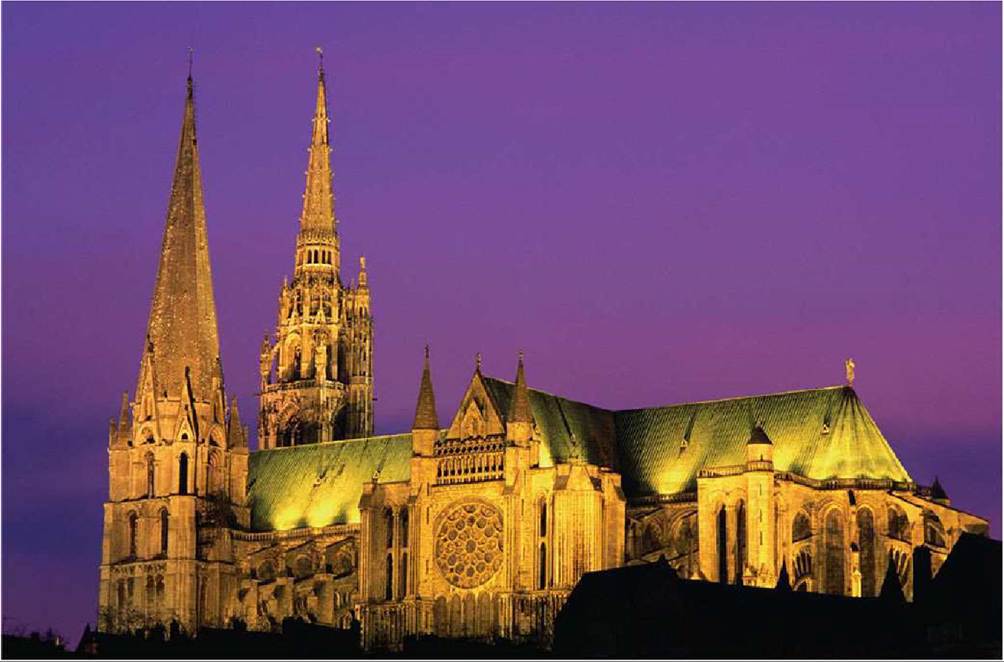
Completed c. 1250, the height and soaring towers of the Gothic cathedral at Chartres in France express the medieval yearning for God. For centuries, pilgrims and secular tourists have come to experience its exquisite, light-filled interior and to see its famous relic, the tunic of the Virgin Mary.
An extremely ugly aspect of medieval Christianity in the West was the Inquisition, the Church’s inquiry into allegations of heresy that began in the twelfth century. Working in partnership with secular rulers, who feared that religious diversity would undermine their authority, the inquisitors sought to eradicate false teachings they believed would endanger the salvation of those who accepted them. The Inquisition also targeted Jews and Muslims. Despite its use of torture and the execution of heretics by burning, the Inquisition could not stamp out heresy. Nevertheless, it persisted in various forms until its final and crudest phase, the Spanish Inquisition, was abolished in 1834.
The Church in the East
In the East, the patriarchs of Constantinople governed the Church jointly with the Byzantine emperors. The Byzantine ideal was a symphonic! (“harmony”) of emperor and patriarch based on their shared vision of a holy empire on earth that reflected the gloiy of the celestial society of heaven. Clashes did occur, but only one threatened the symbiosis of emperor and patriarch. This was the controversy over iconoclasm, or “icon smashing.” Icons, painted images of Christ and the saints, had long been revered by Byzantine Christians. But some saw this as idolatry. When the Emperor Leo III began removing icons from churches and other public places (726), riots erupted throughout the empire. Leo and his successors responded by deposing uncooperative patriarchs and executing monks, the leading defenders of icons. A formal end to iconoclasm came in 787, when the Second Council of Nicea determined that icons are worthy of veneration but not worship, which must be reserved for God alone.
By the twelfth century, Byzantine missionaries had brought the Slavic peoples of Russia and the Balkans into the Eastern Church. But the position of the Church became increasingly difficult in later years as the Byzantine Empire gradually collapsed under pressure from the expanding Islamic world. The empire fell in 1453 with the capture of Constantinople by the Ottoman Turks. For the next four centuries, most Eastern Christians outside Russia lived in the Ottoman Empire, an Islamic state in which they were tolerated but were denied full religious freedom.
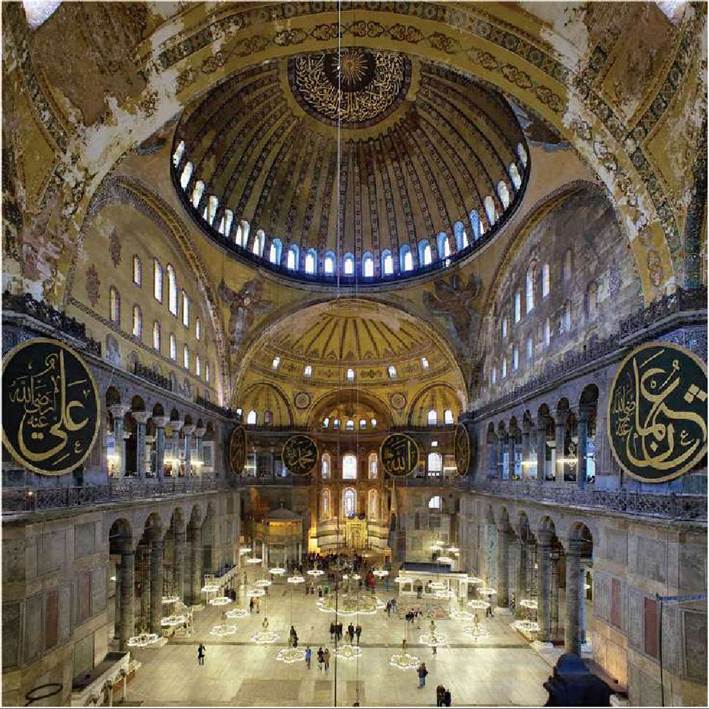
The interior of the Cathedral of Hagia Sophia. Dedicated to the “holy wisdom” embodied by Christ, this sixth-century church is the supreme achievement of Byzantine architecture. After the capture of Constantinople by the Turks in 1453, the city was renamed Istanbul and the church first became a mosque, then a museum.
The Great Schism: East and West Divided
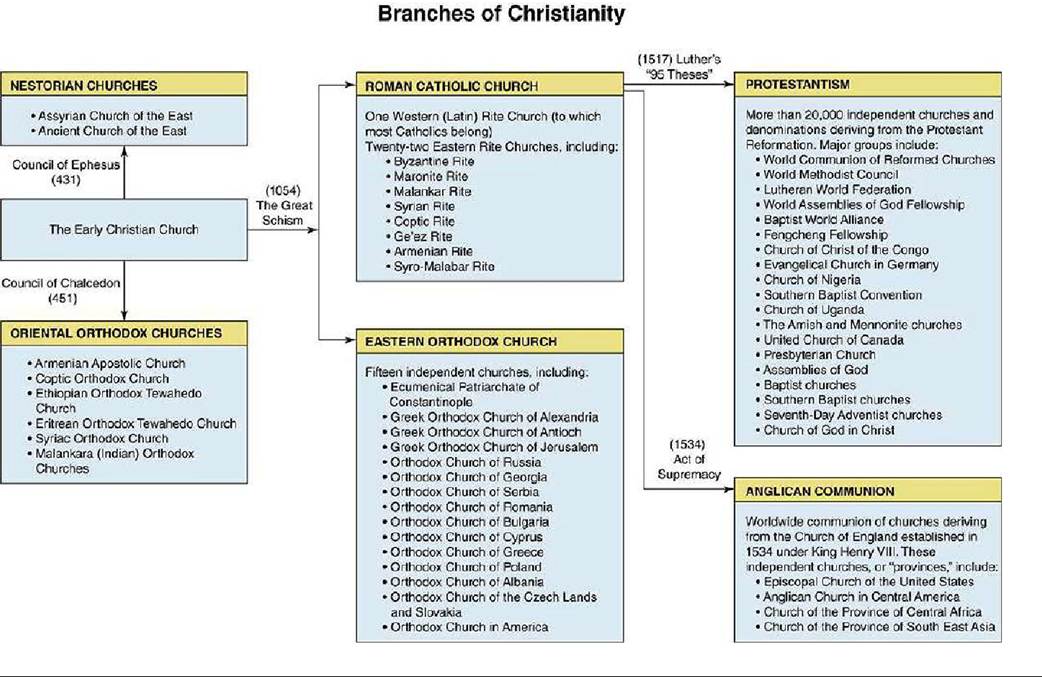
The Great Schism, the split between Western and Eastern Christianity, came after centuries of gradual separation during which the two traditions developed their distinctive forms. Some of their differences were minor: baptism, for example, was performed by a sprinkling of water in the West but by full immersion in the East, and the West urged priests to be celibate whereas the East preferred them to be married. Far more divisive were the attempts of popes to control Eastern bishops and Byzantine lands. In the end, it was the West’s addition of the Latin filioque (“and from the Son”) to the Nicene Creed that brought a final break. The East rejected this move for theological reasons and because the West had acted without sanction by an ecumenical council. In 1054, angry words over the filioque combined with tensions over other issues to force the division of what had always been a single, universal Church into separate Roman Catholic and Orthodox churches.
The Crusades Despite their differences, Eastern and Western Christians did share a common concern over the westward advance of Islamic armies. In 1095, Pope Urban II proclaimed a military crusade intended to push the Muslims back and liberate Jerusalem. Crying “Deus vult!” (“God wills it!”), armies of knights, peasants, and townspeople set out on the First Crusade. In 1099, they celebrated their capture of Jerusalem with a frenzied slaughter of Muslims and Jews. But the crusaders were unable to defend the lands they had conquered, and subsequent crusades to regain them were often military or moral disasters. Participants in the infamous Fourth Crusade (1204) never made it to the Holy Land, deciding instead to plunder Constantinople. The crusades ended at the close of the thirteenth century, having failed to deliver the Holy Land permanently into Christian hands.
Monasticism and Mysticism
One of the most visible features of medieval Christianity was monasticism, a movement that began in the third century when Christians seeking a deeper experience of God withdrew into the deserts of Egypt and Syria. Most early Christian monks and nuns lived solitary lives and practiced a severe asceticism. According to legend, Macarius of Alexandria (d. 395) remained standing for periods as long as forty days, subsisting on a weekly meal of cabbage. The nun Alexandra walled herself up in a tomb for ten years, never seeing another human face.
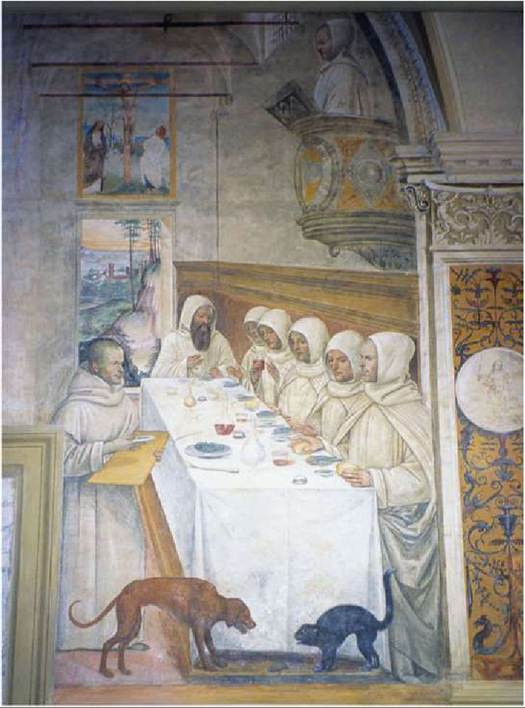
In this fresco by Giovanni Sodoma (1477-1549), Benedictine monks of the Monte Oliveto monastery in Italy eat their meal together—just as they worked and worshiped together in accordance with the Rule of St. Benedict. Note that one of the monks reads to the others from the Bible or some other holy book as they eat.
In the medieval period, monks and nuns were brought together in monasteries governed by “rules” that regularized monastic life and discouraged extreme forms of self-denial. Both the Eastern Rule of Basil the Great (330-379) and the Western Rule of Benedict of Nursia (480- 547) required monks and nuns to take vows of chastity and poverty and to spend their days in communal worship, prayer, and labor. Although the monastic aim of pursuing holiness through the imitation of Christ meant that monks and nuns spent much time in prayer and contemplation, monasteries also served nearby communities, providing them with spiritual guidance, education, shelter for travelers, and care for the poor and sick.
The monastic movement also encouraged mysticism, the direct and intuitive experience of God beyond the limits of mere intellect. Eastern mystics emphasized the absolute “otherness” of God, whom they regarded as so utterly unlike anything else we experience that even concepts as basic as “being” and “nonbeing” are useless in describing divinity. Though remote in his incomprehensibility, they said, God is also near, touching human beings with a love that restores the sinful nature to its original state of perfection in “the image of God” (Genesis 1:26-27). “Love, the divine gift,” wrote Maximus the Confessor (c. 580-662), “perfects human nature until it makes it appear in unity and identity with the divine nature.”5 Building on these ideas, Eastern monks such as Simeon the New Theologian (949-1022) and Gregory Palamas (c. 1296-1359) practiced Hesychasm, the cultivation of an inner quietude (hesychid) that brings an experience of God as divine light.
Western mystics also emphasized the power of divine love. Bernard of Clairvaux (1090-1153) compared Christ to a bridegroom whose love for the soul fills her with a bliss that transcends all earthly feeling. Bonaventure (1217-1274) described how divine love lifts the mind above rational thought, allowing it to unite with God in ecstasy. Many of the great Western mystics were women. Catherine of Siena (1347-1380) described a dialogue between God and a human soul seeking union with the divine in her famous Dialogue on Divine Providence. In her Revelations of Divine Love, the English recluse Julian of Norwich (1342-1416) spoke of God’s love as the only means to abiding joy. “Until I am substantially united to him,” she wrote, “I can never have love or rest or true happiness.”-
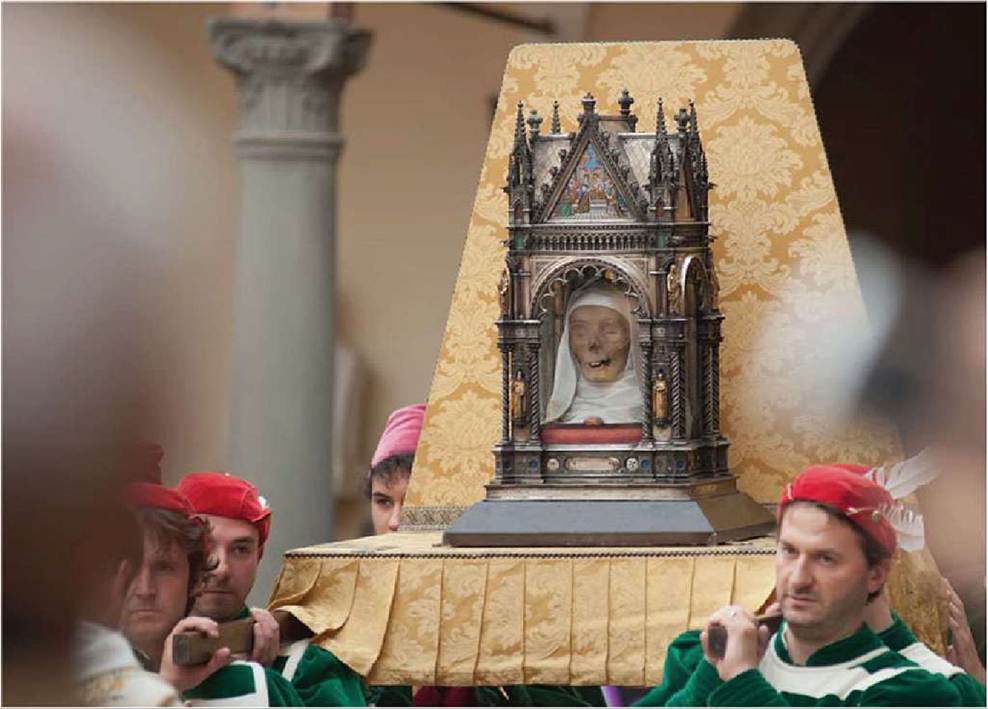
On April 29, the feast day of St. Catherine of Siena, four citizens of Siena, Italy, dress in medieval costumes and carry a casket holding the saint’s relics in a procession.
Theology
In the West, early medieval theology was centered in monasteries, where learned monks and nuns engaged in debates on issues such as predestination, free will, and the sacraments. In seeking to understand how Christ can be truly present in the Eucharist, for example, medieval theologians formulated a doctrine of transubstantiation. According to this doctrine, the bread and wine consecrated by a priest during the Eucharist become the actual body and blood of Christ in substance, though their secondary qualities, such as taste, color, and texture, remain unchanged.
The growth of major universities in the twelfth century created a new setting for theological inquiry. Here, theologians applied the science of logic as developed by Aristotle to grasp the full meaning of truths revealed in the scripture. Known as scholasticism, this effort became the chief intellectual enterprise of the West in the Middle Ages. The greatest of the scholastic theologians was Thomas Aquinas (1226-1274), a professor at the University of Paris. In his Summa Theologica, Thomas argued that although some truths can be known through reason alone, others can be grasped only through faith. Ultimately, said Thomas, there is a perfect harmony between reason and faith, for both come from God.
The most distinctive feature of Eastern theology was its view that all essential Christian truths had been defined once and for all by seven ecumenical councils that completed their work in the eighth century. After the Second Council of Nicea (787), Orthodox theologians devoted themselves to the analysis and elaboration of the faith as articulated by the seven ecumenical councils.
One of the important ways in which Eastern theology differed from that of the West concerns Augustine’s doctrine of original sin. Although both East and West agreed that the original sin of Adam had introduced sin and death into the world, the East did not accept Augustine’s view that this involved a corruption of the human nature that everyone assumes at birth. By contrast, the Eastern Church taught that the natural state of human beings is one of spiritual purity. Human beings succumb to the sin and evil of the world in which we live, but this is ultimately due to the choices we make and not to a sinful nature inherited from generations reaching back to Adam that makes it impossible to live as we should. Both East and West agreed that the remedy for sin is baptism, which cleanses the individual from the effects of sin and brings salvation through union with Christ.
The Reformation: Protestant Challenge and Roman Catholic Response
In the sixteenth century, a religious revolution known as the Reformation rocked Western Christianity. The Reformation’s first phase is known as the Protestant Reformation because of the protests of reformers against Roman Catholic doctrines and practices. Its second phase was the Catholic Reformation, which included direct responses to Protestantism, as well as reforms undertaken independently of it. Ultimately, the Reformation left Europe religiously divided, destroying forever the ancient and medieval ideal of a united Christendom.
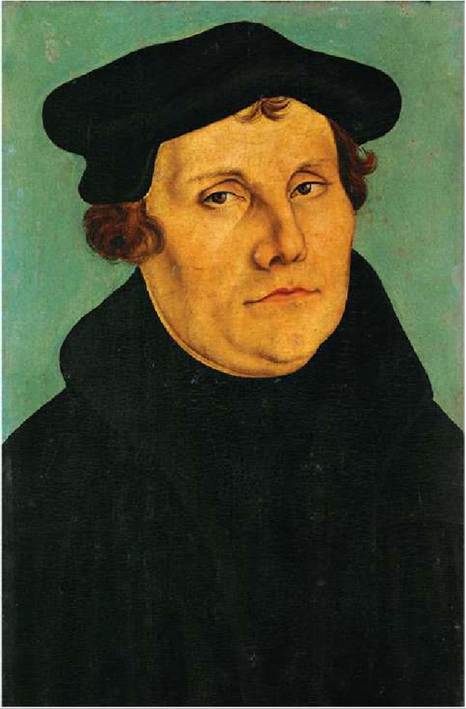
Portrait of Martin Luther by Lucas Cranach the Elder (1529). It was Luther who set the Protestant Reformation in motion by posting his Ninety-Five Theses on the door of the All Saints’ Church in Wittenberg, Germany.
Background to the Reformation
Throughout the Middle Ages, the Roman Catholic Church engaged in constant selfexamination and reform. Even so, voices calling for change grew louder and more numerous. Some complained of corruption among the clergy. Christians north of the Alps resented taxes imposed by the Church, especially since most revenues were spent in Rome. Many were angered by the luxuries enjoyed by popes. Those who wished to emulate the simple piety of the apostles were discouraged by the example set by church leaders who were more interested in wealth and power than in spirituality. Calls for reform were also encouraged by the revival of humanism—a deep faith in human beings that inspired the Renaissance; this cultural movement was flourishing at the time of the Reformation. Humanists such as Desiderius Erasmus (1466-1536) argued that Christians had no need to rely on the Church. Instead, they were capable of taking charge of their spiritual lives based on their own reading and interpretation of the Bible. By the dawn of the sixteenth century desire for religious reform was intense and widespread. The situation was volatile. In 1517, a German monk named Martin Luther (1483-1546) provided a spark.
The Protestant Reformation
Luther was a member of the Augustinian order of monks but had not found peace in monastic life. Despite his efforts to be an ideal monk, he was plagued by a sense of unworthiness and fear of God’s judgment that followed him from his monastery to the University of Wittenberg, where he became a professor of theology. It was in Wittenberg that Luther, reading about “the righteousness of God” in Paul’s letter to the Romans (1:17), came to believe that God’s righteousness did not consist in his desire to condemn the unrighteous but in his eagerness to forgive them. God does not set before sinners the impossible task of earning their salvation, Luther concluded. Instead, he asks only that it be accepted, as an expression of divine grace, by faith. For Luther, it was faith alone, and not good works or sacraments, that “justified” sinners before God.
As Luther considered the implications of “justification by faith,” he identified Church practices that he found objectionable. Among them was the distribution of indulgences (certificates of remission of punishment in purgatory). For centuries, popes had claimed the authority to apply the surplus merits of the saints to penitent sinners, thereby releasing them from punishment otherwise due for unconfessed sin in purgatory. By Luther’s time, the outright sale of indulgences had become an important means of raising funds to finance the papal office.
In 1517, Luther called for public debate on indulgences and other issues by nailing his Ninety- Five Theses, a statement of his theological positions, to the door of the church in Wittenberg. Supporters quickly rallied behind him. When ecclesiastical and secular leaders ordered Luther to recant his views, he refused, setting the Protestant movement in motion.
Luther now began building a Protestant theology based on three principles. First, salvation is made possible by divine “grace alone.” Second, it is “by faith alone” that sinners must respond to grace. Third, “scripture alone,” and not papal pronouncements or church councils, is the only authority on which Christians can completely rely. In order to make the scriptures available to the people, Luther translated the Bible into German. Because he found no mandate in the Bible for an ecclesiastical hierarchy, he rejected the authority of popes and bishops, as well as the traditional distinction between clergy and laity. According to Luther’s doctrine of the “priesthood of all believers,” Christians represented themselves before God and had no need of a special class of priests.
Luther’s intention had been to reform the Roman Catholic Church, not to create a new Christian movement, but his teachings cut too close to the heart of Catholicism to make this possible. Moreover, the rulers of many German territories saw in Luther a champion who might end the unwelcome influence of the pope and his ally, the Holy Roman Emperor, in their lands. They therefore encouraged a break with Rome. Fighting between Catholics and Protestants broke out, and by the time it ended in 1555, Lutheranism had triumphed in northern Germany and Scandinavia.
Luther was soon joined by other reformers who expanded the geographical scope of the Reformation. In his Institutes of the Christian Religion, John Calvin (1509-1564) articulated Protestant doctrines with a power and clarity that put his life in danger in Catholic France. Welcomed by the Swiss city of Geneva, Calvin accepted the essential features of Luther’s thought but gave Protestant theology his own stamp by emphasizing God’s sovereignty over the universe and teaching that every honest occupation is a “calling” given by God. Calvinism quickly took root in Switzerland in the Swiss Reformed churches, in the Dutch Netherlands as the Dutch Reformed Church, and in England and Scotland as Presbyterianism.
In Zurich, the Swiss reformer Ulrich Zwingli (1484-1531) denounced all beliefs and practices that were not described in the Bible. Because the Bible makes no mention of images of Christ and the saints, candles, and incense, he removed these from Zurich’s churches. A space without symbolic and decorative distractions, he reasoned, would be more likely to bring worshipers into direct communion with God. In teaching that the bread and wine used in the Eucharist were mere symbols, Zwingli went far beyond Luther and Calvin, who joined him in rejecting the doctrine of transubstantiation but retained the belief that Christ is truly in the sacrament.
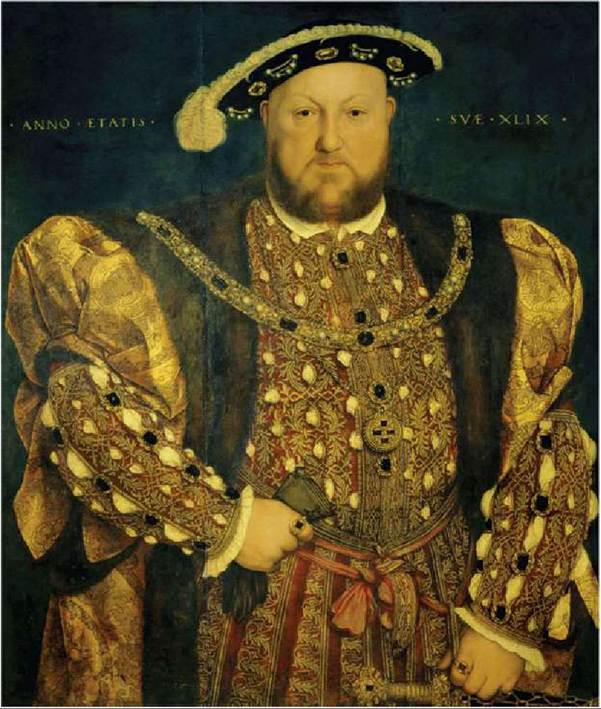
The Reformation was brought to England by King Henry VIII, depicted here in a famous portrait by the sixteenth-century painter Hans Holbein the Younger.
Alongside the Lutheran, Calvinist, and Zwinglian movements emerged smaller, more radical groups that make up what some scholars call the Radical Reformation. Anabaptists (“rebaptizers”) insisted that Christians baptized as infants must be “born again” and baptized again as mature believers. Refusing to recognize the authority of civil governments and their laws, Anabaptists refused to take oaths and were committed to nonviolence. Other radical groups placed such great importance on the inner presence of the Holy Spirit that they saw little value in the Bible or traditional worship. Still others rejected doctrines as basic as the Trinity and the divinity of Christ.
In England, the Reformation began when the pope refused the request of King Henry VIII (r. 1509-1547) for an annulment of his marriage. Taking matters into his own hands, Henry prevailed upon Parliament to pass an Act of Supremacy (1534) that made the king of England, not the pope, the head of the Church in England. This break marked the beginning of the Church of England and of an Anglican tradition that was later exported to England’s colonies. In America, the Anglican Church, as it is sometimes called, came to be known as the Episcopal Church.
Although Henry had wanted to effect only political change, the Church of England soon felt the impact of Protestant thought on the Continent. In the end, a kind of compromise was reached that left the Church of England very “Catholic” in its theology and patterns of worship but clearly influenced by elements of Calvinist and Lutheran theology. Although this arrangement satisfied most Anglicans, there were important groups of dissenters. Calvinist Puritans wanted to “purify” the Church of England of every vestige of Catholicism. Presbyterians, also inspired by Calvinism, wanted to replace the episcopal hierarchy with assemblies of presbyters (“elders”). Quakers rejected all formal worship and all forms of church governance.
The Catholic Reformation
The primary response of the Roman Catholic Church to Protestantism was the Council of Trent (1545-1563), which reaffirmed Catholic teachings but took great care to clarify them. Against Protestant belief in the authority of scripture alone, the council held that tradition is equally authoritative. Against the Protestant reduction of the sacraments to baptism and the Eucharist, it reaffirmed the seven sacraments. In response to the Protestant doctrine of justification by faith, the council insisted that faith must be expressed by good works and cited the New Testament in support of this view (e.g., Romans 2:6; 2 Corinthians 5:10). The council also upheld transubstantiation, confession, priestly celibacy, monasticism, purgatory, and the intercession of saints in heaven on behalf of the living. Although it gave no ground to
Protestantism on doctrinal issues, the Council of Trent did take decisive action to end corruption in the Church, to improve the quality of education received by priests, and to ensure that essential doctrines were made clear in the sermons, or homilies, that were a part of the Mass.
How have reformers and reform movements influenced the development of other religions?
Although the Council of Trent left Catholics and Protestants divided, its reforms and clarification of doctrine did reinvigorate the Roman Catholic Church, especially in its efforts to spread the faith. New religious orders such as the Jesuits, founded by Ignatius Loyola (1491- 1556), spearheaded the effort to reestablish Catholicism in lands where Protestantism had become popular and to bring Christianity to parts of the world where it had never been known, including China, Japan, India, the Philippines, and Latin America.
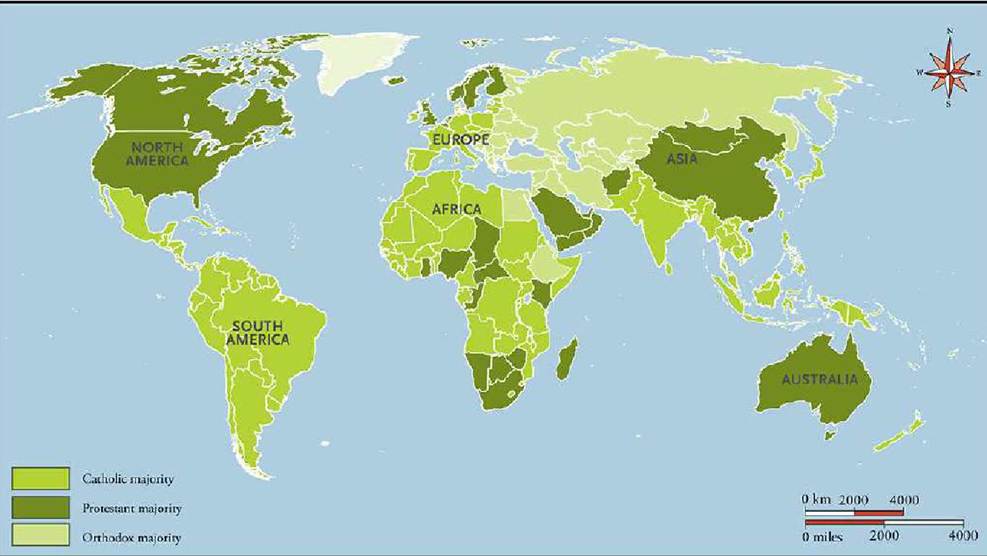
Distribution of major branches of Christianity throughout the world.
Christianity in the Modern World
The Reformation was only the first challenge faced by Christianity in the modern era.
Dramatic scientific, social, political, and intellectual developments also required the Church to respond to a changing world.
As early as the Reformation era, a scientific revolution was beginning to transform the traditional understanding of the universe. For centuries, the Church had endorsed the widespread belief that the universe revolves around Earth—and therefore around humanity, the supreme object of God’s love. But this view was abandoned after Nicholas Copernicus (1473-1543) and Galileo Galilei (1564-1642) proved that Earth and other planets revolve around the sun. When Isaac Newton (1642-1727) demonstrated that the universe operates according to laws of nature not found in scripture, science seemed to make the Bible unnecessary to understanding the physical world. The new scientific approach also undermined old ideas about human beings. Charles Darwin’s On the Origin of Species (1859) challenged the biblical account of the creation of humanity. Later, the work of Sigmund Freud (1856-1939) and the French sociologist Emile Durkheim (1858-1917) suggested that religion did not originate with divine revelation but in the maladjusted psyche or out of a need to create order in society.
The scientific revolution was encouraged by growing confidence in the power of human reason. This was especially evident in the Enlightenment, a philosophical movement of the eighteenth century. Encouraged by Newton’s description of nature as entirely rational, Enlightenment thinkers such as Voltaire (1694-1778), Jean-Jacques Rousseau (1712-1778), and Immanuel Kant (1724-1804) believed the way to all truth was through study of the world around us. Unwilling to accept as true any idea that could not stand up under rational scrutiny, they rejected traditional Christianity except for belief in God, whose existence seemed to be implied by the orderliness of nature, and ethical ideals such as honesty and kindness to others.
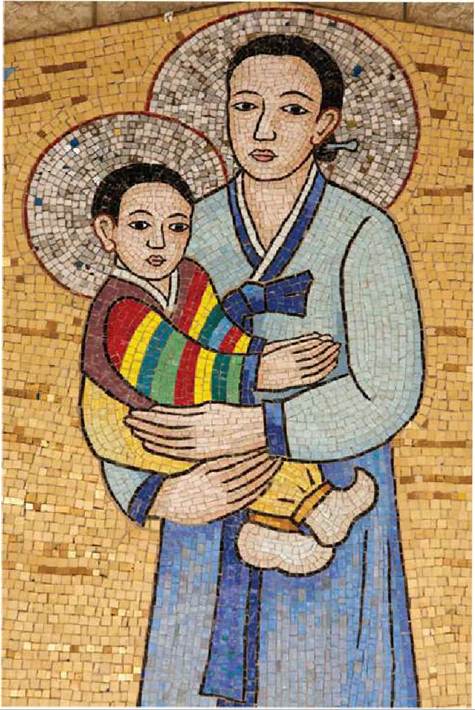
This mosaic of the Virgin Mary and Christ Child is from the Annunciation Basilica in Nazareth, Israel. It is a wonderful example of the desire of Christians all over the world to understand Jesus in relation to themselves and their own cultures.
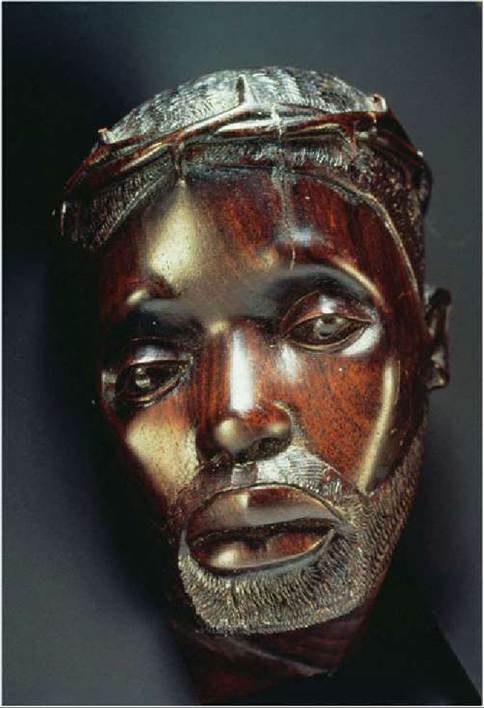
In this wood carving from West Africa, an anonymous twentieth-century artist portrays Jesus as African and manages to capture the sorrow and suffering of the savior, who was about to face crucifixion.
In the nineteenth century, Christianity felt the effects of liberalism and secularism. Nineteenth-century liberalism held that human beings can create an ideal society if they have the freedom to think and act without interference. For this reason, liberals called for limits on the influence of both church and state. Many liberals found it difficult to reconcile Christian beliefs about the sinfulness of human nature and the revelation of truth in scripture with their own views concerning the essential goodness of human beings and the importance of independent thought. Moreover, the progress of democracy across Europe in the nineteenth century brought the implementation of liberal policies that promoted secularism—the belief that religious ideas and institutions should have much less influence in the operation of the state, and especially in public education. The American ideal of the separation of church and state is just one example of this new attitude toward the place of religion in society.
The Missionary Movement
Despite the challenges posed by modem thought and culture, the geographical scope of Christianity grew dramatically in the modem era as European colonial powers expanded their influence into other continents. Most Westerners brought to foreign lands a belief in the superiority of their own culture and the conviction that they had a moral obligation to share its benefits, including Christianity, with the peoples they found there. As the British poet Rudyard Kipling (1865-1936) put it, “the white man’s burden” was to civilize the world’s “lesser breeds.” Regrettably, the “civilizing” of non-Christians sometimes involved conversions accomplished through intimidation or outright force by colonizers.
Roman Catholicism in the Modern World
The Roman Catholic Church adapted slowly to the new realities of the modern era. Shaken by the Protestant Reformation and intent on resisting modern influences, it maintained the defensive posture adopted at the Council of Trent until the middle of the twentieth century.
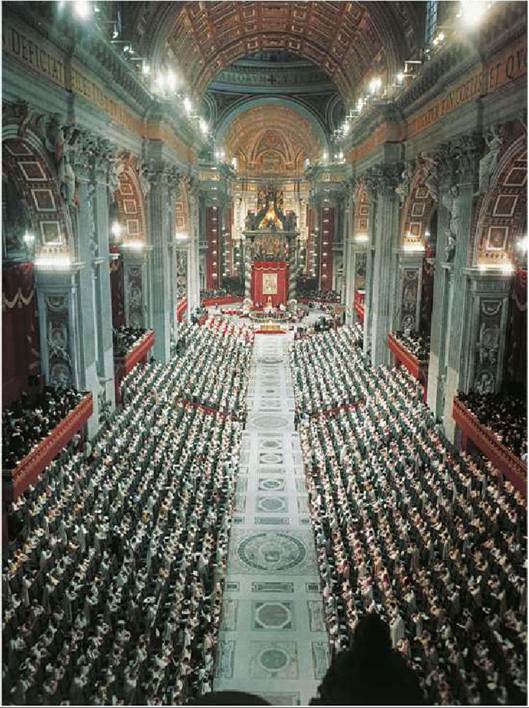
Bishops gathered at the Second Vatican Council (1962-1965) in St. Peter’s Basilica.
Perhaps the greatest challenge faced by Catholicism was secularization. In France, the Emperor Napoleon (r. 1804-1815) stripped the Church of the authority it had enjoyed for centuries over important aspects of public life. Marriage and divorce became civil procedures, and responsibility for education was assumed by the state, which promoted its own ideals in public schools. In Germany, the state seized vast tracts of land from bishops and monasteries and made priests public employees. Disturbed by the loyalty of German Catholics to Rome, Chancellor Otto von Bismarck launched an all-out attack on Catholicism known as the Kulturkampf (“struggle for civilization”) in the 1870s.
During these difficult years, Catholics turned to Rome for decisive leadership. Intent on providing it, nineteenth-century popes asserted their spiritual authority even as their influence in secular affairs rapidly eroded. This trend culminated under Pius IX, whose Syllabus of Errors (1864) urged Catholics to reject modem evils such as civil marriage, separation of church and state, public education, and Marxism. The climax of Pius IX’s reign came with the First Vatican Council (1869-1870), which increased the power of the papacy by proclaiming a doctrine of papal infallibility. According to this doctrine, the pope cannot err when defining doctrines relating to faith and morals.
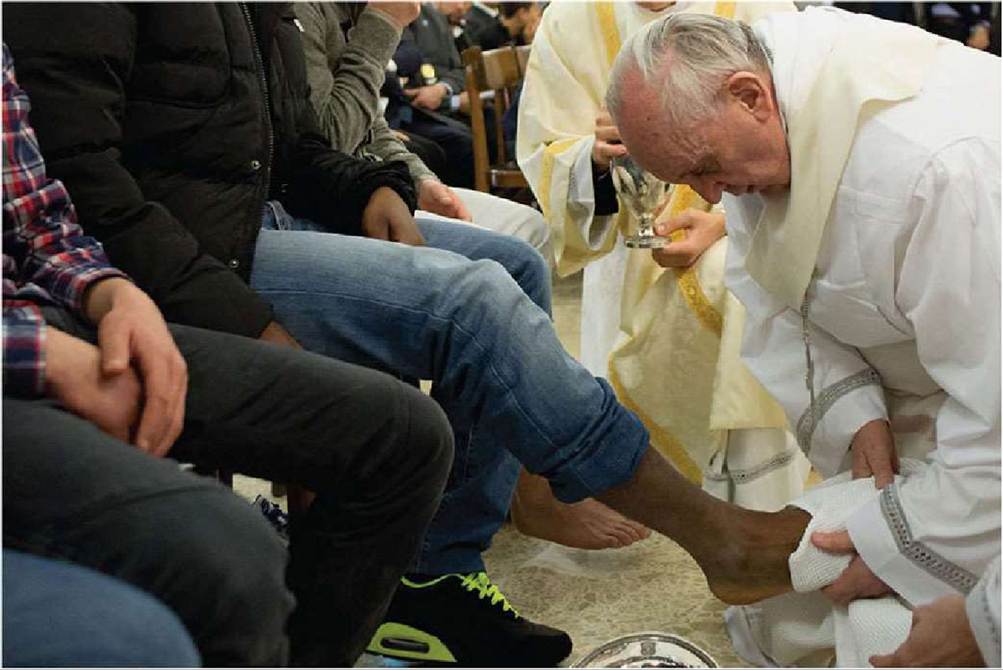
Pope Francis washed the feet of a dozen inmates, including women and Muslims, at a juvenile detention center in a Holy Thursday ritual during the first year of his papacy. Francis’s boldly inclusive gesture just two weeks after his election helped define his papacy.
Later popes upheld Pius IX’s conception of papal authority but also attempted to address modernity in constructive ways. Leo XIII (r. 1878-1903), for example, decried the social inequities created by capitalism and industrialization and outlined principles by which justice might be achieved.
A major turning point came when John XXIII convened the Second Vatican Council (1962- 1965), which called for recognition of the realities of modern culture. Vatican II urged an openness to dialogue with non-Catholic Christians and described the “high regard” of the Roman Catholic Church for other religions. It also reformed Catholic worship by requiring celebration of the Mass in modern languages instead of Latin and allowing laypeople greater participation in worship. Moving away from the traditional tendency to set the clergy above laypeople, the council emphasized the equality of the faithful. Since Vatican II, the Roman Catholic Church has continued to make its relevance apparent in the modern world while at the same time holding fast to tradition. Thus, Pope John Paul II (r. 1978-2005) was a driving force in bringing about the collapse of communism in eastern Europe at the end of the twentieth century but made no concessions to Catholics who urged a greater role for women in the Church and an end to its stand against birth control.
Pope Francis (r. 2013-) has canonized both John XXIII and John Paul II as saints. A former Archbishop of Buenos Aires, Francis upholds traditional Roman Catholic teachings against abortion, contraception, and gay marriage, but he has also set an extraordinary example in his humility and has called upon all Christians to join him in service to all who are poor and marginalized.
Protestantism in the Modern World
From the beginning, Protestantism encouraged Christians to read and interpret the Bible for themselves. It also resisted the creation of any central authority capable of imposing uniformity of belief and practice. As a result, the number of Protestant denominations grew rapidly. Today, the world’s 600 million Protestant Christians belong to thousands of groups. In the United States, the largest Protestant denominations are the Baptist, Methodist, Lutheran, Presbyterian, and Reformed churches.
Despite their many differences, most Protestants share basic doctrines that go back to the Reformation. Following Luther, they believe that salvation from sin is based on faith alone. They regard the Bible as the only authoritative source of revealed truth. Finally, Protestantism allows for diverse forms of church government that give great authority to laypeople and individual congregations.
Since the early 1800s, liberalism and liberal theology have had a significant influence on older and larger Protestant denominations. Interpreting Christianity in the light of modern culture, liberal Protestants have questioned the doctrine of original sin, asked whether a loving God would allow even the worst sinners to suffer in hell, and emphasized the human element in the composition of the scriptures. Embracing the liberal idea that the essential goodness of human beings makes progress toward a better world possible, they have advocated social activism based on the teachings of Jesus as a means of making the kingdom of God a reality.
At the other end of the Protestant spectrum are three important conservative movements: fundamentalism, evangelicalism, and Pentecostalism.
Fundamentalism emerged in the early 1900s as a reaction against liberal theology, the theory of evolution, the academic study of the Bible, and other features of modem culture that conservatives found threatening. The movement takes its name from The Fundamentals, a series of booklets that identified five doctrines essential to Christianity: (1) the literal inerrancy of the Bible, (2) the divinity and virgin birth of Christ, (3) Christ’s atonement for human sin on the cross, (4) the bodily resurrection of Christ, and (5) the imminent Second Coming of Christ. Seeking to defend these doctrines, leaders such as the television evangelist Jerry Falwell made fundamentalism a powerful force in American culture in the 1970s and 1980s. Fundamentalists also fought to defend what they called "traditional values” against feminism, gay rights, legalized abortion, and the elimination of prayer in public schools.
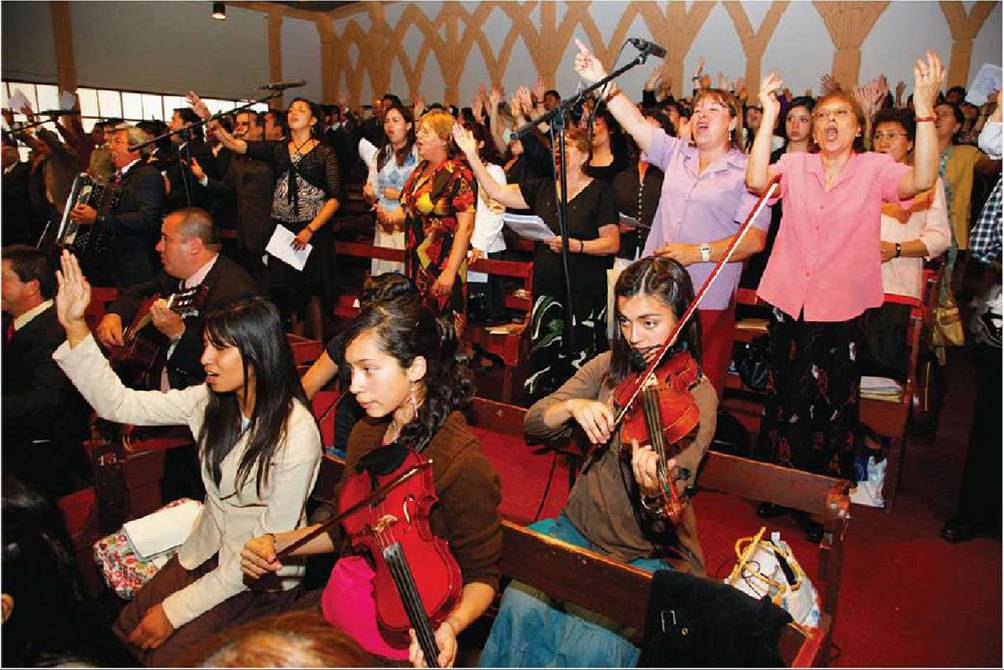
Pentecostal worship at the Catedral Evangelica de Chile in Santiago, Chile.
Fundamentalism grew out of evangelicalism, a much larger movement with roots in the “Great Awakening,” a revival of religious fervor that swept through England and North America in the eighteenth century. As its name suggests, evangelicalism encourages the preaching and sharing of the gospel (Greek evangelion). It also emphasizes the need for every Christian to have a conversion experience, often described as being “bom again” (John 3:3), which leads to a personal relationship with Jesus Christ. Evangelicals regard the Bible as the sole basis of faith, though they do not always insist on its literal interpretation. Like fundamentalists, many evangelicals believe that the end of the age and Second Coming of Christ will occur in the near future. Evangelicalism is a fast-growing worldwide movement that is making its presence felt both in older Protestant denominations and in new movements. It has become a major force in Africa and Asia and is particularly strong in North America. Evangelicals make up as much as one-fourth of the population of the United States,7 where they have promoted the idea that America is an essentially Christian nation. They have had considerable success in applying their understanding of biblical principles to politics and public policy.
Pentecostalism takes its name from the holy day of Pentecost, which commemorates the descent of the Holy Spirit upon Jesus’s followers after his ascension to heaven. According to Acts 1:1-4, these Spirit-filled believers were empowered to “speak in other tongues,” to prophesy, and to perform healings in the name of Christ. Since its beginnings in America in the early twentieth century, the Pentecostal movement has sought to reclaim this feature of earliest Christianity. Its most essential belief is that conversion must be followed by a “baptism in the Spirit” made evident by an ability to speak in tongues and at least one of the other “spiritual gifts” described by Paul in 1 Corinthians 12-14. The belief that the ecstatic experience of God belongs at the center of Christian life is unmistakable in Pentecostal churches, where enthusiastic worshipers raise their arms in praise, speak in tongues, and sometimes dance or weep. The phenomenal growth of Pentecostalism during the last century has made it a major force in contemporary Christianity throughout the world. Today, Pentecostalism is the most popular form of Protestantism in Latin America, and it is rapidly gaining converts in Africa and Asia. In America, the most visible Pentecostal denominations include the Assemblies of God, the Church of God, and the Church of the Foursquare Gospel.
Orthodoxy in the Modern World
We saw earlier that the Ottoman Turks completed their conquest of the Byzantine Empire, the home of Orthodox Christianity, with their capture of Constantinople in 1453. The Muslim rulers of the Ottoman state tolerated the Orthodox Church, but they also brought it under government control. When Greeks, Bulgarians, Serbs, and other Orthodox peoples began declaring their independence from the declining Ottoman Empire in the 1800s, they established independent national churches. Today’s 225 million Orthodox Christians belong to fifteen autonomous churches, including the Orthodox churches of Greece and Russia and the Orthodox Church in America. The Ecumenical Patriarch of Constantinople retains an honorary primacy among Orthodox bishops but has no real authority over them. Despite this, the Orthodox churches are united by a tradition of shared theology and forms of worship they trace back to the apostles.
Orthodox Christianity resisted the influence of Western rationalism and liberalism in the eighteenth and nineteenth centuries. But Western influence in the form of Marxism had a devastating effect on Orthodoxy after the Bolshevik Revolution in Russia (1917) and the creation of a bloc of communist states in eastern Europe after World War IL Because these states saw all religion as an obstacle to the achievement of their social and political goals, they took drastic measures to strip the Church of its influence. Priests and monks were imprisoned, seminaries were closed, and church property was seized. The collapse of communism in the early 1990s brought a restoration of religious freedom and the revival of Orthodoxy. Since then, a dramatic rise in church attendance has testified to the commitment of millions of Russians, Ukrainians, Georgians, Bulgarians, Romanians, and Serbs to Orthodox Christianity.
GLOBAL SNAPSHOT
The Kimbanguist Church in Africa
Although Europeans had traded with Africa since ancient times, it was not until the late 1700s that they began to explore the African continent. By 1900, Europe’s colonial powers had brought most of Africa under their control, and missionaries had established European forms of Christianity that flourished until the post-World War II era. By then, African peoples had begun to declare their political independence and to develop their own Christian traditions.
Today, there is an astonishing variety in African Christianity. Ancient churches continue to thrive in Egypt, Ethiopia, and Eritrea, but most of Africa’s nearly 12,000 denominations are of recent origin and were founded by Africans. Some of these African Initiated Churches (AICs) blend indigenous religions with Christianity. Some are messianic, emphasizing the Christ-like qualities of their leaders. Many are Pentecostal churches that emphasize the power of prayer and the Holy Spirit, as do Pentecostal churches elsewhere, but have a distinctively African character.
One of the largest AICs is the Church of Jesus Christ on Earth Through His Special Envoy Simon Kimbangu. The Kimbanguist Church was founded in 1921 in what is now the Democratic Republic of the Congo by Simon Kimbangu, a charismatic preacher and healer whose miracles included the revival of a child who had died. Kimbangu was imprisoned for life by the Congo’s Belgian rulers who were worried by the thousands who flocked to him for healing, but his movement continued to grow, encouraged by stories of Kimbangu’s bodily appearances to followers even while remaining in prison.
Although the Kimbanguist Church embraces features of traditional Christianity, such as the Apostles’ Creed and a commitment to providing social and educational services, it radically redefines others. For example, it identifies Simon Kimbangu as the Holy Spirit, his first son as God the Father, and his second son as a reincarnation of Jesus Christ. Like his grandfather, Father Simon Kimbangu Kiangani, the current leader of the Kimbanguist Church is the Holy Spirit in human form.
Like other AICs, the Kimbanguist Church attests both to the enduring appeal of Christianity and its adaptability to the needs and aspirations of particular groups.

Kimbanguists holding bowls of money intended as an offering to Simon Kimbangu Kiangani, the current leader of the Kimbanguist Church, in Nkamba, Democratic Republic of Congo, the birthplace of Simon Kimbangu (May 2017).
Self-Assessment 12.2
[Please note: You must be using an online, browser-based eReader in order to view this content.]
More on the topic The History of Christianity:
- The Cognitive (R)evolution: The End?
- Bibliography
- The History of Jainism
- Situating the Igu in the Nani Initaya Religious Movement of the Idu Mishmis
- Nigeria: mission ahead of empire
- Somalia
- The emergence of a materialist conception of law
- CONCLUDING REFLECTIONS
- HR&CE (Hindu Religious and Charitable Endowments Department) and Traditional Community Rights over Folk Temple
- Buddhist Violence in Sri Lanka, Myanmar, Bhutan and Tibet