Beginning of the Golden Age
The century following Prince Volodimers groundbreaking reign would witness a true golden age for Kyiv, with a rapid growth of civilization in Rus. The progress was based largely on trade and craftsmanship, which began to develop in the towns and cities, much of it made possible by the artisanship and technology brought from Constantinople and other parts of the Eastern Roman Empire.
This was in sharp contrast to the rest of Europe, then deeply immersed in the feudal Dark Ages. Kyivbecame a great metropolis easily surpassing other European cities such as Paris or London. The political unity under a single Great Prince, however, would not last just as it failed following Sviatoslav’s death. Adopting Christianity did not end armed conflict amongst the members of the Rurik dynasty and in the absence of an established (and unambiguous) rule of succession as prevailed in western Europe only victory in battle would lead to the highest throne of Kyiv. Such trial by combat was also common in the settling of personal disputes and Victorywould be seen as a sign from God.The lifeblood of the economy of Rus was the east-west and north-south trade, which encouraged the beginnings of art, industry, and a greater knowledge of the surrounding world as learning became valued.
He (the Grand Prince Iaroslav) applied himself to books and read them continually day and night. He assembled many scribes and translated from Greek to Slavic. He (his scribes) wrote and collected many books. For great is the profit from booklearning.... From the words of books we attain wisdom and continence. Books are like rivers that water the whole earth; they are the springs of wisdom. Forbooks have an immeasurable depth.37
And from Metropolitan Ilarion of the Church: “We do not write for the ignorant, but for them that have feasted to fulfillment on the sweetness of books.”38
The flowering of Kyiv’s culture, however, would have to wait until Volodimer s sons settled their scores.
No firm rules had been laid down for the succession to the throne and now history began to repeat itself when one of the oldest sons, Svi- atopolk the Damned, decided to usurp power. He was already in Kyivwhen his father died, having been released from prison some time before. His approach to princedom was to assassinate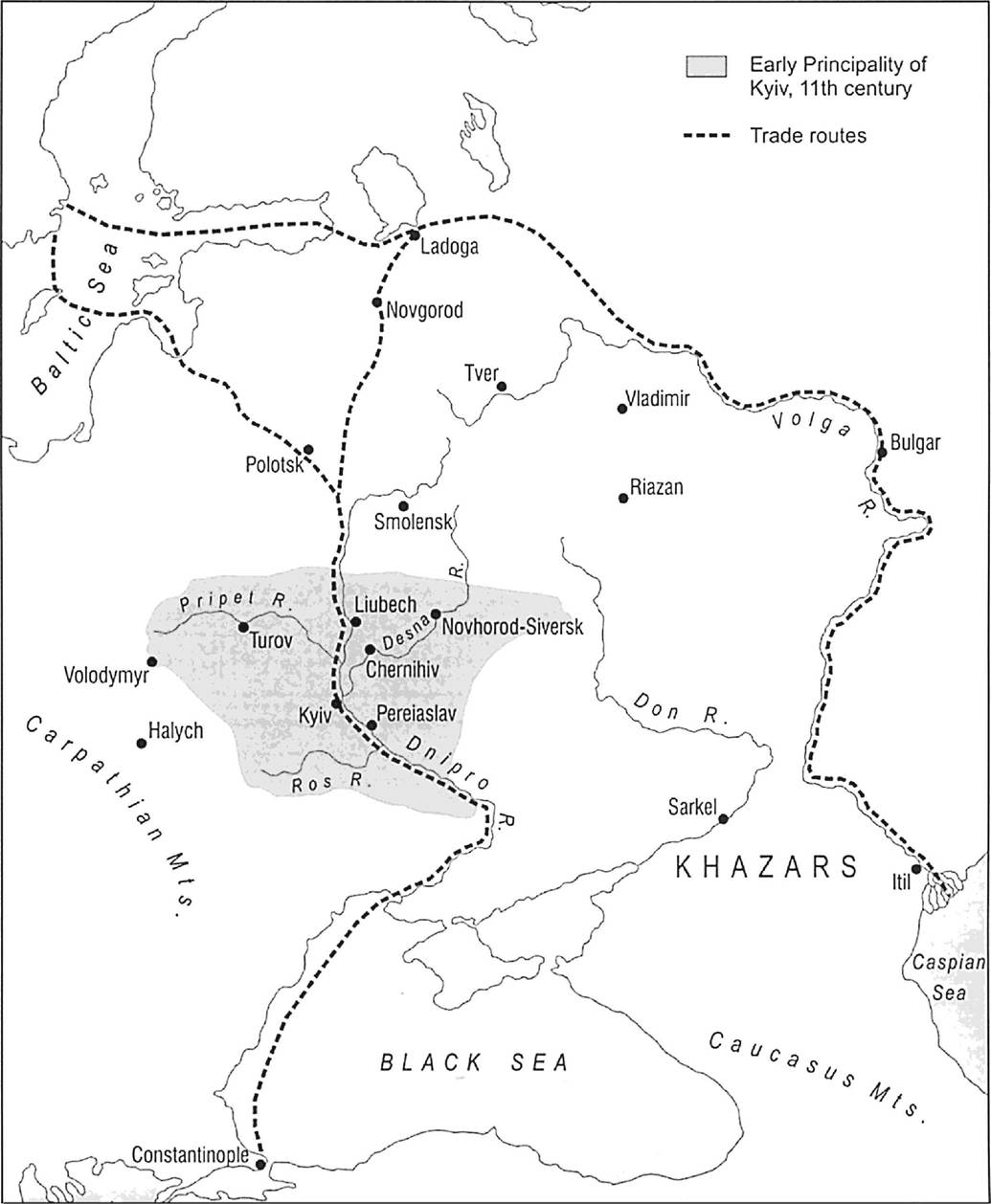
The territory of medieval Rus as indicated in medieval chronicles. It consisted of today’s north-central Ukraine and southern Belarus. The precise boundaries are not known.
as many of his (half) brothers as he could. His first victims were the two youngest brothers Boris and Gled, sons of Prince Volodimer s Bulgarian mistress (and like their father soon to become canonized as saints of the Orthodox Church of Rus). Volodimer had appointed his religious son Boris to lead an expedition of his army into the steppes against the Pechenegs, and upon hearing of his fathers death he began to head back to Kyiv. He halted at the Alta River some 40 km southeast of Kyiv and refused to unseat Sviatopolk from the throne, which prompted Volodimer s men to go over to the older brother’s side. Not content with his newfound support Sviatopolk decided to have his half-brother killed. The boyars who were sent with their men to assassinate Boris found him deep in prayer, and allowing him to finish his matins they stabbed him with their spears, together with the loyal Hungarian servant who had tried to shield Boris with his body. When they brought Boris to Kyiv it was discovered that he was still alive, and Sviatopolk ordered a Varangian to finish the job; he thrust his sword through Boris’ heart. Next, his brother Gleb, the youngest of Volodimers twelve male offspring, was intercepted by Svia- topolk s men, also on his way to Kyiv. Following his brother s example, Gleb also refused to defend himself, and when Svi- atopolk s men came to get him he was stabbed to death by his own cook.
Sviatopolk s last victim seems to have been their halfbrother Sviatoslavwho was killed while trying to escape to Hungary. Sviatopolkwas now master of Kyiv, and to gain the support of the citizens he began to squander large sums on gifts and bribes.Sviatopolk, however, had one last obstacle to overcome, his 37-year-older and lame brother Iaroslavwho was assigned as Prince of Novgorod by his father. Sviatopolk and Iaroslav had defied their father shortly before his death and now they declared war on each other for the throne of Kyiv. At first things did not go well for Iaroslav as described by the Kyiv Primary Chronicle:
While Iaroslav had not yet heard of his father’s death, he had many Varangians under his command, and they offered violence to the inhabitants of Novgorod and to their wives. The men of Novgorod then rose and killed the Varangians in their courtyard. Iaroslav was angry and departed to Rakom.... Then he sent messengers to Novgorod... (and) summoned before him the chief men of the citywho had massacred the Varangians, and craftily killed them. The same night news came from Kyiv sent by his sister Predslava... that his father was dead, that Sviatopolkhad settled in Kyiv after killing Boris and Gleb.... When Iaroslav heard these tidings he grieved for his father and his druzhina.
This treachery notwithstanding, Iaroslav called a meeting of the “Veche” informing the citizens of the state of affairs. “Then the men of Novgorod said tWe can still fight for you, oh Prince, even though our brethren are slain.’ So Iaroslav collected one thousand Varangians and 40,000 other soldiers and marched against Sviatop oik.”39
On hearing that his brother had set out against him, Svi- atopolk assembled a force of Rusians and Pechenegs and began to march north along the Dnipro River to intercept Iaroslav s men. The two armies met on opposite banks of the river at Li- ubech and for several months neither side dared to make the first move.
Sviatopolks men, however, had camped between two lakes to protect their flanks, and due to the limited space the Pechenegs were forced to pitch camp across one of the lakes. Winter was setting in and Iaroslav finally decided to cross the river and give battle. As the two armies faced each other Svi- atopolk realized he was cut off from his Pecheneg cavalry and now had no choice but to stand his ground between the two lakes and fight. Iaroslavwas also determined to fight and once they had crossed ordered that his men’s’ retreat be cut off by having all boats pushed out into the running river. Drawing up in battle formations, the two armies advanced and “the carnage was terrible,” as recorded in the Kyiv Chronicle. As the battle progressed, Sviatopolks men began to give way and pressed onto the thin ice of the lakes, which was unable to support the weight of the armed men. Many of Sviatop oik’s men drowned and Iaroslav carried the day. Sviatopolk managed to save his personal druzhina and flee to seek refuge with his father-in-law, King Boleslav of Poland.Sviatopolk did not give up the struggle, and after a year had passed he was ready to return this time with “a Liakh army” led by Boleslav. On hearing of the advancing enemy, Iaroslav gathered “a force of Rusins, Slavs, and Varangians” and set out to meet Boleslav on the shores of the Buh River. This time Iaroslavwould suffer defeat as recounted by the Kyiv Chronicle with some humor. Iaroslavs guardian and general, Bhudy by name, had decided to take a ride along the shore of the river when he spied Boleslav the Brave on the opposite bank. He could hardly have missed him for the Polish King “was big and heavy and could hardly sit on a horse.” Not able to resist the temptation, Bhudy shouted something to the effect that “we shall pierce your fat belly with a pike” as they were exchanging taunts. The unkind remark greatly offended the King, who, spurring his horse, shouted to his druzhina that if they didn’t follow him he intended to avenge the insult single-handedly.
Charging across the ford, and followed by his startled druzhina and then the entire army, Boleslav struck Iaroslav s troops who, unprepared for the onslaught, gave way and fled. Boleslav entered Kyiv unopposed while Iaroslav fled to Novgorod in the company of four trusted “drughs” (buddies) where he once again found himself dependent on Novgorod’s support. Now Sviatopolkhad the upper hand. Not only could he rely on Kyiv’s wealth to raise a force in Rus, he also had access to powerful allies—Boleslav’s Liakhs (Poles) and the Pecheneg cavalry.To raise a force that could oppose his brother’s, Iaroslav had a single option left to him: seek help in Scandinavia as his father had done. We know that an alliance was concluded with the King of Sweden, Olaf Skotkonung, which was finalized when Iaroslav married his daughter Ingigerd (Irene) in 1018. Now, as Iaroslav s army began to grow his brothers support was slipping away. Boleslavs men continued to loot Kyiv, and to maintain his support Sviatopolk turned on his father-in-law and began killing his men who were quartered in the city. Taking booty and hostages, including Iaroslav s two sisters, Boleslav fled to Poland with the rest of his men, and Iaropolkwas soon driven from Kyiv by his brother s forces which arrived shortly afterwards. Sviatopolk fled to the Pechenegs and concluded an alliance with the khans, who were always ready to fight Kyiv. The final battle was fought on the Alta River and after bitter fighting Iaroslav s men prevailed. Sviatopolk managed to flee and reportedly died of wounds somewhere in the Bohemian wilderness, but Iaroslav was not to rest in Kyiv for long before another challenge arose, this time from Polatsk, a principality ruled by Briachislav, whose father (Iaroslav s brother) had died before the whole conflict for succession began. Briachislav attacked and took Novgorod, returning to Polatsk and taking many of its citizens and a large booty. The situation was restored when Iaroslav intercepted and defeated Briachislav on the Su- doma River some 500 miles north of Kyiv.
Iaroslav had one brother left to contend with, Prince Mstislav of Tmutorokan, a city at the mouth of the Don River. Mstislavhad gained “slava” (renown, glory), by singlehandedly defeating the Kasogian (Circassian) Prince Rededia, as described in the Primary Chronicle.40
... Mstislavwho was in Tmutorokan, attacked the Kasogians.
When Rededia, Prince of the Kasogians heard the report he went forth against him and as both armies stood face to face, Rededia said to Mstislav, “Why do we destroy our forces by mutual warfare? Let us rather fight in single combat ourselves. If you win, you shall receive my property, my wife and my children, and my land. But if I win, I shall take all your possessions.” Then Mstislav assented to his proposal. Rededia then suggested that they should wrestle instead of fighting with weapons... and when they had wrestled for some time Mstislav began to tire, for Rede- dia was large and strong.
After asking the Mother of God for help, Mstislav threw Rededia to the ground and, drawing his knife, killed him. The struggle must have been hard-fought for Mstislav himself was no weakling, being described as "corpulent, red-faced with large eyes, bold in battle...” and referred to in later chronicles as The Fierce.” Having defeated Rededia, Mstislavbecame a prince of the Circassians as well, and (with the Khazars) emerged as the dominant ruler of the whole area from the eastern Crimea to the slopes of the Caucasus Mountains. Gathering a large army he marched on Kyiv to overthrow Iaroslav, but denied access by the citizens he left without a fight and established himself in Chernihiv, which together with Tmutorokan and its possessions became the capital of a large principality.
Iaroslav had not given up on his ambition to become the sole ruler of Rus, and once again he went for aid to Sweden and the colorful Haakon the Blind, who reputedly dressed himself in a robe woven from solid gold thread. Mstislavhad also gather his ""druzhina” and the Severiani tribesmen, and the two contenders met at Listven just north of Chernihiv.
At eventide Mstislav marshaled his troops, placing the Severiani in the center opposite the Varangians while he himself and his druzhina took up their position on the flanks. When night fell there was darkness with lightning, thunder and rain. Mstislav then ordered his followers to attack... and the Severiani in the center met the Varangians, who exhausted themselves in opposing them. Then Mstislav came up with his druzhina to attack the Varangians.... As the lightning flashed, the weapons gleamed and the thunder roared, and the fight was violent and fearsome. Now when Iaroslav saw that he was overpowered, he fled from the field with Haakon the Varangian prince, who lost his gold-woven robe in his flight. Iaroslav arrived safely in Novgorod, but Haakon departed beyond the sea.41
The colorful description of the fighting sounds personal and was probably written by a participant of the battle. It seems as if most of the dead were Varangians and the Severiani tribesmen, much to Mstislav s delight when he that his ""druzhina” had not suffered any casualties. Although victorious, Mstislav proved to be the more compromising of the two, offering his older brother a settlement; Iaroslav could keep Kyiv while he would retain Chernihiv as his seat. A formal treaty was signed in Horodets at the junction of the Dnipro and Dvina rivers, which divided Rus along the Dnipro, with Iaroslav receiving the west side and Mstislav the east.
With peace restored the two brothers could turn their attention to the expansion and control of trade routes, as well as the building of defensive towns and fortifications against the steppe nomads. First in 1030 Iaroslav marched west and captured Belz, in today s eastern Poland. The Finnish Chud tribes to the north and west of Lake Pskov (Peipus) were blocking the river routes to the Gulf of Finland and the Gulf of Riga. Iaroslav took a force north and attacked and defeated the Chuds, and to maintain a presence he founded the fortified city of Yurev on the west shore of Lake Pskov. The following year Boleslav the Brave of Poland died, and both Iaroslav and Mstislav launched a major campaign against Poland. They ravaged the countryside and took many captives who were brought back to Rus, and many were settled in garrison towns along the Ros River. Several years later while on a hunting trip Mstislav was thrown from his horse and killed. Since his son had also died a few years before, Iaroslav became the Great Prince of all Rus including Novgorod and the various tribal and conquered territories. Before assuming power as the Great Prince, Iaroslav took one last precaution. His younger and last half-brother Sud- islav was still alive, and Iaroslav had him imprisoned in Pskov ""because he was slanderously accused” as claimed by the Kyiv Chronicle, with Iaroslav believing the accusation. The charge is not mentioned and the fact he was imprisoned right after Mstislav s “accidental” death casts some doubt on Iaroslav s motives. He intended to rule alone and all was fair in war and in the struggle for power. With Gods help Sudislavwould spend 24 years in the dungeon, outliving all his brothers including Iaroslav. He was released in 1059 by Iaroslav,s sons after swearing “an oath of fealty,” and died as a monk in a monastery four years later. Only Polatsk, lying in an isolated area on the Dvina River halfway between Kyiv and Novgorod, remained under its own prince.
The Pechenegs continued to pose a threat, and while Iaroslavwas installing one of his sons, Volodimer, as Prince of Novgorod a large force attacked and surrounded Kyiv. After a forced march Iaroslav entered Kyiv through a defended gate, and resting his men he sortied from behind the walls to face the enemy. Placing the Varangians in the center, the men of Kyiv on the right and the men of Novgorod on the left, Iaroslav waited for the Pecheneg onslaught. The battle lasted the whole day, at the end of which Iaroslav gained the upper hand. The Pecheneg army was broken, suffering heavy casualties as they were pursued by Iaroslav s men, “while the remnant of them disappeared from that day to this.” The Battle of Kyiv was a great victory and the Pechenegs were never able to recover from the losses they had suffered that day. To be sure they already had been weakened by their confrontation with the Torks, another Turkic people who had begun to move into the Ukrainian steppe. With the Pecheneg threat gone Iaroslav once again turned his attention to the west and north, launching a second attack against the Lithuanians in 1040. The offensive followed a previous campaign against the Yatvigians and was intended to secure the Turov area and the towns along the Buh River. He had formed an alliance with his future brother-in-law Casimir of Poland, and in 1041 a naval expedition from Rus attacked the Mazovians in their lands between the Vistula and the Buh rivers. The Slavic tribe was defeated and their territory incorporated into King Casimir s kingdom. The whole area became secure for trade and ended the constant fighting between the Mazovians and the Yatvigians, Prussians and Lithuanians.
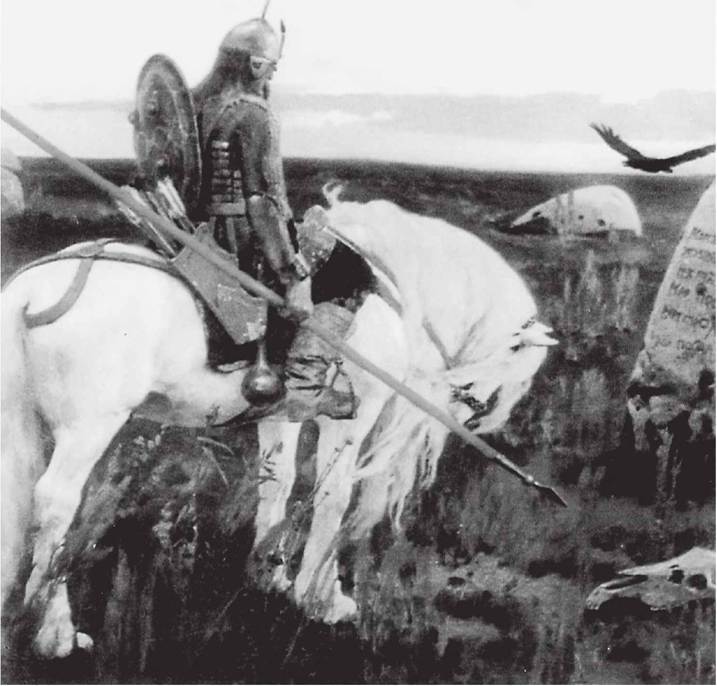
A 12th century man-at-arms from Kyiv-Rus on patrol of the Ukrainian steppe.
These major victories, however, were followed by a defeat on the Black Sea. Iaroslavs relations with Constantinople had worsened and the resentment burst into open conflict when a high-ranking Rusian was killed in a market brawl in Constantinople. A naval expedition from Rus was sent out, arriving before the capital in June 1043. Emperor Constantine IX had twice tried to negotiate a peace treaty and halt the looting but to no avail, and he now sent the Imperial triremes equipped with Greek fire against Iaroslav s fleet, which already had been damaged by a bad storm. Unable to withstand the imperial assault and suffering more losses, the Rusian ships disengaged from the combat and fled northward. Twenty- four heavy triremes were sent in pursuit but were counterattacked by the surviving Rusian vessels and dispersed with the loss of four of the triremes including that of the commander. Iaroslav s expeditionary force had been badly mauled and the CommanderVyshata decided to land his troops at Varna, rest his men and replenish supplies. They were met by the local commander and after a brief struggle were forced to surrender, with the loss of the booty and 800 prisoners which they had taken. Vyshata was also taken prisoner and would remain a captive for the next three years until he was released under a new alliance signed between Iaroslav and Constantine IX. Most of his men were blinded to prevent them from taking part in any future campaigns. Iaroslav s last expedition was to the west on behalf of King Casimir of Poland. In 1047 he attacked again the bog-dwelling Mazovians, killing their prince Maislav and placing them under Casimir’s rule.
Iaroslavhad begun an extensive building program in Kyiv, continuing and surpassing that of his father. It marked the high point of the city’s development, a rapid and planned growth with monumental architecture built under the supervision of skilled craftsmen brought from Constantinople. Adjacent to the southern defenses, a new fortified district of about 72 hectares was created, later to be known as Iaroslav s City. By the time of the Princes death, Kyiv s fortified area had grown to 41 acres with 2.1 miles of new fortifications consisting of earth ramparts 12-16 yards high and a base width of 25 yards. The walls consisted of oak timbers rammed into the ground with earth piled around to form the base, the upper part protruding as a palisade. The removal of the earth also produced a wide ditch, which hindered the scaling of the wooden walls and kept the enemy cavalry at a distance. According to calculations, it took approximately a thousand individuals four years to move the 630,000 cubic yards of earth and install the 50,000 cubic yards of timber.42 Iaroslav s and the earlier Volodimer s cities were linked by the Sophia Gate and three gate towers: the brick Golden Gate, modeled after a similar structure in Constantinople, and the main entrance to the city; the Lyadsky Gate; and the Jewish gate.43 Within the space surrounded by fortifications Iaroslav erected grand buildings with St. Sophia Cathedral forming the centerpiece. Built on the site of his great victory over the Pechenegs, it is still intact with some alterations. Its design was modeled on the great St. Sophia in Constantinople and built using the same techniques and material. Iaroslav also extended his father s outer defenses by establishing a line of fortifications and settlements along the Ros River some sixty miles to the south of the city.
An important part of the growth of civilization in Rus was the introduction of a written legal code by Iaroslav, the “Ruska Pravda” (“Justice of Rus”). Acontemporary version (Grekovs divisions) contains eighteen statutes due to Iaroslav and twenty- five to his sons. His father Volodimer the Great had introduced written general instructions of judicial Competencyfor clerical courts but the “Ruska Pravda” was the first legal document which dealt with civil and criminal matters.44 The publishing of written laws in Kyiv went hand-in-hand with the growth of centralized state authority, where legal sanction was no longer the sole responsibility of a tribal community. Iaroslav s code deals with individual homicide and violence, personal threats and private property. The first article deals with homicide.45
If a man kills a man the following relatives of the murdered man may avenge him: the brother is to avenge his brother; the son, his father; or the father, his son; and the son of the brother (of the murdered man) or the son of his sister (their respective uncles). If there is no avenger (the killer pays) 40 grivna wergeld. Be (the murdered man) a (Kyivan) Rusin—a palace guard, a merchant, an agent, or a sheriff—be he an Izgoi, or a (Novgorod) Slav, his wergeld is 40 grivna.46
Injuries and threats were also punishable by fines, including damage to a mustache or beard.
Article 3: If anyone hits another with a club, or a rod, or a fist, or a bowl, or a (drinking) horn, or the butt (of a tool or a vessel) and (the offender) evades being hit, he has to pay 12 grivna, and that ends the matter.
Article 4: If (anyone) strikes (another) with a sword without unsheathing it, or with the hilt of a sword, 12 grivna for the offense.
Article 7: Ifa finger is cut off, three grivna for the offense. Article 8: And for the moustache, 12 grivna; and for the beard,
12 grivna.
Article 9: He who unsheathes his sword, but does not strike, pays 1 grivna.
Article 10: If a man pulls a man toward himself or pushes him, three grivna, but (the offended man) has to bring two eyewitnesses; in case he is a Varangian, or a Kol- biag(?), an oath is to be taken.{∕ext}
More serious injuries, such as loss of an arm or a leg, carried stiffer fines and could invite retribution by kin. As with automobiles today, stealing someone’s means of transportation was a crime.
Article 12: If anyone rides another’s horse without asking the owner’s permission, he has to pay three grivna.
Article 13: Ifanyone takes another’s horse, or weapon, or clothes, and (the owner) identifies (the object) within his township, he receives it back and three grivna for the offense.
Slaves, however, were not covered and we do not know what “rights” they had, if any. Interestinglyunlike other Christian European states (including the Eastern Roman Empires) Iaroslavs code did not have provisions for capital punishment, which was abolished. Iaroslavs sons expanded the laws to include articles dealing with the murder of different types of individuals and theft, probably reflecting the arrival of a more violent period.
The issuing of the laws was a part of Iaroslav s respect for the written word and indicates Iiteracywas beginning to spread. Influenced by the high regard for education and learning in the Greek world, Iaroslav continued his father’s practice of translating books obtained from abroad, particularly from Bulgaria and the Graeco-Roman Empire. Education was encouraged and both males and females of the privileged classes had access to it. Monks translated from Greek and transcribed Bulgarian and Serbian Slavic books, for example the Lives of the Saints,
the Cosmology of Cosmas Indicopleustes, and Greek tales such as the War of Troy the Romance of Alexander and the tale of Barlaam and Josaphat (with its supposed Similarityto the life of Buddha). Chronicles were also collected and published in the “Izborniki” (Collections), a sort of encyclopedia of the time.47 Not wishing to be seen as a mere vassal of Constantinople, Iaroslavhad the bishops of Rus appoint in 1051 the native Ilarian as Metropolitan of Kyiv and all Rus. This caused a stir in the imperial capital since it was an agreed-upon rule that the Metropolitan was to be chosen by Constantinople. The breach would not be repeated for the next century following which the Grand Prince IziaslavMstislavich again had bishops of Rus appoint the monk Smoliatich as Metropolitan in 1147, even though the Church of Rus continued to remain a diocese of the Patriarch of Constantinople.
A written legal system was also important for the continued development of short and long distance trade and commerce that was making Kyiv and other cities of Rus and Novgorod wealthy. When one of Iaroslav s sons, Iziaslay fled to the court of the Western Roman Emperor Henry II following his father s death, the Germans were astonished at the amount of gold, silver and expensive cloth which he brought with him. The main indication of Iaroslavs European standing and the prestige of Rus was also the network of international marriages and alliances which he and members of his family entered into. Iaroslavhimselfhad married the daughter of the Swedish King Olaf Skotkonung in 1019, while his sister Maria became the wife of King Casimir of Poland. Most of his six sons and four daughters also married foreign rulers, or members of their families. His son Iziaslav married Casimir,s sister Gertrude, his other son Sviatoslav married a grand-niece of the Western Roman Emperor Henry III in 1052, and the 22-year-old Vsevolod married a member of the Roman Emperor Constantine Monomakhos, family (either his sister or a daughter).
There is no mention of the marriage arrangements of Iaroslav s four daughters in the Kyiv Chronicle, but we can reconstruct their marriages from other sources. One daughter, Elizabeth, married Prince Harold Hardrada who later became King of Norway, and later King Sven II of Denmark. While attacking England in 1066 he was killed by the Saxons at the battle of Stamford Bridge on September 25. The Saxons were led by King Harold II who himself was killed soon after by the Normans on October 14 at the Battle of Hastings when they invaded England. The Normans were led by Duke William of Normandy, a nephew of Iaroslav s daughter Anna who had married his uncle King Henry I of France. Henry I had heard of Annas beauty and learning, and had sent an envoy, Bishop Gautier Saveraux, to Kyiv to ask for Anna s hand. The second wife of the French king, she outlived her husband and became the regent for her young son Philip I. Her Slavonic Bible written in the Cyrillic script has been preserved as has an interesting document bearing Annas signature, “Ana Reinaf in Cyrillic. The French officials (as Henryhimself) were illiterate, and had signed the parchment with fancy Xs. The third daughter, Anastasia, married Prince Andrewwho later became King of Hungary.
The fate of Iaroslav s youngest, fourth daughter (as well as her name) has remained something of a mystery until the appearance of two recent publications.48 Her name was Agatha, and her identity is closely related to the Anglo-Saxon kings of England. King Ethelred the Readeless, who had halted Danish raids with large payments of gold, without any warning began to attack and kill Danes who were in England at the time. The slaughter brought a fresh Danish invasion in 1003 led by King Sweyn, and another in 1013. When Sweyn died a year later, his son Cnut defeated Ethelred s son Edmund II Ironside in 1016 at the battle of Assundun becoming King of England and Denmark, and in 1028 of Norway. To secure his position and to extinguish the Anglo-Saxon line of succession, Cnut had Edmunds brother murdered, exiling his two sons Edward age 11 and Edmund age 12 to Sweden. The boys had relatives in the Swedish court since Edmund Ironside had married a Swedish princess by the name of Eadgyth. The two brothers were also supposed to have been killed in secret once they reached Sweden but the sentence was never carried out. Instead, they were sent to Iaroslav,s court in Kyiv to their aunt Ingigerd (Irene) who was Prince Iaroslav s wife.
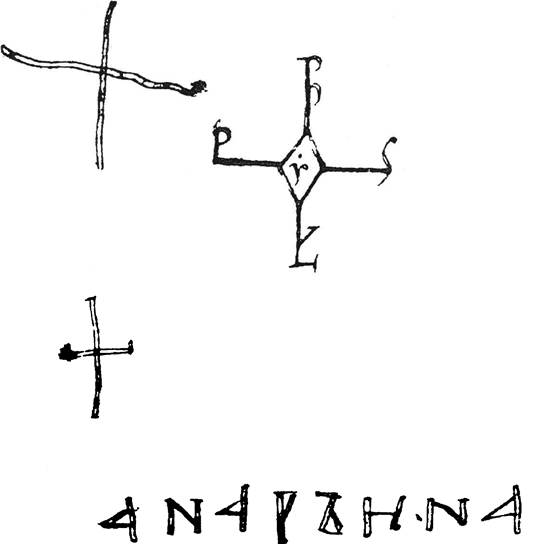
The signature of Anna (“Ana Reina”), daughter of Grand Prince Yaroslav the Wise of Kyiv-Rus, as it appears on an official French document of 1063. Anna’s husband King Phillip I of France was illiterate as were his statesmen, who “signed” with a personalized “X.” Princess Anna was literate in the Cyrillic, Greek, and Latin scripts and spoke several languages, having gone through the Kyiv educational system for the nobility.
Cnut died in 1035 at the age of 40 and was succeeded as King of England by his son Harthacnut. Before his death two years later Harthacnut summoned Edward from Normandy (the surviving son ofEthelred and Emma), recognized him as the legitimate heir to the English throne and in 1042 he became King Edward the Confessor of England. Back in Kyiv his younger 27-year-old brother Edward married Iaroslav s 18-year- old daughter Agatha in 1044, but returning to England he soon died, probably by poison. There is a passage in an old English document, the “Leges Edwardi Confessorisw (the Laws of Edward the Confessor), from about 1130, which acknowledges young Edward s connection with Rus.
Edward... in fear of King Canute fled to the land of the Rugi which we call Russeiam. The king of this land (was) Malesclodus by name... and this same Edward took there a wife of noble family and born to him was Edgar the Atheling and Margaret Queen of Scotland and Christina his sister.49
Princess Agatha s daughter Margaret married King Malcolm III (Canmore) of Scotland, who was a widower and attracted by Margaret s beauty, her learning, and sharp intellect as well as her piety. Being uncultivated and crude “he readily obeyed her wishes and prudent counsels in all things” according to Margaret s biographer Bishop Turgot. Her granddaughter Matilda married Geoffrey Plantagenet, and her son King Henry II (Richard the Lionheart s father) became England s first Plantagenet king. Margaret died three days after both her husband and eldest son Edward were killed on a raiding expedition in England on 16 November 1093. She became a saint of the Roman Catholic Church in 1249 and together with St. Andrew is a patron saint of Scotland.
Iaroslav the Wise, as he became known, died on 20 February 1054 at age 76 as one of the most powerful rulers in Europe. During his long reign he greatly enhanced his own reputation and influence and that of Rus, expanding his rule to almost 600 square miles. He also continued his father s policy of expanding trade, a program of urban development, as well as extending the southern defenses against the powerful nomad tribes of the steppe. He was awarded the title “The Wise” in recognition of his introduction of a set of uniform written laws, as well as implementing a policy of international alliances. As great as Iaroslav s achievements were, however, so was his major failing, the inability or unwillingness to establish a system of primogeniture by which only the oldest son of the Great Prince would succeed to the throne of Kyiv as the ruler of the entire domain. The failing would lead to perpetual warfare between brothers for the succession and prevent the emergence of a unified state.
More on the topic Beginning of the Golden Age:
- REMBRANDT HARMENSZOON VAN RIJN (l6θ6-l669) was the foremost artist of the Golden Age of Dutch painting and one of the most brilliant of all European artists.
- The Post-Keynesian Approach
- Chapter 8 The Cossacks
- The City of Glory
- THE EGYPTIAN AKH AND SAH
- The Sects of Hinduism
- CHAPTER ONE The New Jerusalem: Kiev