Socioeconomic Developments
While Lithuanians still lived within the perimeters of their traditional homeland along the Neman River valley and Baltic Sea coast, and before they were united into a political entity in the thirteenth century, their social structure was relatively simple.
Basically, three social strata existed: (i) tribal princes and their families, (2) freepersons organized into tribal units, and (3) slaves, people who originally had been prisoners of war. But during the reign of Grand Duke Gediminas in the early fourteenth century, when Lithuania was rapidly expanding its borders southward into Belarus and Ukraine, it came into contact with the more highly developed social structure on lands that had once been part of Kievan Rus’. The Lithuanian rulers left intact much of what they found in the Rus’ lands and only gradually developed a distinct social structure that took into consideration the needs of the new Lithuanian-Rus’ state while adopting for their own purposes both the older social system of Kievan Rus’ and the newer social relationships that were forming in neighboring Poland. By the sixteenth century, the outlines of the Lithuanian social structure were clear. It consisted of the following strata: the grand duke (Lithuanian: kunigas), hereditary princes and non-hereditary boyars (bajorai) and gentry, clergy, townspeople, Jews, and peasants.Lithuania’s social structure
While it is true that during the era of territorial expansion the Lithuanian grand dukes left intact much of the administrative and, in particular, Orthodox cultural and religious structure of Kievan Rus’, they began to superimpose their control on this vast territory in two ways. First, they recognized the inherited right to the large landed estates of the princes (kniazi), both the ducal princes descended from their own Gediminid dynasty and those of the Rus’ dynasty of Riuryk.
At the same time, they made huge land grants to those Lithuanian and Rus’ boyars who fought alongside them in their conquests. Despite the enormous wealth of these boyars, they, unlike the hereditary princes, enjoyed no immunity, either as individuals or as a social estate. Rather, in return for his land, each was bound by feudal obligations to the grand duke. Another group, with even fewer privileges than the boyars,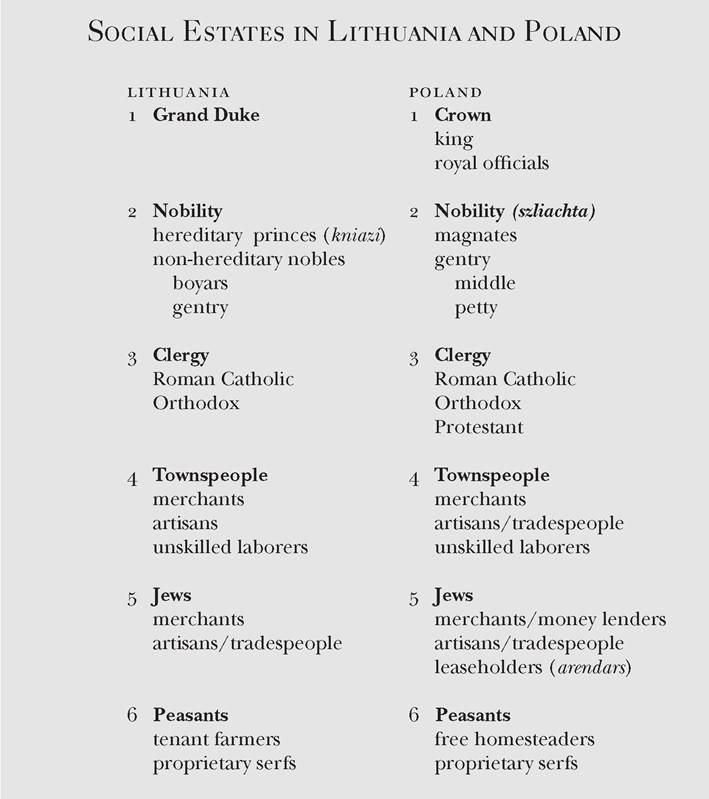
was of mixed origin and eventually came to be known as the gentry. This group consisted of small landholders who received their property as a result of military service performed for the grand duke or, in some cases, for the powerful hereditary princes and dukes.
The vast majority of the inhabitants were peasants, the descendants, from Kievan Rus’ times, of independent agriculturalists (ZZudf), cooperative landholders (siabry), and state peasants (smerdy). The principal trend in the evolution of the peasantry was its members’ loss of rights to their land; accordingly, by the end of the fifteenth century most were tenant farmers either on the crown lands of Lithuania’s grand duke or on the estates of the nobility.
Among the smallest of Lithuania’s social strata was that of the townspeople. They consisted of two subgroups, the merchants and the artisans, each of which had its own guild system. Both subgroups included a significant number of foreigners - Germans, Armenians, Jews - who had been invited by Lithuania’s grand dukes to settle in urban areas. In the sixteenth century, most cities in the Belarusan and Ukrainian lands of Lithuania had a Rus’ majority, but the Rus’ inhabitants were frequently discriminated against in favor of Roman Catholics and foreigners.
Unlike in the Kievan period, the cities of Lithuania declined in economic and political importance. And even though during the fifteenth and sixteenth centuries most cities were granted municipal self-government (the Magdeburg Law), they were excluded from any participation in the central government.
The cities did not even have a monopoly on trade, and as we shall see below, they were undercut by the economic activity of the nobility.Although Lithuania maintained only a tenuous political relationship with Poland in the fifteenth and sixteenth centuries, its social structure was steadily brought closer to that of its neighbor to the west. This became particularly evident in a strengthening of the status of the nobility - both boyars and gentry - and a concomitant weakening of the peasantry. As early as 1387, within a year of Jagiello’s coronation as king, the Lithuanian boyars were granted the rights and privileges of the Polish nobility. Then, according to the agreement at Horodlo (1413), the Lithuanian boyars and Polish nobles were merged into a single estate responsible for deciding the relationship between the two countries as well as for electing the grand duke. It was also at this time that the term boyary was replaced by the Polish term pany (lords) to describe the group. The Lithuanian lords also had the right to maintain their own military regiments, and after 1447 they became exempt from paying taxes. In this way, Lithuania’s princes and boyars were gradually being fused into a single estate of hereditary lords. During the reign of Grand Duke Vytautas (1392-1430), such privileges were given only to boyars of the Roman Catholic faith, but after 1434 they were extended to the Orthodox as well.
Lithuania’s administrative structure
In the course of the fifteenth century, the former Rus’ principalities were gradually replaced by palatinates (voievodstva), which in turn were divided into districts (povity). Unlike in Poland, where the nobility was the dominant political force at the palatinate level, in Lithuania the central government attempted to reduce the autonomy of the palatinates by replacing the local boyars with officials appointed by and directly responsible to the grand duke. These included (1) the governor of each palatinate, known as the voievoda, or palatine, who had administrative, military, and judicial authority; (2) the head of each district, known as the staiosta; and (3) the castellan, who was responsible for the maintenance of royal castles and other military fortifications as well as for summoning the local nobility to arms in times of danger.
Apart from his power of patronage in the appointment of palatines, district heads, and castellans, the political influence of the grand duke was enhanced by economic privileges, including income from the so-called grand ducal lands, revenue from various kinds of taxes, and, in particular, the exclusive right to sell salt and alcohol (the right of propinatsiia).While boyar influence may have been challenged at the local level by the centralizing administrative tendencies of the grand duke, in fact the driving force of Lithuania’s government - especially with regard to foreign affairs - was the Council of Lords (panska rada). The council consisted of the Roman Catholic bishop of Vilnius and the Lithuanian and Rus’ voievoda of each palatinate and starosta of certain districts. The council’s power over the legal structure of the country was institutionalized in 1529 (the First Lithuanian Statute), after which the grand duke pledged to keep intact all former laws and not to make any new ones without the consent of the council. The role of the gentry in Lithuanian sociopolitical life developed more slowly. It was not until the Union of Lublin (1569) that the Lithuanian and Rus’ gentry were freed from military and other feudal obligations and merged with the boyars in one noble estate (szlachta), as in Poland. Gentry political influence came somewhat earlier, since from the fifteenth century this group in Lithuania had its own district assemblies (seimyky).
The grand duchy’s legal system was strongly influenced by that of former Kievan Rus’. The Rus’ Law (Ruskaia Pravda) alongside customary law governed Lithuanian society until 1468, when Lithuania issued its own code (Sudebnik). Three new codes followed in the sixteenth century, each known as the Lithuanian Statute. The first edition (1529) emphasized the rights of the state and of the boyars and magnates, and the second (1564-66) and third (1588) editions reflected a gradual increase in privileges for the gentry as well as a decline in the legal status of the peasantry.
The continuing influence of Kievan Rus’ law was evident not only in the content of the Lithuanian codes, but in their form. The law codes, along with all other state documents, appeared in the grand duchy’s official state language, Ruthenian, which was essentially a Belarusan version of Church Slavonic written in the Cyrillic alphabet. It should also be noted that the Rus’ (Belarusans and Ukrainians) were considered alongside Lithuanians as the ruling groups in the grand duchy. Hence, the Second Lithuanian Statute (1566) specified that the grand duke could not appoint foreigners to offices of the state administration, but only native Lithuanians and Rus’.Despite its strong links to the Kievan past, by the second half of the fifteenth century Lithuania was more and more adapting to the societal model of Poland, which since the death of its last Piast ruler in 1370 itself had set out on a path that was to transform the country into an aristocratic democracy headed by an elected king. This process was a long one, lasting two centuries.
Poland’s social and administrative structure
Poland’s social structure consisted of several estates (Polish: stany). These are frequently confused with socioeconomic classes. Unlike classes in the modern sense, the estates in Polish society were defined on the basis not of a relationship to the means of production or any other measure of wealth or economic status, but of an intended function within society as expressed by specific legal rights and privileges. Accordingly, one can speak of six estates in fifteenth- and sixteenth-century Poland: the crown, the nobility, the clergy, the townspeople, the Jews, and the peasants. Membership in these estates was largely hereditary, and social mobility, while not impossible, was deliberately encumbered by complex legal difficulties. Again, wealth was not a determining factor. Hence, there may have been townspeople, Jews, even peasants who were richer than certain nobles, but with rare exceptions they were barred from entering the noble estate.
The crown estate consisted of the king and his officials, whether senators, ministers, territorial officers, or holders of royal monopolies. The role of the crown was to represent the unity of the realm, whether the Polish Kingdom alone or, through the person of the king, Poland in relationship with the Grand Duchy of Lithuania. After 1573, the king was the elected head of the Polish-Lithuanian Commonwealth. The crown’s authority was progressively restricted by concessions to the Polish nobility and the grand dukes of Lithuania as outlined in varying agreements reached between the late fourteenth and late sixteenth centuries (Kosice, 1374; Krewo, 1385; Horodlo, 1413; Lublin, 1569; the Henrican articles, 1573; and thereafter a pacta conventa with each newly elected king). Nonetheless, the king remained a significant force in Polish society. His political influence was based on the right to distribute offices - those of senator, palatine, castellan, star- osta, and military leader (hetman) - and royal lands. Moreover, the king’s symbolic importance remained intact, since until the very end of Poland’s existence in the second half of the eighteenth century there was never any questioning of the need for a crown estate and for a hereditary or, later, elective king to function at the head of the social structure.
The most influential estate in Poland was the nobility, or szlachta (pronounced shlakhta). Although there was only one estate of the nobility, all of whose members were equal before the law, in practice there existed great discrepancies with regard to the wealth, social prestige, and political influence of Poland’s nobles. Both contemporary and subsequent analyses of Polish society therefore divide the nobility into at least two groups: ( 1 ) the magnates, or heads of great families who, because of their extensive wealth, practically ran the affairs of the state; and (2) the gentry, who had limited wealth - in some cases they did not even own land (the non-pos- sessionati) - and who often served as clients of the great magnates. Writings on the subject sometimes classify the gentry as either the middle gentry or the petty gentry. The point is that, despite great disparities among the magnates, middle gentry, and petty gentry, all were recognized as part of one legal estate, the nobility or szlachta, and all shared equally the legal privileges of that estate. In a sense, the social history of Poland during the fifteenth and sixteenth centuries is the story of how the nobility succeeded in increasing its privileges vis-à-vis not only the crown, but also the church, the townspeople, and the peasants. The justification for the nobility’s privileges derived from its role as defenders of the realm against foreign invasion. In fact, the nobility did fill that role at least until the end of the sixteenth century, although thereafter the traditional call to arms in times of danger (pospolite ruszenie) was gradually replaced by a small permanent armed force supported by taxation.
Compared to that of other European countries at the time, the Polish nobility represented a relatively large proportion of the country’s population. Moreover, their absolute and relative numbers continued to grow. Whereas in 1569 there were about 500,000 nobles, representing 6.6 percent of the population in the Polish-Lithuanian Commonwealth, by 1648 the number had increased to one million, or 9 percent of the population. Of the nobles in 1648, an estimated 5,000 to 10,000 were magnates, and the remaining 900,000 or more were gentry.
The administrative structure of the country also reflected the needs of the influential noble estate. Poland was divided into palatinates (Polish: wojewodztwa), headed by the king’s representative, the palatine (wojewoda). But politically more important were the noble assemblies, or dietines (sejmiki), which formed the basic unit of constitutional life in Poland. There was a long tradition of noble assemblies, which originally were organized by the nobility for military purposes. The concept of permanent dietines was crystallized after 1454, when the king agreed neither to summon the army nor to raise taxes without consulting the nobility beforehand. Each palatinate had its own dietine, and from the dietines developed the idea of a single legislative institution, the central Diet (Sejm). Poland’s Diet met for the first time at 1493 in Piotrkow and, thereafter, once every two years for six-week sessions held mostly in Warsaw and (after 1569) in the Lithuanian town of Hrodna.
The Polish Diet was made up of two houses: (1) the Senate, consisting of Roman Catholic (never Orthodox) bishops, palatines, castellans, and major functionaries of the central government and, later, Lithuanian ministers of state, all appointed by the king mostly from the ranks of the magnates; and (2) the Chamber of Deputies (generally middle gentry), consisting of delegates chosen by the local dietines. Hence, with the development of the permanent diet, Poland acquired a governmental system marked by checks and balances among three interest groups - the king, the magnates, and the gentry. Until 1569, Poland and Lithuania each had its own Diet (Sejm/Soim), but after the agreements reached at Lublin, the nobles from both parts of the Commonwealth sat in one body.
In terms of procedure, the diet, like the dietines, was conducted on the principle of unanimity, a medieval practice that was never replaced by the more modern principal of majority vote. As will become evident in later periods, this antiquated principle on occasion degenerated into the infamous practice of the liberum veto, whereby the negative vote of a single member could, and sometimes did, bring all business to a standstill. But as long as the system of aristocratic parliamentarism worked, especially in the sixteenth and first half of the seventeenth centuries, Poland had a political structure characterized by a balance of power between three estates: the monarch, the magnates, and the gentry.
Peasants, nobles, and Jews
To ensure the continuance of their dominant role in the Polish socioeconomic structure, the nobility (magnates and gentry) encouraged changes in the legal system. They were particularly eager to regulate to their own advantage the status of the peasantry. The result was the implementation of what has come to be known as
MAP 14
LANDHOLDING PATTERNS IN POLISH-RULED UKRAINE, 1569-1648
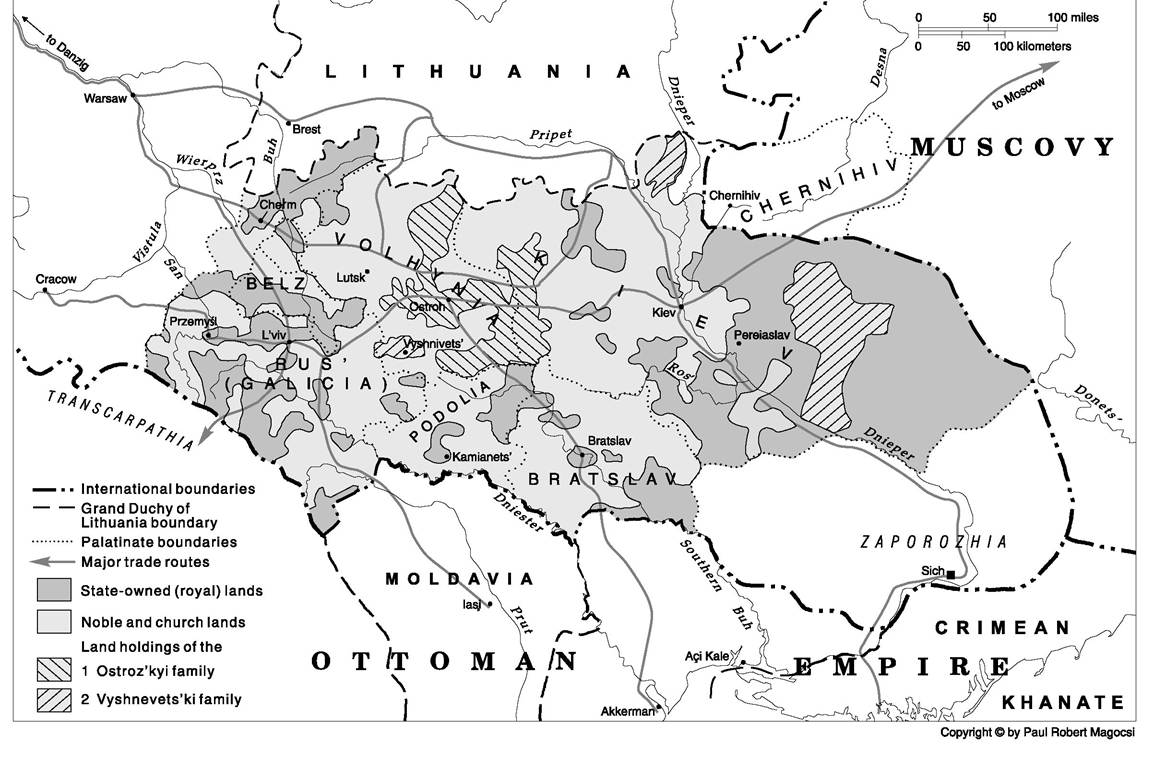
the second serfdom, or neo-serfdom. The initial stage of neo-serfdom saw a series of edicts approved by the Polish Diet (between 1496 and 1520) which placed an increasing number of legal restrictions on the peasant’s ability to leave his or her manorial estate. Particularly advantageous to the nobility was a law passed in 1518, according to which the royal court decided not to accept the complaints of subjects on lands not owned by the crown. Thus, when duty-free periods expired, or when landlords began to introduce unilaterally the corvee (labor obligation), or when they simply seized peasant lands, the peasant living on noble- or church- owned lands could no longer turn to the royal courts. He or she could resort to the local courts, but they were all controlled by nobles, who were unlikely to rule in favor of a peasant plaintiff.
The implementation of neo-serfdom in Poland culminated in 1573. After that date, peasants (men and women) were forbidden under any conditions to leave the manorial estates on which they resided. The corvee, whereby a serf was obliged to render unpaid labor, came to constitute the principal economic relation between noble landowners and peasants. In the Grand Duchy of Lithuania, which included most Ukrainian territory until 1569, serfdom was similarly introduced during the second half of the sixteenth century. As a result of an agricultural reform implemented in 1557, peasants were deprived of property rights to land. Three decades later the Third Lithuanian Statute of 1588 confirmed full bondage by removing the so-called right of transfer, with the consequence that all peasants who had lived with one landowner for a period of ten years became thenceforth “immovable.”
There were some free peasants, rural laborers, and serfs on both church and crown lands, but by the sixteenth century the vast majority of peasants were serfs of the nobility. Serfdom was put into practice in areas that had particular economic significance, such as those adjacent to the Vistula River and its tributaries (including the upper Buh and San Rivers in Ukrainian-inhabited Galicia and western Vol- hynia), as well as in all densely populated areas, where peasants had smaller and less economically viable holdings and were consequently more likely to become indebted to the local landlord. By the second half of the sixteenth century, there was a density of approximately 36 inhabitants per square mile (14 inhabitants per square kilometer) in the more western regions of Poland, including Ukrainian- inhabited Galicia, Belz, and western Podolia, whereas farther east, in the palatinates of Volhynia, Kiev, and Bratslav, the density was as low as 8 persons per square mile (3 persons per square kilometer). Thus, whereas by the end of the sixteenth century serfdom had become widespread in the more densely inhabited western Ukrainian lands, farther east, where large manorial estates (latifundia) were being formed, the peasants had not yet been enserfed, although they were being subjected to an increasing number of duties.
The situation in eastern Ukraine generally evolved in the following manner. Large magnates, whether of Rus’ (Ukrainian) or Polish origin, managed to obtain from the king grants of huge tracts of land (on the condition that they be settled) as well as official posts in the sparsely populated eastern Ukrainian territories. For instance, by 1590 the palatine of Kiev, Prince Kostiantyn/Vasyl’ K. Ostroz’kyi, owned, in the Kiev, Galician, and, especially, Volhynian palatinates,
The Manorial Estate
The evolution of the manorial estate (latifundium) was directly related to the rise of neo-serfdom in Poland. On the estates of magnates and gentry, and sometimes on royal and church lands, the large manorial farm known in Ukrainian as the fil’varok (from the Polish folwark) was organized. The goal in setting up the fil’varok was to make the most efficient use of serf labor for the maximum production of grain. By the second half of the sixteenth century, the average size of a fil’varok was 148 acres (60 hectares), and on it lived the landowner and his family, the landowner’s personnel, and between fifteen and twenty serf families.
The fil’varok itself was generally divided into three parts: (1) the demesne fields, or the lands belonging to the landlord, consolidated through the acquisition of smaller peasant holdings; (2) the lands belonging to the soitys, a village administrator of the landlord; and (3) strip holdings belonging to individual serfs. Generally, the village was in the center of the fil’varok, where the landlord’s manor house, the residence of the soitys, peasant dwellings, and the tavern were located. Near the village center was a common pasture; surrounding it were the demesne fields; and beyond them were the lands belonging to the soitys and the serfs’ strip holdings.
In return for their labor (corvee), serfs and their descendants had the security of possessing some lands or, as it were, of eventually belonging to them. As long as the conditions of serfdom were tolerable, such “attachment” to the land seemed an improvement on a cash economy in which a serf could become bankrupt during bad economic times and be evicted from land and home.
The amount of labor owed by a serf was related to the size of his or her land allotment. Whereas on royal estates there was a uniform system of labor obligations, on magnate- and gentry-owned estates (which by the late sixteenth century accounted for 78 percent of holdings in Ukraine) the number of unpaid work days was determined by the landlord or his estate administrators. The amount of corvee required of serfs therefore varied greatly. For instance, at the end of the sixteenth century, the number of unpaid labor days for serfs who had a typical allotment of land varied from 3 to 6 days per week for one or more members of a household. On magnate estates in Volhynia during the 1620s, however, the requirement was 4 to 6 days and, in some places, even 7 work days per week for a standard unit of land. In a typical serf household, the husband and older sons spent most of their time fulfilling the corvee requirement of the landlord, and the wife and younger children worked the small strips allotted to them in what was at best subsistence-level agriculture, that is, the raising of just enough food to support the family.
As long as Poland’s grain trade was growing, the fil’varok manorial estate system played a positive role in increasing the landlord’s wealth and providing indirectly for the minimal well-being of peasant serfs. But with the leveling off and eventually the decline of the grain trade in the second half of the seventeenth century, landowners tried to make up their losses by increasing the number of serf work days and by expanding the manorial estate system into Poland’s recently acquired Ukrainian lands in the east.
approximately 1,300 villages, 100 towns, 40 castles, and 600 churches. Similarly, by the early seventeenth century the Vyshnevets’kyi family owned nearly the entire Left Bank of the Kiev palatinate (claiming 230,000 subjects), and in Vol- hynia 13 noble families owned 57 percent of all land. These powerful magnates, as well as hundreds of smaller gentry, encouraged the migration of peasants from the more densely populated western territories of Poland, and the peasants were only too glad to escape the increasingly burdensome restrictions placed upon them by the serf system. To encourage these new immigrants, many of whom had to flee illegally from the manorial estates, the large landowners in the east offered them exemptions from rent and labor obligations (corvee) that could last up to 15, 20, or 30 years. Even when these periods ran out, the subsequent labor dues and taxes were less than on estates in the western palatinates of Poland. Consequently, even if by the middle of the seventeenth century serfdom had not yet taken hold in Ukrainian lands east of Galicia, the efforts of landlords to restrict privileges and exact new labor dues brought discontent and the potential for social conflict.
Whereas the nobility made concessions in order to attract settlers to the east, from the beginning they either owned outright or controlled the local mills for processing grain. They also retained the exclusive privilege of distilling and selling alcohol. The Polish and polonized Rus’ magnates and gentry were often not willing, however, to run the huge estates over which they had control. Instead, they relied on leaseholders (arendars), mostly Jews, who eventually became the linchpin of Poland’s arenda (leaseholding) economic system.
Arenda is a Polish term referring to the lease of fixed assets, such as land, mills, inns, breweries, and distilleries, or of special rights, such as the right to collect customs duties and taxes. The Polish landowning nobility was anxious to exploit the rich agricultural resources of the area that formed the basis of a profitable and expanding grain trade with western Europe through Poland’s Baltic ports, but they had little interest in administering vast landed estates on their own. They continued, however, to cultivate their luxurious habits and cultural pursuits, even though they lacked the capital or commercial skills necessary to exploit their properties and support their style of life. The landowners therefore turned to the Jews for money and for their expertise in leasing. The Jews obliged, and by the sixteenth and seventeenth centuries they had come to dominate the arenda system and to manage a considerable portion of the agricultural economy in Ukrainian lands. Not surprisingly, because they served as middlemen for Polish landlords, Jews became symbols of oppression and exploitation in the eyes of the Ukrainian peasant masses.
The Coming of Jews to Ukraine
Jews have had a long tradition of settlement on Ukrainian territory, which can be traced back to the Greek cities of the Bosporan Kingdom in the fifth and fourth centuries bce and the Khazar Kaganate in the seventh and eighth centuries ce. As entrepreneurs from the Near East, Jews were welcomed by the Bosporan and Khazar rulers, and they settled as traders and merchants in the ports of the Crimea and in the heartland of Khazaria along the lower Volga and Don Rivers. The Jews of Polish-ruled sixteenth-century Ukraine, however, were the descendants not of the refugees of Khazar times (with the exception of a few Turkic-speaking Karaite immigrants), but of migrants originally from the Germanic lands of central and east-central Europe. Anti-Jewish violence and other forms of persecution connected with the Crusades and the popular hatred of Jews in medieval Germanic lands forced them to seek refuge in Poland beginning at the close of the eleventh century.
Following the destruction caused by the Mongol invasions of the mid-thirteenth century, Poland’s kings wished to rebuild the country’s economy and, therefore, welcomed immigrants, whether Jews or Germans from the west or Armenians from the east. The newcomers settled primarily in urban areas and helped Poland revive its cities. Before the end of the thirteenth century, the Jews had been awarded the first of many privileges (beginning with the 1264 Statute of Kalisz of Prince Boleslaw “the Pious”) that defended them as a group whose main business was moneylending. The Jews were originally servants of the royal court (servi camerae), and as such they collectively paid a separate tax, often higher than that of Christians. They were, however, entitled to administer themselves in a self-governing municipality known as the kahal (Yiddish: kehile). Jewish self-government in Poland-Lithuania became formalized in the mid-sixteenth century, when the kahals joined to form an umbrella organization known as the Council of Lands. The “lands” were composed of self-governing councils (four in Poland, one in Lithuania), each of which regulated the internal social, economic, ethical, educational, and legal aspects of Jewish life, and which as a unified body represented Jewish interests vis-à-vis the Polish crown and central governmental institutions. Two of the councils were based on Ukrainian territory, one in Galicia (the “Lvov Land”’) and the other in Volhynia.
The first Jews came to Poland from Bohemia after 1098 and settled in neighboring Silesia, an initally Polish-ruled land that was later germanized when it became part of Bohemia-Moravia. Subsequent Jewish immigrants came from Moravia itself and from Germanic lands farther west. All were of the Ashkenazi tradition, speaking the medieval German dialect of Yiddish. By the sixteenth century, Poland had also become attractive to Jews of the Sephardic tradition from as far away as Spain, Italy, and the Crimea.
In the Ukrainian lands, small communities of Ashkenazi Jews developed in Galicia and Volhynia in as early as the twelfth century, when these regions were still ruled by their own Rus’ princes. The Jewish communities there really began to expand, however, only during the fourteenth and fifteenth centuries, after the regions had become part of Poland and Lithuania. The Jews in Lithuania were even better off and were awarded a wide body of privileges (1388-1389), including tax-free concessions for their places of worship and burial, and the right to trade, hold any craft, and own land.
The further spread of Jews eastward into Ukrainian lands along both the Right and the Left Banks was directly related to Poland’s territorial expansion and the colonizing efforts led by Rus’ (Ukrainian) and Polish magnates and gentry after the Union of Lublin in 1569. In this process, Jews became servitors on manorial estates owned by the nobility. According to one Jewish historian (Israel Friedlander), as leaseholders they functioned as “sponges to convey the wealth of the country and the toil of its inhabitants into the pockets of the lords.” Some Jewish arendars not only held leases, but also obtained contracts to administer entire estates. This meant that they had the authority to set labor requirements for the manor’s peasant serfs. With the spread of the Polish manorial estate system into central and eastern Ukraine, the overall number of Jews continued to grow, so that by 1648 there were an estimated 85,000 living in Ukrainian lands. At the same time, the economic status of at least one segment of Jewish society (the arendars and their assistants) vastly improved.
The realignment of international trade patterns
The expansion of Poland’s magnates and gentry into Ukrainian lands in the late sixteenth and early seventeenth centuries and their development and exploitation of the region’s agricultural resources made them part of the new international economic order that was coming into being in eastern Europe. In the early centuries of Kievan Rus’, the highly important international trade routes which crossed eastern Europe transported mainly luxury goods from the Orient via the northern Black Sea ports to Byzantium or to Kiev, and thence northward up the Dnieper to the Baltic Sea ports or westward overland through Galicia to central and western Europe. By the eleventh century, Kiev’s dependence on international trade as a source of income had lessened, with the result that agricultural and related production became the mainstay of the economy.
This trend toward a profit-making agriculture-based economy with export to the southern Crimean and Byzantine markets was interrupted in the twelfth century by the nomads’ seizure of control of the steppe and by the decline of the Byzantine Empire. Then, with the arrival of the Mongols in the mid-thirteenth century, an economic as well as a political realignment took place in eastern Europe. The Mongols made international trade from the Orient and Central Asia via the Black Sea to a revived Byzantium or to the Mediterranean ports of Venice and Genoa their most important economic concern. By the first half of the fifteenth century, however, the Mongolo-Tatar domination of the Black Sea region had declined, and in 1453 the Byzantine Empire ceased to exist. The rise of the Lithuanian and, later, Polish presence in eastern Europe that culminated in the sixteenth century eventually made agricultural production economically viable once again. But the traditional trade routes to the south were cut off, since the Ottoman Empire, which succeeded Byzantium, was locked in a fierce struggle with Christian powers for control of the Balkans and Black Sea region.
As a result, a new western European-oriented economic order emerged, in which the Polish Kingdom and later the Polish-Lithuanian Commonwealth functioned as a supplier of raw materials to western European countries, for which finished products were received in return. That Poland could find a ready market for its products was a result of changes taking place simultaneously in western and southern Europe. A population explosion during the fifteenth and sixteenth centuries, combined with a phenomenal acquisition of wealth from the New World (especially by Spain and Portugal), produced an ever-increasing need for foodstuffs and building materials in western Europe, which now had the financial means (gold and silver from the Americas) to pay for extensive imports.
Poland’s economic and cultural revival
From its ports along the Baltic Sea and by land through Lublin and Poznan, Poland shipped to central and western Europe lumber products (timber, tar, potash), cattle (10,000 were exported annually during the early sixteenth century, and 40,000 annually by the end of the century), and raw hides. The most important export, however, was grain, grown in western Ukraine (Galicia and western Volhynia) and shipped down the Vistula and its tributaries to the Baltic port of Gdansk (Danzig), which Poland had recovered from the Teutonic Order in 1455. It was from the Vistula grain trade that Poland really acquired its wealth. The growth of the grain trade was indeed remarkable: in 1491-1492, an estimated 13,000 tons (12,000 metric tons) were exported, and that figure rose rapidly to 152,000 tons (138,000 metric tons) in 1563 and to a high figure - never to be repeated - of 272,000 tons (248,000 metric tons) in 1618. In return, Poland imported manufactured goods: cloth from Flanders, England, and France, and wine from Spain, France, and Portugal. The growth of the grain market and its lucrative return only increased the appetite of Poland’s nobility for more land and greater control over those who toiled on it.
It is also interesting to note that, unlike in Poland in previous centuries and in much of contemporary western and central Europe, the role of Polish cities and townspeople in the economic expansion was limited and even decreased during the period under consideration. The wealthiest townspeople had fewer rights than the poorest noble, and only the largest cities had self-governing privileges. Of the smaller towns, many were owned outright by nobles. But most important was the fact that the Vistula grain trade bypassed the cities entirely, since international shippers (mostly Dutch) and merchants in the Baltic port of Gdansk, near the mouth of the Vistula, dealt directly with the nobles.
Poland’s increasing economic wealth was matched in the sixteenth century by its cultural achievement. The Italian Renaissance, with its humanist ideas, and the German and Czech religious reformation reached Poland at about the same time. The result was a fertile intellectual and creative environment fostered by various segments of the nobility and symbolized by the creative genius of the writer Jan Kochanowski, the political theorist Andrzej Frycz-Modrzewski, and the renowned astronomer Copernicus. The Polish language was transformed into a literary medium for creative belletristic and scholarly writing, which flowed from the country’s new printing presses. Painting, sculpture, and architecture flourished, and Polish universities were among the leading centers of learning in Europe.
Given this atmosphere, it is not surprising that the Lithuanian and Orthodox Rus’ nobility in the east were attracted as by a magnet to sixteenth-century Western- oriented Polish culture. Many of them aped Polish customs, adopted the Polish language, and, in the case of the Rus’, converted to Roman Catholicism, the official state religion. As for that portion of the Rus’ nobility (whether in Lithuania or in Ukraine) who remained Orthodox, Polish political identity became an important element in their outlook. It is precisely from this segment of the Ukrainian nobility that the concept gente Ruthenus, natione Polonus (a Pole of Rus’ religion) developed. In this regard, it is interesting to note that in 1569, on the eve of the agreement at Lublin to unite Poland and Lithuania, it was the Rus’ magnates and gentry who for the most part wanted the remaining Ukrainian lands in Lithuania - Volhynia, Bratslav, eastern Podolia, and Kiev - to become, as Galicia had previously, an integral part of Poland. While there may have been some disagreement in 1569 over the exact political relationship with the Polish Kingdom, the leading strata of the population, whether Orthodox or Catholic, was anxious to become part of the Polish sphere and to obtain the political and economic advantages that would thereby accrue. Accordingly, the leading strata in Ukrainian society welcomed Polish rule in the late sixteenth century.
Still, there remained the vast majority of the population, represented by peasant-serfs and a small number of Rus’ townspeople. As long as Poland’s agriculturebased economy was thriving as a result of the Vistula grain trade, both groups led a tolerable existence. But when grain prices began to fall in the early seventeenth century, Ukrainian peasants and townspeople - not unlike their Polish and Lithuanian counterparts in other areas of the Commonwealth - began to suffer the negative effect of economic change whereby the nobility attempted to make up for its losses by exploiting the serfs further and by limiting the prerogatives of the townspeople. Added to these general economic developments was the fact that the Rus’ (Ukrainians and Belarusans) were differentiated from the rest of society by their Orthodox Rus’ religious identity. That identity was to prove an extra liability in a Polish society that was experiencing both economic difficulties and the gradual growth of social and religious intolerance. As will become evident in the next two chapters, the manner in which the Rus’ townspeople and peasants reacted to these changes and the degree to which their Orthodox church became involved were to have a profound effect on Ukraine’s relationship to the rest of Poland.
More on the topic Socioeconomic Developments:
- Socioeconomic developments
- Socioeconomic developments
- Socioeconomic Developments in the Hetmanate
- Socioeconomic Developments
- Socioeconomic Developments
- Socioeconomic and Cultural Developments
- Socioeconomic and Cultural Developments
- Socioeconomic Developments in Dnieper Ukraine
- Socioeconomic Developments in Dnieper Ukraine
- Socioeconomic developments and the Galician Communist party
- Socioeconomic and Cultural Developments in the Cossack State
- Socioeconomic and Cultural Developments in the Cossack State
- 27 Socioeconomic Developments in Dnieper Ukraine in the Nineteenth Century
- Socioeconomic Conditions
- 15 Socioeconomic Change