27 Socioeconomic Developments in Dnieper Ukraine in the Nineteenth Century
Ukrainian lands traditionally functioned as a source of agricultural products and raw materials. That tradition, which went back to prehistoric times and which characterized as well the period of Kievan Rus’ and Polish-Lithuanian rule, was to be continued during the long nineteenth century under the hegemony of the Russian Empire.
Dnieper Ukraine also functioned as an important internal market for manufactured goods produced in the more industrialized regions of central Russia. The goods were sold primarily at the hundreds of annual fairs, the most important being in the northern Ukrainian towns of Kharkiv (with four month-long fairs each year), Poltava, Chernihiv, and Romny. But much more important was the Russian Empire’s export trade, based primarily on products extracted from Dnieper Ukraine.Following the integration of Zaporozhia (New Russia) and the annexation of the steppe region from the Ottoman Empire (1774-1791), the Russian imperial government encouraged the opening up of vast new tracts of arable lands—some two million acres (800,000 hectares) in the early nineteenth century and another 15 million acres (6 million hectares) by the 1860s. In effect, Dnieper Ukraine became the empire’s most important agricultural land, the proverbial “bread basket of Russia.” Wheat, in particular, was the major export commodity and earner of foreign currency. From 1812 to 1859 Dnieper Ukraine accounted for 75 percent of all exports from the Russian Empire; by the last half-decade (1909-1913) of the historic nineteenth century that figure had reached a remarkable 98 percent. Aside from wheat, Dnieper Ukraine during that same half-decade accounted for 84 percent of Russia’s corn production, 75 percent of its rye, and 73 percent of its barley. Most of these grain exports left Ukraine’s Black Sea port of Odessa, others via Kherson and Mykolaïv.
Odessa’s exporting firms were almost exclusively operated by Greek, Italian, and Jewish merchants who had settled permanently in what rapidly became an international trading emporium.
27.1 Elevator loading grain onto ships at the Black Sea port of Mykolaïv.
MAP 27 OVERLAND ROUTES AND RAILROADS BEFORE 1914

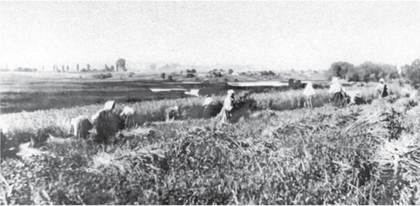
27.2 Harvesting grain by hand in the Volhynia province of Dnieper Ukraine.

27.3 Processing the harvest was a labor-intensive job as seen here in the village of Bilyky in Poltava province.
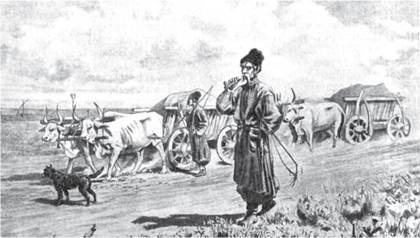
27.4 Transporting salt northward from Crimea by chumaks, whose navigational ability is still remembered by Ukrainians in the names they give to constellations of the stars: Chumats’kyi Viz (The Big Dipper) and Chumats’kyi Shliakh (The Milky Way).
The importance of grain exports motivated imperial Russia to improve its internal transportation system. Until the 1860s Ukraine’s grain was shipped to Odessa by rather circuitous routes over land, rivers, and the sea. The grain would first be gathered at staging areas, such as Kremenchuk, Katerynoslav/Dnipropetrovs’k, and Oleksandrivs’k on the Dnieper River, and at Mohyliv on the Dniester River. From these places the grain would be moved by a combination of river barges and overland oxen-drawn wagon trains driven by teamsters known as chumaky. The river and chumak routes would end directly at Odessa or at Black Sea ports like Kherson, Mykolaïv, and Ievpatoriia in the Crimea; from these ports the grain would be shipped by coastal boats to Odessa.
However, the most important chumak route—seeing on average some 100,000 wagons a year—brought goods in the opposite direction, in particular salt from Perekop near the gateway to the Crimea northward to Kharkiv and from there on to central Russia.
27.5 A sugar processing plant in the Right Bank town of Cherkasy.
Not long after railroads had proved their efficiency in central Europe as a means of shipping goods in bulk, they were introduced into the Russian Empire. Considering the importance of the export trade, it is not surprising that Dnieper Ukraine’s very first railroad line, opened in 1865 and covering a distance of 137 miles (222 kilometers), was built specifically to transport grain from Balta near the grain-growing region in southern Podolia to Odessa. From Balta railroad lines spread further during the second half of the 1860s to cover other grain-producing areas to the east (toward Kremenchuk) and north (toward Zhmerynka and Vinnytsia) and from those places on to Kiev. From Kiev the main lines went north to the empire’s dominant political and administrative centers, St Petersburg and Moscow. By 1914 Dnieper Ukraine had a functional railroad network covering 10,500 miles (16,000 kilometers). Despite the growth of railroad lines, the river barges and overland wagon trains headed by the chumaky remained an important means of transporting grain throughout the decades preceding World War I.
This same period also saw development of industry in Dnieper Ukraine. If, in 1793 there were two hundred industrial plants, by the reform period of the 1860s that number had increased more than ten-fold to 2,329. Especially important were textile factories and sugar-processing plants. This pre-reform period also witnessed a gradual decline in the number of noble-owned factories employing serfs, so that by 1861 those owned by capitalist entrepreneurs accounted for 94 percent of factories, in which 74 percent of the workforce were hired laborers.
TABLE 27.1 Population of Dnieper Ukraine’s Largest Cities, 1860-1914
| ca. 1860 | 1897 | 1914 | |
| Odessa | 113,000 | 404,000 | 669,000 |
| Kiev | 65,000 | 248,000 | 626,000 |
| Kharkiv | 50,000 | 174,000 | 245,000 |
| Katerynoslav/Dnipropetrovs’k | 19,000 | 121,000 | 220,000 |
| Mykolaïv | 32,000 | 92,000 | 104,000 |
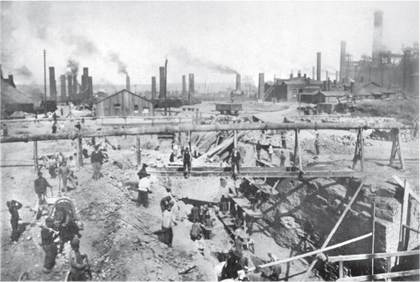
27.6 A metallurgical factory under construction (1911) in Iuzivka (present-day Donets’k), the main industrial center of the Donbas
The second half of the nineteenth century saw even greater industrial growth in Dnieper Ukraine. By 1914 there were more than 30,000 industrial enterprises with a workforce that increased from 82,000 (1860) to over 6.3 million employees in 1914. Aside from existing textile and sugar-processing plants, the post-reform era was characterized by the growth of mineral extraction and processing (e.g., coal and pig iron) and of metallurgical, locomotive, and machine-building industries. Most of these were concentrated in the eastern Donbas region of Dnieper Ukraine and were largely financed by individual French, Belgian, and British investors.
Along with industrial development and the building of a railroad network came urban growth. Between 1863 and 1897 the urban population of Dnieper Ukraine more than doubled, reaching over three million inhabitants living in 130 towns and cities. As in much of eastern and central Europe, most of these urban centers remained small in size, so that by 1897 there were only twelve centers with more than 50,000 inhabitants that could be properly classified as cities.
The five largest cities in Dnieper Ukraine did, however, grow quite rapidly, tripling or quadrupling in size between 1863 and 1897, and then in several cases doubling again by 1914 (see Table 27.1).The ethnic composition of the largest cities did not reflect proportionally the various peoples who lived throughout Dnieper Ukraine. In fact, the country’s majority population, ethnic Ukrainians (71 percent) made up on average only 18 percent the inhabitants of the region’s largest cities. The growing workforce in these cities was drawn from newly arrived immigrants from Russia. Ethnic Ukrainians in the rural countryside who wanted to improve their socioeconomic status did so by moving not to urban areas but rather farther east, beyond the borders of present-day Ukraine, into the Don Cossack and Kuban’ Cossack lands east of the Sea of Azov, or even further east into the unlimited expanses of Russian-ruled Central Asia, southern Siberia, and the maritime provinces along the Pacific Ocean.
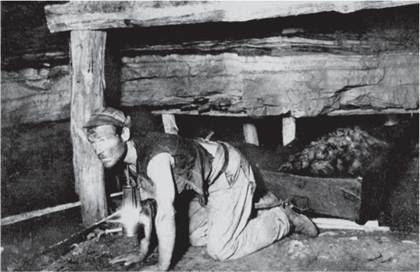
27.7 Above) Backbreaking and dangerous work conditions extracting coal in mines below the Donbas and delivering it to a metallurgical factory above ground at Iuzivka (Below).

Industrialization and the rapid growth of cities during the decades before World War I brought a whole host of new social problems. The imperial authorities in Ukraine’s cities were unable to construct quickly enough the kind of infrastructure (food supply, public transport, sanitation, and medical facilities) needed to service the ever increasing urban population. Housing shortages posed a particularly acute problem, with the result that industrial workers were often forced to live in cramped quarters and shanty towns on the outskirts of cities and in unhealthy conditions near pollution-producing factories and mines.
The difficult conditions on the residential front were matched by what laborers faced daily in the workplace—long hours, low pay, and the constant danger of loosing one’s life or limb because of exposure to machines with limited or no safety devices and subjection to poorly ventilated and shabbily constructed mine shafts.It was not long before workers began to vent their anger against factory and mine owners and government authorities, who they considered were jointly responsible for their worsening fate. Protests at first took the form of spontaneous work stoppages or, at times, material destruction in the workplace. By the outset of the twentieth century newly formed political parties, especially those inspired by socialist ideas originally formulated by the German philosophers Karl Marx and Friedrich Engels, took the lead in organizing unions and strike activity. Urban workers in Dnieper Ukraine either joined political parties that represented the Russian Empire as a whole (the Socialist Revolutionary party and the Social-Democratic Workers’ party with its Menshevik and Bolshevik wings), or those that emphasized both socialist principles and also the national interests of its members (the Revolutionary Ukrainian party for ethnic Ukrainians and the BUND for Jews).
Strikes by urban workers and, for other reasons, by university students continued to increase in size, number, and frequency throughout Dnieper Ukraine during the first decade of the twentieth century. The standard response of the Russian imperial government was to break up the strikes by force, to imprison workers and students, and to exile to Siberia those who now came to form a new “social stratum”—professional revolutionaries. Despite such repressive actions, protests of various kind against the Russian imperial government continued up and beyond the outbreak of World War I in 1914, by which time Dnieper Ukraine had produced its own share of professional revolutionaries, among them Pavel Aksel’rod, Evgeniia Bosh, Mykola Skrypnyk, and Lev Bronstein—better known to the world by his pseudonym, Leon Trotskii.
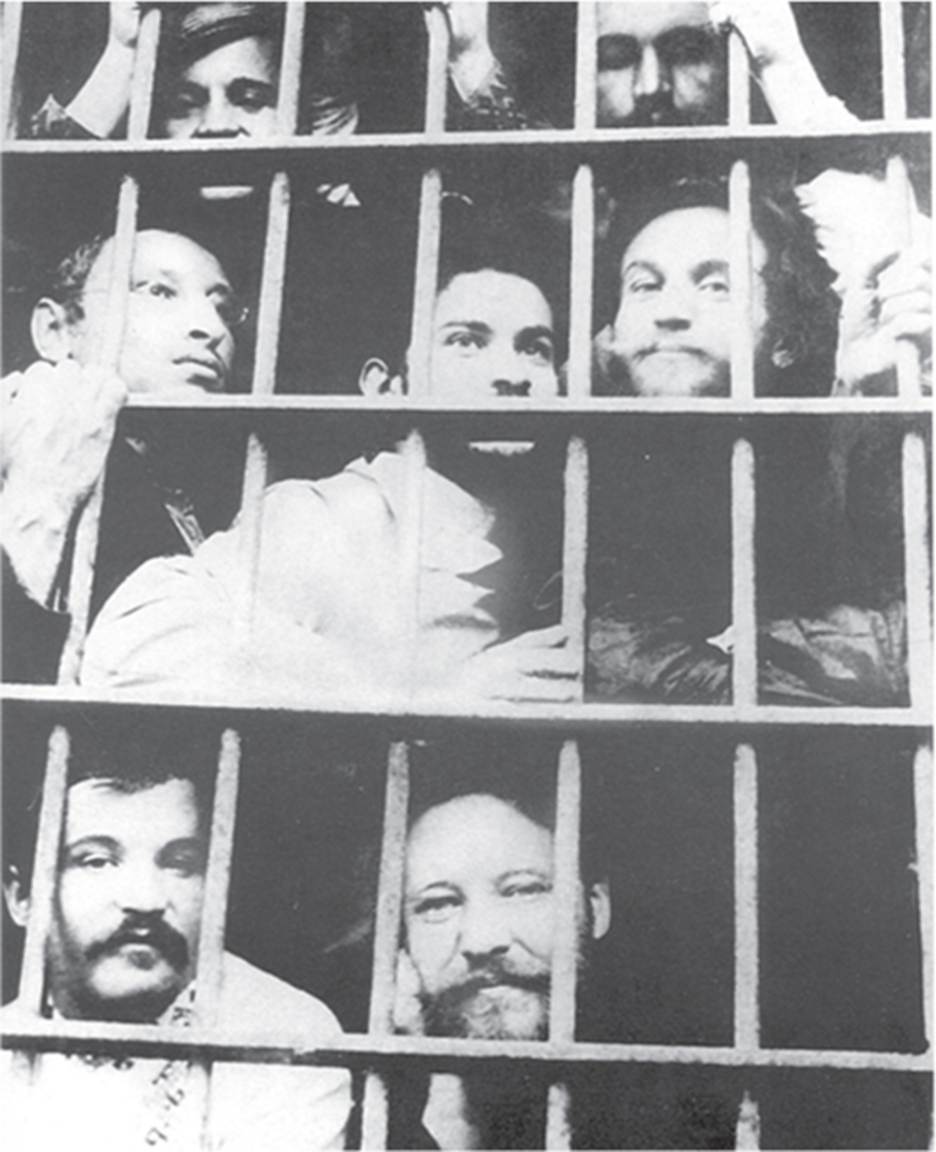
27.8 Revolutionaries arrested in 1906 for anti-tsarist protests look out with pride from their prison cell in Kharkiv.
MAP 28 THE PEOPLES OF UKRAINE, circa 1900

More on the topic 27 Socioeconomic Developments in Dnieper Ukraine in the Nineteenth Century:
- Socioeconomic Developments in Dnieper Ukraine
- Socioeconomic Developments in Dnieper Ukraine
- 28 The Peoples of Dnieper Ukraine in the Nineteenth Century
- Administrative and Political Developments in Dnieper Ukraine
- Administrative and Political Developments in Dnieper Ukraine
- Between Empires: Ukraine in the Nineteenth Century
- Socioeconomic developments
- Socioeconomic Developments in the Hetmanate
- Socioeconomic Developments
- Socioeconomic developments
- Socioeconomic Developments
- Socioeconomic Developments
- Socioeconomic and Cultural Developments
- Socioeconomic and Cultural Developments
- Socioeconomic developments and the Galician Communist party
- Socioeconomic and Cultural Developments in the Cossack State