26 Ukrainian Lands in the Russian Empire in the Nineteenth Century
As a result of the Third Partition of Poland (1795) and the annexation of the southern steppe lands and Crimea from the Ottoman Empire (1774-1791), all Ukrainian territories came within the boundaries of two states: the Russian Empire and the Austrian Empire.
This situation was to remain unchanged throughout the historic or “long” nineteenth century that lasted from 1789 until the outbreak of World War I in 1914. Based on present-day boundaries, 85 percent of Ukraine was within the Russian Empire. This part of Ukrainian territory has conventionally been referred to as eastern, or Dnieper Ukraine.Throughout the entire period of Russian imperial rule, Dnieper Ukraine had no specific administrative status, but was divided—as was the rest of the empire—into provinces. This structure was first implemented during the reign of Catherine II, who in 1775 introduced the relatively standard (in terms of territory and population) unit called the namestnichestvo, or imperial province. In 1802 this unit was replaced by a smaller one known simply as the guberniia, or province. Each province was, in turn, subdivided into counties or districts (Russian: uezd; Ukrainian: povit).
The vast majority of ethnic Ukrainians in the Russian Empire (seventeen million in 1897) lived in nine of the provinces: Chernihiv and Poltava (the former Hetmanate), Kharkiv (most of former Sloboda Ukraine), Katerynoslav and Kherson (former New Russia), Taurida (the Crimea and former khanate lands south of the Dnieper River), and in lands acquired from Poland—the provinces of Kiev (including the city of Kiev that had been part of the Hetmanate), Podolia, and Volhynia. There were another 4.4 million ethnic Ukrainians inhabiting parts of neighboring provinces. These included Kursk and Voronezh to the northeast; the Don Cossack Lands, Stavropol, and the Black Sea Cossack Lands (later Kuban’) to the east; Minsk, Grodno, Siedlce, and Lublin to the northwest; and Bessarabia in the southwest.
Each province was headed by a governor (Russian: gubernator) who was appointed by the head of the state, the emperor (tsar) who resided in St Petersburg. Aside from the governor, the most important officials were the police commandant and the gentry marshal, offices which existed at both the provincial and the county level. Also at those two levels was a provincial and county assembly made up of members of the Russian imperial nobility. These assemblies elected the police commandants, gentry marshals, and other officials, including members of the judiciary. The result was that the Russian imperial administration was run at the provincial and county level by the nobility. After 1831 those towns and cities that had self-government according to Magdeburg Law were placed under the county and provincial administration of the area in which they were located. The only exception was the Black Sea port city of Odessa, which together with a small hinterland territory had the equivalent of provincial status and was dependent directly on the central government.
MAP 26 DNIEPER UKRAINE, circa 1850

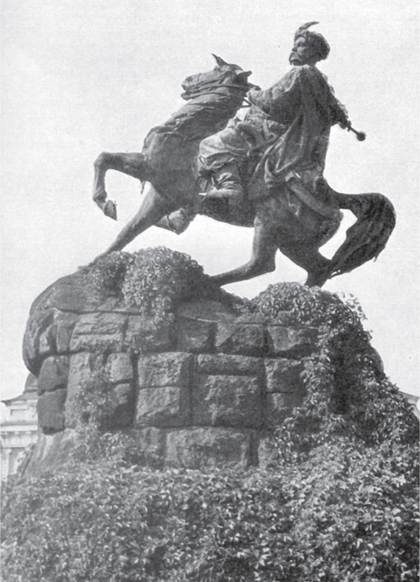
26.1 Symbolic of Dnieper Ukraine’s integration into the Russian Empire is the equestrian statue of Bohdan Khmel’nyts’kyi, by the sculptor Mikhail Mikeshin, erected in 1888 on the St. Sophia Square in Kiev, with its mace (bulava) pointed firmly northward toward Muscovy.
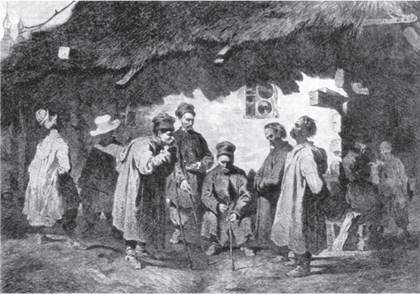
26.2 Deliberation by members of a village assembly in a painting by Taras Shevchenko

26.3 Seat in Poltava of the governor-generalship of Little Russia, architect Adriian Zakharov, built 1810.
In the 1860s the imperial government implemented a large number of reforms.
The cornerstone of the reform era was what became known as the “Great Emancipation” of 1861—the liberation of the Russian Empire’s serfs. This was followed in 1864 by a series of legal reforms that provided equality for all male citizens regardless of social status and for public trials by jury in courts that were made independent of the state administration. The Russian imperial government also attempted to democratize its administration at the provincial and county levels through the introduction of the zemstvo institutions. This limited form of self-government, which provided for local control over education and social services, was slowly introduced throughout the Dnieper Ukraine between 1865 and 1911, but with limited effectiveness. Somewhat more successful as an instrument of local self-government was the rural district administration (volost’) introduced in 1861. The rural district was made up of individual village communes, each of which had its own assembly (Russian: skhod; Ukrainian: hromada) whose members were elected by local peasants. The village commune assembly elected its own village elder (starosta) as well as delegates to the rural district assembly (volostnoi skhod).
26.4 19th-century view of the Kievan Cave Monastery (Kyievo-Pechers’ka Lavra), since its establishment in the 11th century the most important center of Orthodox religious life not only in Ukraine, but in the entire Russian Empire.
Since Ukrainian lands were part of the border region of the Russian Empire, for certain periods they had another administrative level above the province. This was the office of the governor-general (general-gubernator), whose jurisdiction included supervisory and general policy capacity over two or more provinces. At various times in Dnieper Ukraine there were three governor-generalships: Little Russia (1802 to 1856, for the Left Bank provinces of Chernihiv, Poltava, and from 1835 Kharkiv); Kiev (1832 to 1914, for the Right Bank provinces of Kiev, Volhynia, and Podolia); and New Russia and Bessarabia (1822 to 1874, for the steppe provinces of Katerynoslav, Kherson, and Taurida).
The administrative framework of division into provinces in Russian-ruled Dnieper Ukraine was applied to that other important aspect of society, the church. The relative status of the two Eastern-rite churches, Orthodox and Uniate, was to change significantly with the expansion of Russian rule. In 1686 the Orthodox Metropolitanate of Kiev was made jurisdictionally subordinate to the Russian Orthodox Church in Moscow instead of to the ecumenical patriarch in Constantinople. Then, in the course of the eighteenth century, the Kiev Metropolitanate lost its westernmost eparchies to the Uniate churches, and others were placed under the jurisdiction of the Russian Orthodox Church. In 1770 the title of the office itself was changed; in effect, the metropolitan of Kiev became little more than an honorific title, since his actual jurisdiction applied only to the Eparchy of Kiev.

26.5 Tsarist troops fire at Uniates in the village of Pratulin, near Chełm, who refused to convert to Orthodoxy, as depicted by the Polish painter Wojciech Eliasz.
Meanwhile, the entire hierarchical structure of the Russian Orthodox Church was altered. As part of the reforms of Tsar Peter I the Orthodox Church became an instrument of the state and operated as any other branch of government. This process began in 1721, when Peter I abolished the office of patriarch and replaced it with a collegium known as the Holy Synod. The Holy Synod was comprised of twelve bishops and was headed by a secular official, the Chief Procurator, who reported directly to the tsar. It should be noted that while some Russian Orthodox hierarchs opposed such interference by a secular authority, others welcomed the changes. In particular, it was hierarchs from Ukraine (Dymytrii Tuptalo, Stefan Iavors’kyi, and Teofan Prokopovych) who became the leading figures in the Russian Orthodox Holy Synod (see above, Chapter 20). In 1802 Peter’s system of kollegiia, or state departments, was abolished and replaced by ministries (headed by a single minister) for each branch of government, although the Orthodox Church continued to be governed on the collegial principle by the Holy Synod.
In the course of the nineteenth century, the boundaries of Orthodox eparchies in Dnieper Ukraine were basically made to coincide with the boundaries of the secular provinces. To the older eparchies of Volhynia, Kiev, and Bratslav (renamed Podolia) and to the territorially revised Chernihiv and Poltava eparchies were added the following: Kharkiv in 1799, Katerynoslav in 1804, Taurida in 1804, Kherson in 1837, and Kholm/Chełm-Lublin in 1905. Each of the nine eparchies had its own seminary, preparatory schools, and publication programs. Most important was the fact that these institutions prepared an entire clerical social stratum that was loyal not only to Orthodoxy but also to the Russian imperial order. This included use of the Russian language in church-run schools and publications and of the Church Slavonic language (with Russian pronunciation) in the liturgy. In that regard, the Orthodox clergy were almost without exception opposed to any efforts to raise the “Little Russian” (Ukrainian) dialects to the status of a literary language or to recognize Ukrainian as a nationality distinct from Russians. It is not surprising, therefore, that the first tsarist ban issued against the Ukrainian language (1863) was the result of a debate in government circles regarding a request, which was rejected, to approve publication of the Gospels in Ukrainian.
In its new territorial acquisition from Poland-Lithuania, the Russian government was faced with the existence of the Uniate Church. Ever since that body was created by the Union of Brest in 1596, the Orthodox world had rejected the Uniate Church as uncanonical; in other words, illegal. Consequently, when the Russian Empire extended its borders westward as a result of the three partitions of Poland (1772, 1792, and 1795) thousands of Uniate parishes in Right Bank Ukraine and Belarus were closed. Their clergy was forced to become Orthodox and the Uniate metropolitan of Kiev with all its eparchies in former Polish-Lithuanian territory were abolished in 1796.
Within a decade the church was restored as the Uniate Metropolinate of Russia with its seat at Polatsk, but this was to last for only a few decades. In 1827 one of the Uniate bishops (a native of Ukraine, Iosyf Semashko) undertook a campaign which resulted in 1839 in the “voluntary return” of Uniates to Orthodoxy. Hence, wherever Russia extended its rule, the Uniate Church was eventually abolished according to the formula: “voluntary reunion” of the faithful or “return to Orthodoxy.” The last Uniate eparchy in the Russian Empire was closed in 1875. Tsarist Russian policy was to be continued into the twentieth century by the Soviet regime, with dire consequences for the Uniate/Greek Catholic Church in western Ukraine and neighboring countries.
26.6 Iosyf Semashko (1799-1868), from 1829 Uniate bishop of Mstislaü who, for his efforts in abolishing the Uniate Church in the Russian Empire, was made bishop (1839) and metropolitan (1852) in the Russian Orthodox Church.
More on the topic 26 Ukrainian Lands in the Russian Empire in the Nineteenth Century:
- Vasilii Kliuchevsky, the dean of Russian historiography at the turn of the twentieth century, defined Russian history from the early seventeenth to the mid-nineteenth century as an 'all-Russian' period, in opposition to the earlier age, which he called Great Russian and Muscovite.
- Orthodox Colleges in the Russian Empire (Second Half of the Eighteenth to the Beginning of the Nineteenth Century): Between Traditions and Innovations
- Theme 10. The National Revival and Economic Modernization of the Ukrainian Lands under the Austrian (Austro-Hungarian) Monarchy of Habsburgs and the Russian Empire from the Middle 19th to the Early 20th Centuries
- Theme 8. The Liquidation of the Ukrainian Autonomies of Hetmanshchyna, Zaporozhian Host, and Sloboda Regiments by the Government of the Russian Empire in the 18th Century
- The Problem of Ukrainian-Jewish Relations in Nineteenth-Century Ukrainian Political Thought
- Ukrainian Cities in the Nineteenth Century
- 23 Zaporozhia and Southern Ukrainian Lands inthe Eighteenth Century
- In Search of “Ukraine” in the Russian Empire (End of Eighteenth and Early Nineteenth Centuries)
- Theme 9. The Ukrainian Lands in the First Half of the 19th Century
- Did the Austrian Empire govern its Ukrainian lands differently?
- Frontier Violence in the Nineteenth-Century British Empire
- during the russian-ukrainian war, which began in early 2014 and was somewhat misrepresented in Western media as a kind of Ukrainian “civil war,” rather than a Russian invasion, there emerged a number of supposedly new images of Ukrainian warriors.
- The Administrative and Social Structure of Ukrainian Lands in the Austrian. Empire before 1848
- The Administrative and Social Structure of Ukrainian Lands in the Austrian Empire before 1848
- Ukrainian Speakers in the Russian Empire
- 29 RELIGION AND EMPIRE IN THE SOUTH SEAS IN THE FIRST HALF OF THE NINETEENTH CENTURY
- Ukrainian Autonomy in the Russian Empire
- CHAPTER 4 RELATIONS BETWEEN THE UKRAINIAN STATE AND THE RUSSIAN GOVERNMENT IN THE SEVENTEENTH CENTURY
- The Administrative and Socioeconomic Structure of Ukrainian Lands in the Austrian Empire, 1849-1914
- The Administrative and Socioeconomic Structure of Ukrainian Lands in the Austrian Empire, 1849-1914