The Administrative and Social Structure of Ukrainian Lands in the Austrian Empire before 1848
Austria acquires Ukrainian, lands
Ukrainian lands north of the Carpathian Mountains became part of the Habsburg Empire as a result of an international power struggle in east-central Europe that led to the First Partition of Poland in 1772.
In that year, without firing a shot, Habsburg Austria received what came to be known as Galicia. This included those parts of the former Polish palatinates of Cracow and Sandomierz located south of the Vistula River, the Galicia (Rus') and Belz palatinates, and small parts of the Chelm region (around Zamosc) and Podolia palatinate west of the Zbruch River.After the diplomatic fait accompli of 1772, the Habsburg rulers of Austria justified their new territorial acquisition by reviving medieval Hungary’s late twelfthcentury claim (see chapter 9) to the Galician-Volhynian Kingdom. In the interim, the Habsburgs had become the hereditary kings of Hungary, and this ostensibly gave them historical rights to the 1772 ‘reacquisition’ of Hungarian territory, which they officially named the Kingdom of Galicia and Lodomeria (the Latin name for Volhynia), or Galicia (German: Galizien) for short. Two years later, at the close of the Russo-Turkish war in 1774, Austria took advantage of the Ottoman Empire’s weakened position and seized the mountainous region of northern Moldavia known as Bukovina. After an initial twelve years of Austrian military administration, Bukovina was joined to neighboring Galicia, of which it was to remain a part until 1849.
One other territory had been part of Austria’s Habsburg Empire even before 1772. This was Transcarpathia, or historical Subcarpathian Rus', which since the eleventh century had been an integral part of the Kingdom of Hungary. The local East Slavic population, known as Rusyns or Rusnaks, lived in the mountainous northern regions of seven Hungarian counties, an area that today is located in Ukraine’s Transcarpathian oblast and the so-called Presov Region of northeastern Slovakia.
As a result of the Third Partition of Poland, the final one, in 1795, Austria nearly doubled the size of Galicia by adding an extensive territory that stretched from the Pilica River in the west to the Buh River in the east and included the
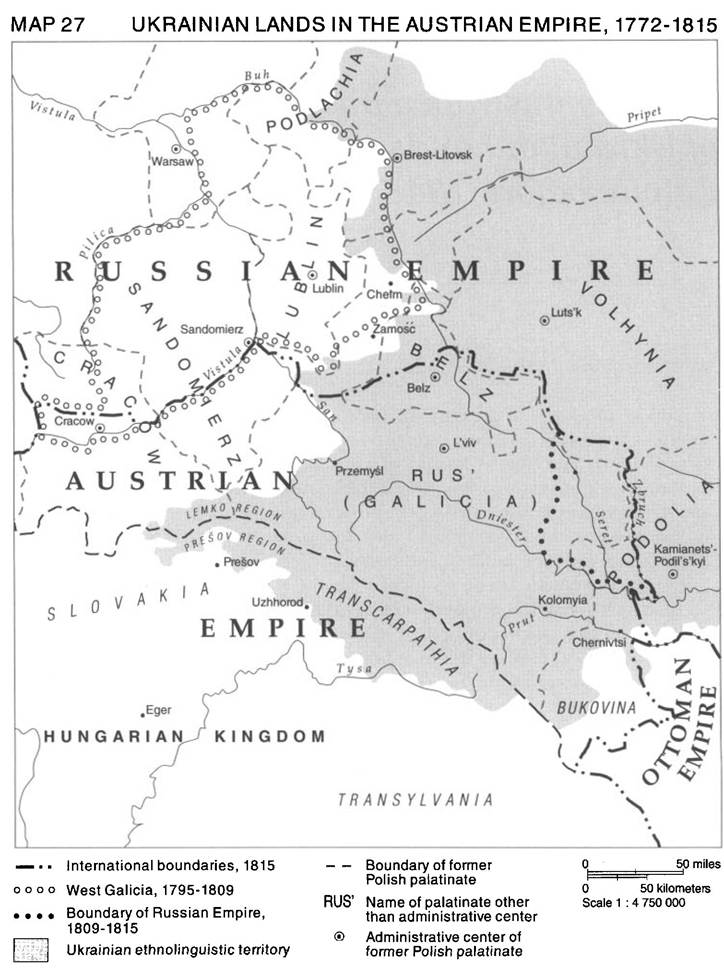
entire upper valley of the Vistula River almost as far north as Warsaw. This new, primarily Polish-inhabited territory was named West Galicia, although it was not to remain in Habsburg hands for long. Following Austria’s defeat by Napoleon, West Galicia together with the Polish-Ukrainian ethnographic borderland region around Zamosc was ceded to the French dependency known as the Duchy of Warsaw. Then, following the defeat of Napoleon, Europe’s boundaries were redrawn in 1815 at the Congress of Vienna. Austria’s northern boundaries were fixed and were to remain unchanged for nearly a century, until the outbreak of World War I in 1914. Austria’s province of Galicia was restored according to the boundaries it had had in 1772, excluding the region around Zamosc. At its far western end, the city of Cracow and its environs north of the Vistula River were detached from Galicia and made into a free republic, although under Austria’s protection.
The structure of the Austrian Empire
What was this Austrian Empire in which large numbers of Ukrainians found themselves during the last quarter of the eighteenth century? In a sense, the empire was a relic from the Middle Ages, a time when royal families acquired territories as part of their personal patrimony. The family in question were the Habsburgs, who, beginning in the thirteenth century with the Germanic territories of Austria, Tyrol, Carniola, and Styria and a capital at Vienna on the middle Danube, steadily expanded their realm. By the late eighteenth century, Habsburg possessions were, in Europe, second only to the Russian Empire in territorial size. To provide some idea of its extent, Habsburg territory at the end of the eighteenth century consisted of what are today the entire countries of Austria, the Czech Republic, Slovakia, Hungary, Slovenia, and Croatia and substantial parts of Italy, Romania (Transylvania), Serbia (Vojvodina), Poland, and Ukraine.
The inhabitants of the Habsburg domains were as diverse as the territories under its rule. The major languages spoken were German, Magyar, Czech, Slovak, Polish, Ukrainian, Slovenian, Serbo-Croatian, Romanian, and Italian. These were only the ten major languages, however, all of which appeared on the empire’s paper money by the late nineteenth century. There were also numerous others, including Yiddish, Romany, and Armenian.
The administrative structure of the Austrian Empire was initially quite complex, since each new territory acquired over the centuries - whether a kingdom, or a grand duchy, or a duchy, or simply a city - often retained its own traditional customs and administration. The largest of these entities, and because of its selfgoverning status the most distinct, was the Hungarian Kingdom. For centuries that powerful kingdom had ruled large parts of east-central Europe, but in the early sixteenth century Hungary was overrun by the Ottoman Turks. It was also at that time that the Habsburgs laid their first claim to the Hungarian throne. When the Ottomans were finally driven out of the Danubian Basin at very end of the seventeenth century, the Habsburgs ruled Hungary as the country’s titular kings, although they were obliged to permit a degree of self-rule, the extent of which was to vary according to political circumstances. It was not until 1867 that the Hungarian Kingdom finally acquired virtual self-governing status, and it is only from this date that the term Austro-Hungarian Empire can properly be used.
Galicia and its inhabitants belonged to the non-Hungarian part of the Austrian Empire. The non-Hungarian part did not really even have a name; it was simply a conglomerate of historical territories or provinces. They included Bohemia, Moravia, Silesia, Galicia, Upper and Lower Austria, Vorarlberg, Tyrol, Salzburg, Styria, Carniola, Gorizia-Gradisca, Trieste, Istria, and Dalmatia, and, for more than half of the nineteenth century, the Italian provinces of Lombardy and Venetia.
For want of another name, the historical literature often refers to all these provinces either as Austria, the Austrian half of the Habsburg Empire, or Cis-Leithenia, that is, ‘lands on this (the Vienna) side of the Leitha River,’ which formed the border with Hungary.Many of the provinces had their own assemblies, made up of representatives from three estates - the clergy, the magnates, and the gentry landowners - which together often struggled to preserve a degree of local autonomy in the face of an ever-growing bureaucracy and a central administration in the imperial capital of Vienna. At the head of that administration was the monarch, a member of the family of Habsburg, who was assisted by several governing boards known as chancelleries. All appointees to the chancelleries were made by the emperor, who in effect was the state’s ultimate authority. The Hungarian Kingdom had its own parliament elected by the Hungarian nobility, although its authority over the kingdom’s affairs varied according to the political fortunes of that country vis-à-vis the Habsburg central administration in Vienna.
Despite its diversity, the Habsburg Empire was not simply a motley conglomerate of territories and peoples held together by military force or political inertia. There were, indeed, several factors which contributed to a sense of unity within the empire. Moreover, the number and reach of the integrating factors increased in the course of the nineteenth century. Some of them obtained until - and even after - the demise of the empire in 1918. Among them was the bureaucracy, which became an efficient and fair, if sometimes overbearing, instrument of Austrian rule. Others were the legal system, the army (in which every male had to serve), and the schools, which provided universal and compulsory education at the elementary level. All these institutions promoted a sense of imperial Habsburg patriotism among the empire’s inhabitants. German was the official language of the administration and upper levels of education, and it functioned as the common language, the lingua franca, of those elements of the population - administrators, intellectuals, tradespeople, even some peasants - who needed a means of communicating with other citizens of the empire.
Perhaps more pervasive were the tangible symbols of imperial culture, which became entrenched in the psyches of the empire’s inhabitants. Architecture was one such symbol. Even today there are sections in cities as widely scattered as Milan, Prague, Budapest, Sarajevo, L'viv, and Chernivtsi that resemble each other as well as the squares and buildings in the imperial capital Vienna of which they are copies. At the more popular level, the coffeehouse culture and Sunday strolls along the corso past parks with bandstands allowed for the waltzes of Johann Strauss, Jr, and the operettas of Strauss and the Hungarian-born Franz Lehar and Emerich Kalman to become a kind of ‘national’ music for the empire as a whole, their melodies probably as well known as was the local folk music to each of the respective nationalities. Finally, the Habsburg rulers themselves became undeniable symbols of unity and, in some cases, national heroes for several of the empire’s peoples. This was certainly true of the eighteenth-century rulers Maria Theresa and Joseph II. Even Franz Joseph, whose nearly seven decades of rule from 1848 to 1916 coincided with the height of nationalist passion among the empire’s peoples, became for many of them a unifying imperial Austrian symbol. He was respected, even revered as a ‘father figure’ who stood above the national and social conflicts of the late nineteenth century. The point is that despite its enormous heterogeneity, the Habsburgs succeeded in creating a sufficient number of unifying and integrative elements that the Austrian Empire became an acceptable social and political framework for most if its inhabitants up to and even after the outbreak of World War I in 1914.
The demographic and administrative status of Galicia and Bukovina
Galicia and Bukovina with their Ukrainian inhabitants entered the Austrian Empire at a favorable time in its history. In 1699, the Habsburgs had finally driven the Ottomans out of territory that formerly had been under either Hungary or Austria.
The threat from the ‘infidels’ (the Turks had besieged Vienna as recently as 1683) had at last ended, and the Habsburgs could now turn to consolidating authority within their lands. To accomplish this, however, they needed to reform the antiquated social and administrative structure of the empire into a more functional structure. Reforms were carried out by two of Austria’s most dynamic and talented rulers, the Empress Maria Theresa (reigned 1740-1780) and her son Joseph II (reigned 1780-1790). Since Joseph became co-regent in 1765, many of the Theresian reforms were actually implemented by him. For this reason, the whole reform period is often known simply as the Josephine era.Both mother and son were enlightened rulers convinced that the good of society as a whole depended on the proper functioning of the state. A successful state in turn depended on the ability of each inhabitant to serve. Thus, each person had a role to play in the system, and it is in this context that Emperor Joseph II described his own role as that of the first servant of the state. Since Galicia became part of the Habsburg Empire during the last years of Maria Theresa’s reign, the enlighted Austrian theory of government was applied to this new territory.
In 1772, the Austrian province of Galicia comprised 31,700 square miles (82,000 square kilometers). According to the census of 1786, the province had 2.7 million inhabitants, divided more or less evenly along the San River between Poles in the western half of the province (the former Cracow and Sandomierz palatinates) and Ukrainians in the eastern half (the former Rus' and Belz palatinates). By 1849, the population had more than doubled, to 4.9 million inhabitants, with a slightly higher number of Ukrainians than Poles (see table 30.1). The vast majority of Ukrainians lived in eastern Galicia, where of a population of 3.1 million they made up 71 percent of the inhabitants. The number of inhabitants increased in Bukovina dramatically, from 75,000 in 1775 to 380,000 in 1846. Bukovina’s population was more or less evenly divided between Ukrainians in the northern half of the province and Romanians in the southern half.
In terms of religious identity, the Poles were Roman Catholic and the Ukraini-
TABLE 30.1
Nationality composition of Galicia, 18491
| Number | Percentage | |
| Ukrainians | 2,303,000 | 46.8 |
| Poles | 2,258,000 | 45.9 |
| Jews | 328,000 | 6.7 |
| Germans | 27,000 | 0.6 |
| Others | 3,000 | 0.0 |
| TOTAL | 4,919,000 | 100.0 |
ans Uniate, or Greek Catholic, although there was also a small minority known as Latynnyky, who were either Ukrainian converts to Roman Catholicism or ukraini- anized Poles who retained their Roman Catholic faith. In Bukovina, the Ukrainians were for the most part Orthodox, although there was a small minority of Greek Catholics. The social structure of Galicia in the 1770s was overwhelmingly agrarian: 87.2 percent of the population lived in 6,300 rural villages. Nearly three- quarters (72 percent) of the population were serfs, of whom 78 percent were owned by the Polish szlachta and 22 percent worked on former Polish crown lands. The Polish szlachta numbered 95,000, or 3.4 percent of the total population.
Since Galicia was acquired during an era of reform in the Habsburg Empire, the former Polish administrative system was entirely dismantled. After 1786, Austrian laws replaced Polish ones. The local dietines (sejmiki) in Poland’s former palatinates were abolished; and while elected town councils survived for a while, they too were later replaced by administrators and bureaucrats appointed from Vienna. Following the pattern in other provinces of the Austrian half of the empire, a body called the Assembly of Estates was set up in L'viv (in German, Lemberg), the province’s administrative capital. The Assembly was composed of clergy, magnates, and gentry, and though it could send petitions to the emperor, it had no real power of its own.
All political power was effectively in the hands of the emperor’s appointee, a governor (German: gubemator, Polish: naczelmk) who ruled with his administration from L'viv. Within a decade of the Austrian acquisition of Galicia, the whole province was divided into nineteen regions (German: Kreise), one of which after 1787 became Bukovina. The free city-state of Cracow remained outside this structure from its inception in 1815 until 1846, when it too was made an integral part of the province of Galicia.
The reforms initiated by the Habsburg rulers were intended to apply throughout the empire and to affect all areas of life. Their objective was to transform the Austrian Empire into a rationally organized modern bureaucratized state. In 1775, most of the internal tariffs left over from medieval times were abolished (although the customs boundary with Hungary continued until 1851); between 1766 and 1788, criminal procedures were regulated and standardized, and torture was abolished; in 1781, an edict of toleration applicable to all religions was imple-
mented, following the earlier governmental declaration that the three Catholic rites in Galicia (Roman, Greek, and Armenian) were of equal standing; in 1782, the entire imperial administration was centralized in Vienna for the Austrian lands and in Buda for Hungary; also in 1782, ‘unnecessary’ monastic estates were secularized; in 1783, a church fund was established making parish priests state employees; and in 1784, German was made the sole official language of the empire. Other reforms had a particularly favorable effect on Galicia. In 1777, Maria Theresa restructured the educational system with the intention of producing worthy and responsible citizen-servants of the state. To ensure that this goal was achieved, Joseph II made elementary education compulsory, with instruction in the vernacular language of the local regions.
Galicia’s nobility and peasantry were also deeply affected by the Josephine reforms. The former dominant position of the Polish szlachta came to an end. Whereas the magnates and gentry who made up the szlachta had always been economically and thus politically differentiated, in legal practice both groups had been equal under the old Polish system. The Austrian government destroyed the ‘egalitarian’ character of the szlachta by splitting it into two estates, the magnates and the gentry. Moreover, the tax-exempt status of both groups was removed, and they were made subject to Austrian law, which did not provide for the kind of personal and property guarantees available in the old Polish-Lithuanian Commonwealth, in which the szlachta, especially in the countryside, to a certain degree had been able to circumvent the law.
The peasant-serfs in particular were affected by the Austrian reforms. Serf obligations became strictly defined under Maria Theresa, with the result that their dependence on the arbitrary will of the landlord was lessened. Joseph II went even further, and in 1781 he abolished many of the more restrictive aspects of serfdom. The peasant was now free to marry without the lord’s permission, to change his or her occupation, and to leave the land provided a replacement could be found. Moreover, he or she had the right to justice in courts which were no longer in the hands of the Polish landlords. The land was divided into dominical, or demesne, estates, owned by the lord, and rustical lands, held by the peasant. In theory, Austrian law prevented landlords from adding rustical lands to their estates, except through an otherwise complicated administrative process. In practice, however, the landlords could and did add such land easily enough during the periodic land surveys. That the transfers did not take place to any significant degree was owing to economic self-interest. In the absence of wage labor, it was more profitable for landlords that the peasantry hold land. By 1844, 70 percent of the arable land, 69 percent of the meadows, and 64 percent of the pastures were classified as rustical lands, although 98 percent of the forests belonged to landlords’ dominical estates.
At the same time, these otherwise positive reforms subjected the peasants to heavier taxes and to long-term compulsory military service. Because the landlords were expected to make provision for collecting taxes and for supplying military recruits, the peasants soon viewed them as an evil force as against the good and understanding emperor in Vienna. Joseph II was particularly lionized after his death. Consequently, when the new emperor, the otherwise competent Leopold II (reigned 1790-1792), was forced to reinstate certain aspects of serfdom (although according to the lord-peasant regulations introduced by Maria Theresa), Joseph II became for Galician-Ukrainian peasants the symbolic prototype of the good emperor, whose efforts on behalf of the downtrodden were to be remembered in prayers and folklore for decades to come. Although the abolition of serfdom was reversed, most of the Theresian and Josephine reforms, especially in the realms of the legal system, education, religious tolerance, and equality among the various Catholic rites, remained in force. They were to have an especially positive effect on Ukrainian life in the Austrian Empire.
The economic status of Galicia before 1848
Owing to the general economic policies of the empire, the economic situation in Galicia did not improve significantly during the first seventy-five years of Austrian rule. Like other European powers of the time, Austria favored the policy of mercantilism, in which the state takes an active role in directing the economy. The Austrian Empire adopted a particular brand of mercantilism, however, based on the concept of autarchy. This meant that Austria was less interested in achieving a favorable balance of trade than in creating an internally self-sufficient economic system based on regional specialization and complementarity. Essentially, the empire’s eastern lands were to supply agricultural products and, wherever possible, raw materials for its western lands, especially the highly industrialized provinces of Bohemia, Moravia, and Lower Austria. Since Galicia and Hungary were in the eastern, agricultural zone, industrialization in these regions was not encouraged. This was because manufactured goods produced there might compete with those from the western portion of the empire, which needed to distribute its goods in the Hungarian and Galician markets in order to survive. Although the system was reasonable in theory, in fact Galicia, like Hungary, became an internal colony of Austria’s western provinces. Moreover, the maintenance of serfdom and, once again, the control of the agricultural sector by tradition-minded Polish landlords worked against any modernization or increase in productivity. At the same time, the average size of peasant land allotments continued to decline, and the number of peasants holding the smallest plots of land increased dramatically. For instance, between 1819 and circa 1853, the number of peasants holding less than 2.7 acres (1.1 hectares) of land increased by 114 percent, and the number of those holding 2-7 to 6.9 acres (1.1 to 2.8 hectares) increased by 62 percent. These two smallest land units represented 35 percent of all holdings in 1819 and 44 percent in 1847-1859.
In short, the economy of Galicia did not improve and the peasant masses remained at a mere subsistence level. The industrial sector remained small and was actively discouraged from expanding. For example, at the end of the eighteenth century there were only 40 iron works, 26 textile mills, 26 glass works, 8 sugar refineries, and 18 printing shops throughout all of Galicia, and most of these were in the western, or Polish, half of the province. The eastern, or Ukrainian, half had a few paper mills and numerous breweries and distilleries. Looked at in another way, while Galicia (together with Bukovina) had 20 percent of the empire’s population, only 5.5 percent of its inhabitants were engaged in some kind of industrial activity.
Other peoples in eastern Galicia
In Galicia east of the San River, the Ukrainians comprised a 71 percent majority of the population. The second-largest nationality were the Poles, who in 1849 numbered 635,000, or 20.4 percent of the inhabitants in eastern Galicia. It was not their number, however, but rather their political and social influence that distinguished the Poles wherever they lived in Galicia. The province’s leading social strata, the magnates and gentry, were exclusively Poles or descendants of Ukrainian gentry who had been polonized centuries ago. Although during the Josephine reform era the Austrian government tried to limit the political and administrative influence of the Polish magnates and gentry, their economic and social influence remained all-pervasive as long as serfdom existed. Then, with the return to a conservative trend in Austrian politics after 1815, Vienna more and more depended upon the Polish gentry, especially the magnates, to run the affairs of the province. Besides the magnates and gentry, there were a large number of Polish peasants who had been settled in eastern Galicia during the previous several centuries by their landlords, and a small group of Roman Catholic clergy, who served the religious needs of the Polish lords and peasants.
Despite their status as a numerical ‘minority’ in eastern Galicia, it is inappropriate to refer to the Poles as a minority. Although their situation had changed during the reform era that coincided with the early decades of Austrian rule in Galicia, it was not long before the Polish magnates and gentry were restored to the same leading roles as when the province was still part of the Polish-Lithuanian Commonwealth. By the same token, the magnates and gentry equated their social status with the very meaning of Polish nationality. Accordingly, only a noble could be a Pole, and it was irrelevant for them whether the peasant masses among whom they lived were ethnically Polish or Ukrainian. As for the territory of Galicia, it was the land that Polish nobles and their ancestors had inhabited for centuries and, as such, an inalienable part of the Polish cultural patrimony, regardless of what state ruled it.
As in Dnieper Ukraine, the Jews were an important element in Galicia. They are known to have inhabited the cities of L'viv and Halych as early as during the thirteenth-century Kingdom of Galicia-Volhynia. It was with the beginning of Polish rule in the second half of the fourteenth century, however, that Jews came in larger numbers as part of the arenda economic system that prevailed in all parts of Polish-controlled Ukraine. By the mid-i770s, just after Galicia had become part of the Austrian Empire, Jews comprised 3.1 percent of the province’s entire population, but 8.7 percent of the inhabitants in the eastern half of the province. Under Austrian rule, their numbers continued to increase: from 144,000 in 1776 to 328,000 in 1849. Three-quarters lived in eastern Galicia, and about 60 percent in small towns and cities.
Seven towns - Brody, Belz, Buchach, Rohatyn, Peremyshliany, Deliatyn, and Sokal' - were almost entirelyjewish. In several cities - L'viv, Zhovkva, Drohobych, Stanyslaviv, Ternopil', and Kolomyia - Jews accounted for one-third or more of the inhabitants. The following percentages, which are from 1900, reflect Jewish occupational patterns throughout the nineteenth century: 63 percent engaged in industry and commerce, 14 percent in agriculture, and 5 percent in civil service and the liberal professions.
Like the other peoples of Galicia, the Jews were deeply affected by the Josephine reforms. Their traditional system of local self-government, known in Poland as the Council of Lands, was abolished by the Austrian government, which viewed it as a relic of the medieval past. Initially, the Austrians set up their own form of internal Jewish autonomy (a system of congregational districts presided over by a general directorate headed by the community’s chief rabbi), but even this seemed to clash with Joseph H’s goals of administrative standardization. Consequently, in 1785 it was abolished together with rabbinical civil law, which had previously governed the community. From Vienna’s point of view, Jews were to be given full equality according to the edict of religious toleration. This also meant that while they would not be singled out for discrimination, they would also have the same responsibilities as other citizens. They would have to pay the same taxes, serve in the army, and use German, not Yiddish, as a medium of secular culture. After Joseph’s death, when many of his reforms were undone, some new restrictions were placed on Jews which affected their freedom of movement and ability to serve in certain offices and professions. In short, the status of the Jews in Galicia fluctuated with the internal political fortunes of the Habsburg Empire.
Joseph’s reforms also had a profound impact on Jewish culture in Galicia. The previous dominance of the rabbis and the traditionalist way of life as set down in the Talmud and rabbinical law came to an end. Although traditional rabbinic talmudism continued to exist, Galician Jewish culture now came to be dominated by two other trends - the Haskalah and Hasidism.
The Haskalah, or enlightenment movement, originated in Germany in the 1760s and soon afterward entered Galicia. Its goals were to abolish the inwardlooking attitudes of the Jewish communities, traditional dress, talmudic education, and the ‘bastardized dialect’ Yiddish. In a sense, the Haskalah was a complement to the Josephine efforts at assimilation. When Vienna’s policies in that direction finally ended in 1806 (the year in which the 104 German-language schools set up specifically for Jews in 1787 were closed), the Haskalah carried on the enlightenment by establishing its own modern secular educational system and its own reformed Jewish synagogues, called temples. The models in education were created by Josef Perl in his German-language Jewish secondary schools (gymnasia) in Brody and Ternopil'.
Despite the advances made by the Haskalah, it was the Hasidic movement that was to have the greatest impact on nineteenth-century Galician Jewry. Hasidism had originated in Dnieper Ukraine, in the neighboring province of Podolia, during the second half of the eighteenth century. The Hasidim were noted for their emphasis, in opposition to that of the learned rabbinical tradition, on the emotional aspect of religious experience. This was expressed through mass enthusiasm, group cohesion, and charismatic leadership. Because of its mystical and ‘superstitious’ nature, Hasidism was castigated both by traditionalist rabbis (mitnaggedim, or opponents) and by Austria’s enlightened reformist Jews and supporters of the Haskalah. Nonetheless, Hasidism enjoyed popular appeal among the Jewish masses, and by the 1830s it had become the dominant way of Jewish life in Galicia.
Late nineteenth-century eastern Galicia also produced cultural figures who became known well beyond the Jewish world into which they were born and to which they had initially been acculturated. The Viennese editor Karl-Emil Franzos (of Sephardic Jewish background) spent the first half of his life in Galicia and Bukovina, whose Ukrainian inhabitants became the subject of some of his German-language novels and short stories. Two other Galician-born Jewish writers were to make their literary careers primarily after World War I, by which time Austria-Hungary had ceased to exist: the German-language novelist Joseph Roth, whose writings are imbued with themes from life during the last years of the Habsburg Empire, and Bruno Schultz, the award-winning Polish novelist and short-story writer whose style singled him out as a pioneer of the magical and absurd in literature.
Among the numerically smaller groups were the Germans. They began to immigrate to Galicia in the late thirteenth and the fourteenth centuries as priests, soldiers, artisans, and traders. By the sixteenth century, most of these medieval settlers had assimilated into Polish culture. A second wave of German colonists arrived in Galicia after it became part of the Austrian Empire. Anxious to improve the economic status of its new province and to secure Germanic influence, the Habsburg government issued two decrees (1774 and 1781) according to which the new colonists would receive land allotments, exemption from military service, and tax-free status for a period of six years. Between 1781 and 1785, 13,000 Germans, mostly from the Palatinate and other southwestern German states, took advantage of the Austrian offer and settled in Galicia. They were followed by 2,000 more Germans from the Sudetenland, that is, Austria’s northwestern Bohemia, who came during the first half of the nineteenth century.
The Germans in Galicia were split between Evangelical Lutherans and Catholics. Their numbers rose steadily, from an estimated 27,000 in 1849 to 65,000 in 1910. About two-thirds resided in eastern Galicia, in a belt of small villages stretching from Zhovkva in the north, on past L'viv, to Drohobych and Stryi in the south. The Galician Germans kept to their agricultural pursuits without much interaction with the surrounding Ukrainians. Isolated for the most part in rural areas, Galicia’s Germans produced only a few individuals who engaged in cultural pursuits. They included the L'viv-born writers Thaddaus Rittner and the better- known Leopold von Sacher-Masoch. The latter’s numerous short stories, with their titillating descriptions of sexual perversion drawn from the author’s observations in the Galician countryside, became very popular in the rest of Europe through French translations, and they provided the ‘new science’ of psychoanalysis with vivid examples of human behavior that subsequently gave rise to the term masochism.
Finally, there was a small Armenian community. Since the Middle Ages, the Armenians had played an important role as artisans and tradespeople, especially in L'viv. The community reached its height during the seventeenth century and then declined in size. By the first half of the nineteenth century, there were only 3,000 Armenians left. In the late seventeenth century, the Christian Armenians of Austria-Hungary entered into union with Rome, and L'viv became the seat of an Armenian-rite archbishopric with jurisdiction throughout the Habsburg Empire. While the Armenian-rite Catholic church continued to function in L'viv with its own bishop and cathedral church, by the nineteenth century the clergy and its small flock had become completely polonized.
More on the topic The Administrative and Social Structure of Ukrainian Lands in the Austrian Empire before 1848:
- The Ukrainian National Awakening in the Austrian Empire before 1848
- 30 The Peoples in Ukrainian Lands under Habsburg Rule, 1772-1914
- Contents
- 29 Ukrainian Lands under Habsburg Rule, 1772-1914
- Revolutionary years, 1848-1849
- The Postwar Treaties and the Reconjiguration. of Ukrainian Lands
- Mykhailo Drahomanov and His Mission