Administrative and Political Developments in Dnieper Ukraine
With the elimination of Poland from the map of Europe following the Third Partition in 1795, all Ukrainians came to live under the rule of two multinational states: the Russian Empire and the Austrian, later the Austro-Hungarian, Empire.
This political situation prevailed until the twentieth century and the outbreak of World War I in 1914. The vast majority of Ukrainians - close to 85 percent - lived within the boundaries of what will be referred to as Dnieper Ukraine in the Russian Empire. This and the next four chapters will discuss developments to 1914 in Dnieper Ukraine. Another six chapters will concentrate on Ukrainian-inhabited lands in the Austro-Hungarian Empire to 1914.Territorial divisions
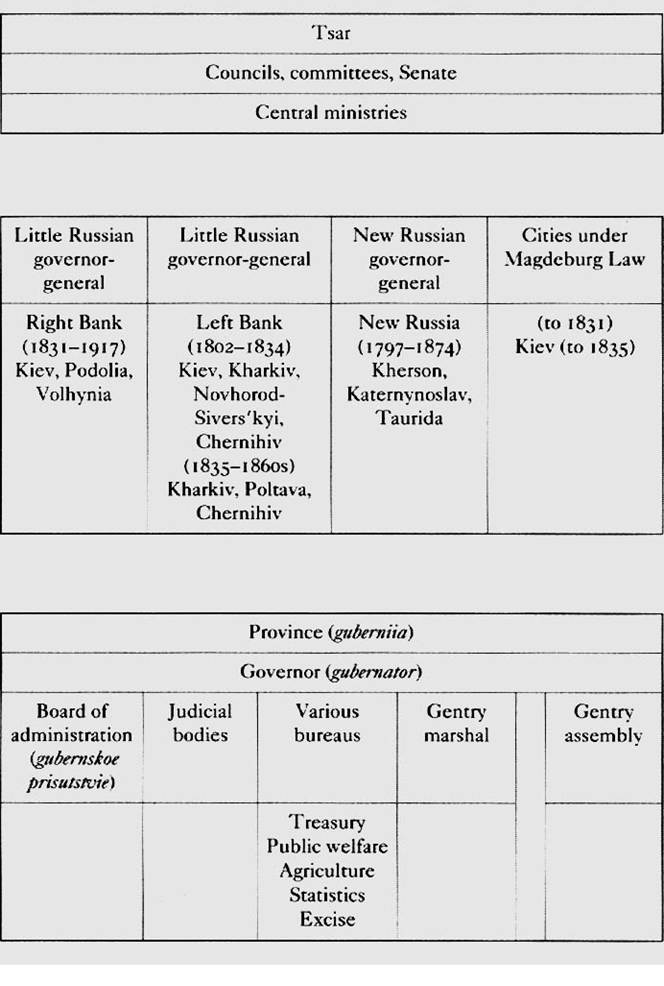
The tone of administrative and political life in Dnieper Ukraine was set by Catherine II during the 1780s, when the last vestiges of autonomy as embodied in the Het- manate were abolished. After 1785, there were no longer any autonomous regions on Ukrainian territory, which henceforth was to be administered in the same manner as other parts of the Russian Empire. Despite several changes during the course of the nineteenth century, the administrative system retained five basic levels: (1) the village and city, (2) the county, (3) the province, (4) the region, and (5) the empire, headed by the tsar and his central administration in St Petersburg.
Administrative restructuring began in 1775, when Empress Catherine II issued the Fundamental Law for the reorganization of the empire. The object of this law was to create a standard administrative pattern throughout the empire. The basic unit was the imperial province (namestnichestvo). Each imperial province was to have a roughly equal number of up to 700,000 inhabitants, and its territory was subdivided into counties or districts (Russian: uezdy; Ukrainian: povity), each of about 70,000 inhabitants.
The imperial province was headed by a governor appointed by the tsar and responsible directly to St Petersburg. This administrative system was applied to Ukrainian territories as well, although after 1802 the old imperial provinces (Russian: namestnichestvd) were replaced by a greater number of smaller provinces (Russian: gubemii).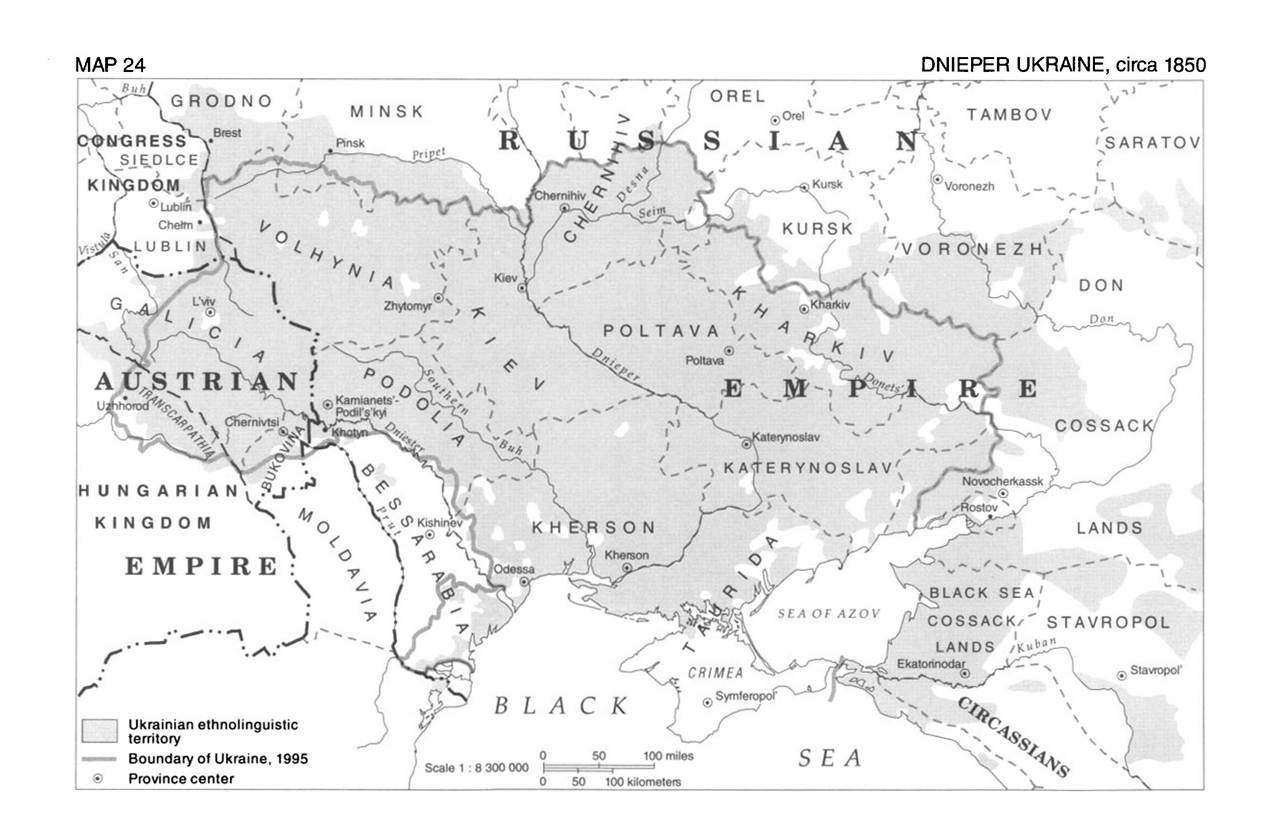
The largest concentration of Ukrainian inhabitants lived in nine provinces. These included, on the territory of the Hetmanate, the provinces of Chernihiv and Poltava. In former Sloboda Ukraine, an imperial province of the same name was established (although without certain territory in the north and northeast), and in 1835 it was renamed the province of Kharkiv. From former Zaporozhia, which had become part of New Russia after 1775, the provinces of Katerynoslav and Kherson (including lands between the lower Dnieper and Dniester Rivers acquired between 1774 and 1791 from the Ottoman Empire) were created. Of the old Crimean Khanate, both the peninsula and the lowland coastal region between the lower Dnieper River and Sea of Azov became the province of Taurida. The lands acquired from Poland in 1793 and 1795 became the provinces of Kiev (including the city and surrounding area formerly within the Hetmanate), Vol- hynia, and Podolia. Together, Kiev, Volhynia, and Podolia provinces were frequently referred to as the Russian Empire’s Southwestern Land (lugo-zapadnyi krai) and will be referred to henceforth as the Right Bank.
Besides the nine ‘Ukrainian’ provinces, Ukrainians also inhabited areas in immediately adjacent provinces or regions of the Russian Empire. These included, in the east, parts of the Don Cossack and Black Sea Cossack Lands; in the west, parts of the province of Bessarabia (both the coastal region in the south and the region around Khotyn in the north); and in the northwest, the regions around Brest and Chelm. These last two borderland regions had a complicated history.
The areas of Brest and Chelm on the left bank of the Buh River were annexed by Austria, those on the eastern or right bank by Russia. In 1809, Russia acquired the left bank as well, which from 1815 to 1861 was made part of the autonomous Congress Kingdom of Poland. Thereafter, the Brest and Chelm regions were divided between the provinces of Grodno, Siedlce, and Lublin.Administrative structure
Like the old imperial provinces, the smaller provinces (gubernii) that formed the basis of the imperial Russian administrative structure during the nineteenth century were each headed by a governor (Russian: gubernator) appointed by the tsar. The governor was assisted by a board of administration (gubemskoe prisutstvie) and various bureaus or committees responsible for specific problems - taxes, public welfare, agriculture, and so on.
Below the province level was the county or district (Russian: uezd', Ukrainian: povit), for which the most important officials were the police commandant (isprav- nik) and gentry marshal (predvoditel' dvmianstua). The county administration also had a ruling board (nizhnii zemskii sud) and various bureaus or committees.
Whether in Dnieper Ukraine or in the Russian Empire as a whole, it was the nobility who directed local government. Each county had its own gentry assembly (sobranie dvorianstva) consisting of all nobles over twenty-five years of age whose lands in the county produced an annual income of at least too rubles. The gentry assembly elected the gentry marshal and police commandant, who were, as mentioned above, the two leading officials at the county level of administration.
Administrative Structure
in Dnieper Ukraine before the 1860s
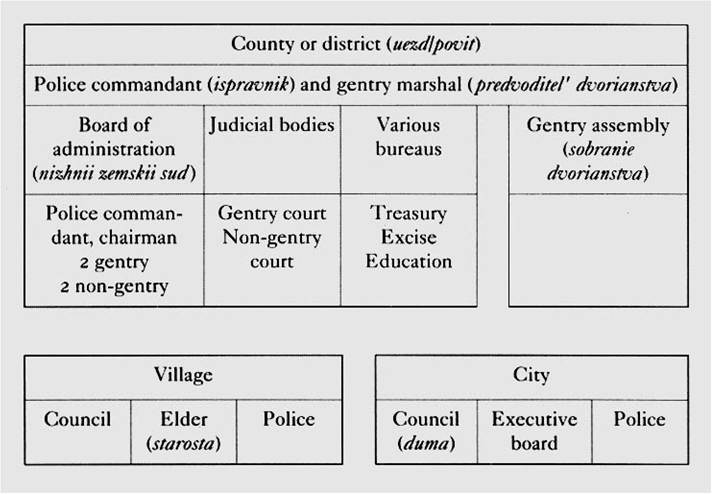
The gentry assembly also chose officials to head the various county bureaus as well as delegates to the provincial gentry assembly.
The assembly at the provincial level functioned in the same manner as that at the county level, that is, it elected officials to head various provincial bureaus and nominated candidates for the post of provincial gentry marshal.The lowest level of administration was the village, and the township or city. Cities experienced a particular development. Those that historically had self-rule as embodied in Magdeburg Law remained outside the provincial structure until 1831 (Kiev until 1835), when Magdeburg Law was abolished. Thereafter, cities and towns, each with its own council (duma) and executive board, were made subordinate to the county or provincial administration of the area in which they were located. The only exception was the port of Odessa, which with a small hinterland formed a territory dependent directly on the central government.
As part of the reform of the 1860s, the so-called zemstvo institutions were introduced in certain parts of the empire. These were established in an effort to democratize governmental administration at the local level and at the same time to resolve pressing social problems by encouraging local initiative and activity. It should be kept in mind that the zemstvos, which existed at both the county and the provincial level, did not replace any existing institution. Rather, they were responsible for a limited number of local matters. Because the zemstvos were administrative entities parallel to the provincial and county gentry assemblies and boards of administration, they often clashed with these bodies over matters of
Administrative Structure
in Dnieper Ukraine after the i86os
id="Picutre 29" class="lazyload" data-src="/files/uch_group78/uch_pgroup304/uch_uch7212/image/image029.jpg">
Administrative and Political Developments 31
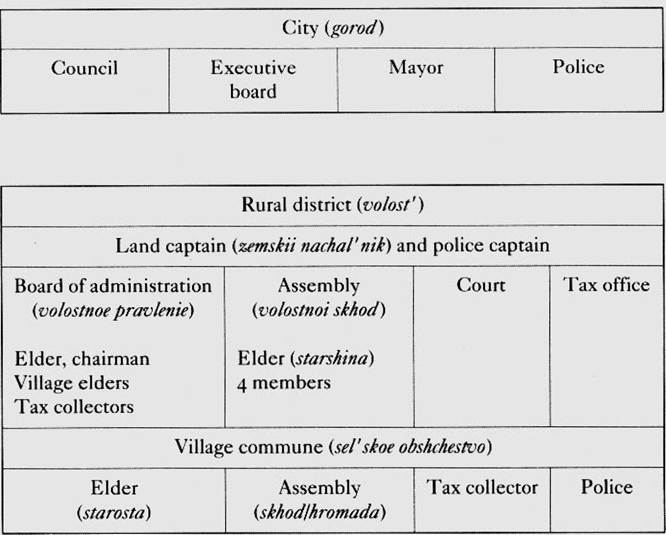
rural district was, in turn, made up of village communes (sei'skie obshchestva). The village commune had its own assembly (Russian: skhod·, Ukrainian: hromada), which elected a village elder (starosta) as well as delegates to the rural district assembly (volostnoi skhod).
Each rural district also had its own board of administration and was headed by a land captain (zemskii nachal' nik) and police captain appointed by the central government.Above the province, the basic administrative division was the office of governor-general (general’ nyi gubernator). This post was never established throughout the Russian Empire as a whole, although it was often to be found in the borderland regions. The Ukrainian provinces fell into this category, and at certain times they had as many as three governors-general. Two of them carried the title Governor-General of Little Russia, although their jurisdictions differed at various times. By the 1830s, there was a governor-general for the Right Bank (Kiev, Podolia, and Volhynia, 1831-1917) and one for the Left Bank (Kharkiv, Poltava, Chernihiv, 1835-18605). There was also a Governor-General of New Russia (Kherson, Katerynoslav, and Taurida, 1797-1874). The governors-general had supervisory capacity over the provincial governors within their respective jurisdictions, and they were responsible for setting general policy for the region as a whole.
Finally, at the very top of the imperial administrative structure was the tsar in St Petersburg. By the nineteenth century, the Russian Empire had become an absolute hereditary monarchy, and with the adoption of the Law of Succession to the Throne in 1797, the Romanov family - specifically the eldest son of each tsar - was given exclusive title to the imperial throne. Thus, unlike in previous centuries, in the nineteenth century the royal mantle could be passed without difficulty from one tsar to the next. During that time, the empire had five rulers: Alexander I (reigned 1801-1825), Nicholas I (reigned 1825-1855), Alexander II (1855-1881), Alexander III (reigned 1881-1894), and Nicholas II (reigned 1894-1917). Until the very end of the Russian Empire’s existence in 1917, the tsar, in contrast to rulers or governments in most other parts of Europe, had absolute control over his subjects.
Not even the revolutionary events and constitutional experiments during the first decade of the twentieth century limited in any serious way the tsar’s authority.At the imperial level, the Russian Empire was administered by several ministries, each headed by a single minister appointed by the tsar. The ministerial system, adopted in 1802 (instituted in 1811), replaced the old system of colleges, or collegia (i.e., state departments headed by boards of twelve members) set up a century earlier by Peter I. By the end of the nineteenth century, there were ten ministries and several other administrative agencies. From the standpoint of the empire’s administrative structure, the most important of these was the Ministry of Internal Affairs, which headed a chain of command that went down from the imperial level through the provincial governors to the county police commandant, rural district police captain, and, finally, village commune police.
The imperial administration also consisted of various bodies, such as the Committee of Ministers, the Council of Ministers (est. 1857), the State Council (est. 1801), the Senate, and the tsar’s Chancery. Some of these, in cooperation with the tsar, were responsible for legislative and judicial as well as administrative matters. The result of such a system was often jurisdictional overlap. Finally, in 1906, in an attempt to alleviate the problem of overlapping jurisdictions, a new governmental structure was adopted. Henceforth, there were to be clear divisions between legislative (State Council and State Duma), executive (Council of Ministries), and judicial (Senate) responsibilities. All these branches at the imperial level of government were under the supreme authority of the tsar.
In essence, the administrative structure of the Russian Empire was designed so that despite certain areas of administrative autonomy (provincial and county gentry assemblies and zemstvos, and rural district and village commune assemblies) there was a chain of command represented by certain officials (especially in the police) whose ultimate authority rested in the unchallenged authority of the tsar. Within such a centralized and autocratic structure, Ukraine had no real distinct administrative life. The Dnieper-Ukrainian lands formed an integral part of the Russian Empire, which throughout the nineteenth century managed to follow a relatively stable existence.
The evolution of the Russian Empire, 1814-1914
After the end of the Napoleonic Wars and the defeat of France in 1814, the Russian Empire emerged as Europe’s greatest land power. Of Russia’s traditional enemies, Poland had ceased to exist; Ottoman Turkey was growing weaker and on its way to becoming the proverbial ‘sick man of Europe’; and France was in the throes of its post-Napoleonic defeat. Immediately to the west, the tsarist government was, at least during the first half of the nineteenth century, closely allied with both the Austrian Empire and Prussia, who together with Russia saw themselves a part of a Holy Alliance ‘destined’ to protect and preserve stability in Europe. Russia’s prestige was therefore at its height in the decades after 1815. Even when revolution spread throughout most of Europe in 1848, the Russian Empire was virtually unique in not experiencing political disturbance. As the strongest and most stable force of the day, the tsar was even called upon by Habsburg Austria to intervene in its struggle with the Hungarians. Hence, it was the army of Tsar Nicholas I that put down the Hungarian revolution in 1849 and that saved the Austrian Empire for its new emperor, Franz Joseph (reigned 18481916).
The first half of the nineteenth century also marked the continual territorial growth of the Russian Empire. Territorial annexations followed in a virtually uninterrupted sequence: Finland (1809), Bessarabia (1812), Poland’s Congress Kingdom, by reacquisition (1815), the Transcaucasian kingdoms (1801-1828), the Transcaspian and Central Asian territories (1822-1895), and the Amur and maritime provinces (1858-1860) near Chinese Manchuria and along the Pacific coast in the Far East. Before the end of the nineteenth century, the Russian Empire had come to control one-sixth of the surface of the globe.
All this does not mean that the empire was without problems. For instance, in 1853, when St Petersburg pressed for greater influence over Ottoman-ruled lands in the Balkans and for free access through the Bosporan straits near Constantinople, western Europe’s Great Powers felt obliged to respond. Anxious to protect their own commercial interests in the Near East, Britain, France, and Sardinia- Piedmont came to the defense of the Ottoman Empire. In response to Russia’s invasion of the Balkans, the western allies crossed the Black Sea, disembarked in the southwestern Crimea, and surrounded the tsarist fleet at Symferopol'. By late 1855, Russia had been defeated in what became known as the Crimean War. Aside from disrupting the economy and thereby causing discontent among landowners in Ukraine, the Crimean War revealed several weaknesses of tsarist rule and the need for reform. The war also left an indelible imprint on the western mind, since among the heroes of the Crimean campaign were the nurse Florence Nightingale and a British unit immortalized by Alfred, Lord Tennyson in his poem ‘The Charge of the Light Brigade’ (1854).
Aside from foreign invasion, the restless Poles revolted twice against Russian rule, in 1830 and 1863. Then, at the beginning of the twentieth century, tactless Russian expansion in the Far East was checked by the Japanese, who unexpectedly won the Russo-Japanese War of 1904-1905. This was followed by a revolution in the streets of St Petersburg which forced the tsar to make certain political concessions, however nominal, to his increasingly restless subjects. The revolution of 1905 was only the symbolic capstone of several decades of increasingly widespread revolutionary activity by a host of Russian and non-Russian political activists who hoped to overthrow the existing order. Finally, Russia’s greatest problem was its economic backwardness vis-à-vis the rest of Europe, only partially alleviated by the abolition of serfdom in 1861 and the beginnings of industrialization in the very last decade of the nineteenth century.
Nevertheless, none of these external and internal problems seriously shook the structure of the Russian Empire. On the contrary, the imperial system, despite its backward social structure and increasingly discontented national minorities, especially in the European parts of Russia, continued to survive and even flourish until 1914 and the outbreak of World War I.
Given the situation of Dnieper Ukraine, it is not surprising that political activity directed to improving the status of Ukrainians as a distinct national entity was for the longest time virtually non-existent. At best only a few individuals and movements appeared on Ukrainian territory with the goal of changing the existing order. As early as the 1790s, a Ukrainian nobleman, Vasyl' Kapnist, published antiRussian tracts and traveled to Berlin in the hope of obtaining support for an independent Ukraine. Then, during Napoleon’s invasion of Russia in 1812, when his Austrian allies were stationed for several months in western Volhynia, some French diplomats put forth vague ideas about a separate Ukrainian entity. The 1820s also brought political activity to Ukrainian territory in the form of the Masonic movement and activity by military officers’ societies which led to the abortive Decembrist revolt in St Petersburg in 1825. The regiment stationed in Chernihiv began to advance toward Kiev at this time but was speedily repulsed. The 1830s saw the Right Bank transformed into a fertile seedbed for Polish revolutionary activity. With the exception perhaps of Kapnist, none of these movements ever considered the idea of a separate Ukrainian cultural or political entity.
It is not until the very end of the nineteenth century and the beginning of the twentieth century, a time when the first Ukrainian political parties came into being, that is possible to speak in national terms of a Ukrainian political life. At that time, several parties were formed, and while some supported the existing regime and others cooperated with Russian socialist revolutionaries, there were still others who favored the idea of autonomy or even independence for a Ukrainian national state. Yet despite the fact that these parties were represented in Russia’s first and second parliament, the so-called Dumas of 1906 and 1907, each of which had a Ukrainian bloc of deputies, the embryonic Ukrainian political movement remained stillborn within an autocratic and highly centralized imperial structure that since the 1860s had actively suppressed any manifestation of national separatism within its borders.
For all these reasons, Ukrainian history in the Russian Empire during the nineteenth century is basically the history of a region whose economic life and social structure were integrated with, subordinate to, and dependent upon developments in the rest of the empire. Yet despite the seemingly complete integration of the Dnieper-Ukrainian lands in the Russian Empire, the region had a long and distinct historical and cultural tradition, whose memory was kept alive in the writings of a small group of intellectual leaders. This group, known as the nationalist intelligentsia, succeeded in creating a national movement that eventually was to win the hearts and minds of ethnic Ukrainians as it tried to prepare them to accept the idea of independent statehood when after the collapse of the Russian Empire in 1917 an opportune political moment finally arrived. Before turning to the Ukrainian national renaissance and the subsequent national movement in the Russian Empire, it is first necessary to look at socioeconomic developments in Dnieper Ukraine.
More on the topic Administrative and Political Developments in Dnieper Ukraine:
- Administrative and Political Developments in Dnieper Ukraine
- Socioeconomic Developments in Dnieper Ukraine
- Socioeconomic Developments in Dnieper Ukraine
- 27 Socioeconomic Developments in Dnieper Ukraine in the Nineteenth Century
- The Peoples of Dnieper Ukraine
- The Peoples of Dnieper Ukraine
- 28 The Peoples of Dnieper Ukraine in the Nineteenth Century
- The Revolutionary Era and Dnieper Ukraine’s Other Peoples
- Soviet Ukraine's Administrative-Territorial Structure
- 32 Revolution in Dnieper Ukraine, 1917-1918
- The Ukrainian National Awakening in Dnieper Ukraine before the 1860s
- The Ukrainian National Renaissance in Dnieper Ukraine before the 1860s
- The Ukrainian National Movement in Dnieper Ukraine after the Era of Reforms
- The Ukrainian National Movement in Dnieper Ukraine after the Era of Reforms