The Right Bank and Western Ukraine
While the Hetmanate, Sloboda Ukraine, and Zaporozhia were gradually becoming integrated in the Russian Empire during the course of the eighteenth century, the Right Bank, Volhynia, Podolia, Belz, and Galicia continued to be ruled by Poland.
Polish rule in the Right Bank had been seriously undermined by the Khmel'nyts'kyi revolution of 1648. It was only after Poland and Muscovy agreed to divide their spheres of influence more or less along the Dnieper River (in 1667 and 1686) that the Poles were able to restore their authority over most of Ukraine’s Right Bank. The restoration, however, did not proceed without difficulty.First of all, a large part of the Right Bank (the palatinates of Bratslav and southern Kiev) and Podolia were under Ottoman rule between 1672 and 1699. Even after Poland reacquired these territories through a treaty with the Ottoman Empire (1699), the full restoration of Polish rule, at least in the Right Bank, was delayed for more than a decade owing to several factors: (1) a Cossack revolt led by Semen Palii between 1702 and 1704; (2) the control of the region by Hetman Mazepa’s forces (from 1705 to 1708) during the Great Northern War; and (3) invasions by Mazepa’s successor-in-exile, Pylyp Orlyk, and his Muscovite antagonist, Tsar Peter I (between 1711 and 1714). Only after 1714, which ushered in a period of peace among Poland, Muscovy, and the Ottoman Empire, was it possible for the Polish government to restore a measure of control over the Right Bank.
The return of Polish rule in the Right Bank
With its return to power, the Polish government reinstituted its system of administration based on the palatinate. These included the Right Bank palatinates of Kiev (now only west of the Dnieper River) and Bratslav, as well as, farther west, the palatinates of Podolia, Volhynia, Rus' (Galicia), and Belz, where Polish rule had never been seriously threatened.
Each palatinate was ruled by a palatine (Polish: wojewodd) appointed by the Polish king, although this royal official’s authority was reduced from what it had been in the period before 1648. His responsibilities were essentially to lead the local militia and to chair the local dietine (sejmik)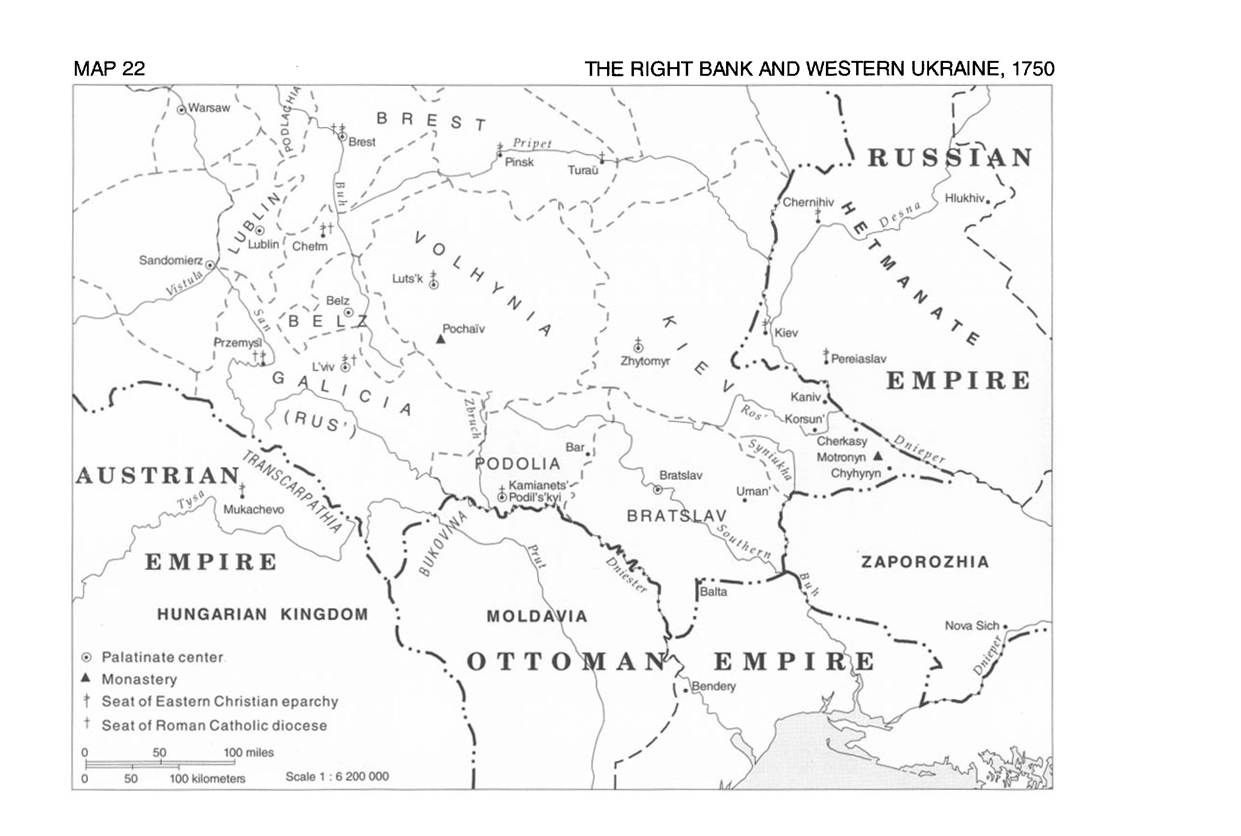
located in the palatine center. In effect, it was not the palatine but the dietines of each palatinate which held real political and administrative power, and they were completely in the hands of the powerful magnates and their gentry vassals. The dietines regulated taxes, controlled the draft, and chose deputies to the central Diet (Sejm) in Warsaw.
The decades after 1714 were marked by a return to the Right Bank of old as well as new Polish magnates from the Lubomirski, Seniawski, Rzewuski, Jablo- nowski, Sanguszko, Branicki, Potocki, Czartoryski, Tyszkiewicz, and other families. Without exception, these families prided themselves on being the initiators of a resettlement plan that ostensibly brought cultivation and civilization once again to the ‘wild Ukrainian steppe.’ As a result of the upheavals of the previous century, Poland’s kings also once again became holders of huge estates, especially in the Bratslav and the southern regions of the Kiev palatinates.
The manner in which the Polish socioeconomic system was reestablished also followed past models. In more heavily populated areas, the arenda system was put in place, and more often than not the leaseholders who ran the Polish estates and mills were Jews. In fact, the eighteenth century witnessed a steady increase in the number of Jews in the Right Bank. Despite the destruction of the Khmel'nyts'kyi era, a century later, in the 1760s, there were over 250,000 Jews in more than eighty communities. Jews served in the agriculture-based arenda system that dominated the countryside, and they also congregated in large numbers in towns and cities, where they dominated trade and the small handicrafts industries.
In the barren and more underpopulated territories, especially in the eastern Bratslav and southern Kiev palatinates, Polish magnates took the initiative by inviting peasants from the more densely populated areas of Galicia, Belz, western Volhynia, and even the Polish and Lithuanian palatinates farther to the west and north. Peasants from these regions, whose duties to landlords continually increased, were easily attracted to Poland’s southeastern ‘frontier,’ where, at least initially, they were allowed to settle for so-called free periods. This meant they did not have to pay taxes or perform labor duties for their landlords during the period specified.
The eventual fate of the peasantry was to be influenced by the changes in Poland’s political life. The eighteenth century was a time when central authority had almost entirely broken down. Poland’s kings - August II of Saxony (reigned 1709-1733), the beleaguered sovereign who returned to his throne after Muscovy’s victory over Sweden in 1709; August III (reigned 1733-1763); and Stanislaw Poniatowski (reigned 1764-1795) - became for the most part figureheads. More often than not they were elected because (1) they represented the most acceptable compromise between candidates of the Polish Diet’s increasingly contentious Senate and House of Deputies; and (2) they were acceptable to Russia, which by then was playing an increasingly dominant role in Polish politics. By the eighteenth century, the traditional balance of power in Poland among the crown, the magnates (represented by the Senate), and the gentry (represented by the House of Deputies) had broken down, essentially leaving the field open to the economically and socially powerful magnates. In this situation, the large magnates fully controlled the countryside, where their huge manorial estates (latifundia) became what have been called little kingdoms, or kinglets. Each magnate maintained his own private army, and, not surprisingly, in the Right Bank, Podolia, and eastern Volhynia the Polish landlords were responsible for reactivating Cossack-like military formations to serve their own interests.
In such circumstances, the plight of the Ukrainian peasantry varied. In the western palatinates - Rus' (Galicia), Belz, western Volhynia, and western Podolia - the peasants bore the greatest burdens of serfdom. Farther east, especially in those palatinates only recently resettled - eastern Volhynia, eastern Podolia, Kiev, and Bratslav - serfdom had not yet been implemented. Peasants did serve there on manorial estates, but their duties were less or, in instances of duty-free residence, virtually non-existent. The duty-free periods sooner or later ran out, however, and when they did, peasant discontent increased and the potential for revolt became real.
Added to the socioeconomic problem was a cultural one. The restoration of Polish rule in the Right Bank was accompanied by the return of the Roman Catholic and Uniate churches and the concomitant decline of the Orthodox church. All this, moreover, was occurring in an era marked by increasing religious intolerance in Poland. The new religious intolerance of the late seventeenth and the eighteenth centuries was accompanied by a secular belief called Sarmatianism (Sarmalyzm). According to this belief, Poland’s nobles were descendants of the ancient Sarmatians; they accordingly made up the ruling and only core stratum of the Polish nation and had a historic duty to defend Christianity. For Sarmatians, the only acceptable form of Christianity was that represented by the Polish Roman Catholic church. As an ideology, Sarmatianism was characterized by an extreme intolerance of cultural, political, and religious beliefs other than those of the Polish nobility, which was convinced of its superiority not only to other social estates in Poland but to other nationalities as well. Such self-centered, even xenophobic views on the part of the Polish nobility were bound to have an effect on the Orthodox Ukrainian population living in the eastern borderlands.
From the standpoint of Polish law, the charter of 1632, which had legalized the existence of the Orthodox as well as the Uniate church, was still in force.
The subsequent fate of each of these churches varied greatly, however, according to political circumstances. During the Khmel'nyts'kyi revolution and the rule of his successors in the Cossack state (at least through the hetmanship of Petro Doroshenko until 1676), Roman Catholics and Uniates were barred from the Right Bank. Orthodoxy had full control over religious affairs within the Cossack state, and the church was enriched with large land grants to the point that it became an economic power in its own right. By the late seventeenth century, however, the situation had changed substantially. Several factors - a decrease in the influence of the Cossacks, a reduction in the number of Orthodox adherents because of large-scale flight to Muscovite-controlled territory on the Left Bank, the subordination of the Kievan metropolitan see to Muscovy, the arrival of Polish landlords - contributed to the decline of Orthodoxy in the Right Bank. The decline took place, even though according to the provisions of the Polish-Muscovite ‘eternal peace’ of 1686 Muscovy retained the right to intervene on behalf of the Orthodox Ukrainians living on the Right Bank. In terms of ecclesiastical jurisdiction, the Orthodox population in the Polish-ruled Right Bank and neighboring palatinates was under the authority of the bishop of Pereiaslav, who resided in the Muscovite-controlled Hetmanate. The bishop could not, however, stem the decline of Orthodoxy beyond Muscovy’s borders.Even in the center of the Orthodox cultural revival during the late sixteenth century, Galicia and western Volhynia, the Orthodox church was virtually eliminated. One after another, the Orthodox eparchies of Przemysl (1691), L'viv (1700), and Luts'k (1721) became Uniate, as did the Pochaiv Monastery (1721) in Volhynia and the very stronghold of the Orthodox cultural revival, the Staurope- gial Brotherhood in L'viv (1708). With the acceptance by Luts'k of the Union, there was no longer any Orthodox eparchy within the boundaries of the Polish- Lithuanian Commonwealth.
Social protest and the haidamak revolts
Faced with the socioeconomic decline of the peasantry, the virtual elimination of the Cossacks, and the dissolution of the Orthodox church structure and subsequent pressure on the population by Poland’s Roman Catholic and Uniate churches, large segments of the Ukrainian population continued to believe that farther east, beyond the Dnieper River in Russian territory, things were somehow better. Certainly in relation to Polish-controlled Ukrainian territory, tsarist Russia seemed more promising. In the mid-eighteenth century, the Hetmanate, Zaporo- zhia, and even Sloboda Ukraine still had varying degrees of political autonomy. Moreover, serfdom had not yet been fully imposed in any of these territories, and Zaporozhia still served as a haven for those who wanted to live in a landlord-less society. Finally, Russia was an Orthodox country where Roman Catholics and Uniates were not favored. Thus, socioeconomic and religious discontent mixed with vague hopes for salvation in Russia made a potent recipe for disburbances, large or small, within Polish-controlled Ukrainian territory.
Disturbances did take place throughout the eighteenth century, in different forms ranging from small-scale bandit-like raids on manorial estates to large-scale military campaigns and peasant revolts. Social protests of the oldest and most contained kind took place in the westernmost Ukrainian lands, especially along Poland’s border with Hungary, in the Carpathian foothills and valleys of southern Galicia and Transcarpathia. There, small groups of discontented peasants, sheep herders, and, occasionally, demobilized soldiers banded together, attacked property owned by landlords, and sometimes distributed their spoils to the poor peasantry. These Robin Hood-like groups who lived in the Carpathians were known as opryshky. Although the opryshky had no general religious or ideological motivation, they became the subject of praise in local folklore and literature. The opryshky phenomenon began in the sixteenth century and in some places lasted until the twentieth century. The movement was most widespread in the eighteenth century, during which its most famous leader, Oleksa Dovbush, was active.
More widespread was the haidamak movement on the Right Bank (haidamak was originally a Turkish word meaning robber or pillager). The haidamak movement consisted of virtually continuous spontaneous revolts by Orthodox peasants and Cossacks against Polish Catholic landlords and their Jewish arendars as well as against the Roman Catholic and Uniate clergy. Besides sporadic revolts limited to specific regions or manors, major uprisings occurred in the years 1734, 1750, and 1768.
The haidamak phenomenon has been distorted in the historical memory of eastern Europeans even more than has the Khmel'nyts'kyi era. Polish historians traditionally have argued that the haidamak movement was ‘unleashed’ by Russia to destroy Poland (T. Morawski) or else that it reflected the fundamentally degenerate character of the Ukrainian people (F. Rawita-Gawronski). Jewish historians have considered the haidamak revolt a ‘catastrophe’ during which their people were ‘murdered in beastlike fashion’ (S. Dubnow). Russian and Ukrainian historians too have been critical of the movement’s uncontrolled excesses (A. Skal'kovs'kyi, D.L. Mordovets'). But the popular Ukrainian view was created by the influential nineteenth-century ‘national bard,’ Taras Shevchenko, who in his poem Haidamaky (The Haidamaks) presented them as heroes struggling against national oppression.
The haidamak movement consisted of a kind of ongoing guerrilla warfare conducted by small groups of discontented peasants, servants, or artisans who attacked the manors of the great landowners on the Polish-controlled Right Bank. When necessary, they would seek refuge across the Dnieper River in the Het- manate or Zaporozhia. The Russian government and the Zaporozhian Cossacks, however, were generally opposed to what they considered bandits, and haidamaks caught on Russian territory would be arrested and turned over to the Polish authorities. Although their guerrilla-like raids were a nuisance, they could be contained by local Polish authorities and by landlords, with their private armies. Particularly dangerous, however, were situations in which the haidamaks combined with peasants and were joined and, sometimes, led by Cossacks, who otherwise were in the service of Polish magnates. Such combinations were formed during the first (1734) and last (1768) of the three major haidamak revolts.
The first revolt broke out in 1734, when Russia sent a large army into Poland and the Right Bank after the death of King August II in 1733. That year, the Polish Diet elected the exiled Stanislaw Leszczynski, the former pro-Swedish king of Poland (reigned 1706-1709), who planned a return to the Polish throne with the help of France and several Polish nobles. Russia, which opposed such an eventuality, sent an army to drive out Leszczynski and had August H’s son, August III, elected instead. The Russian military presence in the Right Bank, however, raised false hopes in the Ukrainian peasantry that their liberation from Polish rule was imminent. A rebellion broke out among peasants in the southern Kiev palatinate and spread quickly to eastern Volhynia and Podolia, where it was led by a Cossack captain known simply as Verlan, previously in the service of a local Polish magnate. But the Russians came quickly to the aid of the new Polish king and put down the revolt.
In 1750, another peasant revolt broke out, when haidamak rebels who had been organized on Zaporozhian territory (perhaps with clandestine Cossack consent and participation) crossed into the Right Bank, where they were joined by peasants unhappy that their settlers’ free period had ended in 1750. This revolt, which began in the southern regions of the Kiev palatinate, spread to Bratslav but was put down by the Poles.
The last major haidamak revolt occurred in 1768. It was the largest and it was the only one which seemed to have specific political and social goals. It was inspired also by the characteristic blend of peasant socioeconomic and religious discontent with hopes for salvation in Russia. This last major uprising, which once again began in the southern part of the Kiev palatinate, became known as the Koliwshchyna rebellion, a name probably derived from the pikes or lances (kola) with which the rebels, called kolii, were armed.
During the 1760s, the duty-free periods allowed the recent settlers were coming to an end in the southern Kiev palatinate. But the peasants were reluctant to accept the landlords’ demands for labor services and dues. At the same time, an Orthodox revival was under way at the Motronyn Monastery near Chyhyryn. The monastery was headed by the archimandrite Melkhysedek Znachko-Iavors'kyi, who in 1761 was made assistant to the bishop of Pereiaslav. The bishop of Pereiaslav, in the Russian-controlled Hetmanate, who had jurisdiction over the Orthodox population in neighboring Poland, encouraged Znachko-Iavors'kyi’s anti-Uniate activity. The archimandrite also received support from the Zaporozhian Cossacks. As a result of this activity, Znachko-Iavors'kyi was arrested by the Poles, but he escaped and fled to Russia, where Empress Catherine II received him and apparently promised to intervene on his behalf through diplomatic channels. Buoyed by such news, the archimandrite returned to his monastery, where he renewed his contact with the Zaporozhian Cossacks.
Meanwhile, the Polish nobility was becoming increasingly dissatisfied with Russia’s interference in Poland. Since the beginning of the eighteenth century, a significant proportion of the Polish nobles had favored either pro-Swedish or proFrench candidates for their country’s throne, but their efforts were consistently blocked by St Petersburg, which succeeded in having pro-Russian candidates (August II of Saxony and his son, August III) elected instead. Moreover, Poland’s newest king, Stanislaw Poniatowski, who came to the throne in 1764, seemed to many nobles little more than a Russian puppet. Accordingly, in early 1768 several Polish nobles organized the so-called Confederation of Bar, based in the eastern Podolia and Bratslav palatinates. The result was a noble-led insurrection whose intent was to rid the country of its pro-Russian ruler. In response, a tsarist army already in Poland was dispatched southward to crush the rebellion.
At the same time the Confederation of Bar was beginning its insurrection, farther east a Zaporozhian Cossack named Maksym Zalizniak, who had been living at Znachko-Iavors'kyi’s Motronyn Monastery for over a year, organized a rebel group of Zaporozhian Cossacks against the Polish noble Confederation of Bar. This group believed the Confederation was intent on destroying all Orthodox adherents. In the early spring of 1768, Zalizniak and his forces formed in the traditional haidamak gathering place of Kholodnyi lar, near the Motronyn Monas-
Uman' as a Symbol for Ukrainians, Poles, and Jews
Ever since the haidamak rebellion of 1768 and Gonta’s capture of Uman', that town on the Right Bank halfway between Kiev and the shores of the Black Sea has been an important symbol in the historical mythologies of Ukrainians, Poles, and Jews, yet one profoundly different for all three.
Among Ukrainians, Uman' is best remembered from its depiction in Haidamaky (The Haidamaks, 1843), the longest of the poems of the most widely read Ukrainian writer, Taras Shevchenko. Based loosely on events during the 1768 haidamak rebellion, Shevchenko’s work expresses the wild and often merciless character of peasant revolts against social oppression. While he docs not condone the murderous exploits of Zalizniak and Gonta, he sees the past, even with all its evils, as a source of inspiration for Ukrainians in the future.
Along the entire way
From Kiev to Uman' the dead
In heaping piles were laid.
The Haidamaky on Uman' Like heavy clouds converge At midnight. Ere the night is done The whole town is submerged. The Haidamaky take the town With shouts: The Poles should pay!’ Dragoons are downed, their bodies roll Around the market-place;
The ill, the cripples, children too.
All die, no one is spared.
Wild cries and screams. ’Mid streams of blood
Stands Gonta on the scpiare With Zalizniak together, they Urge on the rebel band:
‘Good work, stout lads! There, that’s the way To punish them, the damned!’ And then the rebels brought to him A Jesuit, a monk,
With two young boys. ‘Look, Gonta, look! These youngsters are your sons! They’re Catholics: since you kill all, Can you leave them alone?
W'hy are you waiting? Kill them now'...
And the two lads were slain.
They fell to earth, still bubbling words:
‘O dad! We are not Poles!
We... we...’ And then they spoke no more. Their bodies growing cold.
‘Perhaps they should be buried, what?’
‘No need! They’re Catholic.’
Much time has gone by, since a child, a poor orphan. In sacking and coatless, without any bread, I roamed that Ukraine where Zalizniak and Gonta With sanctified sabres had wreaked vengeance dread. Much time has gone by since, along those same highways Where rode Haidamaky, exhausted and sore 1 tramped through the country, its high roads and by-ways,
And weeping, sought people to teach me good lore. As now I recall them, my youthful misfortunes, I grieve that they’re past! I would trade present fortune
If only those days could be brought back again....*
I’he popular Polish image of liman' was, like the Ukrainian, forged by early nineteenth-century’ Romantic writers and publicists. Some saw the event as one of the worst examples of Cossack barbarism against Polish civilization. Others saw it as a lesson from which Polish society should learn. Among the most widely read and debated works was Seweryn Goszczynski’s epic poem Zamek kaniowsii (The Castle of Kaniv, 1828), based on oral and memoiristic accounts of what the author later called the ‘Uman1 massacre.’ Goszcyznski suggested that while the Poles may have suffered at Uman', that experience should be used to point the way to reconciliation with Ukrainians and to the creation with them of a common platform in the search for freedom from tsarist oppression for both peoples. Such a message formed the ideological basis of the Uman' Society (Gromada Human), a Polish revolutionary group founded in exile following the abortive 1831 uprising against tsarist Russia. For that group, Uman' (in Polish, Human) became the very symbol of Polish regeneration:
The memory of the errors of our fathers, for which our country and we now suffer severe punishment from heaven, commanded us to put our finger to the most painful of wounds. It was fitting for us, children of Human and noblemen, to take on the name of that theater of horror so as to make humble expiation before heaven, our fatherland and mankind for the guilt of our fathers. It was fitting for us to assume the name of Human so that with the people of Ukraine, the people of Greek faith, we could make a truce of renewal, a union of the future; so that in the terrible memory we could expunge the mutual suffering; so that with this name we could wash off the mutual hate and remove the bloody memory that came from the persecution of the people of Ukraine and the most terrible reaction that provoked....
It is on the hands of the tsars that you should look for the blackened stain of innocent blood. But do not blame the people. They are unfortunate; the victims of ignorance; the plaything of intrigues; the tool of their own and of others’ pain. For not only he who dies but also he who kills is worthy of pity. Human is a lesson both for the Polish and the Ukrainian people/
As for the Jewish perspective, the distinguished twentieth-century historian of cast European Jewry, Simon Dubnow, called Oman' ‘the second Ukrainian catastrophe.’ It was a Yiddish folk song from the late eighteenth century, however, which perhaps best summed up Jewish attitudes:
Our Father in Heaven, how can you stand the sights, That Ukrainian Jews should suffer such horrible troubles! Where in the world are such persecutions heard of? Gonta has even killed small children and taken their money. The most evil of the haidamaks should come before you, Lord of the world,
And you should help all who have protected us!*
Uman' also became the burial place of Rabbi Nachman of Bratslav, the great-grandson of the founder of Hasidism, Israel Baal Shcm Tov. Nachman, himself the founder of an important Hasidic rabbical dynasty, believed that for some reason a number of the Jews killed in Uman' in 1768 were unable to rise to heaven. Accordingly, he chose to spend his last years in Uman', in a house overlooking the Jewish cemetery, where he too was eventually buried. Since the early eighteenth century, Uman’ has been an important site for Hasidic Jewish pilgrimages; they were banned by the Soviets but permitted again in 1989, during the Gorbachev era.
• Taras Shevchenko, Selected Worts, translated by John Weir (Moscow 1964), pp. 97-99. 104.
’ George G. Grabowicz, ‘The History and Myth of the Cossack Ukraine in Polish and Russian Romantic Literature* (unpublished PhD dissertation, Harvard University 1975), p. 127.
* Mendel Osherowitsch, Shtet un shtrtlekh in Utrayne un in andere tayln fun Rutland, Vol. II (New York 1948), p. 172. Translation by Henry Abramson.
tery. They soon captured several towns in the southern Kiev palatinate (Cherkasy, Korsun', Kaniv, and others), then moved farther afield into Volhynia, Podolia, and Bratslav. En route, Zalizniak’s forces attracted more peasant supporters and, following the haidamak tradition, killed, often in brutal fashion, all the Polish landlords and Roman Catholic and Uniate clergy they could find. The rebel’s most spectacular triumph came at the end of June at Uman', where a local Cossack captain in the Polish service, Ivan Gonta, who was entrusted with defending the town, suddenly joined the haidamaks. The combined forces of Zalizniak and Gonta then turned on Uman', captured the town, and massacred as many as 2,000 Poles and Jews living there. It seems that Zalizniak, who in the interim was proclaimed Zaporozhian hetman, wanted to drive all Polish nobles from the Right Bank, including the rebellious Bar confederates. He hoped to return, under the protection of the Polish king, to the supposed ideal conditions before the enserf- ment of the peasantry and to set up a Cossack-like political entity without landlords or their ideological allies, the Roman Catholics and Uniates.
The Russian Empire’s role in the 1768 Koliwshchyna revolt of haidamaks was ambiguous. While on the one hand encouragement was given to the Orthodox clergy on the Right Bank, on the other the rebellion of Zalizniak and Gonta seemed to have gone too far. Neither the haidamaks’ plans for social liberation and Cossack autonomy, nor the resultant weakening of Poland, nor the possibility of friction along the Ottoman border (the Turks had lodged a strong protest when their border town of Balta was captured by the haidamaks) made the Koliwshchyna uprising particularly attractive to tsarist Russia. Consequently, Catherine II ordered her army in Podolia, which had just put down the rebellious Polish nobles of the Confederation of Bar, to crush the haidamaks. This action was accompanied by a Polish pacification in which 5,000 to 7,000 peasants were killed. Gonta and Zalizniak were captured, and to show its good will toward Poland and toward the Ottomans, Russia turned over 900 insurgents to the Poles and then held a show trial near the Ottoman border at which 250 haidamaks (including Zalizniak) were condemned to death (their sentences later were commuted to hard labor in Siberia). As for Gonta, he was considered a traitor because of his actions at Uman'. He was brought to Warsaw and tortured, and his dismembered body put on public display. The blood spilled on both sides during and after the uprising only deepened the enmity between Poles and Ukrainians, with the result that the hadiamak rebellion of 1768, the Koliwshchyna, became a lasting symbol - fed by subsequent literary and historical distortion - of Polish-Ukrainian and, to a lesser degree, Jewish-Ukrainian hatred.
The Partitions of Poland
In 1768, Poland had once again been saved by Russia, but this was to be the last time. As a country, Poland had become a political anomaly by the eighteenth century. Its political structure, with a weak elected king and diffusion of authority throughout the country among an independent-minded and often selfishly paci- fistic nobility, created a state of internal anarchy which made the country vulnerable to the expansionist tendencies of its neighbors. In stark contrast to Poland, all its neighbors - Prussia in the west, Austria in the south, and Russia in the east - had succeeded in creating increasingly centralized political and military structures by the middle of the eighteenth century. Poland would have to change, and change quickly, or succumb to its more powerful neighbors. The Poles did
The Right Bank and Western Ukraine 301 attempt to make basic structural changes in their political system, but these came much too late.
In 1772, in order to satisfy their territorial ambitions, Prussia and Russia planned to annex simultaneously portions of Poland’s territory. From the time of the haidamak revolt and the uprising of Polish nobles at Bar in 1768, the Russian Empire had maintained a standing army on Polish territory in the Right Bank. In the following year, 1769, it even placed a garrison in the far western city of L'viv, the capital of the Rus' (Galicia) palatinate. This was not particularly surprising, since from the perspective of St Petersburg these so-called Little Russian territories were part of the historical patrimony of the Russian Empire, which was the self-proclaimed descendant of Kievan Rus'.
For its part, Prussia did not want to see Russia’s political and military interference in Poland become the basis for unilateral territorial aggrandizement. To prevent such an eventuality, therefore, and to maintain a balance of power in the region as a whole, Prussia urged Austria to join with it and Russia in the territorial partitioning of Poland. Austria had become wary of Russia’s victories (since 1769) in its war against the Ottoman Turks, which made possible the expansion of tsarist influence near Austria’s southern borders in the Balkans as well as near its eastern borders in Polish-ruled Ukrainian territories (i.e., Galicia). Hence, with feigned reluctance, Austria went along with the international partitioning scheme.
The result was the First Partition of Poland, whereby Prussia acquired Polish territory along the Baltic Sea, Russia a swath of territory along Poland’s northeastern boundary, and Austria the Ukrainian-inhabited Polish palatinates of Galicia- Rus' and Belz as well as territory south of the Vistula River as far west as and including Cracow. Ironically, of the three partitioning powers, Austria, which had had to be ‘persuaded’ by the others to go along with the scheme, received the largest number of inhabitants (2,650,000) and area of land (32,000 square miles [82,000 square kilometers]). Vienna justified its acquisition by reviving the medieval Hungarian claim to sovereignty over the old Kievan Rus' principalities of Galicia and Volhynia. Since the Habsburgs were simultaneously kings of Hungary, they could argue that they had historic rights over this new territory, which they named the Kingdom of Galicia-Lodomeria (Konigreich Galizien und Lodomerien), or Galicia (Galizien) for short. Two years later, in 1774, the Habsburgs acquired from Moldavia, in the Ottoman Empire, the mountainous region of Bukovina, which was thereupon united with Galicia. As a result of these border changes, the Russian Empire withdrew its army, however reluctantly, from Galicia’s capital of L'viv.
Thus, the First Partition of Poland in 1772 took place through diplomatic means, without a shot being fired. This was not the case two decades later, when Prussia, Russia, and Austria were once again ready to cooperate in acquiring more territory from Poland. Sensing the new threat, the Poles tried to restructure their political system (in the Constitution of 3 May 1791), and in a rare display of national unity they fought against the Prussian and Russian armies invading the country. But it was too late. Poland was partitioned in 1793 and 1795. The last partition removed Poland entirely from the map of Europe.
Of the Ukrainian territories, Russia acquired the former Polish palatinates of
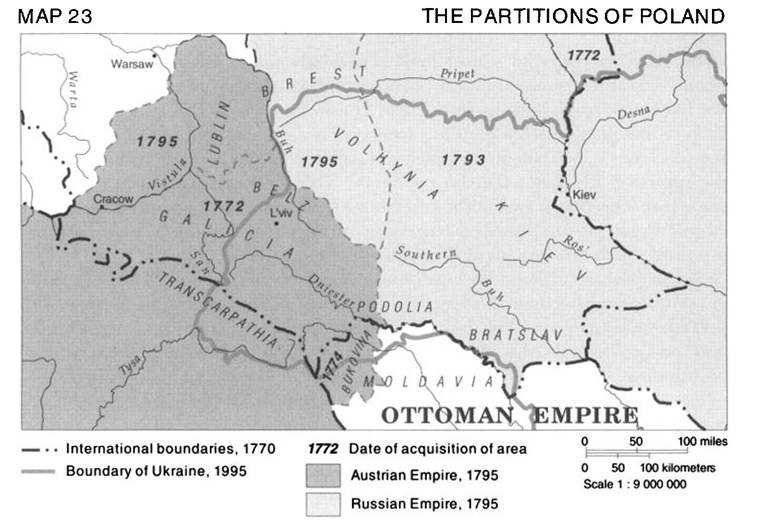
Kiev, Bratslav, Podolia, and eastern Volhynia during the Second Partition in 1793, and western Volhynia and the eastern part of Chelm during the Third Partition in 1795. As in other parts of the Russian Empire, these newly acquired areas were divided into provinces (gubemu), each with its own governor directly responsible to St Petersburg. The former Polish palatinate of Kiev (together with the city of Kiev, which had belonged to Russia since the late seventeenth century) became the province of Kiev; Volhynia together with eastern Chelm became the province of Volhynia; and the Podolia and Bratslav palatinates became the province of Podolia.
Thus, Polish rule over Ukrainian territories, which had begun to take hold as long before as the fourteenth century (Galicia and Belz) and which had expanded considerably in the late sixteenth century (Volhynia, Podolia, the Right and Left Banks), slowly withered in the seventeenth century until it finally came to an end in 1795. The last decades of the eighteenth century also witnessed the end of Ottoman rule over the Crimean Khanate and other lands north of the Black Sea (see chapter 21). All Ukrainian territories were now under the control of two major powers: the Russian Empire, which held the vast majority; and the Austrian Empire, which held the western lands of Galicia, Belz, Bukovina, and Transcarpathia.
More on the topic The Right Bank and Western Ukraine:
- The Right Bank and Western Ukraine
- The Right Bank under Polish Rule
- 31 Western Ukraine during World War I
- The Left Bank under Russian Overlordship
- CHAPTER TWENTY-ONE THE REPUBLIC OF WESTERN UKRAINE
- The Absorption of Western Ukraine
- List of Maps
- Magocsi Paul Robert. Ukraine: An Illustrated History. University of Toronto Press,2007. — 336 p., 2007
- The Soviet Return to Ukraine
- Cossacks and Borders