16 Tatars and Cossacks
During the fourteenth century, while Lithuanian and Polish rule was being established in central and western Ukrainian lands, the southern steppe region and the Crimea were undergoing political change.
The Mongolo-Tatar Golden Horde was weakened after 1357 by two decades of internal strife and then, in the 1390s, by the efforts of Tamerlane to rule the entire Mongol Empire. As a result, during the first half of the fifteenth century, two new Tatar khanates were carved out of the Golden Horde’s territory: the Crimean Khanate in the west and the Kazan’ Khanate in the north. Finally, in 1502 the Golden Horde itself ceased to exist and its heartland on the lower Volga River was transformed into the Astrakhan Khanate. The three khanates were formidable military powers and each continued the Golden Horde’s practice of demanding tribute from Muscovy.The Crimean Khanate, which had a direct impact on Ukrainian lands, was under the rule of the Giray dynasty whose capitals were first at Krym (later renamed Eski Kirim, today Staryi Krym) and from the fifteenth century at Bakhchesarai/Bahçesaray. In contrast to the Golden Horde, the Crimean Tatar rulers were at times positively and at others negatively inclined toward Italianate (Genoese and Venetian) control of the Crimean coastal regions. But it was the Ottoman conqueror of Constantinople, Sultan Mehmet II (r. 1451-1481), who was the decisive factor in Crimean affairs. Determined to make the Black Sea into an “Ottoman lake,” he managed in 1475 to remove permanently the Genoese from the coastal area, which was placed directly under an Ottoman administration. Symbolic of the Italianate decline was the change in place-names. Moncastro (today Bilhorod-Dnistrovs’kyi) became Turkish Akkerman/Aq Kerman, Tana (today Azov) became Azaq, and Caffa (today Feodosiia)—the most important Crimean port city—became Kefe.
Under Ottoman rule Kefe’s port was expanded and its population increased to such an extent that by the early seventeenth century it was one of the largest cites in eastern Europe.
16.1 The palace of the Crimean khans at Bakhchesarai/Bahçesaray.
MAP 16 THE CRIMEAN KHANATE AND SOUTHERN UKRAINE, circa 1625

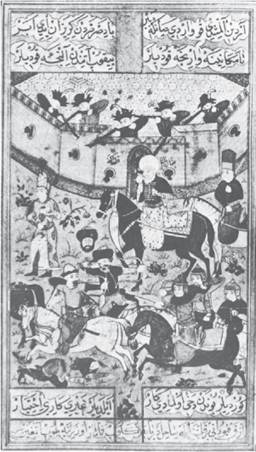
16.2 Battle between the Ottoman Turks and Crimean Tatars for control of Caffa/Kefe, from an Ottoman manuscript, 1586.
The Ottomans eventually recognized the Giray dynasty, and although the Crimean Khanate was formally a vassal state, it remained only loosely subordinate to the Ottoman Empire and effectively functioned as an independent state. The Crimean Khanate included not only the Crimean peninsula (subdivided into two distinct parts—the lowland steppe and the mountains along the southern coast), but also the steppe lands beyond the Perekop Isthmus that stretch from the mouth of the Dnieper River eastward all around the shores of the Sea of Azov to the Kuban region. This vast, sparsely settled territory was basically divided into two regions: the peninsula (including its steppe lands) and the steppe lands farther north. The sedentary Giray rulers based in Bakhchesarai and the Tatar tribal clans allied with them controlled most of the Crimean peninsula. As for the steppe lands farther north of the peninsula, they were after the mid-sixteenth century the domain of nomadic Nogay tribes (originally from the lower Volga valley), who were nominally subordinate to but more often independent of Crimean authority.
These various Nogay tribes (Kuban’, Yediçkul, Jamboyluk, Yedisan, Buçak) supplied the greatest number of “Tatars” most directly involved in Ukrainian lands.
Despite their tenuous and often problematic relationship with the Crimean Khanate, the Nogays fulfilled for that state a quite useful purpose. Their presence prevented the establishment of Slavic settlements in the steppe and they provided the Crimean and Ottoman markets with a steady supply of its most important commodity—slaves. Captured slaves from Ukrainian lands functioned at all levels of Ottoman society, from agricultural workers and house servants to galley slaves and soldiers in the imperial army and navy, advisors and government officials, and—in the case of women—as prized members of the harems of wealthy nobles and the imperial court. Among the best known captives destined for the imperial harem was Nastia Lisovs’ka, the daughter of a priest in Rohatyn (far western Ukraine), who was abducted in 1520. As the legendary Roksolana, she became the only wife and political consultant of Sultan Süleyman I (“the Magnificent,” r. 1520-1556).In short, the Crimean export trade, and therefore its economic well-being, was based primarily on the slave trade. The Crimean rulers and merchants acted as middlemen, “processing” the slaves that they bought from the Nogay and Tatar raiders and then reselling them to buyers from the Ottoman Empire. The main source for the Nogay slave trade were Slavs captured mostly north of the open steppe in central and western Ukraine. Beginning in the 1470s and continuing to the end of the seventeenth century, the Nogay Tatars undertook annual slave raids along fixed routes that brought them to the southern Kiev, Bratslav, Podolia, and Galicia palatinates.

16.3 Crimean Tatar town dwellers at rest.
Because of the Nogay and Tatar danger, the southern frontier regions of Ukraine became a kind of no-man’s land. These were the proverbial Wild Fields (Dzikie Pole) in contemporary Polish writings, which separated Poland-Lithuania from the Crimean Khanate.
The Wild Fields were at the same time a naturally rich and fertile region “teeming,” as contemporary documents recall, with cattle, wild animals, and fish. Consequently, as early as the fifteenth century a few individuals ventured into the Wild Fields on short-term expeditions to acquire the region’s natural wealth. It was not long before the number of travelers to Ukraine’s wilderness increased. This mode of existence—farming, hunting, then returning home in the winter or perhaps remaining permanently—came to be known as the Cossack way of life.
16.4 A Nogay Tatar mobile residence on the open steppe.
In order to deal with the everpresent danger of Nogay slave raiders, the mostly Rus’-Ukrainian peasants and townspeople-turned-frontier-dwellers were by circumstance forced to become skilled in the art of self-defense. With their new skills, some began to turn on the offensive, attacking Nogay slave-raiding parties and Tatar trade caravans. It was not long before the frontier dwellers formed small armed bands to attack Ottoman commercial centers in the Crimea, Moldavia, and Walachia. The very word Cossack, derived from the Turkish term qazaq (meaning freebooting warrior or raider), was first applied to Tatar renegades from the Crimean Khanate who were hired to fight for Muscovy and Lithuania. Despite its origins, the term qazaq/Cossack was before long associated with those frontier dwellers, primarily Slavs but including all others who were opposed to the “Tatar enemy.”
As early as the second half of the fifteenth century, Cossacks were being hired by Lithuanian officials from Ukraine’s frontier palatinates and districts in order to help defend the grand duchy’s southern border. Because they were stationed in frontier settlements like Cherkasy, Chyhyryn, and Bratslav, these forces were known as “town Cossacks.” For a while the group as a whole was called Cherkasy, after the fortified town along the Dnieper River south of Kiev where they concentrated in largest numbers.
The town Cossacks, officially recognized because of their service to the Lithuanian and later Polish authorities, were in the course of the sixteenth century employed more and more frequently by powerful Rus’ magnates in Ukraine and by Poland’s kings. Beginning in 1572, the king introduced the system of a register, whose rolls began with three hundred Cossacks. Subsequently the number of registered Cossacks, depending on political and military conditions in Poland-Lithuania, was to fluctuate during the first half of the seventeenth century from a high of 20,000 in 1620 to a low of 6,000 in 1638. In return for their services, the registered Cossacks (drawn primarily from well-to-do town Cossacks) were granted what later became known as “traditional liberties.” These included the right to own land and to pass it on to their offspring, exemption from taxes and from local Polish authorities, and effective self-government under a leader (starshyi) appointed by the government from among Cossack ranks. The registered Cossacks, officially known as the Army of Zaporozhia (even though they did not reside in Zaporozhia proper) were given the town of Trakhtemyriv and its monastery as their permanent headquarters. In essence, the registered Cossacks became property holders with a vested interest in maintaining social stability within Poland-Lithuania.

16.5 Roksolana (1505-1558), wife of the Ottoman Sultan Süleyman I Canuni, as depicted in a 17th-century engraving.
In contrast to the town and registered Cossacks were those Cossacks who lived farther south, away from Polish-Lithuanian authority and beyond the rapids located about half way between the first and second great bends of the Dnieper River. It was from this geographic concept—beyond the rapids (Ukrainian: za porohamy)—that the regional name Zaporozhia and the group name Zaporozhian Cossacks derives.

16.6 Officers among the town, or registered Cossacks.
Zaporozhia became a haven for dissatisfied townspeople, for ever larger numbers of peasants wanting to flee the increasing burdens of Poland’s manorial system and the reintroduction of serfdom, and for a host of other adventurers of various social backgrounds who simply wished to live beyond the reach of existing government control. In terms of ethnicity, the vast majority were Slavs, in particular ancestors of modern-day Ukrainians, although there were also Romanians/Moldavians, Tatars, Turks, and Jews who sought refuge in Zaporozhia. The center of Zaporozhian Cossack life was a fortified center known as the sich (see Chapter 17). Despite their rejection of governmental authority—and their scorn for town Cossacks who were formally registered—the Zaporozhian Cossacks also served the Polish king from time to time, especially when he needed large numbers of troops to protect or extend the commonwealth’s frontiers. The Zaporozhians served as well under registered Cossack leaders, or hetmans, when they felt it was in their interests to do so.
Like the Crimean Khanate, which had difficulty in controlling “its” Nogay Tatars, so too did Poland-Lithuania have little control over the actions of “its” Zaporozhian Cossacks. The Zaporozhians were particularly fond of carrying out sea raids against towns and landed estates in the Crimean Khanate and in Ottoman territories all along the shores of the Black Sea—in some cases reaching as far as the outskirts of the latter’s capital, Istanbul. These acts provoked reprisals on the part of the Ottoman authorities with the result that the first half of the seventeenth century witnessed a seemingly unbreakable cycle of actions and counteractions: the Zaporozhian Cossacks would raid the Crimea and Ottoman Empire; the Ottomans would retaliate with threats and at times would invade Poland-Lithuania; the commonwealth’s authorities would demand that the Zaporozhians cease their anti-Ottoman and anti-Crimean raids and would send punitive expeditions to intervene in Zaporozhian affairs; the Zaporozhians would rebel against this interference and often fierce battles with Polish armies would result. In the end nothing decisive ever occurred and the cycle would be repeated all over again.

16.7 A Zaporozhian Cossack in military garb.
The repetitive cycle did, however, produce much bloodshed. This was particularly the case during two major Polish-Ottoman battles in Moldavia, at Tutora/Cecora in 1620 (won by the Ottomans and Crimean Tatars), and at Khotyn in 1621 (won by Poland-Lithuania with the aid of registered Zaporozhian Cossacks). As for the Polish-Zaporozhian clashes, these were most widespread during seven uprisings led by Kryshtof Kosyns’kyi (1591-1593), Severyn Nalyvaiko and Hryhorii Loboda (1594-1596), Marko Zhmailo (1625), Taras Fedorovych (1630), Ivan Sulyma (1635), Pavlo Pavliuk-But and Dmytro Hunia (1637), and Iakiv Ostrianyn (1638). Following the failure of the last of these revolts in 1638 the unregistered Cossacks in Zaporozhia were all declared outlaws.
Formally outlaws or not, Poland’s military establishment almost without exception considered the Cossacks of Zaporozhia and their peasant followers to be social outcasts and dealt with them as such on the battlefield. Consequently, the treatment meted out by Poles to captured Zaporozhian Cossacks and by Cossacks to captured Poles (and in particular to their registered Cossack allies) was often brutal. In short, a deep-seated hatred and distrust developed on both sides between Zaporozhian Cossacks and Poles, something which was later depicted with great insight in the popular nineteenth-century novel by Nikolai Gogol, Taras Bulba. In the end, however, neither the registered Cossacks nor even unregistered Cossacks ever really questioned the premise that they were subjects of the Polish king. They simply wanted to be granted a special status within the Polish-Lithuanian Commonwealth, whether recognition as a distinct social estate for the registered Cossacks or non-interference in Zaporozhia for the unregistered Cossacks.

16.8 Zaporozhian Cossacks not only operated on land but also took to the sea, as depicted in this engraving (1622) of their attacks against the Crimean port of Kefe/Caffa.
During the first half of the seventeenth century, the Cossacks took on an additional role. They came to be viewed and they viewed themselves as defenders of Orthodoxy. In short, the Orthodox Rus’ with their Cossack defenders were pitted against Roman Catholic Poles and the western oriented Rus’ Uniates in a struggle that concerned not only social and administrative rights and privileges but also cultural values and, in this pre-national age, group identity.
Crucial to this process was the activity of Petro Sahaidachnyi, hetman of the Zaporozhian Cossacks and the hero in Poland’s victory against the Ottoman Turks at the 1621 Battle of Khotyn. Taking advantage of his prestige in Polish society, Sahaidachnyi pressed the commonwealth to recognize the Orthodox hierarchy (secretly elected in 1620) and he enrolled all his Cossacks in the newly established Orthodox Kiev Brotherhood. For their part the church hierarchs recognized the historic mission of the Cossacks and considered the Army of Zaporozhia, in the words of Orthodox Metropolitan Iov Borets’kyi (r. 1620-1631), as “descendants of the glorious Rus’,” who more than any others “in the whole world do so much for the benefit of persecuted and oppressed [Orthodox] Christians.” Certainly, by the mid-seventeenth century the Cossacks had become for the Rus’ (Ukrainian and Belarusan) populace of Poland-Lithuania the symbolic and real defenders of the Orthodox faith and identity.

16.10 Petro Konashevych-Sahaidachnyi (ca. 1570-1622), hetman of the Zaporozhian Cossacks from 1614 until his death, as depicted in a contemporary engraving.