15 Religion and Culture in Ukrainian Lands in the 16th and 17th Centuries
Ever since Kievan times, religion and elite culture had been inseparable. Moreover, in keeping with Byzantine tradition, the Orthodox Church of the Rus’ peoples was closely associated with the secular states under whose rule they found themselves.
This situation remained basically unchanged during the Lithuanian-Polish era, which lasted from the fourteenth to mid-seventeenth century in much of what is today Ukraine and Belarus. What was new, however, was that Lithuania and Poland were officially Roman Catholic states, and this reality was eventually to threaten the very survival of Orthodoxy among the Rus’ inhabitants of Poland-Lithuania.As a result of Lithuanian lobbying, the Orthodox ecumenical patriarch in 1458 finally recognized the division of the Kievan metropolitanate into two jurisdictions, each claiming the title of Kiev and All Rus’. One had its residence in Moscow, the other in Navahrudak (Lithuania). The Lithuanian-based metropolitanate of Kiev, Galicia, and All Rus’ based in Navahrudak included nine eparchies, six of which (Kiev, Volodymyr-Brest, Luts’k-Ostroh, Halych-L’viv, Przemysl-Sambir, and Chelm-Belz) were entirely or largely based in Ukrainian lands. Despite its improved jurisdictional status the “Lithuanian” Orthodox metropolitanate of Kiev remained isolated from its brethren in the faith: from the Orthodox in Muscovy, who viewed them as jurisdictional rivals; from the ecumenical patriarch in Constantinople, whose political and economic influence had been substantially reduced after the Ottoman conquest of Byzantium (1453); and from neighboring Moldavia, which itself was struggling to survive the Ottoman advance into the northern Balkans. Such isolation was particularly problematic in the western Ukrainian eparchies of Halych-L’viv and Przemysl-Sambir, located in territories under the direct rule of Poland. There, in particular, the Polish king exercised his right to appoint Orthodox bishops, and some of his candidates included recently ordained secular magnates who often had little interest in spiritual matters.
The result was a marked decline in Orthodox moral and religious life in general.
15.1 Monastery complex at Pochaïv in southwestern Volhynia within the former Orthodox eparchy of Luts’k-Ostroh.
MAP 15 RELIGION AND CULTURE, 16th and 17th CENTURIES

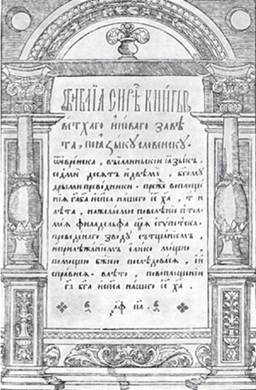
15.2 Title page of the Ostroh Bible (1581) produced at the Ostroz’kyi estate on a printing press operated by Ivan Fedorovych/Fedorov.
Concerned with the status of their church, the Orthodox reacted in at least three ways. One option was a withdrawal from the temporal world into the realm of spirituality. The result was the establishment of several new or rebuilt monasteries between the late fifteenth and early seventeenth centuries in Galicia (St Onufrius in L’viv, Krekiv, Univ, and Skyt Maniavs’kyi), Volhynia (Pochaïv, Kremenets’, Dubno, Derman’, and Zhydychyn), the Left Bank (Novhorod-Sivers’kyi, Hustyn, Mhar, and Zolotonosha), and alongside the eleventh-century Caves Monastery (Pechers’ka Lavra) in Kiev the Epiphany and St Nicholas monasteries in that same city. Some monasteries had schools and printing presses which produced a wide variety of church books and religious literature. The most productive printing centers were at the Caves Monastery in Kiev, which experienced a spiritual and cultural revival during the first half of the seventeenth century, and at the Dormition Monastery in Pochaïv.
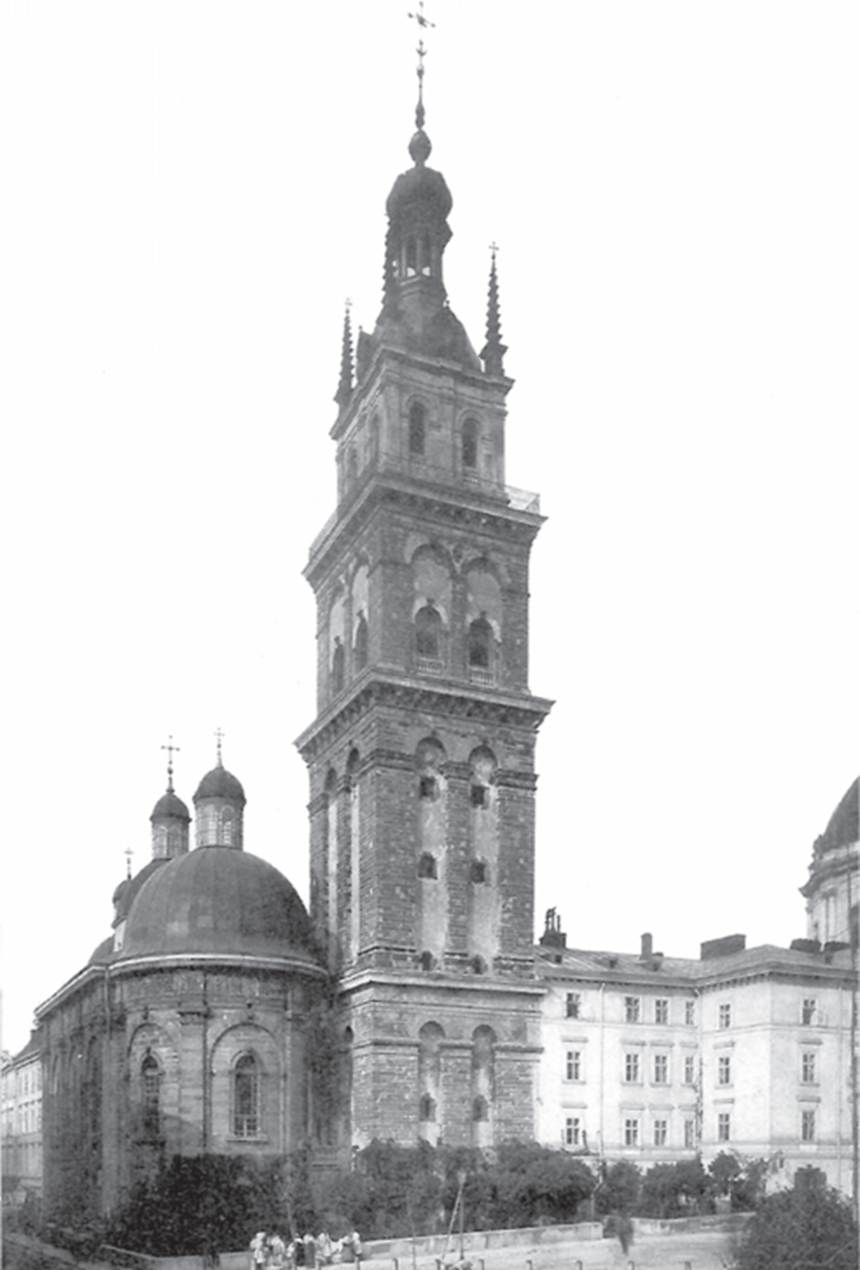
15.3 The Korniakt Tower (1572-78) and Church of the Dormition (Uspens’kyi sobor, 1591-1631) in L’viv with which the Orthodox Stauropegial Brotherhood was associated.
Of broader social significance was the role of monasteries as pilgrimage sites.
Aside from the spiritual value of pilgrimages, the very act of bringing together Orthodox adherents from various parts of the Rus’ world and beyond helped to instill in them the sense of a common identity. It is important to remember that in this pre-national era, when religious affiliation was paramount among individuals, identification with Orthodoxy created a common bond among people who only much later were to develop separate Ukrainian, Belarusan, Russian, or Moldovan-Romanian identities.A second kind of Orthodox response came from a small group of Orthodox Rus’ magnates who tried to raise the general level of their religiously based culture. They did this through the establishment of schools and printing presses, the most famous of which was on the estate of Prince Kostiantyn Ostroz’kyi at Ostroh. There, during the 1570s, the prince established a primary school, a printing press, and an institution of higher learning and research (especially for translations) known as the Ostroh Academy.
The third option was adopted primarily by townspeople, who set up brotherhoods (brat-stva) to support the financial, social, and legal interests of individual Orthodox parishes. The brotherhoods carried out their work through fund-raising social activities which allowed them to establish hospitals, schools, libraries, and printing presses. The brotherhood movement became especially widespread during the sixteenth century, beginning first in western Ukraine lands, especially L’viv, then spreading to Volhynia, Podolia, and Kiev. The most influential of all brotherhoods was the one associated with the Church of the Holy Dormition (Uspens’kyi Sobor) in L’viv. It eventually came to be known as the Stauropegial Brotherhood and as such became directly involved in what resulted in the permanent division of the Eastern-rite church in Ukraine.
Ever since the growing separation between the Western (Roman) and Eastern (Byzantine) branches of the Universal Church, which culminated in mutual anathemas and the split of 1054, there had been frequent talk and sporadic attempts at church union.
The Orthodox cultural revival, led since the 1570s by the Rus’ magnates of Poland-Lithuania, also addressed seriously the possibility of church union. At the same time, the sixteenth century was a critical period for the Roman Catholic Church, faced as it was by the spread of the Protestant Reformation throughout much of Europe, including Poland-Lithuania. Rome’s response was the Counter-Reformation, which reached Poland with the arrival of the Catholic Jesuit monastic order in 1564. Through their school system and printing presses, the Jesuits were soon leading a polemical campaign that was directed not only at the Protestants but also at the what they described as the Orthodox “schismatics” living in the eastern regions of the Polish-Lithuanian Commonwealth.
15.4 Frontispiece of the Apostol (Book of Apostles, 1574) produced at the printing press of the L’viv Stauropegial Brotherhood operated by Ivan Fedorovych/Fedorov.
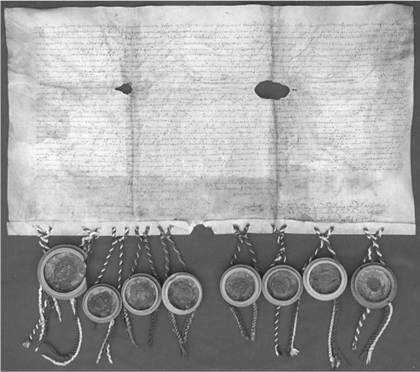
15.5 Charter of the Union of Brest (1596), with signatures and seals of church prelates and government representatives.
It was in this general context that the Orthodox of western Ukraine themselves initiated a new effort at church union. Their move seems to have been motivated less by ideological or spiritual conviction than by disputes regarding jurisdictional authority. Generally, monasteries and other religious institutions fall under the jurisdiction of the local bishop on whose territory they are located. In 1589, the ecumenical patriarch of Constantinople, on a return trip from Muscovy (where he was seeking funds), stopped in western Ukraine. Shocked by the low moral standards of the Orthodox Church in general and in particular those of its hierarchs, he granted the L’viv Dormition Church Brotherhood the right of stauropegion; that is, he placed the brotherhood under his direct authority and commissioned it to report on farther abuses within the local Orthodox Church.
Incensed by such interference and driven by a desire to be “liberated from the slavery of the patriarch of Constantinople,” the bishop of L’viv, Hedeon Balaban (r. 1569-1607), in 1590 convinced the Orthodox metropolitan of Kiev and three fellow bishops in Poland-Lithuania to inform the king of their readiness to recognize the supremacy of the Roman pope. The secular leaders of the Orthodox cultural revival, in particular Prince Kostiantyn Ostroz’kyi, were asked to participate, but they refused, arguing that church union would be valid only if the entire Orthodox world (Muscovy, Moldavia, Walachia, and the ecumenical and other patriarchates) were involved. Undeterred and backed by the Polish king, the pro-union forces continued along their unilateral path. They submitted a request to Rome and the following year, 1596, convened a meeting in southern Lithuania to proclaim what came to be known as the Union of Brest. Also meeting at Brest were the anti-union forces led by Prince Ostroz’kyi, who rejected the Brest agreement.
The immediate results of the Union of Brest were the following. The church union was supported by Poland-Lithuania, which legally recognized only the pro-union or Uniate bishops. The government then proceeded to put pressure on the remaining Orthodox hierarchs to accept the Brest agreement. The Metropolitanate of Kiev, Halych, and All Rus’ based in Lithuania was also now split, with the metropolitan himself and several bishops becoming Uniate and other bishops (including Balaban who had initiated the initial pro-union agreement) remaining Orthodox. From the very outset, the Orthodox argued that the Uniates acted against church law, and to this day they do not recognize the canonicity of Uniate (subsequently renamed Greek Catholic and Ukrainian Catholic) churches wherever they may be located. The Orthodox also presented themselves as the “true” church of the Rus’ people, whether they lived in Poland-Lithuania (present-day Belarus and Ukraine) or Muscovy (present-day Russia), while the Uniates were depicted as stooges of the Vatican who only wished to enhance their social (and financial) status in a Roman Catholic political environment.

15.6 Petru Movilă (Ukrainian: Petro Mohyla, 1597-1647), son of the ruler of Walachia and Moldavia, from 1627 archimandrite of the Kievan Cave Monastery and from 1633 Orthodox Metropolitan of Kiev.
For the next half a century the Orthodox of Poland-Lithuania found themselves on the defensive. They were able to regain legal status in 1607; they chose a full set of hierarchs in 1620, although they were not recognized by the governmental authorities. Finally their status vis-à-vis Poland-Lithuania’s secular authorities was regulated in 1632. At that time, the metropolitanate of Kiev in Poland-Lithuania was formally divided: the archeparchy of Kiev, the eparchies of L’viv-Halych, Przemysl-Sambir, Lutsk-Ostroh, and the newly created eparchy of Mstislaü went to the Orthodox; the eparchies of Polatsk, Chelm, Volodymyr, Pinsk-Turaü, and Smolensk (then under Polish control) to the Uniates. Moreover, each church had its own Kiev metropolitan: the Orthodox resident in Kiev itself; the Uniate in Vilnius or Navahrudak. It was also at this time that the Orthodox Church was to experience another spiritual and cultural revival under the newly consecrated Kievan metropolitan of Moldavian-Romanian origin, Petru Movilã/Petro Mohyla (r. 1633-1647). Among his numerous achievements was the creation in 1632 of a college, later known as the Kievan Mohyla Academy, which became the most important center of learning and scholarship throughout the entire Orthodox world.
Ultimately, the ability of the Orthodox to survive in Poland-Lithuania was not the result of monastic activity, the magnate-led Orthodox cultural revival, or the urban-based brotherhood movement. Rather, at the outset of the seventeenth century, the Orthodox Rus’ population found allies in a new military and political force whose representatives adopted Orthodoxy as a main component of their own identity. This force was the Zaporozhian Cossacks.

15.7 The Kievan Mohyla Academy, founded in 1632 by Petro Mohyla as a collegium, raised to the status of an academy in 1701; the “old” building as it was reconstructed (1732-40) by the architect Johann Gottfried Schädel.
More on the topic 15 Religion and Culture in Ukrainian Lands in the 16th and 17th Centuries:
- Notes
- THE THEORY AND PRACTICE OF EMPIRE-BUILDING
- 21 White Bears, Whales and Walruses
- The City of Glory
- The Adventures of Yisroel Kulyk
- 16 EXPANDING FLORA’S EMPIRE
- 33 The Struggle for the Indian Ocean
- PART VI THE GREAT CONFLUENCE
- YOU CAN SEE A SCAR