The First Victories
Great optimism permeated the Polish and Lithuanian Commonwealth following the Cossack capitulation. More Ukrainian land was expropriated by the Polish nobility strong measures were taken to harness the Cossack movement, and the enserfed peasantry was pressed even harder.
Religious intolerance towards the Greek Orthodox and Protestants continued to be spearheaded by the Jesuits, although some accommodation of the Orthodox Church hierarchy had been made to satisfy the Orthodox nobility. Fed by exaggerated accounts of the “defeat” of the Cossacks, and wallowing in much self- praise, the Polish nobility felt itself to be omnipotent. After all, it was firmly in control, it was calling all the shots, and in any future uprising—as the boasting went—it wouldn’t even be necessary for the lords to draw their sabers in battle; the rabble would simplybe dispersed with whips and riding crops! Only a single lesson had been learned from the revolts—the way to maintain power and “law and order” was through brute force. Yet only ten years would pass before rebellious Cossack regiments were on the march again, inaugurating one of the most violent and bloody periods in east European history, one which would signal the end of the commonwealth.We have several documents and eyewitness accounts of the persecution that descended upon the Ukrainian land. Apetition submitted to the Sejm Convocation of 1648 by the “Cossack Army,” such as it was, lists many of the outstanding abuses:
We are lodging a complaint against the lords (nobility) and the Ukraina (border) administration, that although they have us according to their will, they do not act towards us as one should treat knightly men and Royal servants, but inflict greater losses and more intolerable wrongs on us than on their slaves, so that we are not free not only in our property but even in our own persons.
Homesteads, hayfields, meadows, sown fields, plowed fields, ponds, mills—whatever may appeal to the gentlemen officials that belongs to us Cossacks—they forcibly seize. As for ourselves, who are not guilty of anything, they rob us, beat us, murder us, throw us into prison, put us to death for our property, and so they have wounded and maimed a great number of our comrades. They take a tithe on beehives and a cattle tax from the Cossacks on a par with the burghers, even though they (Cossacks) live on Royal estates (i.e., crown land). Sons of Cossacks are not permitted to lodge their own mothers or fathers (without performing extra duties) in their old age; to turn them out is unbecoming and a sin. Cossack wives surviving their husbands are not permitted to live freely—no matter how old she maybe, she is immediately subjected to the lord’s dues and robbed without mercy.1The petition continues at length to describe additional abuses from their own (appointed) colonels, and the high taxes imposed on those who attempt to make a living from hunting and fishing. The so-called CossackaEyewitness Chronicle” further describes the religious persecution:
There was also a great “obstacle” to the Faith of Rus (Greek Orthodoxy) on the part of the Uniates (Greek Catholic) and Roman Catholic priests... also in Ukraine, the Union had begun to gain the upper hand... they sealed Orthodox churches in the cities. In this their (the Uniates’) helpers were the nobility, the administration, and the Roman Catholic priests, for by now in Ukraine where there was a city there was a Roman Catholic Church. In Kyiv, too, there was no small oppression of the ancient Godly (i.e., Orthodox) churches. Janusz Tysziewicz, the palatine at the time, as well as Jesuits, Dominicans, Bernardines and other (monastic) orders, by means of raids and lawsuits, were persecuting the Metropolitan and banning study in schools... but the worst mockery and oppression that the nation of Rus suffered was from those who converted from the Faith of Rus to the Roman.2
The abuses were even noted by some contemporary Polish sources such as Samuel Kuszewicz, who reported the raping of Cossack and peasant wives and daughters by Polish officials and members of the Polish army, and the merciless “extortion” by the Jews in the service of the nobility.3
The great Upheavalwhen it came in 1648 produced something which all previous Cossackrevolts lacked—an outstanding
tactician and strategist who would be able to Outmaneuver and outplan the Commonwealth commanders.
Now one such appeared, a Cossack officer by the name of Bohdan Zinovy Khmelnitsky4 He was born in 1595 the son of Mikhailo Khmelnitsky a captain in the Chihirin district in Ukraine. As far as we know he was an only son with one sister, which was unusual at that time when families were much larger—perhaps this was why he was given the name “Bohdan” or “God Given.” His father s early background is not known, but he most likely belonged to an old Cossack family from Khmilnyk (Volin), perhaps the descendant of the boyar—Cossack CommanderVenzhyk Khmelnitsky—who in 1534 destroyed a large Tatarhorde near Zaslav in Volin. Later Bohdan Khmelnitsky referred to himself as “well born” and displayed a coat of arms, but his membership in the official nobility is doubtful. His father was an example of a Greek Orthodox Ukrainian in the service of the King and the Commonwealth, who was well rewarded for his loyal service and was able to establish a homestead ranch near Chihirin called Subotiv. Mikhailo Khmelnitsky s lifestyle was similar to that of a minor noble, and when Bohdan reached his teens he was sent to study in a Roman Catholic school in Galicia, either in Jaroslav or Lviv or both. We know that he was tutored by the Jesuit priest Andrzej Mokrski in a curriculum which took 6-8 years to complete and was capped by the study of “rhetoric,” which Bohdan completed successfully. No doubt his father s intentions were to prepare his only son for a career in the King s service, and to make him appreciate the benefits of Roman Catholic civilization. This may explain in part Bohdans abstention from the rank-and-file (“chern”) Cossackuprisings of 1625 and 1637- 38 which were breaking out all around him.When war began with Turkey in 1620 Mikhailo Khmelnitsky and his 25-year-old son took part in Hetman Zolkiewski s disastrous Moldavian campaign. Bohdan s father was killed in the battle of Tsitsora, and he himself was taken prisoner to Constantinople to be enslaved to a helmsman in the Ottoman navy.
There he learned Turkish and took the opportunity to study the Koran, a copy of which he later kept in his modest library, no doubt for reference when dealing with his future Muslim allies. He was now fluent in the common language spoken in Ukraine and Rus, the literary Church Slavonic, which was also the language of the Muscovite state, Polish, Latin (Greek?), and Turkish. Nothing further is known about Khmelnitsky until the revolt of 1637; presumably he spent the Interveningperiod with the Chihirin Cossackregiment guarding against Tatar attacks, and tending his ranch in Subotiv. We know that he married the daughter of a propertied Cossackbythe name of Hanna Somko and had several sons and daughters. Following the 1637 revolts Khmelnitskyfirst appears in Polish records as a captain in the Chihirin regiment as well as the Secretary of the loyal Registered Cossacks, and was appointed by Potocki to sign the Cossack document of submission.5Why did Khmelnitsky and thousands of other Cossacks not join their comrades and the peasants in the uprising of 1637-38? This was a revolt of the have-nots, who had executed senior Cossack officers, men who felt they had too much to lose with the collapse of the Commonwealth. Many others felt the revolt would fail with so many untrained peasants in its ranks, a self-fulfilling prophecy which came true with the defeat of the uprising. The king now appointed the Hetman and all the colonels and senior officers in the same way as provincial starosta-governors, the castellan, and the crown hetmans. Most were ethnic Poles of Roman Catholic backgrounds who were chosen to keep a tight lid on the unruly and “willful” Cossacks. The Commonwealth government was beginning to realize that ethnic and non-Roman Catholic Rusins could not be trusted to implement the repressive measures.
Bohdan Khmelnitsky, however, was gaining the confidence of King WladyslavIV, and together with the senior Cossack officers Barabash and Illiash was chosen to attend a meeting with the King in Warsaw.
Wladyslav ΓV was planning a major war with Turkey for which he lacked sufficient funds. He attempted to increase his coffers in 1645 by putting a stop to the tribute payments to the Crimean Khan, which he hoped would also provoke a Tatar attack during which the Sejm would have to vote funds for the defense of the realm.6 When an attack was not forthcoming Wladyslavlaunched a diplomatic effort to gain allies (including Muslim Persia and Morocco), but OnlyVenice responded favorably.7 In his hour of need Wladyslav also remembered the Zaporozhian Cossacks, and the three delegates were promised the restoration of the Cossack “ancient liberties and privileges” in return for their support. The Cossack royal register was also to be increased from 7,000 to 12,000 men, who of course would be exempt from serfdom. The meeting took place in secret, during which the three Cossacks supposedly received a letter from the King confirming his promises, but to date no such document has come to light. It was either destroyed in the turmoil which followed or the promise was never committed to writing, but in any case all came to naught. Chancellor Ossolinski and other senators got wind of the King s plans and forced him to consult the Sejm. All preparations for war were rejected, and Wladyslavhad to disband his newly gathered force. We know, however, that a meeting did in fact take place. According to Giovanni Tieplo the Venetian envoy to Wla- dyslav s court, the King had informed him of having met Cossack officers in the spring of 1646, shortly after the death of Hetman Koniecpolski. Two years later a Cossack captive Mi- chailo Drushenko had also revealed under torture at the Election Sejm of 1648 following Wladyslav s death, that the three Cossack officers had visited Wladyslav at night and attended a council meeting, where seven senators were present. The Cossacks were given 6,000 tallers (18,000 zlotys) “to build boats, throw off their yoke and go to sea (to raid the Turks).”8The loyalty shown by Khmelnitsky however, would count for naught as personal misfortunes worthy of Job descended upon him.
His wife Hanna had died, and at 52, not wishing to remarry, he took a young woman to live with him. Helen was as promiscuous as she was beautiful, and soon caught the eye of a young “Liakh” (ethnic Pole), Daniel Chaplinski, the newly appointed vice-starosta of Chihirin. The young noble soon convinced Helen to leave Bohdan while the Cossack captain was away on an anti-Tatar expedition, and converting to Roman Catholicism she and Chaplinskiwere soon married. Apersonal feud now developed between the middle-aged Cossack captain and the young vice-starosta who, taking advantage of his position, began to harass Bohdan. First irregular taxes were imposed, and when the Cossack lodged a complaint the enraged nobleman had Khmelnitsky’s 10-year-old son seized and flogged in the Chihirin market square with such severity that the boy soon died. When two attempts on Khmelnitsky s life failed, Chap- Iinski convinced the Starosta that the Cossack captain occupied his ranch at Subotiv illegally, and that in fact the land belonged to the starosta district. To boot, the Cossack was also a dangerous individual—in fact a traitor—and Chaplinski was given permission to attack and occupy Subotiv, burning down the barns and other buildings. Khmelnitsky himself was arrested, but since the starosta did not have the authority to detain a royal regimental Cossack captain without the colonels approval, Khmelnitskywas released on bail to his Chihirin colonel (and friend) Michailo Krichevsky, a Roman Catholic and a Pol- onized Rusin. They both realized that any appeal, particularly to the Polish Hetman Potocki, would be futile, and Khmelnitsky decided to seek refuge Down Under in the Zaporozhian Sich. He would soon begin to realize the superficial nature of his position in the Commonwealth, an arbitrary and abusive kingdom ruled by, and for, the nobility. Although 52 years of age Bohdan was still a vigorous man but at times given to melancholy as described a few years later by the Venetian envoy Alberto Vim- ina.He is rather taller than average in height, big-boned with a powerful build. His speech and command show mature judgment and a keen mind. Although he occasionally drinks a great deal, he does not forsake affairs, hence it seems as if there are two natures in him. One active, unyielding and devoted to his command, the other somnolent, drowned in inebriation. He is gracious and simple in conduct, and thereby earns his soldiers’ affection, but on the other hand he maintains discipline by means of severe punishment.9
Khmelnitskywas also simple of dress, which was not very different from that of an ordinary Cossack. Rich dress was for the nobility and would have been viewed with great suspicion by the rank-and-file, the “chern.”
Avoiding the registered Cossack guards along the Dnipro River, Khmelnitsky arrived at the Sich in late 1647 with his eldest son Tymish, finding only 250 Cossacks in residence, whom he had little difficulty in convincing to go on a war footing. Once elected as the commanding officer of the Sich, the “koshovy ataman,” his first step was to gather men and move against the Cherkasy and Korsun Registered Cossackregiments that had been stationed in the vicinity to enforce the Polish conditions of 1638. Dissatisfaction at the Shabbytreatmentby the appointed Polish colonels had penetrated into the ranks of the King’s Cossacks, and when approached by Khmelnitsky s envoys they attacked and drove out the commanding officers and their dragoon bodyguards. By 30 January 1648 Khmelnitsky was in control of the Sich and the surrounding areas. Other Zaporozhians who were away hunting and fishing began to trickle in, having gotten word that the once General Secretary of the Registered Cossacks was raising the standard of revolt against the Polish Commonwealth.
At the first news of the rebellion the Polish Hetman Potocki began to move south into Ukraine, and anticipating an attack Khmelnitsky established a stronghold on Butsk Island. By early 1648 he had 2,500 Cossacks and 500 Tatars, the latter sent by the Crimean Khan in response to the Hetmans request. As reported by Potocki, Khmelnitsky “had the audacity to transport several hundred of them (Tatars) to this side (of the Dnipro River) so that they might chase away our guards who are stationed on various routes... to prevent the unruly from rallying to him.”10
Khmelnitsky was also assured that with the first spring grass he would receive more Tatar support. He also didn’t forget the serfs and the town burghers, sending traveling minstrels to the towns and villages to announce the uprising and the coming of the Cossacks. Written announcements were posted such as the one declaring that “you whose fathers recognized no (state) laws, who never subjected themselves to kings, be slaves no longer!”11
Greek Orthodox nobles were also contacted for support, often by priests and monks acting as clandestine emissaries. To convince those who hesitated to become involved in what were illegal activities, Khmelnitskyused his meeting with KingWla- dyslav to spread rumors that the King supported the Cossacks and “The Greek Faith of Rus” against the arbitrariness of the Liakh nobility; he was fleeing Warsaw to join the Cossacks; the revolt was really against the powerful and wealthy magnates and the king’s misguided government officials and not against Wladyslav, and so forth. Khmelnitsky’s defiance of the Polish Commonwealth would strike a popular chord with members of all Ukrainian social groups and classes, not just the serfs as was the case in the previous uprisings. The oppression of the Greek Orthodox Church had emerged as a major factor and ethnicity began to play a role with nobility being identified as “Liakhs” as opposed to the native “Rusins.” Many Greek Orthodox nobles had been deprived of land by their powerful
Catholic neighbors, who continued to reap great fortunes from the export of wheat and other agricultural commodities.
By the spring of 1648 Khmelnitsky already had 6,000 men divided into 8 regiments, but not nearly enough to challenge the might of the Polish-Lithuanian Commonwealth. He desperately needed Crimean support, at least their guaranteed neutrality so as to secure his rear and and keep him from being caught between two fronts. The Polish Hetman Potocki was also not wasting time. Although he had acknowledged the wrongs done to the Cossacks in a letter to King Wladyslav and urged strong action against the Ukrainian (border) starostas, once the revolt began to spread he set himself the task of suppressing it as quickly as possible. Potocki s promise to Khmelnitsky that “not a single hair” would fall from his head if he submitted to government authority fell on deaf ears, and the Cossack Hetman responded with three demands: the repeal of the oppressive regulations of 1638, the restoration of full Cossackliberties and rights, and the withdrawal of all Crown troops from Cossack territory. Potocki s reply was that the measures could only be implemented by the Sejm, and he himself had no authority over such matters. He, after all, was just a soldier.
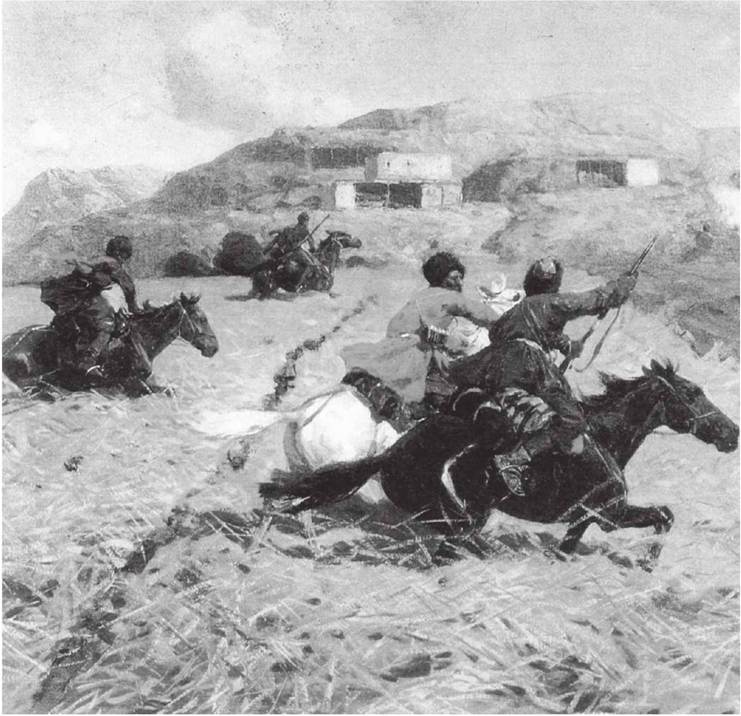
Cossack skirmishers testing an enemy position.
The main Polish army was concentrating in Korsun some 5,000 strong, and other regiments were arriving under the command of the district starostas Seniawski, Zaslawski, and Lubomirski, with additional troops expected. At the same time a force of4,000 men—1,500 Polish Crown troops and 2,500 registered Cossacks—were sent toward the Dnipro rapids to establish an advance position in the vicinity of the Kodak fortress, which at the time was garrisoned by 600 loyal troops. To expedite matters, and not expecting strong opposition so early in the campaign, Potocki divided his army into two groups. The first consisted of three infantry Cossack regiments under the appointed colonels Krichevsky, Wadowski and Gorski, seven troops of dragoons (mounted infantry), and four troops of light cavalry supported by 12 pieces of artillery, all under the command of Commissioner Szemberg. Ivan Barabash and Illiash Karaimovich in the meantime sailed down the Dnipro towards the Kodak fortress with several companies of Registered Cossacks.
Departing on 21 April 1648, within a week the Polish land force was 12 miles south of Chihirn in the watershed of the Dnipro and its tributary the Inhulets. It had attracted many young men from some of the best noble Polish families seeking adventure and eager to make a name for themselves in what was to be an easy victory over “rabble.” Hetman Potockis 26- year-old son Stefan the starosta of Dorozhnia served as the second in command to the experienced Szem- berg. The young nobles had brought a plentiful supply of wine, spirits and good food and the expedition proceeded in a pleasant atmosphere, with servants setting festive tables at the end of the day under great marquis tents.
Khmelnitsky s first target was the flotilla sailing down the Dnipro River. When on 3 May the barges of the Registered Cossacks pulled up to shore at Kamiany Zaton to establish camp they were approached by Khmelnitskys agents and incited to revolt. When the officers tried to interfere they were all killed with the exception of Michailo Krichevsky, who was recognized as Khmelnitsky s comrade. An election for new officers was held on the spot with Filon Dzedzally elected colonel, and one Krivulia as his “osaul.” Although a Roman Catholic, Krichevsky was also a Rusian nobleman who had decided to throw in his lot with the Cossacks against the Polish Commonwealth, which was increasingly seen by the nobility of Rus as a foreign and oppressive power. With the Registered Cossacks on his side Khmelnitsky next positioned the regiments on the west shore of the Dnipro to block the advance of the main 6,000 man Polish army, which under Hetman Potocki and the Field Hetman Kalinowski was following Szemberg s advance detachment. Having learned of the registered Cossack revolt and not hearing news from Szemberg (whose messengers were being intercepted by Cossack scouts) the main Polish army halted, and began to pull back. This gave Khmelnitsky a free hand to deal with Szemberg, who in the meantime had entrenched himself behind an encircled wagon “tabor” by the “Zhovti Vody” (YellowWaters) River to wait for Potockis relief force. Surrounded on three sides with the river at their backs, for the next two weeks the Polish force succeeded in beating back several Cossack and Tatar attacks. Seeing little hope Szemberg s Registered Cossacks also revolted and went over to Khmelnitsky. They were joined by the dragoons, who were mainly recruited in Galicia and were Greek Orthodox Rusins described by the Poles as “natione Roxolani, religione Graeci, habitu Germani.”12 Realizing the hopelessness of his position, Szemberg sent an envoy to negotiate terms. Although the Polish force was now much reduced it was nevertheless dug-in a strong position defended by 12 pieces of artillery, and to avoid further Cossack casualties Khmelnitsky agreed to lift the siege. The Poles would be allowed to leave with their camp intact, but on condition they surrender the field artillery, of which Khmelnitsky had none. As the Poles were pulling out, they were attacked by Tugai Bey s Tatars, who could not endure to see such a rich prize slip through their fingers. Refusing to surrender, the whole Polish contingent was massacred with a single noble s serving man managing to bring back news of the disaster. Chaplinski and his envoys who had been sent to Khmelnitsky for negotiations also survived. The young Stefan Potocki was badly wounded and soon died in Tatar captivity. The commander Szemberg, who was hated by the Registered Cossacks for his abusive treatment, was tortured to death and his head nailed to a pole on Khmelnitskys orders. The battle of “Zhovti Vody” was over, its memory kept alive in Ukrainian ballads:
Oi, from the YellowWaters to the Prince’s Ravine,
The green field is strewn with many colors.
Not with spring flowers, but with the nobles’ corpses.” and
An eagle flies o’er a ranch, weaving in the wind.
Oi, there the poor Cossack is fighting with the Poles.
Oi, ’tis time to cease drinking the blood of Rus!
Not just a single young Liakh has orphaned his children!13
Did Khmelnitsky need the Tatars to defeat the Poles at Zhovti Vody? Probably not. The Cossack-Tatar joint military campaign against non-Tatars was without precedent and at first drew criticism from most Cossacks, as is illustrated by the speech given by a Cossack at a “rada” meeting:
Master Hetman and lads! The hetman’s (otaman’s) will, and yours are free, but I do not know whether it would be good for us to take pagans (non-Christians) as our protectors. God will grant, and our Army can ensure, that without these pagans we can defend ourselves against the Liakhs, and obtain redress for our grievances from our Lord the King.14
The speech was met with wide approval. It also did not help matters that Khmelnitsky knew Turkish and could quote from the Koran. Had he secretly converted to Islam? The presence of several thousand Tatar horsemen was certainly helpful but the most important factor was strategy. Khmelnitskyneeded to ensure that his rear was secure from attack as he moved into Ukraine, which (as future events would indicate) would have occurred if Poland decided to renew its treaty with the Crimean Khan and the Ottoman Sultan. King Wladyslavs refusal to continue the payment of tribute had antagonized Khan Islam Giray and Khmelnitsky realized that his proposal for a military alliance stood a good chance of being successful.
Unsure as to the size of Khmelnitsky’s army and alarmed by the annihilation of Szemberg s forces, Hetman Potocki decided to retreat to Korsun. Khmelnitsky was spreading misinformation about the size of his Cossack and Tatar forces in order to hide his weak numbers and to avoid being attacked by Po- tocki’s powerful and well-equipped regiments. Alarmed at the reports of the huge Cossack and Tatar forces, the Poles stripped Korsun of anything that could be useful to the enemy, burned it to the ground, and proceeded to dig a camp outside of the town, surrounded by trenches and wagons, to await the arrival of Prince Wishniowiecki, who had sent a courier to announce his arrival with 6,000 men. Khmelnitskywas Continuallybeing informed as to the movements and composition of Wish- niowiecki’s army, which was swelling rapidly with Catholic and Jewish refugees. Having taken over most of the left bank Ukraine as his property the Prince ruled his possessions as an absolute monarch and by 1647 his vast holdings consisted of 38,460 households!15 Khmelnitskywas now in a dangerous situation. His force was too weak to attack Potockis dug-in army, and with Wishniowieckis arrival he would be greatly outnumbered, attacked on two fronts, and annihilated.
Time was of the essence, and Khmelnitsky acted quickly. He first sent word through his network to have every boat on the Dnipro River destroyed to prevent the Prince from crossing to the west. Next, Khmelnitsky turned his attention to Potockis positions. His spies were keeping him abreast of developments in the Polish camp and he now learned that the Poles were in a great state of apprehension, believing that the Cossack and Tatar forces were much larger than they actually were. After all, how else could Szemberg have been defeated so completely, with just a single survivor? Khmelnitskypaid a great deal of attention to intelligence gathering, and he knew that Potocki would do the same. Towards the evening a Polish scouting party captured a Cossack “but” or translator and brought him back for questioning. When interrogated under torture he at first refused to talk, but eventually “broke down” and “revealed” that Khmelnitsky was on his way with a force of 15,000 regular Cossacks, supported by 40,000 Tatar cavalry led by Tughay Bey of Perekop. The “but” also volunteered the information that the Cossacks were damming the Stebliv River to deprive the Poles of drinking water. When Potocki was brought news that the river level was indeed falling, the “but s” Credibilitywas confirmed.
A council was convened by Potocki, where it was decided not to risk annihilation at the hands of what was obviously a much superior enemy force. The next day the Polish army began to pull out towards Bohuslav along the Ros River, protected by 8 rows of wagons but only 12 pieces of artillery since most of the guns had to be left behind. This is what Khmelnitsky was waiting for. The only way out which Potocki was allowed to take led through a heavily wooded ravine, the Horokh Woods, where the 6,000 man Polish army would be strung out in a long line. As the Polish rear entered the depression the advance units found their path blocked by great tree trunks which had been dragged across the road, and the Korsun Cossack regiment commanded by Maksim Krivonos (“Crooked Nose”) lying in wait.16 At the given signal Cossack infantry emerged from the ambush pouring volleys of musket and artillery fire into the massed Polish file, and with sabers and pike charged the enemy. Hemmed in and unable to deploy their forces, the Polish army was trapped, unable to bring into play its artillery. The battle lasted the whole day at the end of which Potocki s army was all but destroyed. Only Prince Koretsky managed to fight his way out
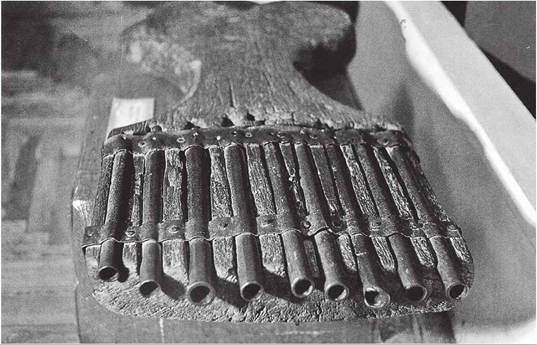
The multi-barrel handheld Cossack “ozhiha ” 17th century. Ignited by fuses, the barrels could be discharged either individually or in sequence, usually at close range. Ukrainian Cossack regiments routinely faced armored cavalry and infantry and relied heavily on firepower (Ukrainian National Museum, Kyiv).
with half of his cavalry regiment and reach Kyiv.17 Much needed military equipment and supplies fell into Cossack hands. The spoils of war were very rich since many of the high nobility had brought fine table settings, silverware, expensive clothing and other personal valuables, expecting the expedition against the “rabble” to be something of an outing. Bohdan Khmelnitsky himself was given 13 Ioadedwagons by the Cossacks as his share of the spoils. Both Polish Hetmans Potocki and Kalinovski were wounded and many officers and over 1,000 soldiers were taken prisoner and handed over to the Tatars as part of their spoils of war. In fact the Tatar cavalry had played a minor role in the cramped quarters of the battle, where “the barrel of a gun almost reached the other (enemy) side” as recounted by a surviving Polish musketeer. 520 soldiers and 60 officers were able to buy their freedom on the spot, while the remaining prisoners were brought to the Crimea with the Polish Hetmans who were each held for a ransom of20,000 pieces of gold. Some of the Polish troops were Greek Orthodox Rusins who expressed a wish to join Khmelnitsky, while those who did not were allowed to go free. With the exception of the debacle at Tsutsora against the Turks this was the greatest defeat suffered by Polish Commonwealth arms to date and sent Warsaw into a panic.
More on the topic The First Victories:
- Greek Combat Sports
- From Pastoral Chiefdoms to Nomadic Empire
- The first of the five phases was by far the longest, lasting roughly three and a half centuries.
- The First Gulf War
- Social Science—The Syllabus
- Deliberative Assemblies
- 14.4.3 POLISHING THE BRIEF
- 17 Tin Traders
- The Sura as Paradigmatic Heroic Warrior
- Chalcedonians and Non-Chalcedonians