The Rise of Polish and Lithuanian Dominance
Kyiv and Rus were destroyed by the Mongol invasion and what remained of Riuriks dynasty was too fragmented to stand up to its neighbors. The Papal envoy Carpini commented on the weakness of Rus some five years after the fall of Kyiv: “we always traveled in a deadly danger because of the Lithuanians who often carry out secret attacks...
especially in the area through which we had to pass, and because most of the Rusian (Ruthenian) men have been killed or captured by the Tatars.”22In spite of the occasional support from the Golden Horde, by the middle of the 14th century the Kingdom of Galicia was inherited by QueenJadwiga of Poland following King Casimir’s conquest, who gained 52,000 square kilometers of land and a population of some 200,000 inhabitants. The gains in the east were made at a cost of losing Silesia to Czech Bohemia and the Baltic coast to the Teutonic Knights but nevertheless Poland was emerging as one of the more powerful kingdoms of Europe. Casimir the Great’s victories were also based on a new army which he had raised, by offering land to nobles and peasants in return for military service. His own personal power also extended beyond Poland proper which consisted of Great (Major) Poland in the west and Little (Minor) Poland in the south since
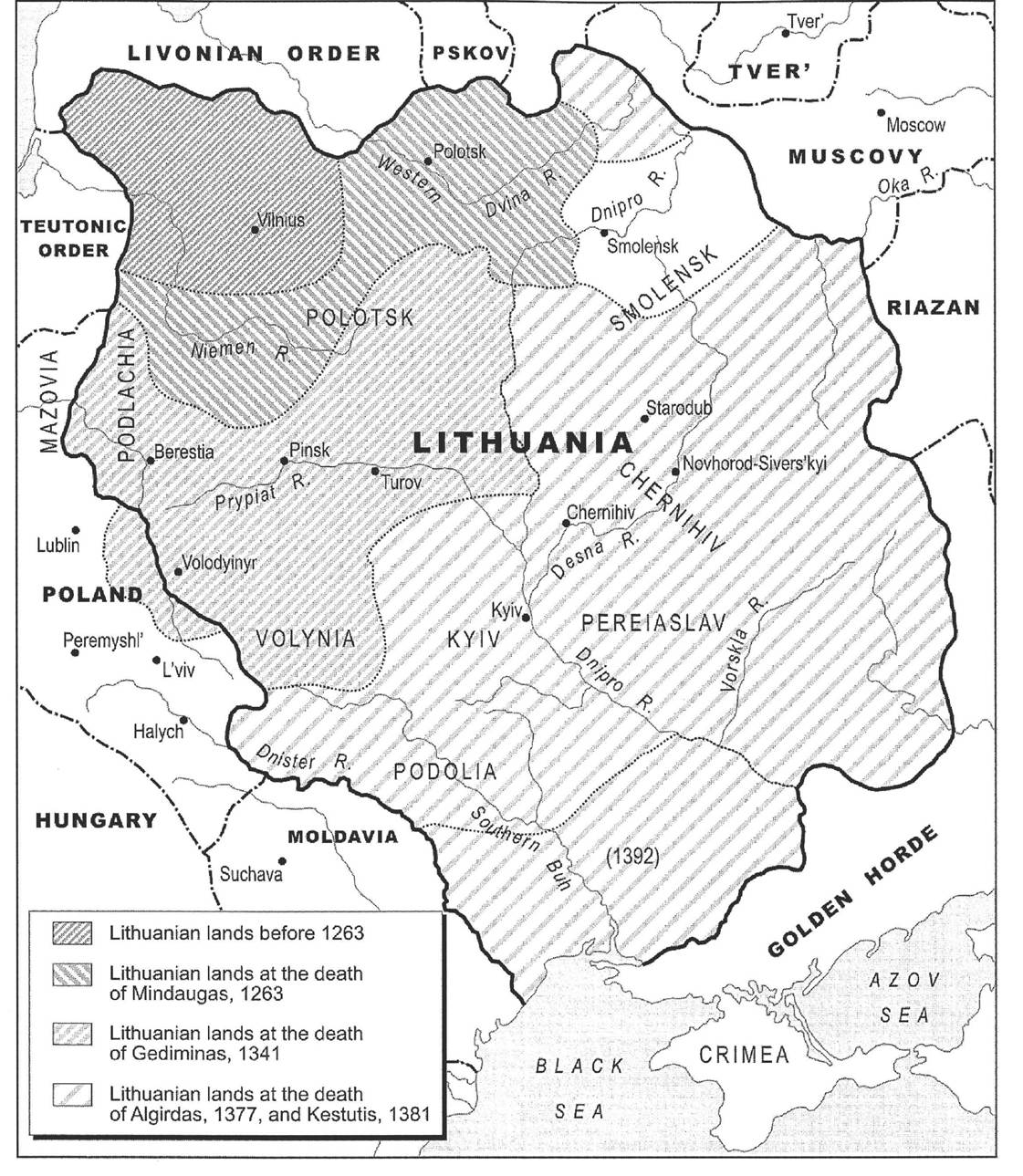
The Principality of Lithuania-Rus following the Mongol invasion as most of Galicia became part of the Polish Kingdom.
the dukes of independent Mazovia also recognized his overlordship. The Galician kingdom (Red Rus), however, was a foreign conquest, and to establish control Casimir III took over many Greek Orthodox estates by claims of inadequate proof of ownership, and those which had been abandoned by Galician princes, and turning them over to Polish nobles.
Catholic Church schools were extended to the nobility, and the University of Cracowwas founded in 1364.An even more rapid rise in power was that of the Lithuanian tribes led by Prince and later King Mindaugas (Mindog) and his successors. The Lithuanian, Prussian, and Lettish tribes were the last remaining pagans in Europe, involved in a drawn- out Conflictwith the Christianworld, particularly the Crusaders and the Teutonic Knights. The Lettish tribes were the first to succumb to the Crusaders in what is today Latvia, followed by lengthy Christian campaigns against the Prussians, whose lands stretched from the mouth of the Vistula to the Nieman (Ne- munas) rivers. After several setbacks the Prussians began to offer stiff resistance to the Teutonic Knights and the Poles, and allied with the Pomeranian Duke Swatopelk they destroyed most of the forts along the Vistula River erected by the Teutonic Order. More spectacularly a German army was annihilated in the battle of Rensen in 1244 with the loss of the commanding marshal, and five years later the Prussian tribesmen repeated the performance by wiping out another German army at Krucken, also with the death of the commander. Although not as well equipped militarily as the Christians such as the much- vaunted Teutonic Knights, the pagan tribesmen were learning their enemy’s tactics and ways to overcome them in their own familiar territory.
The Pomeranian Duke Swatopelk was not as successful and failed to destroy a force of Teutonic Knights which he had attacked in 1254 outside of Torun. Faced with a combined German-Polish army he was forced to sue for peace and recognize the Order’s presence in the delta of the Vistula River. The Teutonic Knights were further strengthened by King Ottokar of Bohemia, who joined the Baltic Crusade in 1254 and financed the fort in the Sambian Peninsula which became the order’s headquarters, known as Konigsberg. In the same year King Danylo of Galicia in alliance with the Polish Dukes Samovit and Boleslav invaded the territory of the Yatwingians— the most powerful of the Prussian tribes.
The Teutonic Knights took advantage of the support to renew their building activities by establishing a fortress at Klaipeda (Memel) to cut off the Samogitians from the sea, and began sending raiding expeditions against the Sambian and Samogitian tribes.The Prussians sued for peace and the Crusaders used the lull in the fighting to strengthen their ranks with volunteer knights who came from as far away as England. Troops were also sent from Pomerania (now a Crusaders’ ally), Bohemia, Moravia and Poland to help fight the pagans but to little avail.
A Catholic force led by the Order’s Master von Hornhausen was attacked by the Samogitians and defeated at Skuodas (Schoten) in 1259, and the Prussians were Onlyprevented from following up on the victory by a Mongolian invasion. Not used to fighting in the dense forested wetlands the Mongols withdrew, which freed up the Semigallian Prussians to join the Letts and in the following year inflict an even greater defeat on the Crusaders, in the Battle of Drube. Commanded again by the Teutonic Order’s Master von Hornhausen, the Catholic army was destroyed and the Grand Master himself killed in the fighting, along with 150 of his knights.23
Durbe was followed by another Lithuanian victory against the Teutonic Order at their stronghold of Lenevarden which signaled a general anti-Crusader uprising. King Mindaugas renounced his treaty with the Teutonic Order and with his Novgorod allies and a pagan Lithuanian force he declared war on the Order. The troops from Novgorod attacked Tartu (Dorpat), and the following year the Lithuanian Prince Treniata defeated the Knights at Ust-Dvinsk (Dunamunde), joined forces with the Yatvigians and invaded the German-occupied part of Prussia, Polish Masovia, and Volin. Many German colonies were massacred and when a Crusader reinforcing army arrived, it was wiped out at the battle of Pokarwis in 1262. All forts with the exception of Koningsberg were burned and the Teutonic Knights were virtually wiped out, prompting Pope Urban IV to divert his anti-Mongol effort (such as it was) against the Baltic tribes.
The Crusader defeat of 1262 was followed by three other major catastrophes in 1270, 1279, and 1287 where four Masters of the Order were killed in battle, with Marshall Willekin captured and burned at the stake, probably in retaliation for a similar Crusader practice when captured pagans refused to convert.The pagan victories prompted a massive Catholic reaction from the Saxons and the Christianized Slavic lands of northern Germany. A new Crusade was organized, led by the Duke of Brunswick and the Margraves of Thuringia, Brandenburg, and Meissen. In a renewed effort in 1280 the reinforced Teutonic Knights also opened a campaign against the Prussian tribes of Sudavia, and within three years succeeded in conquering the area. Also in 1282, Duke Leszek the Black of Cracow crushed the Yatvigians near the Nieman River which ended independence. By 1290 a line of forts had been built from Dunanburg to Memel, in spite of the defeat three years earlier, and a burnt, devastated no-man’s land was established to the south to act as a defensive buffer zone. Many Prussians headed east to seek refuge with the Lithuanians who had managed to halt the German advance, and those who stayed behind had to accept forcible conversion. Two unsuccessful revolts by the "converts” took place in 1286 and 1295, following which the Crusaders were left in control ofLivonia and the depopulated Prussian lands. By the mid-14th century the native Prussians had been wiped out, one of the first known cases of genocide in Europe.
The Letts (Latvians) were conquered and Prussia largely depopulated, but the Lithuanian tribes continued to thrive in their forest homeland, reinforced by Prussian refugees. Hemmed in between the German Catholic Crusaders and the Slavic Orthodox city states to the east and south, the Lithuanians began to realize the military value of inter-tribal unity under a single monarch, to replace the loose tribal co-operation common at the time. The process took several decades and began with Prince Mindaugas, an able strategist and politician who after inheriting his father’s large estates began to enlarge them at his tribal neighbors’ expense.
He next turned his attention to the Slavic city-states, but at first things did not go well. His attack on Polatsk and Novgorod territory were met with defeat at the hands of Alexander Nevsky, and reinforced by German and other European Crusaders. The Teutonic Knights were gaining the upper hand as they invaded and ravaged the Lithuanian Naliskiai and Samogitia. In 1249 Mindaugas’ rival for leadership, Tautvila (Tavtivil) allied himself with the Teutonic Order, and converted to Catholicism. Hard-pressed by the Crusaders, Mindaugas saw little choice but to be baptized as well, and in 1252 he was crowned King by the Pope’s envoy.Mindaugas’ conversion was only political to stall for time and he continued to observe the Lithuanian pagan faith, turning on the Crusaders, as we saw during the great uprising of 1260. He had raised a strong and well-equipped army and by 1235 he was in possession of Black Rus, the most westerly part of the weakening principality of Polatsk in today’s Belarus. The rest of the principality was soon seized by his nephew Tautvila, who proceeded to install himself as the Grand Prince of Polatsk, while another nephew became prince of Vitebsk. Also by the middle of the 13th CenturyMindaugas was in control of Nov- gorodok, Grodno, Volkovysk and Slonim, giving him possession of much of Bela Rus (White Rus) since the prince of Pinsk also recognized him as his sovereign. Mindaugas had realized that his Lithuanians alone could not withstand the Christians for long without the participation of the neighboring city states of Rus. With a treaty he gained significant support in manpower and Rus gave him access to ready-made state institutions, manufacturing capability, and military training and technology. The Slav princes in turn welcomed the Lithuanian military support against the Mongols and the Polish Roman Catholic pressure. An alliance was also concluded between Lithuania and Galicia- Volin when Mindaugas’ niece married King Danylo. Mindaugas was now powerful enough to withstand both Mongol and Crusader pressure.
Thus a large Mongol raid in 1259 did not prevent the Lithuanians from driving the Teutonic Knights from Cour- land, Samogitia and Yatwingia, and four years later advancing to the mouth of the Dvina River. There, in a moonlit night battle near Riga, Mindaugas’ nephew Treniata (Trainot) defeated aRoman Catholic army and, continuing south, caused much damage in Prussia and Mazovia.
KingMindaugaswas assassinated in 1264, and the following year Treniata was killed in a steam bath. The reason seems to have been personal but could also have involved a faction of princes who opposed Mindaugas’ rising power and wealth. After his wife’s death Mindaugas had availed himself of Prince Dau- mantas’ (Dovmont) wife, and was killed with two of his sons by the Prince who fled to Pskov where he was baptized and made prince of the city. Mindaugas’ surviving son Vaishelga (Vaisvilkas) had become a monk in a Greek Orthodox monastery who now came out to don armor and avenge his father and brothers. The conspirators were defeated and not wishing to assume power Vaishelga appointed his brother-in-law (and King Danylos son) Svamas as Prince, and returned to the peaceful world of the cloister. Svamas was assassinated the following year and was replaced by Traidenis who resumed the war with the Teutonic Knights. Vaishelga had re-established relations with both the Teutonic Order and Volin, an unpopular policy which was also followed by Svarnas and which had allowed the Order to launch their campaign of extermination against the Prussians and reduce the Sambian peninsula to a burnt desert. The Yatvigians were also attacked by Boleslav of Cracow, and were finally defeated and subjugated by Leszek the Black in 1282.
Vaishelga died in 1282 and a new dynasty came to power with a Grand Prince known as Liutavras. His son Vytenis became Grand Prince in 1295 as the whole area to the east and south of the Baltic Sea again became a theater of constant warfare, with new Crusades declared, in the struggle for supremacy. A state of open warfare developed between the Archbishop of Riga and the Teutonic Order, which continued to pursue its narrow corporate interests. In 1298 the burghers of Riga sought the help of the pagan Prince Vytenis, who sent a force to garrison the city, defeated the Teutonic Knights under the command of Master Bruno and, entering Livonia and Prussia, destroyed many of the newly established German colonies. In spite of the Lithuanian pagans’ alliance with the Archbishop of Riga a new Crusade was declared against them at the beginning of the 14th century. Nowwith the support of much of Catholic Europe the Teutonic Knights began to launch intensive raids into Lithuanian territory, in the process even destroying Catholic churches that had been allowed to operate under Vytenis’ policy of religious tolerance. It is known that the Teutonic Order took steps to prevent the spread of Catholicism in pagan territory, which would have destroyed much of its Yaison d’etre” for the conquests of pagan lands. In 1311 Vytenis suffered a defeat at Woplauken near Rastenburg as raids into Lithuanian territory by the Knights continued unabated.
Prince Vytenis was succeeded by his brother Gediminas in 1316, who continued to expand his domain and encourage trade and the crafts by allowing freedom of commerce and religion. He also attempted to arrive at an understanding with the Catholic powers by signing peace accords with the Archbishop of Riga, the Danish King, and the Teutonic Order. The truce was short-lived and in 1322 Gediminas sent a force to devastate Dorpat in Livonia; and while his brother David the Prince OfPskovinvaded Estonia, the main Lithuanian army advanced to the mouth of the Niemen River and took the fort of Memel. In 1323 Gediminas ravaged Samland and Dobrzyn, forcing the Teutonic Order to send a delegation to his capital Vilnius, to ask for a truce. In a year and a half the Lithuanians had killed or captured some 20,000 Crusaders and German colonists.24
The Teutonic Order continued to be an implacable foe, and reinforced by a new Crusade called by PopeJohn XXII against pagans, Mongols, and Orthodox Christians, the Knights went on the offensive. In order to recoup the territory in Pomerania with the port of Gdansk (Danzig), King Wladyslav I of Poland concluded an alliance with the Lithuanians which resulted in the defeat of the Order’s allies Brandenburg and Ma- zovia at the battle of Ploce, in 1331. While Gediminas pillaged the interior ofLivonia the Teutonic Knights laid siege to Riga, which again had allied itself with the Lithuanians. The city fell in the following year and Grandmaster von Orseln of the Order with KingJohn of Bohemia led a large Crusader army into Poland, forcing King Wladyslav I to sue for peace and give up the Baltic territory.
For the Lithuanians, however, the real opportunities for expansion lay to the east and south. Appointing his war-like brother Keistutis to face the Teutonic Order, Gediminas turned his attention to the neighboring city states of Rus, and by patient diplomacy more than doubled his domain. In 1318 his son Algirdas married the only daughter of the Prince of Vitebsk, and two years later he succeeded his father-in-law while five years later his youngest son Liubartas (Lubart) inherited north Volin by wedding the Prince ofVolodimer s daughter. Gediminas now assumed the title “Lithuanian and Rusian King” (Lethewindo- rum et Ruthenorum Rex)25 and in 1331 his daughter Auka married King Iury II of Galicia-Rus. Gediminas was killed in 1341 defending the Lithuanian stronghold of Veliuoma, and by the time of his death he oversaw the beginning of a Lithuanian- Slavic state stretching from the Nieman River to Kyiv. His reign was based on the respect of regional traditions and did not impose on local princely autonomy, and the Greek Orthodox Church was allowed to function unopposed. Gediminas also adopted the expanded “Ruska Pravda” legal code of Kyiv Rus, and Rusian Church Slavonic became the official language of the courts and administration. Lithuanian princes also began to take Slavic wives and convert to Greek Orthodoxy, as the Lithuanian nobility was slowly being assimilated by the more advanced culture and civil society of Rus. Gediminas himself, however, never converted to Christianity, and remained true to the traditional Lithuanian faith and practices.
In the winter of 1344-45 Gediminas’ son Algirdas (Ol- gerd) was proclaimed as Grand Prince by his uncle Kestutis. The new Grand Prince and his uncle faced a difficult situation. The Teutonic Order had purchased Estonia from the King of Denmark and captured Pomerania from the Polish King and now held land along the Baltic, stretching from about the mouth of the Odra River to the Gulf of Finland. The territorial continuity was only broken by the stubborn resistance of the Samogita Letts, between the Nieman River and Courland, helped by the Lithuanians further to the east. Algirdas and his uncle now decided to expel the Teutonic Order from the entire Baltic territory. Kistutis led an attack on Samland while Algirdas ravaged central Livonia around Riga, returning home with booty and some 600 prisoners. The area was raided again in 1346 and the year after that, resulting in thousands of prisoners and captives, many of whom were sold as slaves to the Mon- gols.
The Teutonic Order was in a precarious situation but was once again saved by large reinforcements, particularly from England and France, which allowed Marshall Von Kniprode to mount a winter raid and defeat a Lithuanian-Rus force near the Strawa River. The war was halted by an outbreak of the Black Death, but resumed in 1352 and again in 1356 when Lithuanian- Rusian forces razed some 17 German villages near Allenstein (Olsztyn). The Order had used the pause in the fighting to regroup and build new fortifications, and the period leading to Prince Algirdas’ death in 1377 was once more marked by raids and counter-raids, with neither side able to deliver the final blow. The no-man’s land separating their respective territories consisted ofvirtually IOO miles Ofimpenetrable deciduous forest, marshes and rivers which prevented the passage of large armies. Gunpowder made its appearance at this time, when in 1381 the Teutonic Order brought a cannon by boat to bombard a Lithuanian fortification.26
While unable to drive the Teutonic Order into the sea, Grand Prince Algirdas met with greater success to the east and south. The principality of Moscow (Moskva) was emerging as a regional power under the umbrella of the Golden Horde and in 1351 Prince Simeon of Moscow attacked Smolensk, but was forced to retreat when Algirdas appeared with a strong force. By 1355 he had succeeded in adding Rzhev, Mstislavl, Velizh and Belyi to his domain and in the following year he took Bryansk. Taking advantage of the Golden Horde’s dynastic infighting, Algirdas also proceeded to take Novgorod-Seversk and Chernihiv. He was now in possession of a large and powerful Lithuanian-Rusian state, consisting mainly of what are today Lithuania, Belarus, and northern Ukraine but his greatest success came with the victory over the Mongols in 1362 in the battle of “Syni Vody” (Blue Waters). The battle was fought in what became Bratslav Province in Ukraine between Kyiv and Podilia, and allowed Algirdas to occupy Kyiv and most of today’s central Ukraine down to the Black Sea between the Dnister and Dnipro rivers. Not much has come down to us of the battle, but it was the first time the Golden Horde had suffered a major defeat in Europe, almost two decades before Dmitry of Moscow’s celebrated victory at aKulikovo Pole.”
The political importance of Lithuania-Rus—its military strength, size and wealth—depended largely on the Grand Prince’s Rus possessions.27 Most of Algirdas’ subjects were from Rus and probably also formed the majority in his CapitalVilnius, which was built in eastern Slav architecture brought from Constantinople. Sixteen princesses of Rus were married to Lithuanian princes, and fifteen Rusian princes had taken Lithuanian princesses as wives. Christianitywas beginning to take hold with some 56 pagan princes converting to Orthodoxy, and Algirdas himself was baptized shortly before his death. His attempts to establish a metropolitan sect, on the Otherhand, were short lived. In 1354 Constantinople assigned a Metropolitan for Lithuania-Rus and seven years after his death in 1369 the office was assumed by Cyprian, who in 1390 also became Metropolitan of Moscow. Once again the Greek Orthodox Church had a single head in Eastern Europe.
More on the topic The Rise of Polish and Lithuanian Dominance:
- The Ukrainian Southwest: Galicia-Volhynia
- Chapter 14 The Books of the Genesis
- Cossack Tatar Fighters
- Chapter 8 The Cossacks
- The Turning Point
- Notes
- CHAPTER ONE The New Jerusalem: Kiev
- Conclusions
- Ukraine: Between Empires and National SelfDetermination
- Notes