The Strugglefor Ukrainian Autonomy
During the four decades following Peter Γs death, there would be three Empresses and three Emperors on the Russian throne—and as many policies towards Cossack Ukraine. Peter I was succeeded by his wife, a Livonian woman who was once Field Marshall Menshikov’s mistress, who ascended the throne as Catherine I.
Although a commoner, Catherine had been crowned by her husband a year before his death, and when she died two years later Peter Γs grandson—the son of the murdered Alexei—became Peter II.The Ukraine, in the meantime, saw a Hetman restored to the left-bank. During Catherine Γs reign the Field Marshall Menshikovhad become her lover again and an influential power behind the throne as well as Peter IIs official regent. He had been given extensive properties in Ukraine for which he didn’t like paying the high taxes, and moreover he was becoming worried about the political stability following the disturbances which were taking place, as was recorded in 1728 by the Imperial Russian supreme commander the Field Marshall Count Burkhard C. Miinnick:
... they (the Cossacks) imagined the time of the Ministry of Peter II would be more favorable and began to raise commotions; but they were soon reduced to Orderbythe sending of troops against them. Some of the richest, and the most turbulent were seized and sent to Siberia: the rest begged for mercy and obtained it; not, however, without having been compelled to send a numerous deputation to Moscow.... Their Prince, or Hetman, was at the head of it.16
The 73-year-old colonel of the Mirhorod Regiment, Danilo Apostol, had been elected as Hetman on 1 October 1727, and in a manifesto sent to Apostol by Menshikov (in Peter IIs name) much of Ukrainian Cossack self-governance was restored, the College OfRussiaMinorwas abolished (with most of the taxes), and in June 1727 the Supreme Secret Council transferred all Ukrainian affairs from the Imperial Senate to the Ministry OfForeignAffairs, the “Possolsky Prikaz.”
In February 1728, Hetman Apostol arrived in Moscow for Peter II s coronation ceremonies, where he was received by the young emperor with pomp and due respect.
A series of talks ensued with the Foreign Minister Golovkin which resulted in the 28 “Confirmed Articles” as they became known, published on 20 August of the same year, which defined Lesser Russian (Ukraine’s) position within the Imperial system. The main highlights of the document were that the Hetman was confirmed as the autonomous authority in Ukraine subject only to the person of the Emperor, whose minister was to reside in Hlukhiv the hetman’s capital; all taxes were abolished except for the tax which had been introduced by Hetman Bohdan Khmelnitsky for defense; and like other foreigners, Greater Russians (Muscovites) were forbidden to buy land in Ukraine. Hetman Apos- tol was prohibited, however, from having relations with foreign powers with the exception of Poland, the Crimea, and the Great Porte, and then only on questions of settling border disputes in collaboration with the Imperial Minister. A court was also to be set up with three Cossack members and an equal number oflmperial appointees, with the Hetman as president.Finally, the ten Cossack and three paid regiments (the Serdiuks) were to be under the Imperial resident minister but only in times of war; otherwise the Hetman was to be the supreme commander of all Ukrainian regiments.
With the restoration of Ukrainian autonomy and the lifting of customs duties and taxes, the economy began to revive. Hetman Apostol also began to introduce state-like rule by creating the “General Inquiry into Land Ownership,” which was to Clarifytitles of land ownership and collect information and data dealing with land issues. A treasury board was also set up to provide the first annual budget for the Hetmans office and to regulate Army expenses. Much was also needed to provide legal order. The written Lithuanian Statute of the 16th century was still in effect but most Ukrainian laws were based on past precedent and common law and were normally administered by Cossack courts. The major towns and cities relied on Magdeburg Law which placed most burghers outside of the reach of imperial authority.
Apostol continued the work of Hetman Skoropadsky s legal commission begun in 1721, which was to compile a single legal code under the preliminary title of “Direction to Procedure and Appeal in Ukrainian Courts.” Hetman Apos- toΓs commission completed its work after his death 15 years Iaterwhen a complete compilation of Ukrainian Iawwas published in Church Slavonic, the official language of the Muscovite and then the Russian state which had Originallybeen introduced to Kiev-Rus by Prince Vladimer.Following Hetman Apostol by the mid-18th century it appears as if Ukraine had established a hetmanate state as at times is claimed, but nothing could be further from the truth. Ukraine was still under the distinctive Cossack system of governance—military rule without state institutions, and towns and cities under the Magdeburg Law of self-governance.17 The Ukrainian Cossack system of governance was fairly unique, and the closest which came to it was Cromwells England after the dismissal of the “rump parliament.” The supreme authority in Ukraine continued to be the Hetman, who during wartime held absolute power over every rank-and-file Cossack and officer. He was no longer elected democratically by a general “rada” of all Cossacks but now was selected by the senior (and wealthy) officers with the official title of “Hetman of His Majesty the Tsar s Zaporozhian Armies of Both Banks of the Dnipro.”18 It was only in the Zaporozhian lands of the wild steppe that direct democracy was still practiced.
The Hetman worked closely with his GeneralArmy Office (aHeneralnaVijskova Kantselaria”)—as shown in Table 17.1 — which met three times a year or when meetings were required to deal with special matters of policy such as defense, foreign expeditions, and others. Much of the actual power resided with the 10 regiments, each based in a particular left-bank region usually named after its chief town or city. A regiment (“polk”) was under the command of a colonel (“polkovnik”), who was also the governor responsible for civilian affairs.
The working regimental language was the common dialect, which had developed in the regions around the Dnipro River, particularly the Poltava region on the left-bank, referred to as “Ukrainian,” and all orders and battle communications were issued in that language. At first only Greek Orthodox Ukrainians and occasionally Belarusins were elected as colonels and captains by the rank-and-file, but often ethnic affiliation made little difference as for example in the case of colonels Pavlo Hertsyk, Michailo Borokhovich, Anton Krizhanovsky and Hetman Skoropadsky s son-in-law Andriy Markovich, who were of Jewish background.19 In Greater Russia this would have been unthinkable. Not OnlywereJews not permitted into the Tsars army but they were prohibited from residing on Muscovite territory. Following the battle of Poltava, Muscovites and other Greek Orthodox foreigners such as Serbs and Greeks began to be appointed in Ukraine by the Russian Imperial Government to ensure loyalty.20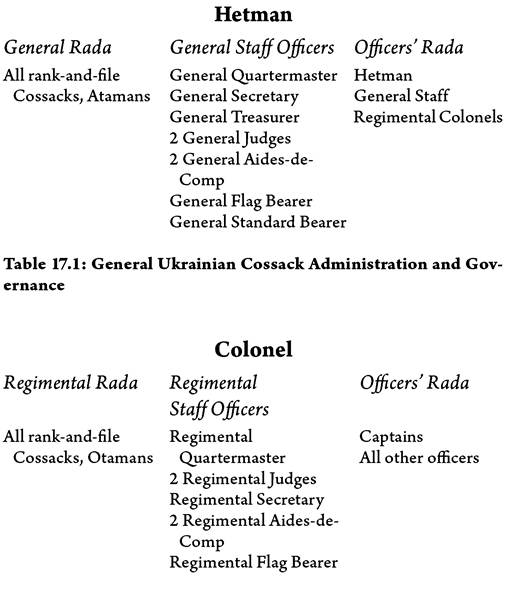
Table 17.2: RegimentalUkrainianAdministration and Governance
The regimental quartermaster was second in importance after the colonel, and usually replaced him as the battlefield commander during his absence. He was responsible for the regiment s artillery, munitions, and the baggage train, as well as all fortifications in his region. Judges sat in military and civil cases, held assizes, and could pronounce verdicts. Regimental administration was carried out by the secretary (“chancellor”), who had to have a good education and who received special training.
He kept all records and documents and maintained contacts with the Hetmans General Chancellery and the company scribes. The regimental “osauls” were the “aides-de-camp” or the colonels administrative assistants, and in time of war an “osaul” commanded a battalion or a detachment of Cossacks. During peacetime they investigated land claims, trained Cossacks and provided policing when called for, such as during county fairs or to hunt down criminals (or rebels!).
Finally, the Flag Bearer, a “khorunzy” (lieutenant), carried the regimental banner into battle, or in a parade, at the head of a select troop of Cossacks known as the Comrades of the Banner. He also mustered the men for an assembly, organized campgrounds or bivouac areas, collected levies, and organized construction. The Standard Bearerwas responsible for other regimental standards such as the horsetail “bunchuk.”The fundamental unit of a regiment was the company (the “sotnia”) commanded by a captain (“sotnik”) who was also the head civilian authority in the area where the company was raised. Captains attended the Regimental “Rada” which met in the colonels residence and had a staff consisting of a scribe, a company “osaul” who was his second in command, and the company flag bearer. The company further broke down into platoons or “kurins” commanded by an “otaman,” and consisted of Cossacks from the same village or neighboring settlements. No longer elected by the rank-and-file, the captains were appointed by the regimental colonel or by the hetman himself, and usually with Russian approval. Due to its importance the artillery—both Regimental and General—had its own command staff of trained officers and bombardiers who remained with the guns all year round.
Ukrainian Cossack regiments continued to play a key role in the Russian wars. In 1722 while still a colonel, Danilo Apostol had led 10,000 Cossacks in Peter Is war with Persia when Baku, Astrabad, and Derbent were occupied, at a cost of many Cossacks who died from pestilence and other disease. Three years later colonels Lizohub, Kandyba, and Horlenko took part in the fighting in Gilan in northern Persia, and in 1729 Cossacks again saw action in the vicinity of Derbent. Many Cossacks and peasants were also drafted on Imperial orders for construction workwhich interfered with the harvest and weakened Cossack physical wellbeing. Hetman Danilo Apostol died in January 1734, leaving much property behind, both personal and that earmarked for the CossackArmy.
We know from an assessment of holdings carried out by the Imperial Government in 1724 that besides their residences Apostols family had in their possession 4 towns, 16 villages, 1 freehold, and 10 ranches, in all revenue from 2,678 households.21 Much of the possessions were acquired by Apostol having sided with Peter I against the Swedes and Mazepa s Cossacks.The 14-year-old Peter II had died on 30 January 1730 of smallpox, on the same day as his scheduled wedding to the 17- year-old Catherine Dolgoruky. With his death Peter Is male line came to an end, but to keep the crown with the Romanovs Catherine I had left a document by which the throne was to pass to Peter Is niece Anna of Holstein, or her descendants, and then to Peter Is youngest daughter Elizabeth or to her descendants. The six-man Supreme Secret Council agreed to honor Catherines wishes, but two members—Prince Dol- goruky and Baron Osterman—had drafted a document limiting the autocratic powers of the Tsarina to which Anne agreed. She was not to appoint an heir or to marry, declare war or peace, impose taxes, deprive the nobles of their estates, Conferhigher ranks, or spend state revenues without the Secret Councils approval. As a Romanov, however, Anne had the support of the Guards Regiments and much of the minor gentry. Ten days after assuming power in October 1731 Anne tore up the document, which if implemented would have introduced a limited constitutional monarchy to Russia and changed the Empire in a fundamental way. Surrounding herself with Baltic Germans, especially her lover Count Ernst-Johan Biron (Biihrer) who became the real power behind the throne, she had the Supreme Secret Council replaced by a Cabinet of Ministers with Field Marshall Miinnick appointed commander of the armed forces and Osterman put in charge of foreign affairs. Annes power rested mainly on the nobility (particularly the new set which had been created by Peter I) whose lot improved while that of the serfs deteriorated markedly when in 1737 they were forbidden to purchase land or pursue commercial activities. She became known for her grotesque sense of humor, an enjoyment ofhunting and killing animals, and callousness towards the predicament of the unfortunate members of society.
The cornerstone of Ostermans policy was an alliance with Austria, Denmark, and a commercial agreement with England, which were aimed at the Ottoman Empire, Sweden, and Poland (supported by France). A war soon broke out, known as the War of the Polish Succession, when Stanislaw Leszczynski was again elected King of Poland. He had survived Augustus II, Charles XII, Peter I and Hetman Mazepa, and now was opposed by Augustus IIs son (also CalledAugustus) SupportedbyRussia and her allies. During Leszczynski s exile in France his daughter Maria had married King Louis XV, who was seeking an ally in the east against the Austrian Hapsburgs. Russian and Ukrainian armies under General Lacey invaded Poland where they staged another election with only about 1,000 nobles in attendance, and on 17 June 1734 Augustus III was crowned in Cracow as the rival king. Lacey s army was near Warsaw, and Leszczynski fled with several of his regiments to Gdanskwhich also fell after a five month siege when the expected French relief force did not materialize. Leszczynski fled once more disguised as a peasant, and at King Louis XVs request abdicated for the Duchy of Lorraine which had recently been occupied by Louis XVs troops.
The War of the Polish Succession made it possible for the Zaporozhian Cossacks to reach an agreement with Empress Annes government, signed on February 1734 in Lubny recognizing their petition to return to their “usual places” and the traditional hunting, fishing, and trading rights. They also received a subsidy of20,000 rubles per year as a retainer for military service and border guard duty. In return Empress Anne I was recognized as their sovereign and the elected “Koshovy Ataman” became subject to the command of the Russian Imperial resident of “Lesser Russia” (Ukraine), although the vast Zaporozhian territory was not made an administrative part of Ukraine. Otherwise, with the Sich established on Crimean- Ottoman territory the Zaporozhians were beyond Russian Imperial influence and moreover they would have joined the Turkish Sultan who was supporting Leszczynski for the Polish throne. In the following year a new Sich was established near the Bazavluk area of the Pidpilna tributary of the Dnipro where it become an autonomous territory of Empress Anne Γs Russia and no longer independent. Nevertheless the Zaporozhian Cossacks preserved their democratic practices and military organization, there would be no serfdom, and refugees were not be turned over to Imperial authorities.
The “Koshovy Ataman” was the hetman figure of the entire Zaporozhian territory, and he continued to enjoy virtually unlimited power as the military commander and the chief judge of the army, but during peacetime he had to stand for re-election every 1 January. During wartime his word was law and he held the power of life and death over every rank-and-file Cossack and officer. The “Koshovy Ataman” was supported by staff officers who were also elected annually, the second-in-command “osaul” who ran the camp and performed administrative and policing duties, military judges, and a treasurer. These chief officers had junior officers under their disposal to help in the everyday running of the Sich and its territory. The number of terms was not limited, and all could be re-elected year after year. The days when the Zaporozhian Brotherhood could go raiding the Crimea and the Ottoman Empire to gather needed supplies and booty were over, all officers received an income from the Sich Army treasury, and based on the Lubny Treaty of 1734 they were also paid by the Imperial Government. This enabled many to acquire landed property such as extensive grazing lands for horses, cattle, and sheep; but being an officer of the Sich was no easy task, involving the administration of well-armed, free warrior-soldiers. The character of the entire Zaporozhian territory and the “Great Under” was slowly changing, as settlers—some welcomed and others not—began to claim the fertile and free land of the steppe.
Left-bank Ukraine did not fare as well. Following the death of Hetman Apostol, Empress Anne s lover Biron once again curtailed Ukrainian autonomous rights by forbidding the election of a hetman. It was also accompanied by a reign of terror in Russia which cost tens of thousands of lives. A governing Council was established, consisting of three Russians and three Ukrainians with the Imperial resident as head. To ensure control of Ukraine and its “loyalty,” 25 regiments of Imperial troops were stationed on the left bank to be supported financially by the local population. The process was observed by General Manstein in his diary:
At present they (the Ukrainian Cossacks) have no longer any privileges and are looked upon in the light of a conquered province. Their last Hetman Apostol dying in 1734, they were not left at liberty to choose another, and are now actually governed by a Russian (Imperial) Regencywhich resides in Glouchov (Hlu- khiv). They can (still) absolutely bring two and twenty thousand men into the field....22
Economically, however, the population was enjoying a measure of prosperity and was not shackled by serfdom as were many of the peasants in Russia proper.
In the spring of 1735, following on the heels of the war of the Polish Succession, another Russo-Turkish war broke out which would last until the Treaty of Belgrade four years later. Without their hetman the Ukrainian regiments fought halfheartedly under the incompetence of Marshall Miinnich in steppe fighting against the Tatars, with high casualties and desertions, and it was only after the Ottoman defeat at Khotin that the Turkish Sultan decided to hold negotiations in which Russia retained Azov.
Empress Anne I died in 1740, and Biren was soon overthrown by Marshall Miinnick and Osterman, who in turn were ousted by Peter Is only surviving daughter, the 32-year-old Elizabeth. When Empress Annes will was read on the day following her death it was revealed that she had left the throne to her niece s two-month old son, who was anointed and pronounced as Ivan VI with his mother (also called Anne) as regent. Elizabeth had again been passed over for the throne, and on 24 November 1741 she was informed by her French physician, Les- tocq, that Anne was going to force her into a convent that very night. At midnight Elizabeth entered the barracks of the Preobrazhensky Guards Regiment, where she was well known, and with several hundred men marched into the Winter Palace. Anne was forced to step down as regent. Elizabeth I was crowned Empress and when Ivan VI turned four, he was imprisoned in Schlusselburg Castle with Anne, her entire family exiled to Brunswick, Germany.
Fluent in German, Italian, and French, Elizabeth I had no formal education, was highly religious and superstitious and left the job of running the Empire to her friends and favorites. Her engagement to the Lutheran Bishop of Holstein ended with his death, and Elizabeth settled to a life filled with amorous relations with Guard Officers. The Conference of Ten became the highest civil administrative body, with jurisdiction over the armed forces and external affairs, the police and internal security
being placed in the hands of the Secret Chancellery. Early in her reign Elizabeth I had introduced some changes, not for the better. The social and economic status of serfs was reduced further by the manifesto of 6 December 1741 issued to announce her ascendancy to the throne, but for the first time serfs did not have to take the oath of allegiance, making them in effect nonmembers of the realm. Then in March 1746 the nobility received the exclusive right to own land and serfs, with both being confiscated from non-noble proprietors. The final step in the enslavement of serfs was announced by the decree of 15 December 1747 by which they could be bought and sold with or without the land. We know the total serf population in Russia Major from the criminal code of 1754, where they are listed simply as property of the gentry together with cattle and other animals. To facilitate the purchase of land and serfs Elizabeth I authorized the creation of the Gentry Bank in St. Petersburg to provide cheap credit. The decree of Peter II which prohibited serfs from joining the military and seeking freedom was maintained, although serfs could once again register as merchants, with taxes being paid to the owner who also received a portion of the value of all sales. Deeplyreligious, Elizabeth I abolished the death penalty halfway through her reign.
The changes introduced by Elizabeth I had little effect in Ukraine, which still differed from Russian Muscovy to a great extent. Most peasants and townsfolk were Telativelyprosperous, without the stranglehold which serfdom had on the general economy. Manstein referred to left-bank Ukraine as “without question one of the finest countries in Europe.../’ still trying to maintain education: “When Peter I ascended the throne he found his people plunged in the grossest ignorance; even the priests could scarcely write.... It was only the clergy of the Ukraine that had some tincture of erudition.” AndJohn Bell of Antermony observed while traveling in Ukraine in 1737 that “they have a university in Kiev of considerable reputation in these parts.”23
The British traveler Joseph Marshall has left us with extensive descriptions ofUkraine based on his voyage in 1768- 70. He was impressed by the “immense tracts of wild country” in Belarus-northern Ukraine, where he felt totally safe. He was especially impressed by Ukrainian agriculture and society.
Czernishen (Chernihiv) is a very well built town... very well fortified and inhabited by about fifteen thousand people... all the track of county which lies upon the River Desna is very rich and well cultivated.... I made enquiries here concerning the danger of traveling through the Ukraine in this time of war, and they assured me that whether it was war or peace, I should not see the least appearance of any danger, that I should find the Ukraine... as well regulated a province as any county in England.... The present race of the Ukraine are a civilized people, and the best husbandmen (farmers) in the Russian Empire.... Ukraine is the richest province in the Russian Empire.24
Marshall expressed amazement at the amount of hemp and flax being grown, the former acting as the “cleaner of the land,” since no weeds could grow in a dense hemp field. Ofgreat interest is Marshalls description of rural social conditions and the prosperity, which in his opinion was due to the prevalence of free family farms.
The property of all this country is very much divided, here are very few great estates belonging to the nobility. The old inhabitants of the country were very free, and had a great equality among them, and this in possessions as well as other circumstances; and fortunately this continues, though in subjection to Russia, most of the peasants are little farmers whose farms are their own, with ten times the liberty among them that I anywhere else saw in Russia; the government is extremely cautious of oppressing or offending them, for they never will be in want of solicitations from the Turks, to join the Tatars in alliance with the Porte. They pay a considerable tribute (tax) but raise it among themselves according to their own customs; and they also furnish the Russian armies with a great many very faithful troops.25
The maintenance of family farms and ranches may answer in part why so many Cossacks in Ukraine chose to support Tsar Peter I and not Charles XII of Sweden, an ally of Poland whose nobility had re-introduced oppressive serfdom in right-bank Ukraine.
The agricultural surpluses and revenue provided by free farming were no doubt another incentive for keeping serfdom out ofUkraine. Traveling south towards the open prairie Marshall encountered more estates, which, however, were not as populated or well cultivated as the private farms,
... which is a strong proof that much of the good husbandry met with in the Ukraine is owing to the peasants being owners of their lands, and vassalage almost unknown in the province... but I have seen in other provinces of this empire where (even with good land) enslaved peasantry (serfs) are utterly inconsistent with a flourishing husbandry... in Ukraine the husbandry is much superior to anything that I have seen since I left Flanders.26
Trade between left-bank Ukraine and other countries was also well developed with Ukraine exporting furs, wax, leather, rough linen, fish, and tobacco, while importing some manufactured goods, tropical fruit, wine, and salt.
Other descriptions ofUkraine and its people were provided by the German writer G. Herder in 1769, and the German physician and scientist S.G. Gmelin. Herder praised “... the beautiful climate of this country, the gay disposition of the people, their musical inclination, and the fertile soil...”27 while Gmelin noticed that Ukrainians were “very diligent, gay by nature and friendly, devoted to music and drink.... Theylike and cultivate cleanliness; therefore, even the humblest house is much cleaner than the richest palaces of the Russians.... Also their food is much more delicate.”28
Ofinterest is Gmelins account of a well-developed chemical industry, such as saltpeter. He was particularly impressed by the various chemical medicines that were known in Ukraine, and that inoculation against smallpox was common, an influence of the relatively developed medicine of the Ottoman Empire. Politically Gmelin noted that “the people as a whole recall with pleasure the times when Ukraine was independent, and feel indignant towards the present government which endeavors to curtail their ancient liberties.”
Like others before him, the German scientist also felt safe while traveling in Ukraine:
In the land of these people one can travel much more safely than in states of the greatest police surveillance. This difference is at once evident upon crossing from Muscovyinto Ukraine. In Muscovy, the post stations usually had to warn the passengers of dangerous places, whereas such places simply do not exist in Ukraine.29
The Ukrainian lifestyle tended to produce a healthy people when compared to the serf-bound population of Muscovy. This was noted by the Frenchman C.F. Masson, who was in the service of the Russian Imperial Government for four decades (1762-1802) and knew the empire well.
The warlike nation of the Cossaques is diminishing from day to day. It will soon disappear from the face of the earth, as have disappeared others fallen under the Russian scepter, unless some happy revolution would soon arrive to liberate it from the yoke which it endures.... The Cossaques have nothing in common with the Russians (Muscovites) with the exception of the Greek religion and corrupted (altered) language. Their customs, their mode of life, food, wars—are totally different, if one does not take into consideration certain similarities which always exist in neighboring peoples. The Cossaques are more handsome, taller, more active, more dexterous, more ingenious, and above all, more honest than the Russians, and less used to serfdom. They are sincere and brave and speak their minds. Their appearance is less uniform and the imprint of slavery has not made midgets out of them nor rendered them base.... The Cossaques are cruel and bloody, but only in battle, while the Russians are, by nature, coldblooded, merciless, and severe.30
Unlike the official government accounts, observations by foreign visitors give us a rare glimpse into the life of the individual on the left-bank of Ukraine, which continued to be very different from the rest of the population of the Russian Empire, even as late as the eve of the 19th century.
The fact that left-bank Ukraine was mainly spared the evils of serfdom until the close of the century is due in no small measure to two remarkable Cossacks, the Rozumovsky brothers, whose adult lives read like a fairy book. During the reigns of EmpressesAnne opportunities began to open in St. Petersburg and Moscow for talented Ukrainians, who generally had better access to education and training while growing up in Ukraine. Empresses enjoyed the theater, the balls, song and dance, and began to hire young singers, most of them Ukrainians who had trained in the Hlukhiv School of Music. Natural talent could also be discovered in church, since Ukrainian Orthodox church services were always accompanied by a choir. In 1731 during Christmas holidays a Cossack colonel by the name of Fedir Vishnevsky was passing through a village in the Chernihiv region called Chemer when he heard the powerful bass voice of a young Cossack, Oleksa Rozum, who was singing with the church choir. The extraordinary voice of the 22-year-old Cossack attracted the colonels attention—perhaps he was traveling as a scout agent searching for singers—and on his next trip to St. Petersburg he took the young man with him.
On arrival in the capital Oleksa Rozum was accepted in the choir of the court chapel which the young and deeply religious Elizabeth Romanov frequented on a regular basis. One day during service she heard a new deep bass voice emanating from the choir, and on closer inspection she discovered the voice belonged to a tall, handsome young man. Elizabeths lover, a young officer of the Semenovsky Guards, Oleksy Shubin, had been arrested by Anne Γs Secret Council for allegedly having insulted the Empress, and Elizabeth decided to transfer Oleksa Rozum to her own personal chapel. Besides his good looks the young Cossack was good natured, gentle and kind, and the princess soon fell in love with him. He also had no interest in politics, and the future Empress Catherine II would remember in her memoirs that (then) as a young girl she thought that he (Oleksa Rozum) was “one of the most handsome men I have seen in my life.”31
There was genuine love between the young couple, and after Elizabeth I ascended the throne the two were married (as rumor had it) in the autumn of 1741 in a private (and secret) ceremony, in a village near Moscow called Perov.32 Unlike a “favorite,” he very quickly made Master of the Hunt, was appointed as Lieutenant-General of the army, and the following year he became a Knight of the Order of Andrew Pervosnany (St. Andrew). In 1744 due to Elizabeth Γs efforts Oleksa Rozumovsky, as he was now known, was made a Count of the Holy Roman Empire by Charles VI, and two months later he became a Count of the Russian Empire. Needless to say he acquired great wealth and became the owner of estates such as Anichkov Palace on the Nevsky Prospect, which was built especially for him. As a Cossack, raised in a tradition of earned merit, he was puzzled by his titles, particularly his appointment as a General of the Army, as he once exclaimed to Elizabeth I: “Your Majesty may create me a Field Marshal but I challenge you or anyone to make even a passable captain out of me.” The marriage was “morganatic,” by which a royal person married a commoner who did not become regent to the monarch nor receive royal status.
The newly minted Count did not forget his family or his people, and it was due to his request that Elizabeth I agreed to the restoration of the office of Hetman in Ukraine, the removal of Imperial Russian regiments, and the establishment of free trade between Russia and Ukraine. There was to be an election held for Hetman but Elizabeth I stipulated that the only candidate to stand was to be Oleksas young brother Kirilo, who was brought to St. Petersburg at the age of 15 to be properly groomed for his future job. The family surname suited Kirilo better than his older brother and in 1743 he was sent abroad for two years to study in Germany France, and Italy.33 Once back, his studies continued under the supervision of Grigory Teplov, a senior member of the Russian Academy of Sciences. It seems Kirilo liked to attend lectures given by Euler, the German mathematician who had found employment at the Academy in St. Petersburg, where he would establish the Russian School OfMathematics, and become famous throughout Europe. In 1746, Kirilo Rozumovsky married Catherine Naryshkina, the Empress’ niece, and shortly afterwards—and still only 18 years old—he was appointed president of the Academy of Sciences. There he introduced the novel practice that academy members be required to give some lectures in addition to their usual scholarly activities—nine years before the inauguration of the University of Moscow. The young president became known for his support of local members and adjuncts against domination by German scholars. One such protege was the young M. Lomonosov, who, like Kirilo Rozumovsky, had been a student at the MohilivAcademy in Kyiv. On a more personal level the two Cossack brothers caused quite a stir at court in St. Petersburg, as was recorded by the then young future Empress Catherine II.
Besides, it was known that all the prettiest ladies of the court and city fought for his (Kirilos) attention, and he was truly a handsome man, very pleasant, more intelligent than his brother (Oleksa),- who nevertheless equaled him in beauty and surpassed him in generosity and kindness. These two brothers were the best-loved that I ever saw.34
With greater expanded powers, government officials stepped up their corrupt exploitation of Turkic and Siberian tribes, leading to prolonged and bloody uprisings. Cossack regiments were needed again, which helped Oleksa Rozumovsky s policy to re-establish Ukrainian autonomy, and to ease the financial burden on the people. On 5 May 1743 Elizabeth I signed the order restoring a hetman, but it was three years before the imperial document was brought to Ukraine, by which time Kirilo Rozumovsky had been appointed colonel of the Is- mailovsky Life Guards and was probably becoming a Freemason.
Following the signing of the document, in 1744 Elizabeth I and Oleksa Rozumovskywent on a long tour of left-bank Ukraine where the Empress noticed how different the country was from Russia and other parts of the empire, and was impressed by the general prosperity and order. Arriving in Kyiv Elizabeth I announced her gift, the church of St. Andrew, patron saint of Ukraine. The construction began in 1747 and took twenty years to complete under the supervision of the Italian architect Rastrelli, who seven years Iaterwould begin the Winter Palace in St. Petersburg, built at the incredible cost of 2.5 billion rubles.
In February 1750—in the presence of Elizabeth Is Minister of Foreign Affairs S. Pisarev, and the Metropolitan of Kyiv Zborovsky—the imperial document arrived in Hlukhiv with much fanfare. The procession was greeted by the Cossack general staff, officers, and thousands of Cossacks who had camped in the streets to await the historic moment, but Kirilo Rozu- movsky remained in St. Petersburg. The Bunchukhorsetail ensign, the silver mace and other symbols of the hetmans office and authority were carried to the great Cossack “rada,” where Elizabeth Is representative Hendrickovannounced that following custom the hetman was to be chosen by a free vote of the Cossacks. The new Metropolitan of Kyiv thanked the “motherly kindness shown to the people of Russia Minor by Empress Elizabeth I,” and when Hendrickov asked the assembled Cossacks whom they would choose as hetman, he received the agreed- upon answer, “Count Kirilo Rozumovsky.” The vote was confirmed two more times between beats of the great drums, followed by a IOl gun salute and thousands of Cossack muskets. By an imperial decree of 5 June 1750, the Zaporozhian Sich also came under the authority of the Ukrainian hetman together with the vast steppe territory of “Down Under.”
A great Iiturgywas celebrated in the main church, followed by a great banquet, during which Count Hendrickovwas presented with 10,000 rubles by the senior Cossack officers, with 3,000 rubles to be distributed among the Count s “common people.” The banquet was conducted in Ukrainian style, with all invited, where reportedly 200 pails of Ukrainian “horilka” (vodka) were drunk in toasts. On 13 September Kirilo Rozumovsky swore an oath in the church of the imperial court in St. Petersburg, to be “a faithful and good and obedient slave (of the Empress)...,” to maintain faithful rule in Ukraine, and not to have any foreign contacts. He then received from Elizabeth Is own hand the symbols of his Cossack authority—the silver mace and other traditional ceremonial items, which had been brought to St. Petersburg for the purpose. InJuly 1750, the Hetman arrived in Ukraine where he decided to move his capital from Hlukhiv to Mazepa s old capital Baturin, certainly a symbolic act that was not lost on the population. At the age of 22, Kirilo Rozumovsky had become the Hetman of Ukraine and all of Zaporozhia.
The Rozumovsky brothers introduced many Ukranian customs to the St. Petersburg court, such as the Ornatelypainted Easter eggs that were widely imitated by the Russian nobility. The imperial court also opened many employment opportunities for Ukrainians who, seeking their fortune, began to make their way north to St. Petersburg. Education in left-bank Ukraine was a long way ahead of the education available in Russia, and Ukrainians began to occupy many of the civil service jobs.35 This included some of the highest positions available such as that of chancellor, occupied by O. Bezborodko; V. Kochubei who became vice-chancellor; D. Troshchynsky appointed as state secretary; and P. Zavadovsky who developed much of the infrastructure such as education, medicine, and the banking system, moving to the Department of Laws in 1810, two years before his death.
Other singers from Cossack Ukraine also followed Oleksa Rosum to the imperial capital, among them the young Hrihory Skovoroda, who would become the first east European philosopher, “the Ukrainian Socrates.”36 Born in 1722 in left-bank Ukraine, he received an education at the Kyiv Academy, and we know that he sang in Elizabeth Γs court choir but by 1744 he was back in Kyiv. The depravity and immoral conduct of the Russian nobility (“... a noble s household—a den of deceit and wickedness”) deeply disturbed the young Ukrainian who witnessed the widespread oppression of serfdom at first hand. After serving as the director of the Russian Imperial mission in Hungary, he taught poetics, syntax, Latin, Greek, and ethics at the Kharkiv Collegium on and off for ten years, but denied a permanent position, he spent the rest of his life writing and traveling throughout left-bank Ukraine, engaging the local villagers in debate as to the source of human happiness. He died in 1794, and it was a full Centurybefore any of his works would be published.
The first impression Skovoroda leaves is that he is a deeply religious man, inspired by the Bible and especially the Ten Commandments, which he considered to be divinely inspired and studied all his life. He was unaffected by the emerging Enlightenment in his quest for an ethical position and rejected whatever he knew of it, since Rationalism, with science as its corollary, also supported opulence and corruption. Man s main purpose was to achieve happiness, but not only in the sense of Epicurus (one of his most favorite thinkers) or the Stoics, Cynics, and Skeptics, who sought to conquer the passions, but happiness with joy and love, with “the heart s gaiety.” This, however, could not be achieved in isolation, without commitment, since “to care for nothing, to be disturbed by nothing, means not to live but to be dead....” Especially important was co-operative social labor for which each was chosen based on the individuals nature. Although Skovoroda upheld the pre-eminence of the Bible he also ascribed wisdom to Greek and Roman sources, particularly to Epicurus, with Jesus Christ as “the Hebrew Epicurus.”
Skovorodas philosophy centers on the individual and is grounded on “Christianity” and nature. The individual, however, was to rise above his physical and social reality, and seek a divine reality and morality in order to produce a harmonious society. As he said of himself, “The world sought to snare me, but it never trapped me.”37 Skovorodas God, however, is not one of theology, and his interpretation of the Bible is symbolic: “The entire world consists of two natures: one visible, the other invisible. The visible (nature) is called creation, while the invisible is called God. This invisible nature, or God, permeates and sustains all creation; it was, it is, and will be always and everywhere.”38
Perhaps an early anticipation of Kant s world of “phenomena” and “noumena,” the visible world is also perishable, whereas the invisible world (and the human soul) is not. Skovoroda does not mention life after death, Heaven or Hell, or the souls existence after death, and denies explicitly any kind of judgment, reward, or punishment in the afterlife. Heaven and Hell are within human beings and exist in this life, and God (nature) provides what is necessary for both life and happiness.
More on the topic The Strugglefor Ukrainian Autonomy:
- The Decline of Ukrainian Autonomy
- Ukrainian Autonomy in the Russian Empire
- SECTORAL AUTONOMY
- Two Senses of Autonomy
- Soviet Ukraine: The Struggle for Autonomy
- The East European intelligentsia was indifferent to Ukrainian cultural endeavors at the time the descendant of an affluent Jewish family, Grigorii Kerner, made up his mind to identify with the Ukrainian national strivings, dedicate himself to Ukrainian poetry, and adopt the pen name Hryts'ko Kernerenko.
- Soviet Ukraine: The Struggle for Autonomy
- Ukraine’s Autonomy and the Russian Empire
- Asceticism and Autonomy?
- Corporate Autonomy
- during the russian-ukrainian war, which began in early 2014 and was somewhat misrepresented in Western media as a kind of Ukrainian “civil war,” rather than a Russian invasion, there emerged a number of supposedly new images of Ukrainian warriors.
- Moral autonomy and family law
- 29 CORPORATE MORAL RESPONSIBILITY AND THE EXPECTATION OF AUTONOMY
- Polish-Ukrainian war and the Ukrainian Galician Army, 1918-1919
- Theme 11. The Ukrainian Lands in the First World War between 1914 and 1918. The Ukrainian National Revolution between 1917 and 1921
- Catherine II, Evdokim Shcherbinin, and the Abolition of Sloboda Ukraine’s Autonomy
- The Problem of Ukrainian-Jewish Relations in Nineteenth-Century Ukrainian Political Thought
- Contemporary discussions on the Organization of Ukrainian Nationalists (OUN) and the Ukrainian Insurgent Army (UPA) have been structured around two dominant discourses.