NEF AND IMMUNE EVASION OF HIV
The control and eradication of a viral infection normally require virus-specific cytotoxic T lymphocytes (CTLs). Professional antigen-presenting cells induce CTLs, for example, dendritic cells, which process viral proteins and present MHC-associated specific peptides.
CTLs recognize virally infected cells through viral peptides associated with MHC class I molecules and kill them through perforin- or Fas-dependent pathways before new virus particles are made and released. After recognition, the elimination of infected cells takes less than 4 h. To counteract this mechanism, viruses developed tricks to avoid recognition by CTLs. Herpesviruses, such as herpes simplex virus (HSV) or cytomegalovirus (CMV) avoid recognition by inhibiting the transport of viral peptides from the cytosol to the endoplasmic reticulum (ER).22 HIV developed a similar idea but changed the execution.Nef-dependent downmodulation of MHC class I, A and B was shown to diminish recognition of HIV-infected cells by cytotoxic T cells21 (Figure 8.5). Surprisingly, the effect is not as efficient as CD4 downregulation and seems to require higher expression levels of Nef. More importantly, HLA C and HLA B molecules are not downregulated by Nef, probably because they are able to bind to inhibitory receptors of natural killer (NK) cells. Taken together, Nef-mediated MHC downmodulation may delay or avoid recognition by specific CTLs as well as nonspecific NK cells. The latter could give the infected cell a deadly advantage. Possibly, in a timely connected process, Nef interacts with the -chain of the T cell receptor, leading to the upregulation of Fas-ligand26 (Figure 8.5). HIV-specific cytotoxic T cells that screen T cells for viral antigen may not recognize the infected cell quickly enough to react. Instead, they might be stimulated for their own death program through Fas-ligand on the infected cell.
Although not formally proven, there is evidence, in vivo as well as in vitro, that it is the infected cell that is protected, while bystander cells (as seen by immunostainings54) and attacking CTLs (as seen in monkey experiments55) undergo Fas/Fas ligand- mediated apoptosis. The immune evasion function of Nef is a good example of how different molecular mechanisms of this protein (T cell receptor-associated signaling and interference with cellular trafficking) converge in order to make up for one function. Upregulation of Fas-ligand clearly is a consequence of Nef signaling and, more specifically, the activation of the T cell receptor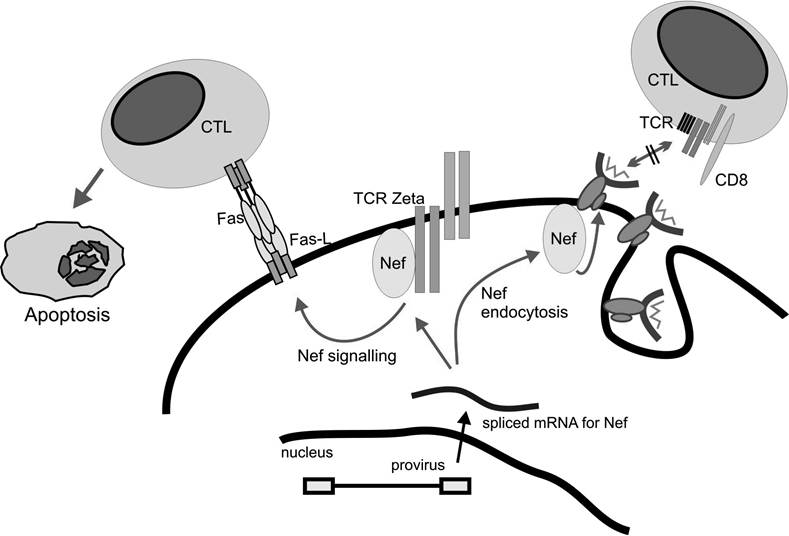
FIGURE 8.5 Immune evasion of HIV-infected cells through Nef. At the plasma membrane, Nef interacts with TCR-, which stimulates FasL expression. This may protect infected cells from attacking CTLs through Fas/Fas ligand ligation. Nef also downregulates MHC class I expression and, therefore, avoids specific recognition of the infected cells by HIV-specific CTLs.
ζ-chain through Nef. The latter occurs in the context of the Nef-mediated assembly of signaling molecules from the T cell receptor environment. In this manner, for example, Nef could bring together Nef-associated Lck and TCR-ζ, which, as in physiological TCR stimulation, could lead to tyrosine phosphorylation and, thus, activation of ζ. In line with this finding, the ζ chain was found to be required for the upregulation of Fas ligand in a physiological setting.56
Proapoptotic effects of nef
HIV, similar to other viruses, dedicates a great deal of its genetic information to survival strategies, leaving the impression that it is a master of survival. Surprisingly, the virus completely changes the strategy in the late phase of the replication cycle. At least four viral proteins (Vpu, Vpr, Env, and Tat) have been reported to induce apoptosis in the infected cell (for review, see Ross57).
In addition, Nef was shown to induce apoptosis in stably transfected T cell lines when targeted to the plasma membrane. This effect was interpreted as activation-induced cell death due to the prolonged and increased membrane targeting of Nef using a CD8 tag.23 Because Nef is rapidly internalized, it is at least doubtful that prolonged membrane targeting and, therefore, activation-induced cell death occur in primary lymphocytes. The latter may have been an artifact of that particular system in vitro, which showed that Nef is able to activate T cells. However, it cannot be ruled out that a continuous expression of Nef will lead to a fast depletion of signaling intermediates, such as phosphoinositols, that cannot be replenished by the cell. In addition, Nef may sequester important signaling molecules from the plasma membrane. Both effects would render the cell refractory to certain stimuli, which has been described by a number of reports. In addition, these cells may then be more susceptible to apoptotic cell death. For example, if PI3 kinase cannot be activated after prolonged Nef expression, this important survival pathway could no longer inhibit proapoptotic molecules of the Bcl-2 family.But why would the virus induce apoptosis of the infected cell toward the end of the viral replication cycle? A simple explanation may be that this would increase the release of newly generated viral particles. Apoptotic, in contrast to necrotic, cells are phagocytosed by macrophages and dendritic cells, leading to cross-presentation of viral antigens. This could possibly induce T cell tolerance rather than immunity.58 The latter would constitute yet another and perhaps important mechanism of immune evasion. It should be noted, however, that cross-presentation could also lead to increased immunity. The latter may depend on the cell that presents the antigen.
In recent years, several reports have demonstrated that a soluble Nef protein induces apoptotic cell death in noninfected human lymphocytes through a Fas-independent mechanism.59,60 Furthermore, it has been shown that extracellular Nef targets the CXCR4 surface receptor to induce apoptosis.61 However, this mechanism awaits a more detailed analysis and confirmation through different groups. Also, whether it constitutes an important mechanism of CD4/CD8 cell depletion in vivo remains to be determined. In this context, Mueller and colleagues62 reported that in HIV infection, the HIV-specific CD8 immune response shows a higher susceptibility to apoptotic cell death but not for the CMV-specific immune response. This implies a more specific cellular immune depletion than anticipated from a broad and general killing effect of extracellular Nef protein.