Risk of HIV Transmission to Patients
The risk of HIV transmission through blood transfusion is well known in France, and is higher during cardiac surgery because blood transfusion is very common during cardiac surgery with ECC (in our institution, 41% of patients who underwent cardiac surgery with ECC were transfused with heterologous blood).
This risk has been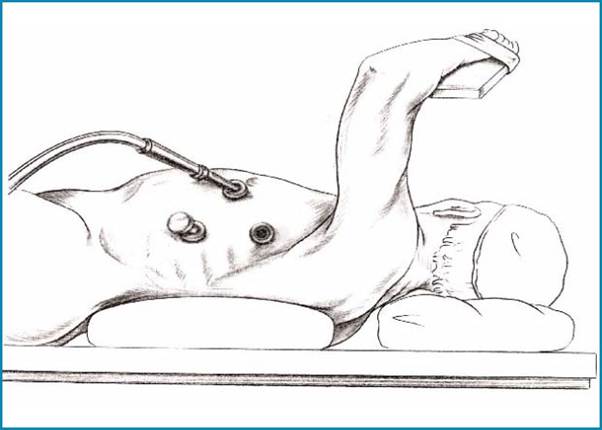
Fig. 6 Videoscopic surgery
reduced by screening blood donors and blood units. Serologic screening of donors for antibodies to HIV-1 and HTLV-I coupled with exclusion of donors from groups having a relatively high risk for infection has led to a low incidence of transfusion-transmitted HIV-1 and HTLV-I/II infection. A small risk remains, however, despite these measures. The residual risk for HIV-1 and HTLV-II infection from transfusion of screened blood was about 1 in 60,000 units [41], 1 in 100,000 per unit for Cohen et al. [42], and is now 1 in 32,5000 for Pillonel et al. [43].
Pooling of plasma donations increases the risk for blood-borne infections. In solvent- or detergent-treated plasma, lipid- enveloped viruses are efficiently inactivated; transfusion of solvent-/detergent-treated plasma was found to be safe with regard to lipid-enveloped viruses [44].
The risk of infection has been further reduced by limitation of blood transfusion itself. After the discovery in the 1980s that HIV can be transmitted via blood transfusion, there has been increased interest in technologies that reduce the amount of allogeneic blood used during and after surgery. These technologies include various drugs (aprotinin, tranexamic acid, epsilon- aminocaproic acid, erythropoietin), devices (cell salvage; Fig. 7), and techniques (acute hemodilution, predeposited autologous donation). Enhancement of comprehension
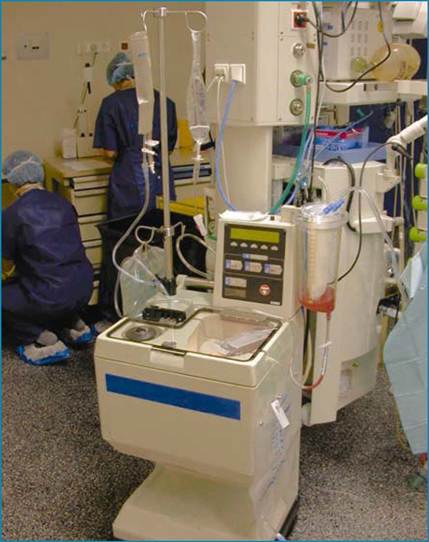
Fig.
7 Cell saverand assumption of hemostasis before, during, and after cardiac surgery has resulted in a major reduction in the incidence of reoperation for bleeding and heterologous blood transfusion. Other new therapeutics such as the recombinant factor VIIa (Novo- Seven) should be of interest for reduction of blood transfusions [45].
Information about transfused patients is legal in France. Thus, in the HIV Information Project, six previously unsuspected HIV-seropositive cases were diagnosed after studying 1,793 patients who underwent cardiac surgery between 1980-1985 [46].
Transmission of HIV from healthcare workers to patients has been documented in one report. A retrospective review was conducted of 612 patients of an HIV-positive cardio- thoracic surgeon, in an attempt to identify any instance of viral transmission. A total of 189 patients received HIV testing and counseling and no positive test results were obtained [47]. Pathogens can be transferred through contact between patients undergoing surgery and the surgical team, resulting in postoperative or blood-borne infections in patients or blood-borne infections in the surgical team. Both the patient and the surgical team need to be protected from this risk. Implementing protective barriers such as wearing surgical gloves can reduce this risk. Wearing two pairs of surgical gloves instead of one pair is considered as providing an additional barrier, further reducing the risk of contamination. Wearing two pairs of latex gloves significantly reduces the number of perforations to the innermost glove.
More on the topic Risk of HIV Transmission to Patients:
- Types of violence against women: who is affected? What is the impact?
- Conclusion
- RESURRECTION
- Control of BTB in Ethiopia
- Natural History of HIV Infection
- The Burden of TB in Africa
- Salmonella enterica Infection: Salmonellosis
- Conclusion and Recommendations
- SELECT DEFINITIONS AND CONCEPTS