Basic Approach to Joint Pain
GENERAL PRINCIPLES
• The first step is to differentiate between arthritis versus periarthritis. Arthritis is any process affecting a joint or joints, causing pain, swelling, and stiffness.
Periarthritis, which mimics arthritis, involves the soft tissues surrounding the joint like tendons and bursal structures. Pain from arthritis is usually present in all directions of motion, whereas pain from periarthritis is usually evident at a single point or direction in the range of motion. In addition, pain occurs primarily with active movement in periarthritis, while it can occur with active and passive movements in arthritis.• The second step is to categorize arthritis as inflammatory or noninflammatory. This will depend on the pattern of joint involvement and the evidence of inflammatory findings on joint exam. Features of inflammatory arthritis include swelling, erythema, warmth over the joint, as well as the presence of prolonged morning stiffness of more than 1 hour that worsens with inactivity. Associated symptoms such as fever, weight loss, skin rashes, uveitis, scleritis, mouth ulcers, and serositis, among others, may give clues to an underlying systemic connective tissue disease (CTD).
DIAGNOSIS
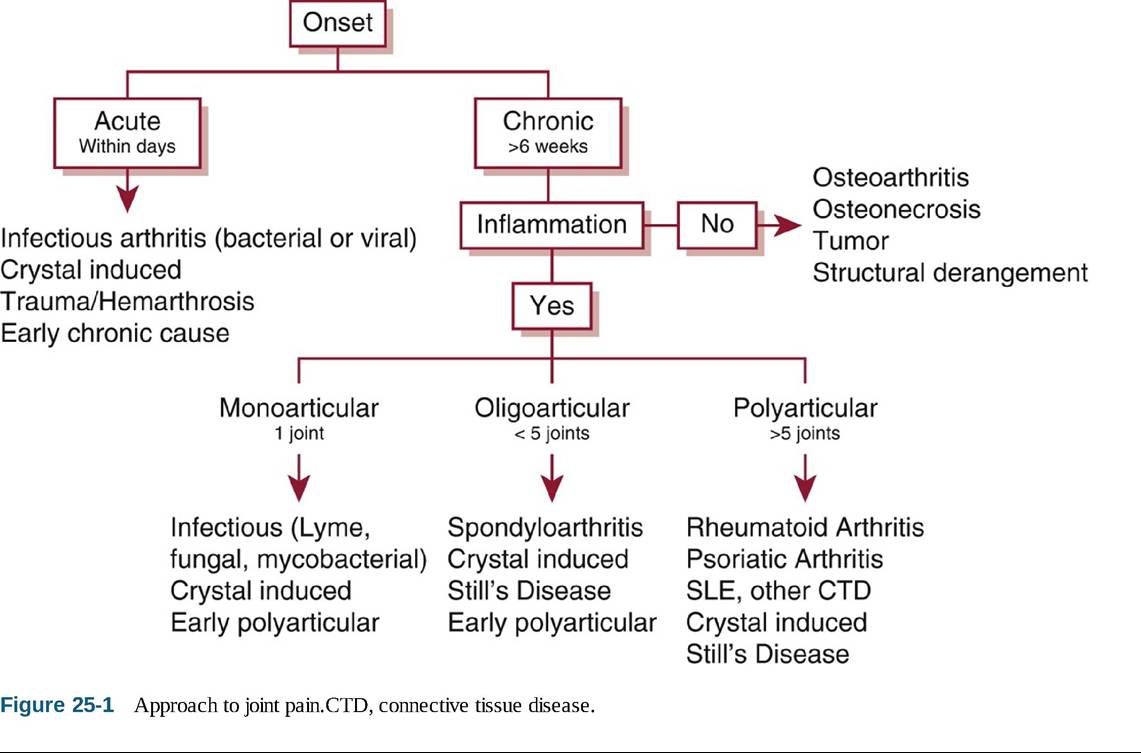
Arthritis can be approached by the number, pattern, and acuity of joint involvement (Figure 25-1).
Ancillary Tests
• Laboratory tests and imaging are helpful in supporting a diagnosis if their use is directed by the specific findings on the history and physical examination. Laboratory evidence of inflammation may be helpful although not specific. These include erythrocyte sedimentation rate (ESR), C-reactive protein (CRP), and synovial fluid analysis.
• Arthrocentesis should be performed in all patients with acute monoarthritis.
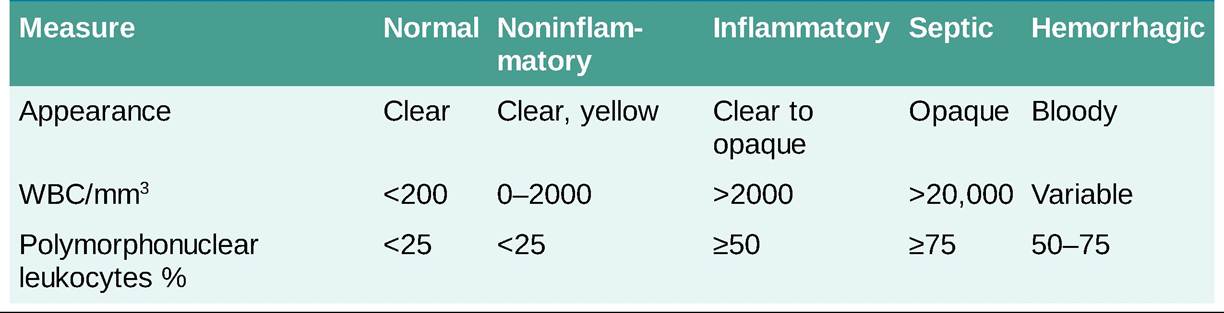
Synovial fluid analysis should be sent for cell count, microscopic examination for crystals, Gram stain, and cultures (Table 251). Normal joints contain a small volume of synovial fluid that is highly viscous, clear, and essentially acellular.TABLE 25-1
SYNOVIAL FLUID ANALYSIS

Important Factors for Synovial Fluid Interpretation
• Septic arthritis is associated with white blood cell counts gt;20,000 and frequently gt;50,000. The cutoff is no longer 50,000 due to lowered sensitivity, 50%-70%, although the specificity is high, 80%-90%.1 The chances of septic arthritis increase as counts increase. Counts of lt;20,000 may be observed in disseminated gonococcal infection.
• Monosodium urate: sensitivity 63%-78%, specificity 93%-100%. Calcium pyrophosphate dihydrate crystals: sensitivity 12%-83%, specificity 78%-96%. The presence of crystals does not exclude infection.
• Gram stain should be performed but sensitivity is low. A negative Gram stain does not rule out an infection.
TREATMENT
Therapeutic approaches involve either local or systemic administration of analgesic, anti-inflammatory, immunomodulatory, or immunosuppressive drugs. This will be reviewed in each section.
More on the topic Basic Approach to Joint Pain:
- Basic Approach to Joint Pain
- PROBLEM-SOLVING APPROACHES IN INTERNATIONAL CONFLICT: INTERACTIVE CONFLICT RESOLUTION
- Tachyarrhythm ias Approach to Tachyarrhythmias
- Macrovascular Complications of Diabetes Mellitus
- The comprehensive constitutional order
- HOW TO INTERVENE IN CONFLICT, CONTROL NEGATIVE EMOTIONS, AND FOSTER POSITIVE EMOTIONS
- Rescuing h-traits via the gadfly, curiosity, and solitude
- Agrawal M.. Textbook of Pediatrics. 3rd ed. — CBS Publishers,2025. — 973 p., 2025
- Chapter 33 Disorders of the Breast
- Clinical assessment