EXISTENCE AND NON-EXISTENCE
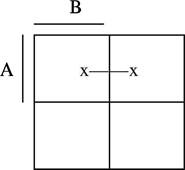
Now, suppose we have two categories, A and B, and we are told simply that “There are some A.” If we are told nothing about whether these individuals are or are not B, we will not know whether to put the x in the top left square (AB) or the top right .
.
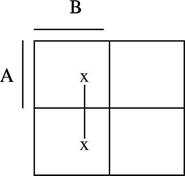
Similarly, if we were told that “There are some B,” this would be represented:
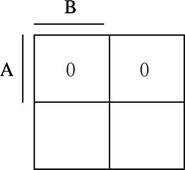
Now, suppose we have the same two categories, A and B, and we are told simply that “There are no A.” This requires us to put a 0 in two regions: the top left square (AB) and the top right
15.2.3
More on the topic EXISTENCE AND NON-EXISTENCE:
- Godel’s Argument[119]
- Summary and concluding remarks
- Changes in the Concept of Price over the Last Century
- THE SOPHISTICATED RELIGIONISTS: BUBER AND POLANYI
- North Korea: the last Stalinist state
- CHAPTER ONE The New Jerusalem: Kiev
- Violence in the Mesolithic
- Chapter 8 The Cossacks
- CASE 145: Periods of Gestation
- References
-
Contemporary philosophical research -
Fundamentals of philosophy -
Logic -
Philosophy of Science and Technology -
Political philosophy -
Social philosophy -
-
Conflictology -
Ecology -
Economy -
Finance -
History -
Law -
Medicine -
Philosophy -
Religious studies -