Changes in the Concept of Price over the Last Century
By the 1970s, the keen interest in the theory of price and production that had dominated the 1920s and 1930s had decreased drastically. The contributions of von Neumann, Wald, Remak, von Cassel, von Stackelberg, Schneider, and Samuelson, among others, motivated many scientists to study economics, which led to the growth of mathematical economics in the mid-1950s.
The existence and stability proofs of general equilibrium were therefore achieved with remarkable mathematical precision. However, by the 1970s, many of the books on production and distribution were no longer on sale, demonstrating the metamorphosis of fundamental business activities in advanced countries as the banking business and other advanced industries began to computerize their activities.Here, imperfect or irrational conditions no longer matter. More significantly, equilibrium prices no longer play a primary role in realizing products in the market. The present mode of production is subject to increasing returns and to the market generating a path-dependent process of trading shares, as Arthur (1994) demonstrated. This process is accompanied by a persistent innovation process,
© Springer Japan 2015
Y. Aruka, Evolutionary Foundations of Economic Science, Evolutionary Economics and Social Complexity Science 1, DOI 10.1007/978-4-431-54844-7__3 bringing steady change to the economic environment. In this mode of production, the novelty of products becomes more important. This feature is quite similar to biological evolution, as Holland (1992, 1995) noted in his genetic algorithm. In other words, a new mode of production emerged, starting at the end of the last century, which in turn changed the bidding system. The economic system can operate without resorting to equilibrium prices; producers need not employ the equilibrium price system to survive. The agents in an economy always receive feedback from other agents’ reactions.
In an actual system accompanying persistent innovations, the environment should always be renormalized.3.1.1 Shift in Trading Methods and the Environmental Niche
In short, price no longer plays a crucial role in the economy. The equilibrium price system is no longer the sole decisive factor in the fulfillment of trades. While price is still a principal source of information, it is not the final determinant in equilibrating supply and demand. The prices actually employed are no longer the so-called equilibrium prices that eliminate excess demand. This alteration suggests that a replacement of the trading method will occur. In fact, the amount traded through “batch auctions” has shrunk drastically, while “continuous double auctions” have become much more dominant. As illustrated in Chap. 4, batch auction depends on price priority, while double auction depends on time priority. In the latter, the settlement is attained by matching ask and bid, according to the time preference principle. This observation is not limited to the stock exchange, but may also be more generally applied to the process of selecting a productive plan. This shift is a reflection of the metamorphosis of production. General equilibrium prices are no longer required. The bid/ask mechanism for selecting an adaptive productive plan might be replaced by the bucket brigade algorithm as an internal mechanism, as the evolutionary genetic algorithm shows. The algorithm has been developed by the idea of “complex adaptive system” originally defined by Holland (1995, Chap. 1). The evolutionary process based on this algorithm moves to a new stage via the feedback loop from a consecutively modified environment. The genetic algorithm will be explained further in Sect. 3.2 of this chapter. See Fig. 3.2.
3.1.2 Classical Steps Towards Equilibrium
As Aruka and Koyama (2011, p. 149) demonstrated, the agent who sets the desired amount of a set of {price, quantity} to trade with an arbitrary agent must have an independent plan, which is never influenced by the external environment.
Consequently, the agent must cancel the original offer if things do not go according to plan. Suppose that the agent is a buyer who wants to purchase a desired good at a price slightly higher than the asking price. In this case, a rule will be applied:1. In the case that there is a market order to sell, any purchase plan could be at least partly fulfilled. Here, let the concerned buyer be the person who obtains a contract.
2. If the asking price rises to a price higher than planned, the buyer must then give up the contract right to purchase.
3. The buyer must then become a seller of the obtained amount, adding to the market supply. However, this transition from buyer to seller will be not realized in the Walrasian tatonnement, because all the contracts obtained before equilibrium are canceled.
3.1.3 Application of a Genetic Algorithm to the Economic System
In the classifier system set out by Holland (1992, Chap. 10; 1995, Chap. 2), genetic evolution will be achieved by the following mechanisms:
1. The learning process to find a rule
2. The credit assignment on rules
3. Rule discovery
The learning process has an interactive mechanism involving the defector (on input), effector (on output), and the environment. The key issues for motivating an evolutionary system are stage-setting and adaption of the rule to the environment, which are taken into consideration by the bucket brigade algorithm. Decisions (or intentions) in an economic system might be regarded as stage-setting moves (Holland 1992, p. 177).
In such a feedback system, agents cannot necessarily immediately identify equilibrium prices. The environment in which the agents operate will be changed before equilibrium has been detected. Practically, then, equilibrium prices might be replaced by quasi-mean values in a dynamic process of production and trading. In parallel with this replacement, the bidding process for production costs might also be changed. A feedback system will therefore change the world of equilibrium into a true evolutionary economic process.
In a genetic algorithm, a gene can evolve through bidding or asking a price, provided its bid or price matches a receiver’s or consumer’s offer. In this trade, a kind of double auction is at work. However, there is no auctioneer or neutral mediator in the bidding, so the participants refer only to expected mean advantages or the quasimean fitness of a particular ensemble of genes. Suppliers might use such a mean value as the basis for asking prices.
We now turn to the von Neumann economic system in light of Holland (1992, 1995). Holland ingeniously envisaged that the von Neumann economic system could be reformulated as a genetic algorithm, although von Neumann’s original bid/ask mechanism differs from new systems such as a bucket brigade algorithm.
Here, emphasis is placed on the adaptive capability of a process in its environment. This chapter will focus on the internal selection mechanism of the original von Neumann balanced economic system, in light of a genetic algorithm. This argument may also provide a new insight into the Sraffa standard commodity, which is also found in the original von Neumann model.
3.1.4 Significance of the Standard Commodity, in the Context of the Genetic Algorithm
3.1.4.1 The Classical Meaning of Prices
Despite the work of Sraffa (1960), the significance of the “standard commodity” has still not been elucidated satisfactorily. One of the major reasons for its ambiguity may be the impossibility of it occurring in a general case such as a joint-production system; for example, the von Neumann economic system. This view can easily lead to the devaluation of its contribution, especially since there is no proper equilibrium in a more general case. Sraffa’s original concern, however, was irrelevant to the price equilibrium. The classical principle of political economy refers to the natural price, or prices other than the equilibrium prices, as the center of gravity in the economic system. It is therefore clear that the classical meaning of prices is not the same as prices in general equilibrium.
3.1.4.2 Property of the Original von Neumann Solution Based on the Constancy of the Environment
The solution of the von Neumann economic system contains optimal prices and quantities. It is derived by referring to the payoff function (the value of the game). Von Neumann employed the two-person strategy game of growth-maximizing and cost-minimizing players to prove the solution and establish equilibrium. However, it is difficult to interpret his original proof with an actual counterpart because, as previously pointed out, both players are aggregates and so hypothetical agents. In this construction, equilibrium, as a quasi-stationary state, only attains optimality over time. The balanced growth or sustainability therefore simply requires constancy in its environment. Once the equilibrium has been attained, the state should be constant forever. However, the internal selection mechanism is missing: the exchange of information with the environment in the original von Neumann system. As the environment changes before the end of the time horizon on a productive plan, equilibrium cannot help being changed or revised. The constancy of the environment must be relaxed, which will be accompanied by a feedback system, as in the bucket brigade algorithm. This algorithm can run a “classifier system” as shown in Sect. 3.2.5. See Fig. 3.2.
3.1.4.3 Introduction of a Genetic Algorithm into the Original
Sraffa System
The same limitation seems to be found in Sraffa’s system too. However, Sraffa’s original intention was to measure fluctuating price movements in terms of the invariant measure of the value of the standard commodity. Any idea of production scale was not presupposed by his essential image of the production of commodities by means of commodities, so his system did not need constancy of environment. The standard commodity in the original sense is at only one point of production. In other words, the standard commodity simply gives a momentary profile of the system. As time goes by, it must change and be continuously updated.
If we extend our vision to the future evolution of the economic system, it is clear that the standard commodity must evolve.The standard commodity represents a reference point for the sustainability of the system. The process of selection among productive plans requires an anchoring point by which the process will be evaluated. We must therefore look for a basis for calculating the mean value of the profitability of the economic system. However, actual systems do not always provide a square matrix and unique maximal vector. Therefore, some approximation is needed to find an equivalent surrogate system.
3.1.4.4 Derivation of the Standard Commodity
Linearity of the production process is not a requirement for derivation of the standard commodity. However, the assumption of linearity is convenient for proving the standard commodity, as the special commodity is the same idea as the nonnegative eigenvector of the input matrix in the linear form of the production system. We assume the linearity of the production system. However, labor, l, as the sole primary factor of production, may be explicitly treated as a limiting factor in the Sraffa production system, which can take into account the distributive effects on the price system. We denote such an extended production system by [A, B, l].
An exact description of the existence proof of the standard commodity is set out in Aruka (1991, 2012) and elsewhere. Here, we only show the significance of the standard commodity in the simplest production system. The preparation for this proof is:
Consider a linear production system without joint production, where each process produces a single product. Labor is the sole primary factor of production and is essential for each process. A is an n x n square matrix of input coefficients aij, α0 is a labor input vector, p is a price vector and r is the rate of profit. I is a unit matrix, with all elements zero except for 1 on the
(continued) diagonal. The simplest price system will then be an inhomogeneous equation system: 
Here, the price of labor (the wage rate) is fixed at unity, and prices of produced goods are therefore expressed in terms of labor. By virtue of the following assumptions, we can obtain, as a solution, a non-negative vector:

2. An input matrix A as a whole is non-negative and irreducible, and its eigenvalue is smaller than 1/(1 C r/.
Either guarantees a non-negative solution:

(2) confirms a unique non-negative solution. We can then prove the transformation of the Sraffa price system in view of the commutable matrices; that is,

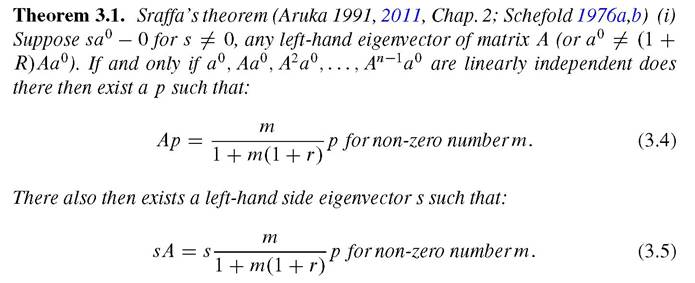
Here, s is the standard commodity. (ii) Normal modes of the Sraffa price system are equivalent to the necessary and sufficient condition (i) of this theorem.
3.1.4.5 The Balancing Proportion
Sraffa originally demonstrated “the balancing proportion” for prices against the changes of a distributive variable. In the present framework of the production system, the balancing proportion may be represented by the following expression:
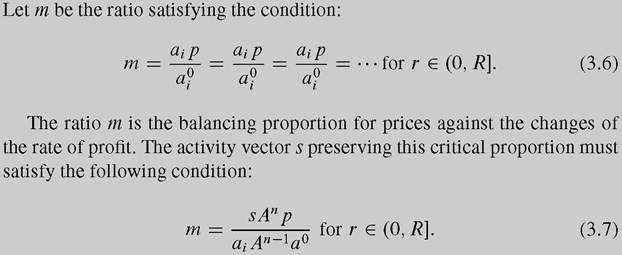
It is therefore easy to ascertain that there is a unique non-negative eigenvector to support the balancing proportion m.[XXXVIII]
3.1.4.6 The Standard Commodity in the Sraffa Joint-Production System
We can insert the von Neumann system into the Sraffa production system as a special case. According to Gale (1956, p. 286), this kind of model is obtained by adding two extra conditions to the von Neumann model in von Neumann (1937, 1945-1946):
1. The number of basic production processes is the same as the number of basic goods.
2. Only one good is produced by each process.
We also define the Sraffa joint-production system Here, input and
output matrices are of square forms. The price system of the joint-production system will be: 

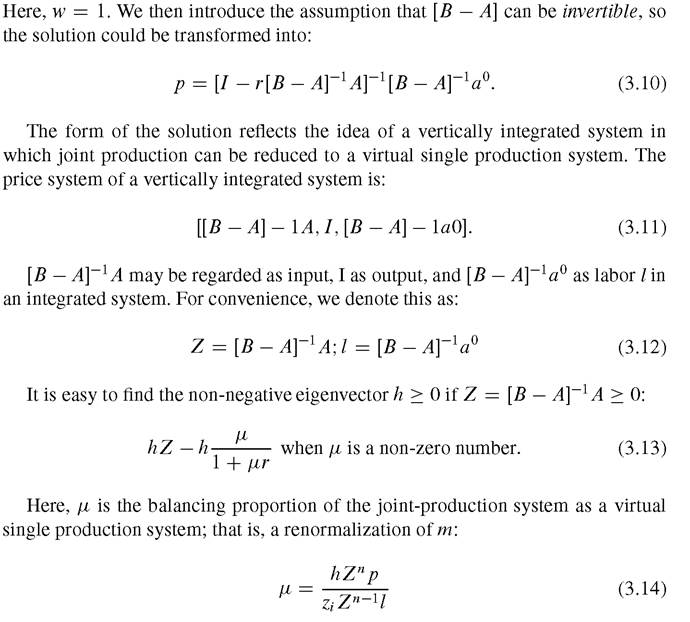
The non-negative eigenvector h > 0 may then be regarded as the standard commodity equivalent to the modified joint-production system. We have therefore applied the same reasoning to the vertically integrated system to deduce the equivalent standard commodity. We have restricted the domain of the von Neumann system of [A, B] to a square system by adding fictitious commodities, and implemented a limiting primary factor l in the modified system.
3.1.4.7 Significance of the Standard Commodity
If we compare the results of the Sraffa theorem with the payoff function of the original von Neumann system, it holds from the Sraffa theorem for the eigenvectors s and p that: 
If we assume B = I in the original von Neumann system, and apply the eigenvectors s and p to the payoff function of the von Neumann system, then we obtain:

If we interpreted m∕(1 C m(1 C r)) with 1∕p, expressions (3.15) and (3.16) could be regarded as equivalent. This means that the payoff function of the appropriately restricted von Neumann system by the condition B = I could be represented in terms of Sraffa’s standard commodity by employing the balancing proportion m.
3.1.4.8 A Standard Commodity in an Extended System
The invertibility of [B — A] was indispensable in setting up the Sraffa jointproduction system. In fact, Sraffa (1960) skillfully implemented a new set of fictitious processes and commodities to complement the system to make the matrix [B — A] square. This is a necessary condition for the invertibility of [B — A]. A fictitious process could realize a potential set of commodities. This realization may induce preparation of the new environment for either a newly emerged commodity or a new efficient process.
Suppose the actual production system is a general joint-production system. This does not necessarily confirm its solution in general. The non-existence of a solution (equilibrium prices) does not necessarily imply the impossibility of trading/production. Even without knowing the equilibrium prices, producers can trade with other producers under the double auction process underlying the changing environment.
3.1.4.9 A Standard Commodity to Measure the Profitability
of the Fictitious Processes/Commodities in an Extended System
Each producer is assumed to have the right to post a new fictitious process or commodity. Here, we imagine the market as a field in which agents can post their rules and prices.
For example, if the number of commodities is greater than the number of processes in the existing production system, the system is under-determinant. If such a system successfully selected some of the posted fictitious processes to implement into itself, a standard commodity at that point in time could then be assured. In other words, a standard commodity can be fabricated in a proposed system. However, a chosen standard commodity may vary according to the method of selection of a set of new fictitious commodities. To generate a standard commodity in an extended system, there may exist a kind of combinatorial number corresponding to the difference between the number of commodities n and the number of processes m. Hence, the standard commodity of an extended system is not always unique.
A derived standard commodity in the above procedure will be a useful measure for producers who posted their fictitious processes to decide whether those processes are more profitable. That is to say, the payoff function of this virtual system will be evaluated by employing a derived standard commodity s as its weight. In this sense, a standard commodity is regarded as the weight to measure the profitability of the fictitious processes and commodities in a virtually implemented system. The implication of the standard commodity given here must coincide with what Sraffa originally defined as the invariant measure of value.
The measure, even if hypothetical, could work as a reference point for a new system. This kind of measure could be regarded as the quasi-mean average of the concerned ensemble generated by the base production set. In this context, the mean average can be calculated by employing a standard commodity generated by the fictitious processes and commodities. This gives new insight into the Sraffa standard commodity in an extended system.[XXXIX]
Lemma 3.1. Updating a standard commodity Competition among multiple standard commodities will orientate the future direction of the production system, which must provide feedback to its environment.
1. To guarantee the solution, some fictitious processor commodities should be added to the original system. However, the solution depends on the method of choosing each fictitious set. It may be multiple.
2. The profitability of the additional processes and commodities can be judged by the use of the standard commodity s expected as a result of their addition.
3. Each standard commodity will give a virtual expected mean of the average profitability of the system.
4. The competing standard commodities will prepare for a new environment in which a new standard commodity can be updated.
We now turn to an intuitive scheme of this procedure. We can still use many detailed empirical analyses to compute the actual different standard commodities among national economies. These attempts will shed new light on the application of our new principle to empirical studies.
3.2
More on the topic Changes in the Concept of Price over the Last Century:
- Changes in the Concept of Price over the Last Century
- A Makeshift Idea of Compensated Demand and Income
- Alternative Interpretation: Trader Dynamics to Generate Financial Complexity
- Reconsidering the Law of Supply and Demand in the Free Market
- The Matching Mechanisms in the U-Mart Experiment
- 21 Community Service: Penological Progress
- The Doctrines of Political Economy in the Anglo-Saxon Tradition
- Appendix B
- The U-Mart System and Historical Background
- Mercantilism