Ideas, Innovations, and Technical Progress
We next turn to a final category of growth models, in which technical progress is a result of ideas and innovations that lead to higher total factor productivity or labor efficiency.
These models emphasize the externalities involved in generating new ideas and innovations that increase the efficiency of production. Just as the learning-by-doing model of Arrow emphasizes the externalities from capital accumulation, so the ideas-and-innovations models emphasize the externalities of the production of ideas and innovations.
Models in this category are sometimes called research and development (R&D) models. Although they date from the late 1960s, the microeconomic foundations of these models and their implications for the functioning of markets were developed in the early 1990s, inspired by the work of Romer [1990]. Under certain conditions, these models can lead to endogenous growth as well.7
8.3.1 Key Features of Ideas and Innovations
A crucial assumption of such models is that ideas and innovations can improve the efficiency of production, either through total factor productivity or through labor efficiency.
These models recognize that, unlike most other goods and services, the use of an idea or an innovation by a particular firm (or employee) does not prevent the use of the same idea or innovation by other firms or workers. The use of a particular idea or innovation is nonrivalrous, in contrast to the use of a particular machine or a specific employee. From the time an idea or innovation has been produced, anyone with knowledge of this idea can use it, independently of how many others use it simultaneously. If a firm uses a specific machine or a particular employee, it automatically excludes any other firm from simultaneously using the same machine or employee. The property of nonrivalry gives ideas and innovations the character of a quasi-public good.
But in contrast to purely public goods, the use of an idea can be partially excludable by law. This allows the producer of an idea to charge for the use of her idea. For example, if an idea or innovation is legally covered by a patent, then a firm or an employee who wants to use this idea or innovation will have to pay a fee to the holder of the patent.
The use of ideas and innovations is not rivalrous, but the degree of excludability that can be achieved varies considerably among ideas and innovations. For example, the use of an encrypted television signal is easily excludable, whereas the use of computer software is excludable only with greater difficulty.
Purely public goods and services are both nonrivalrous and nonexcludable. Other goods and services, such as ideas that can be covered by copyright laws, may be nonrivalrous but may also be excludable. Consequently, the producers of goods and services that use an idea or innovation may be charged for the benefits arising from their use.
The production of nonrivalrous and nonexcludable goods and services implies externalities, which are not reflected in the remuneration of producers of these goods and services. Goods and services that result in positive externalities, such as ideas and innovations, will be produced in smaller quantities than would be socially desirable. And goods and services that result in negative externalities, such as pollution of the environment, will be produced in larger quantities than would be socially desirable.
If the use of ideas and innovations is both nonrivalrous and nonexcludable, then the market will produce fewer ideas and innovations than would be socially desirable. However, if the use of ideas and innovations can be made excludable by the protection of laws on copyright or a patent, then the production of ideas and innovations can rise, as producers of ideas and innovations will be paid for the value of their product.
In the analysis that follows, we shall ignore many of the microeconomic characteristics of the markets for ideas and innovations and will focus on a simple growth model in which technological progress is simply the result of the production of new ideas and innovations.8
8.3.2 Key Elements of an Ideas-and-Innovations Growth Model
To present the key elements of a growth model based on the production of ideas and innovations, we start with the production function of goods and services.
Assume a Cobb-Douglas production function, of the form
where H is the existing aggregate stock of ideas and innovations that affects the efficiency of labor in the goods and services sector, and Ly is the number of workers who are employed in the goods and services sector.
Apart from goods and services, the economy produces new ideas and innovations. The new ideas and innovations produced per instant are proportional to the number of research workers (i.e., those employed in the production of ideas and innovations). This relationship can be written as

where Lh is the number of workers employed in the production of ideas and innovations (whom we call research workers or researchers) and h(·) is the average productivity of research workers.
Assume that the average productivity of research workers is a positive function of the total stock of ideas and innovations and a negative function of the number of research workers. The existing stock of ideas and innovations makes every researcher more productive. However, assume that this effect is subject to diminishing returns. In contrast, as the number of researchers increases, the probability of duplication of effort (that is, the probability of simultaneous production of the same idea or innovation by more than one researcher) increases. Thus, the average productivity of research workers falls with the number of researchers.
In particular, we will assume that the productivity function of research workers, with the characteristics highlighted above, takes the form

where h > 0, 0 < β < 1, and 0 < γ < 1.
Substituting (8.92) in (8.91), we can express the production function of ideas and innovations as

This production function implies that the existing stock of ideas and innovations has diminishing returns in the production of new ideas and innovations, because the higher the existing stock of ideas and innovations is, the more difficult it will be to discover new ones.
It also implies that the number of research workers is also associated with diminishing returns, as the likelihood of duplication of effort in the production of new ideas and innovations is growing with the number of research workers.The total number of workers in the economy is the sum of workers employed in the production of goods and services and research workers employed in the generation of new ideas and innovations. Consequently, we have

To keep the model simple, assume, as in the Solow model, that the savings rate is a constant proportion of output sY, and that the number of research workers is a constant fraction of the total number of workers sH. In addition, assume that the growth rate of the population and the labor force is exogenous and equal to n. It therefore follows that


We can now examine the behavior of the model.
8.3.3 Endogenous Determination of the Rate of Technical Progress
To determine the rate of technical progress g, substitute (8.97) in (8.93) and divide by the total stock of ideas and innovations H:

On the balanced growth path, the rate of technical progress will be constant. Taking the logarithm of (8.99) and then taking the first derivative of the resulting log-linear equation with respect to time, it follows that the rate of technical progress on the balanced growth path will be given by

The rate of technical progress on the balanced growth path, denoted by g, will be proportional to the population growth rate n.
The reason is that the population growth rate determines the growth rate of research workers, who contribute to the generation of new ideas and innovations.The only other parameters that determine the endogenous rate of technical progress are the parameters of the production function of new ideas and innovations, β and γ. Both have a positive impact on the endogenous rate of technical progress. The higher the elasticity of production of new ideas and innovations is with respect to the existing stock of ideas and innovations (β) and with respect to the number of research workers (γ), the higher the rate of technical progress on the balanced growth path will be. Thus, this model attributes technical progress to population growth and to the parameters of the production function of new ideas and innovations.9
8.3.4 The Balanced Growth Path with Endogenous Technical Progress
On the balanced growth path, all per capita variables grow at the endogenous rate of technical progress g, as given by (8.100). Variables per efficiency unit of labor are determined in a way similar to the corresponding Solow model. One can show that, on the balanced growth path, we have
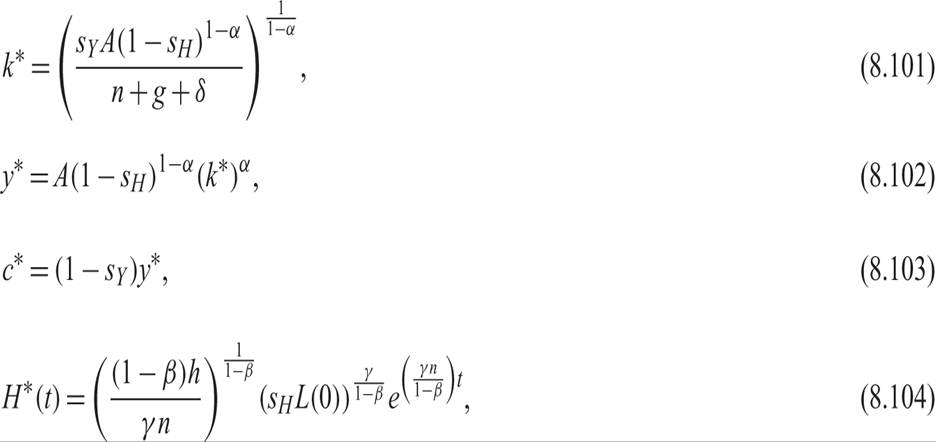
where k = K/(HL), y = Y/(HL), c = C/(HL), and the superscript * denotes the value of the corresponding variable on the balanced growth path.
On the balanced growth path, the model behaves exactly as the Solow model does, except that the rate of technical progress g is determined endogenously and depends on population growth and the parameters that characterize the production function of new ideas and innovations.
8.4
More on the topic Ideas, Innovations, and Technical Progress:
- Conclusion
- Different Conceptions of Technology
- References and Literature
- In this chapter, we examine growth models in which the efficiency of labor is no longer entirely exogenous, but may be influenced by positive externalities from the accumulation of physical capital,
- Joseph Alois Schumpeter
- THE LONG GERMINATION OF THE IDEA OF A WORLD FREE OF POVERTY
- Appropriate and Inappropriate Technologies and Productivity Differences
- Science and technology studies and economic sociology
- Contents
- Conclusion