References and Literature
This chapter covered a lot of ground and in most cases, many details were omitted for brevity. Most readers will be familiar with much of the material in this chapter. Mas-Colell, Winston and Green (1995) have an excellent discussion of issues of aggregation and what types of models admit representative households.
They also have a version of the Debreu-Mantel- Sonnenschein theorem, with a sketch proof. The representative firm theorem, Theorem 5.4, presented here is rather straightforward, but I am not aware of any other discussion of this theorem in the literature. It is important to distinguish the sub ject matter of this theorem from the Cambridge controversy in early growth theory, which revolved around the issue of whether different types of capital goods could be aggregated into a single capital index (see, for example, Wan, 1969). The representative firm theorem says nothing about this issue.The best reference for existence of competitive equilibrium and the welfare theorems with a finite number of consumers and a finite number of commodities is still Debreu’s (1959) Theory of Value. This short book introduces all of the mathematical tools necessary for general equilibrium theory and gives a very clean exposition. Equally lucid and more modern are the treatments of the same topics in Mas-Colell, Winston and Green (1995) and Bewley (2006). The reader may also wish to consult Mas-Colell, Winston and Green (1995, Chapter 16) for a full proof of the Second Welfare Theorem with a finite number of commodities (which was only sketched in Theorem 5.7 above). Both of these books also have an excellent discussion of the necessary restrictions on preferences so that they can be represented by utility functions. Mas-Colell, Winston and Green (1995) also has an excellent discussion of expected utility theory of von Neumann and Morgenstern, which we have touched upon.
Mas-Colell, Winston and Green (1995, Chapter 19) also gives a very clear discussion of the role of Arrow securities and the relationship between trading at the single point in time and sequential trading. The classic reference on Arrow securities is Arrow (1964).Neither of these two references discuss infinite-dimensional economies. The seminal reference for infinite dimensional welfare theorems is Debreu (1954). Stokey, Lucas and Prescott (1989, Chapter 15) presents existence and welfare theorems for economies with a finite number of consumers and countably infinite number of commodities. The mathematical prerequisites for their treatment are greater than what has been assumed here, but their treatment is both thorough and straightforward to follow once the reader makes the investment in the necessary mathematical techniques. The most accessible reference for the Hahn-Banach Theorem, which is necessary for a proof of Theorem 5.7 in infinite-dimensional spaces are Kolmogorov and Fomin (1970), Kreyszig (1978) and Luenberger (1969). The latter is also an excellent source for all the mathematical techniques used in Stokey, Lucas and Prescott (1989) and also contains much material useful for appreciating continuous time optimization. Finally, a version of Theorem 5.6 is presented in Bewley (2006), which contains an excellent discussion of overlapping generations models.
5.13. Exercises

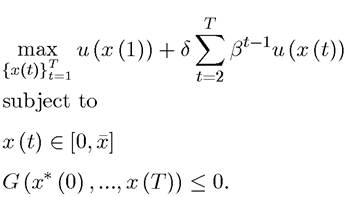
(1) Consider the following optimization problem
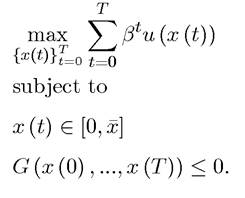
Although you do not need to, you may assume that G is continuous and convex, and u is continuous and concave.
Prove that any solution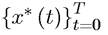 to this problem is time consistent.
(2) Now Consider the optimization problem
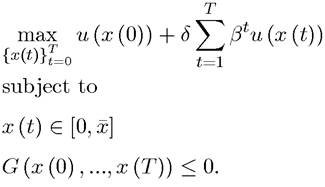
the problem

Exercise 5.2.
This exercise asks you to work through an example that illustrates the difference between the coefficient of relative risk aversion and the intertemporal elasticity of substitution. Consider a household with the following non-time-separable preferences over consumption levels at two dates:
where E is the expectations operator. The budget constraint of the household is 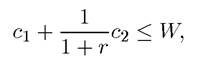 where r is the interest rate and W is its total wealth, which may be stochastic.
(1) Let us first suppose that W is nonstochastic and equal to Wo > 0. Characterize the utility maximizing choice of ci and c∙2.
(2) Compute the intertemporal elasticity of substitution.
(3) Now suppose that W is distributed over the support with some distribution
function G(W), where Characterize the utility maximizing
choice of ci and compute the coefficient of relative risk aversion. Provide conditions under which the coefficient of relative risk aversion is the same as the intertemporal elasticity of substitution. Explain why the two differ and interpret the conditions under which they are the same.
Exercise
5.3.
Prove Theorem 5.2.
Exercise 5.4. Prove Theorem 5.3 when there is also production.
Exercise 5.5. * Generalize Theorem 5.3 to an economy with a continuum of commodities.
Exercise 5.6. (1) Derive the utility maximizing demands for consumers in Example
5.1 and show that the resulting indirect utility function for each consumer is given
by (5.5).
(2) Show that maximization of (5.6) leads to the indirect utility function corresponding to the representative household.
(3) Now suppose that Repeat the same com
putations and verify that the resulting indirect utility function is homogeneous of degree 0 in p and y, but does not satisfy the Gorman form.
Show, however, that a monotonic transformation of the indirect utility function satisfies the Gorman form. Is this sufficient to ensure that the economy admits a representative household?EXERCISE 5.7. Construct a continuous-time version of the model with finite lives and random death. In particular suppose that an individual faces a constant (Poisson) flow rate of death equal to ν > 0 and has a true discount factor equal to ρ. Show that this individual will behave as if he is infinitely lived with an effective discount factor of ρ + ν.
Exercise 5.8. (1) Will dynastic preferences as those discussed in Section 5.2 lead to
infinite-horizon maximization if the instantaneous utility function of future generations are different (i.e., ut (∙) potentially different for each generation t)?
(2) How would the results be different if an individual cares about the continuation utility of his offspring with discount factor β, but also cares about the continuation utility of the offspring of his offspring with a smaller discount factor δ?
Exercise 5.9. Prove Theorem 5.8.
EXERCISE 5.10. Consider the sequential trading model discussed above and suppose now that individuals can trade bonds at time t that deliver one unit of good 0 at time t'. Denote the price of such bonds by qtt∣.
(1) Rewrite the budget constraint of household h at time t, (5.18), including these bonds.
(2) Prove an equivalent of Theorem 5.8 in this environment with the extended set of bonds.
Exercise 5.11. Consider a two-period economy consisting of two types of households. Na households have the utility function


with P в < β a. Each group, respectively, has income yA and ув at date 1, and can save this to the second date at some exogenously given gross interest rate R.
Show that for general u (∙), this economy does not admit a representative household.Exercise 5.12. Consider an economy consisting of N households each with utility function at time t = 0 given by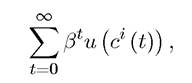
with denotes the consumption of household i at time t. The economy
starts with an endowment of Y units of the final good and has access to no production technology. This endowment can be saved without depreciating or gaining interest rate between periods.
(1) What are the Arrow-Debreu commodities in this economy?
(2) Characterize the set of Pareto optimal allocations of this economy.
(3) Does Theorem 5.7 apply to this economy?
(4) Now consider an allocation of Y units to the households, such that
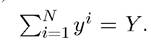 Given this allocation, find the unique competitive equilibrium price vector and the corresponding consumption allocations.
(5) Are all competitive equilibria Pareto optimal?
(6) Now derive a redistribution scheme for decentralizing the entire set of Pareto optimal allocations?
(2) Suppose that the production structure is given by a neoclassical production function, where the production vector at time t is only a function of inputs at time t and capital stock chosen at time t — 1, and that higher capital so contributes to greater

Exercise 5.14. *

(3) Show that this modified version of Theorem 5.7 covers the economy in case 1 of this exercise.
More on the topic References and Literature:
- References and Literature
- References
- REFERENCES
- References
- References
- Arulkumaran S., Regan L., Papageorghiou A.T., Monga A., Farquharson D.I.M.. Oxford Desk Reference: Obstetrics and Gynaecology. Oxford University Press,2011. — 1434 p., 2011
- References
- REFERENCES
- Oetzel John, Ting-Toomey Stella. The SAGE Handbook of Conflict Communication: Integrating Theory, Research and Practice. SAGE Publications,2013. — 912 p., 2013
- REFERENCES