Role of Social Security in Capital Accumulation
We now briefly discuss how Social Security can be introduced as a way of dealing with overaccumulation in the overlapping-generations model. We first consider a fully-funded system, in which the young make contributions to the Social Security system and their contributions are paid back to them in their old age.
The alternative is an unfunded system or a pay-as-you-go Social Security system, where transfers from the young directly go to the current old. We will see that, as is typically presumed, pay-as-you-go (unfunded) Social Security discourages aggregate savings. However, when there is dynamic inefficiency, discouraging savings may lead to a Pareto improvement.9.5.1. Fully Funded Social Security. In a fully funded Social Security system, the government at date t raises some amount d (t) from the young, for example, by compulsory contributions to their Social Security accounts. These funds are invested in the only productive asset of the economy, the capital stock, and pays the workers when they are old an amount R (t + 1) d (t). This implies that the individual maximization problem under a fully funded social security system becomes

subject to

and

for a given choice of d (t) by the government. Notice that now the total amount invested in capital accumulation is
It is also no longer the case that individuals will always choose s (t) > 0, since they have the income from Social Security. Therefore this economy can be analyzed under two alternative assumptions, with the constraint that s (t) ≥ 0 and without.
It is clear that as long as s (t) is free, whatever the sequence of feasible Social Security payments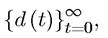 the competitive equilibrium applies. When s (t) ≥ 0 is imposed as
a constraint, then the competitive equilibrium applies if given the sequence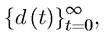 the
the
privately-optimal saving sequence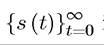 is such that s (t) > 0 for all t. Consequently, we
have the following straightforward results:
PROPOSITION 9.7. Consider a fully funded Social Security system in the above-described environment whereby the government collects d (t) from young individuals at date t.
(1) Suppose that s (t) ≥ 0 for all t. If given the feasible sequence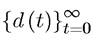 of Social
Security payments, the utility-maximizing sequence of savings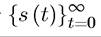 is such that
s (t) > 0 for all t, then the set of competitive equilibria without Social Security are the set of competitive equilibria with Social Security.
(2) Without the constraint s (t) ≥ 0, given any feasible sequence of Social
Security payments, the set of competitive equilibria without Social Security are the set of competitive equilibria with Social Security.
Proof. See Exercise 9.10. ?
This is very intuitive: the d (t) taken out by the government is fully offset by a decrease in s (t) as long as individuals were performing enough savings (or always when there are no constraints to force positive savings privately). Exercise 9.11 shows that even when there is the restriction that s (t) ≥ 0, a funded Social Security program cannot lead to the Pareto improvement.
9.5.2. Unfunded Social Security. The situation is different with unfunded Social Security. Now we have that the government collects d (t) from the young at time t and distributes this to the current old with per capita transfer b (t) = (1 + n) d (t) (which takes into account that there are more young than old because of population growth). Therefore, the individual maximization problem becomes

subject to
and

for a given feasible sequence of Social Security payment levels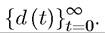
What this implies is that the rate of return on Social Security payments is n rather than r (t + 1) = R (t + 1) — 1, because unfunded Social Security is a pure transfer system. Only s (t)—rather than s (t) plus d (t) as in the funded scheme—goes into capital accumulation. This is the basis of the claim that unfunded Social Security systems discourage aggregate savings. Of course, it is possible that s (t) will change in order to compensate this effect, but such an offsetting change does not typically take place. Consequently, unfunded Social Security reduces capital accumulation. Discouraging capital accumulation can have negative consequences for growth and welfare. In fact, the empirical evidence we have seen in Chapters 1-4 suggests that there are many societies in which the level of capital accumulation is suboptimally low. In contrast, in the current model reducing aggregate savings and capital accumulation may be a good thing when the economy exhibits dynamic inefficiency (and overaccumaltion). This leads to the following proposition.
PROPOSITION 9.8. Consider the above-described overlapping generations economy and suppose that the decentralized competitive equilibrium is dynamically inefficient.
Then there exists a feasible sequence of unfunded Social Security payments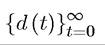 which will lead
 to a competitive equilibrium starting from any date t that Pareto dominates the competitive equilibrium without Social Security.
Proof. See Exercise 9.13. ?
Unfunded Social Security reduces the overaccumulation and improves the allocation of resources. The similarity between the way in which unfunded Social Security achieves a Pareto improvement in this proposition and the way in which the Pareto optimal allocation was decentralized in the example economy of Section 9.1 is apparent. In essence, unfunded Social Security is transferring resources from future generations to initial old generation, and when designed appropriately, it can do so without hurting the future generations. Once again, this depends on dynamic inefficiency; when there is no dynamic inefficiency, any transfer of resources (and any unfunded Social Security program) would make some future generation worse-off. You are asked to prove this result in Exercise 9.14.
9.6.
More on the topic Role of Social Security in Capital Accumulation:
- Role of Social Security in Capital Accumulation
- Role of Social Security in Capital Accumulation
- Taking Stock
- A key feature of the neoclassical growth model analyzed in the previous chapter is that it admits a representative household.
- About the Authors
- Contents
- Acemoglu Daron. Introduction to Modern Economic Growth: Parts 1-4. Department of Economics, Massachusetts Institute of Technology,2008. — 604 p., 2008
- Table of contents
- Acemoglu D.. Introduction to Modern Economic Growth. Princeton University Press,2008. — 1248 p., 2008
- Long-Run Growth: The Solow Model