Technological Change and the Canonical Neoclassical Model
The above analysis was for the neoclassical growth model without any technological change. As with the basic Solow model, the neoclassical growth model would not be able to account for the long-run growth experience of the world economy without some type of exogenous technological change.
Therefore, the more interesting version of this model is the one that incorporates technological change. We now analyze the neoclassical model with exogenous technological change.We extend the production function to:
(8.26)
where
A (t) = exp (gt) A (0).
Notice that the production function (8.26) imposes purely labor-augmenting—Harrod- neutral—technological change. This is a consequence of Theorem 2.7 above, which was proved in the context of the constant saving rate model, but equally applies in this context. Only purely labor-augmenting technological change is consistent with balanced growth.
We continue to adopt all the other assumptions, in particular Assumptions 1, 2 and 3. Assumption 40 will be strengthened further in order to ensure finite discounted utility in the presence of sustained economic growth.
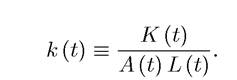
The constant returns to scale feature again enables us to work with normalized variables. Now let us define 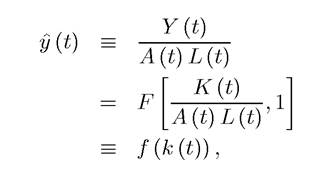 where
where
(8.27) is the capital to effective capital-labor ratio, which is defined taking into account that effective labor is increasing because of labor-augmenting technological change. Naturally, this is similar to the way that the effective capital-labor ratio was defined in the basic Solow growth model.
In addition to the assumptions on technology, we also need to impose a further assumption on preferences in order to ensure balanced growth.
Again as in the basic Solow model, we define balanced growth as a pattern of growth consistent with the Kaldor facts of constant capital-output ratio and capital share in national income. These two observations together also imply that the rental rate of return on capital, R (t), has to be constant, which, from (8.8), implies that r (t) has to be constant. Be again refer to an equilibrium path that satisfies these conditions as a balanced growth path (BGP). Balanced growth also requires that consumption and output grow at a constant rate. The Euler equation implies that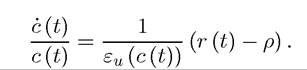

marginal utility of consumption is asymptotically constant. Therefore, balanced growth is only consistent with utility functions that have asymptotically constant elasticity of marginal utility of consumption. Since this result is important, we state it as a proposition:
PROPOSITION 8.5. Balanced growth in the neoclassical model requires that asymptotically (as t → ∞) all technological change is purely labor-augmenting and the elasticity of intertemporal substitution, εu (c (t)), tends to a constant εu.
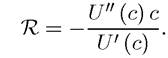
The next example shows the family of utility functions with constant intertemporal elasticity of substitution, which are also those with a constant coefficient of relative risk aversion. Example 8.1. (CRRA Utility) Recall that the Arrow-Pratt coefficient of relative risk aversion for a twice-continuously differentiable concave utility function U (c) is
324
Constant relative risk aversion (CRRA) utility function satisfies the property that R is constant. Now integrating both sides of the previous equation, setting R to a constant, implies that the family of CRRA utility functions is given by

with the coefficient of relative risk aversion given by θ.
In writing this expression, we separated the case where θ = 1, since is undefined at θ = 1. However, it can be
 shown that lnc is indeed the right limit when θ → 1 (see Exercise 5.4).
With time separable utility functions, the inverse of the elasticity of intertemporal substitution (defined in equation (8.16)) and the coefficient of relative risk aversion are identical. Therefore, the family of CRRA utility functions are also those with constant elasticity of intertemporal substitution.
Now to link this utility function to the Gorman preferences discussed in Chapter 5, let us consider a slightly different problem in which an individual has preferences defined over the consumption of N commodities {ci,...,cn} given by

Suppose also that this individual faces a price vector p =(pι,...,pN) and has income y, so that his budget constraint can be expressed as

Maximizing utility sub ject to this budget constraint leads of the following indirect utility function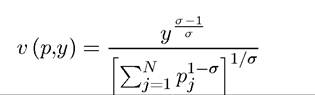
(see Exercise 5.6). Although this indirect utility function does not satisfy the Gorman form in Theorem 5.2, a monotonic transformation thereof does (that is, we simply raise it to the power σ/ (σ — 1)).
This establishes that CRRA utility functions are within the Gorman class, and if all individuals have CRRA utility functions, then we can aggregate their preferences and represent them as if it belonged to a single individual.
Now consider a dynamic version of these preferences (defined over infinite horizon):

The important feature of these preferences for us is not that the coefficient of relative risk aversion constant per se, but that the intertemporal elasticity of substitution is constant.
Thisis the case because most of the models we focus on in this book do not feature uncertainty, so that attitudes towards risk are not important. However, as noted before and illustrated in Exercise 5.2 in Chapter 5, with time-separable utility functions the coefficient of relative risk aversion in the inverse of the intertemporal elasticity of substitution are identical. The intertemporal elasticity of substitution is particularly important in growth models because it will regulate how willing individuals are to substitute consumption over time, thus their savings and consumption behavior. In view of this, it may be more appropriate to refer to CRRA preferences as “constant intertemporal elasticity of substitution” preferences. Nevertheless, we follow the standard convention in the literature and stick to the term CRRA.
Given the restriction that balanced growth is only possible with preferences featuring a constant elasticity of intertemporal substitution, we might as well start with a utility function that has this feature throughout. As noted above, the unique time-separable utility function with this feature is the CRRA preferences, given by

where the elasticity of marginal utility of consumption, εu, is given by the constant θ. When θ = 0, these represent linear preferences, whereas when θ = 1, we have log preferences. As θ → ∞, these preferences become infinitely risk-averse, and infinitely unwilling to substitute consumption over time.
More specifically, we now assume that the economy admits a representative household with CRRA preferences

where c(t) ? C (t) /L (t) is per capita consumption. We used to notation c (t) in order to preserve c (t) for a further normalization.
We refer to this model, with labor-augmenting technological change and CRRA preference as given by (8.30) as the canonical model, since it is the model used in almost all applications of the neoclassical growth model.
The Euler equation in this case takes the simpler form:
Let us first characterize the steady-state equilibrium in this model with technological progress. Since with technological progress there will be growth in per capita income, c(t) will grow. Instead, in analogy with k (t), let us define
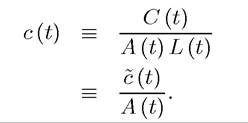
326
We will see that this normalized consumption level will remain constant along the BGP. In particular, we have
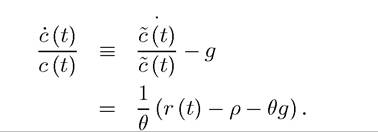
Moreover, for the accumulation of capital stock, we have

The transversality condition, in turn, can be expressed as

In addition, the equilibrium interest rate, r (t), is still given by (8.8), so

Since in steady state c (t) must remain constant, we also have
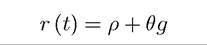
or

which pins down the steady-state value of the normalized capital ratio k* uniquely, in a way similar to the model without technological progress. The level of normalized consumption is then given by

while per capita consumption grows at the rate g.
The only additional condition in this case is that because there is growth, we have to make sure that the transversality condition is in fact satisfied. Substituting (8.33) into (8.32), we have
which can only hold if the integral within the exponent goes to zero, i.e., if ρ-(1 — θ) g—n > 0, or alternatively if the following assumption is satisfied:
Assumption 4.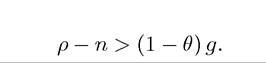
Note that this assumption strengthens Assumption 40 when θ < 1.
Alternatively, recall that in steady state we have r = ρ + θg and the growth rate of output is g + n. Therefore, Assumption 4 is equivalent to requiring that r > g + n. We will encounter conditions like this all throughout, and they will also be related to issues of “dynamic efficiency” as we will see below.The following is an immediate generalization of Proposition 8.2:
PROPOSITION 8.6. Consider the neoclassical growth model with labor-augmenting technological progress at the rate g and preferences given by (8.30). Suppose that Assumptions 1, 2, 3 and 4 hold. Then there exists a unique balanced growth path with a normalized capital to effective labor ratio of k*, given by (8.33), and output per capita and consumption per capita grow at the rate g.
As noted above, the result that the steady-state capital-labor ratio was independent of preferences is no longer the case, since now k* given by (8.33) depends on the elasticity of marginal utility (or the inverse of the intertemporal elasticity of substitution), θ. The reason for this is that there is now positive growth in output per capita, and thus in consumption per capita. Since individuals face an upward-sloping consumption profile, their willingness to substitute consumption today for consumption tomorrow determines how much they will accumulate and thus the equilibrium effective capital-labor ratio.
Perhaps the most important implication of Proposition 8.6 is that, while the steady-state effective capital-labor ratio, k*, is determined endogenously, the steady-state growth rate of the economy is given exogenously and is equal to the rate of labor-augmenting technological progress, g. Therefore, the neoclassical growth model, like the basic Solow growth model, endogenizes the capital-labor ratio, but not the growth rate of the economy. The advantage of the neoclassical growth model is that the capital-labor ratio and the equilibrium level of (normalized) output and consumption are determined by the preferences of the individuals rather than an exogenously fixed saving rate. This also enables us to compare equilibrium and optimal growth (and in this case conclude that the competitive equilibrium is Pareto optimal and any Pareto optimum can be decentralized). But the determination of the rate of growth of the economy is still outside the scope of analysis.
A similar analysis to before also leads to a generalization of Proposition 8.4.
PROPOSITION 8.7. Consider the neoclassical growth model with labor-augmenting technological progress at the rate g and preferences given by (8.30). Suppose that Assumptions 1, 2, 3 and 4 hold. Then there exists a unique equilibrium path of normalized capital and consumption, (k (t),c (t)) converging to the unique steady-state (k*,c*) with k* given by (8.33). Moreover, if k (0) < к*, then k (t) ↑ k* and c (t) ↑ c*, whereas if k (0) > к*, then c (t) ∣ k* and c (t) ∣ c*.
Proof. See Exercise 8.9. ?
It is also useful to briefly look at an example with Cobb-Douglas technology.
Example 8.2. Consider the model with CRRA utility and labor-augmenting technologi- 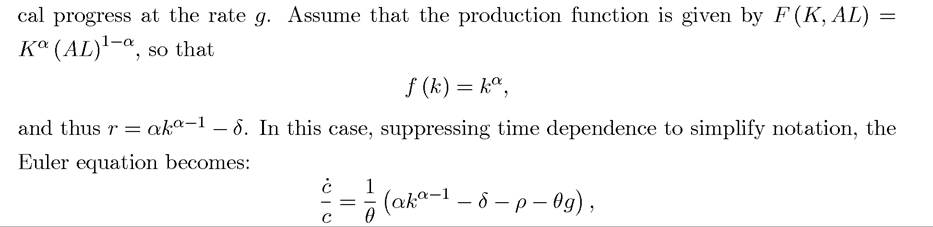 and the accumulation equation can be written as
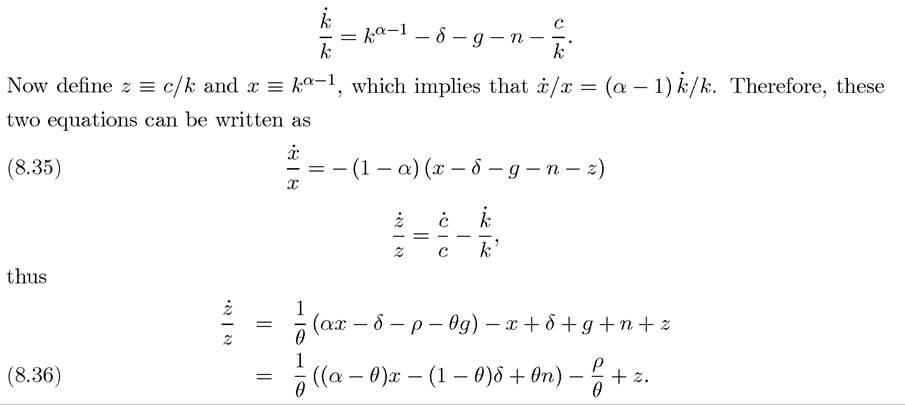
The two differential equations (8.35) and (8.36) together with the initial condition x (0) and the transversality condition completely determine the dynamics of the system. In Exercise
8.12, you are asked to complete this example for the special case in which (i.e., log preferences).
8.7.
More on the topic Technological Change and the Canonical Neoclassical Model:
- Technological Change and the Canonical Neoclassical Model
- Table of contents
- Acemoglu D.. Introduction to Modern Economic Growth. Princeton University Press,2008. — 1248 p., 2008
- Preface
- Political Institutions and Growth-Enhancing Policies