The Canonical Overlapping Generations Model
Even the model with CRRA utility and Cobb-Douglas production function is relatively messy. For this reason, many of the applications of the overlapping generations model use an even more specific utility function, log preferences (or equivalently θ = 1 in terms of the CRRA preferences of the last section).
Log preferences are particularly useful in this context, since they ensure that income and substitution effects exactly cancel each other out, so that changes in the interest rate (and therefore changes in the capital-labor ratio of the economy) have no effect on the saving rate.Since this version of the model is sufficiently common, it may deserve to be called the canonical overlapping generations model and will be the focus of this section. Another interesting feature of this model is that the structure of the equilibrium is essentially identical to the basic Solow model we studied in Chapter 2.
Suppose that the utility of the household and generation t is given by  where as before β ∈ (0,1) (even though β ≥ 1 could be allowed here without any change in the analysis). The aggregate production technology is again Cobb-Douglas, that is,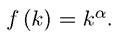
The consumption Euler equation now becomes even simpler:
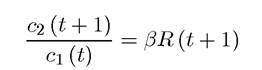
and implies that savings should satisfy the equation
(9.19)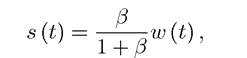
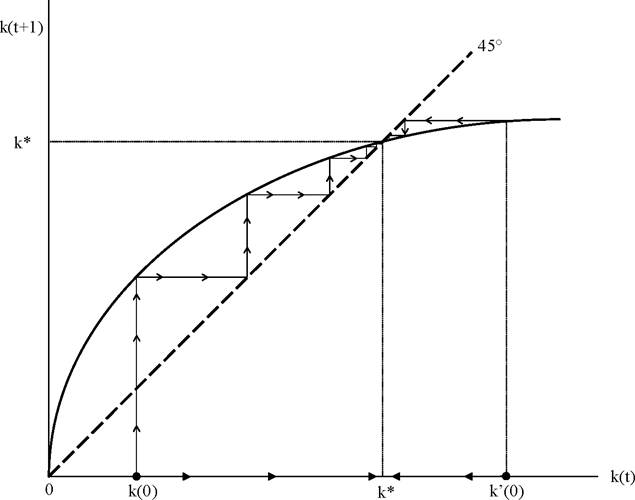
Figure 9.2. Equilibrium dynamics in the canonical overlapping generations model.
which corresponds to a constant saving rate, equal to β/ (1 + β), out of labor income for each individual.
This constant saving rate makes this model very similar to the baseline Solow growth model of Chapter 2.Now combining this with the capital accumulation equation (9.8), we obtain
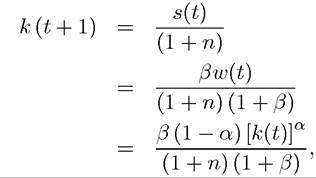
where the second line uses (9.19) and the last line uses the fact that, given competitive factor markets, the wage rate is equal to w
It is straightforward to verify that there exists a unique steady state with capital-labor ratio given by

Moreover, starting with any k (0) > 0, equilibrium dynamics are identical to those of the basic Solow model and monotonically converge to k*. This is illustrated in Figure 9.2 and stated in the next proposition:
PROPOSITION 9.5. In the canonical overlapping generations model with log preferences and Cobb-Douglas technology, there exists a unique steady state, with capital-labor ratio k* given by (9.20). Starting with any k (0) ∈ (0,k*), equilibrium dynamics are such that k (t) ↑ k*, and starting with any k' (0) > к*, equilibrium dynamics involve .
.
Exercise 9.6 asks you to introduce technological progress into this canonical model and to conduct a range of comparative static exercises. Exercise 9.7, on the other hand, asks you to analyze the same economy without the Cobb-Douglas technology assumption.
9.4.
More on the topic The Canonical Overlapping Generations Model:
- The Canonical Overlapping Generations Model
- Exercises
- The Baseline Overlapping Generations Model
- Overlapping Generations with Impure Altruism
- Conclusion