Introduction
'All b. Muhammad b. Ja'far b. Ibrahim b. Abi Salama b. al-Walid al-Anf al-'Abshaml al-Qurashi (d. 612/1215, hereon 'Ali b. Muhammad) is the fifth da'i mutlaq (literally “the absolute missionary”) of the Musta'li-Tayyibi Isma'ilis.2 Born and raised in Yemen, he assumed the leadership of the Musta'li-Tayyibi daWa (proselytising mission) at the advanced age of eighty-three; he was leader for 7 years from 605/1209 to 612/1215.
In order to understand the role and status of the da'i mutlaq, a brief historical background of this hierarchical rank within the daWa is necessary. The Isma'ili daWa divided into Nizari and Musta'li factions following the death of the Fatimid Caliph-Imam Mustansir bi’llah in 487/1094.3 His oldest son Nizar (d. 488/1095) was favoured for the seat of imamate by the Persian and Syrian Isma'ili communities. The Isma'ilis of Egypt and Yemen, on the other hand, supported the leadership of Nizar’s younger half-brother Musta'li (d. 495/1101). The Isma'ili daWa herefore split between two Imams. In the Musta'li branch, Musta'li was succeeded by his son Amir. A further split occurred among them on the issue of Amir’s succession. Who was the designated successor of Amir? The Egyptian Musta'li daWa proclaimed the imamate of Hafiz 'Abd al-Majid (d. 544/1149), Amir’s cousin, justifying this by the claim that the latter did not leave any heir. The equally powerful Yemeni Musta'li daWa asserted that Amir left a son, named Tayyib, who was born just before his assassination and, therefore, advocated the imamate of the infant Tayyib.4 Tayyib was then believed to have gone in concealment (satr). It was at this point that a distinctive Isma'ili Musta'li-Tayyibi community emerged. The followers of the Musta'li-Tayyibi tradition hold that the imamate enters a period of concealment (dawr al-satr) during which the chain of imamate continues in the progeny of Tayyib, though the identity of the Imam at any point in time is unknown. In the absence of the Imams, the leadership of the community is delegated to the da'i mutlaq.5 The author of the text presented below is the fifth such da'i in the chain of Isma'ili Musta'li-Tayyibi da'is.6'Ali b. Muhammad hailed from the distinguished al-Walid family of al-Quraysh. He was a notable scholar who played a critical role in both the administrative supervision and intellectual direction of the Musta'li-Tayyibi Isma'ilis. He served as the ma’dhun (deputy) for the third da'i mutlaq Hatim b. Ibrahim b. al-Husayn al-Hamidi (d. 596/1199). Hatim al-Hamidi has offered him highest accolade. He writes:
As with the nobility of lineage, 'Ali b. Muhammad hails from the noblest of the lineages of his time; he boasts the most impressive pedigree; he is the highest ranked member of the guiding da'wa (al-da'wa al-hadiya); he precedes others in virtuous and praiseworthy deeds. His great-grandfather Ibrahim b. Abi Salama - may God bless his soul - was dispatched as a delegate to the court of al-Mustansir by 'Ali b. Muhammad [al-Sulayhi] (d. 459/1067, the founder of the Yemeni Sulayhid dynasty) - may God send his blessing on both of them -... They [the al-Walid family] trace their origins to Banu 'Abd Manaf b. Qusayy, one of the noblest families of al-Quraysh and stellar tribes of the Arabs. None of his contemporaries could match him in purity, piety, worship, chastity, devotion, loyalty (walaya - loyalty to the Imams) and exemplary conduct. All those necessary qualifications enumerated by the da'i [Ahmad al-Nisaburi, d. after 386/996] - may God elevate his status - in this epistle [al-Risala al-mujaza al-kafiya fi adab al-du'at] are found in him. It is for this reason, I entrusted him with the affairs of the guiding da'wa (al-da'wa al-hadiya) in Yemen - may God's blessings be upon its master -.7
'Ali b. Muhammad was also the tutor of the soon-to-be fourth da'i 'Ali b. Hatim whom he succeeded as the fifth da'i. In fact, it was 'Ali b.
Muhammad who recommended Hatim b. Ibrahim to appoint his son as the next da'i.8 He also wrote a treatise (Risalat al-bayan wa-mudhidat al-buhtan) in refutation of Muhammad b. Ahmad al-Ahwari who claimed the da'iship after da'i Hatim. This demonstrates his influence in the most sensitive and personal decisions of the da'i and the dacwa administration. On the political front, he maintained strong relationships with Ayyubids, Sulay- hids and Hamdanids during his tenure. He died in San'a3 at an advanced age of ninety years. The leadership of the da'wa continued in his family for almost three and a half centuries (until 946/1539), with two brief interruptions, before it moved to India in the 10th/16th century.'Ali b. Muhammad composed several works. Hamdani and Poonawala offer a list of sixteen titles.9 Most of these works relate to Isma'ili theology, cosmology and eschatology. His works also include eulogies of early da'is and refutations of their adversaries, particularly those who supported the imamate of Hafiz.10 There is a noticeable absence of writings on Isma'ili law and legal theory among these titles. 'Ali b. Muhammad is not an isolated example of having shown little interest in writings on fiqh; early da'is too did not appear to have composed independent works on law. However, 'Ali b. Muhammad has analysed legal positions of other schools in his works of refutations, and it is by reading these works we are able to glean his expositions on Musta'li-Tayyibi law and legal theory. One such work is his Mukhtasar al-usul, the first chapter of which is edited and commented upon in this section. The study of the Mukhtasar al-usul is, therefore, an attempt to discover those nuances which underpin the Musta'li-Tayyibi legal frame- work.11
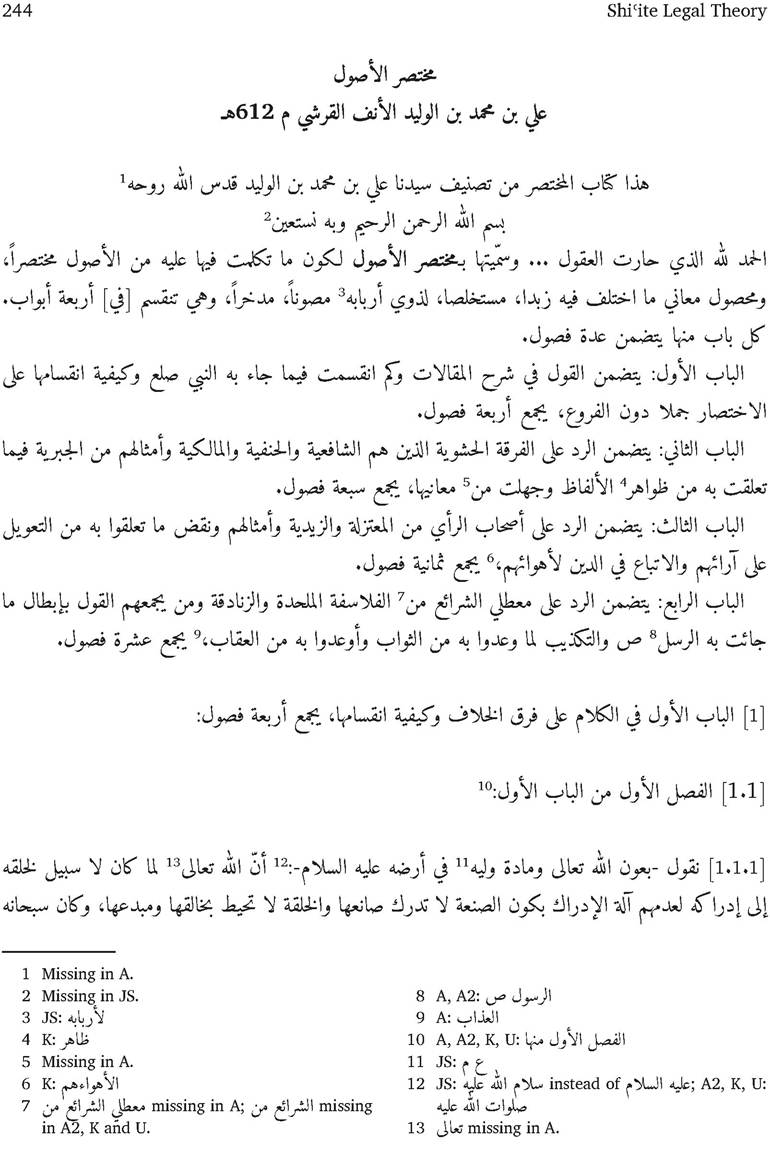
In the introduction of the Mukhtasar al-usul, 'Ali b. Muhammad justifies the reason behind his selection of the title Mukhtasar al-usul - a concise book on usul.
It is a succinct treatise, he writes, that is set to expound on the tenets of Isma'ili tradition by refuting the opinions espoused by other legal and doctrinal schools. The word usul in the title, it should be noted, does not appear to refer to the discipline of legal theory (usul al-fiqh) rather alludes to the key doctrines on which the foundation of Isma'ili tradition is laid. In explicating these usul, he examines the theories of legal interpretation, legal hermeneutics and legal authority - topics that are conventionally studied in the works of usul al-fiqh.Unlike other Islamic legal schools of the third-fifth/ninth-eleventh centuries, Isma'ilis did not produce any independent manuals of usul al-fiqh. This is important since, as Stewart argues, for any legal school to become authoritative it had become a necessity either to outline its distinctive legal theory or to conform or respond to the existing legal hermeneutics.12 Was Isma'ili legal tradition lagging behind other Sunni and Shi'i legal schools? Did the direct access to Imams until 526/1132 (the year in which Tayyib was alleged to have gone in concealment) rendered legal interpretation redundant because the presence of a living Imam suspends the need of taking recourse to a jurist’s opinions? In the Isma'ili doctrinal and legal framework, religious authority is bestowed upon the Imam. In the absence of an Imam, the da'i occupies the same position with the exact same role and function. Religious guidance is, then, the exclusive prerogative of the Imam or the da'i and the followers are expected to submit to their authority. Simply put, their words and actions are ‘sources’ of law in themselves and not mere interpretations of ‘sources’. The very presence of a central authoritative figure such as an imam (or a da'i in his absence) leave no room for personal juristic reasoning, let alone a school, to emerge.13
Though the field of Islamic law (fiqh) in general, and in particular, the discipline of legal theory (usul al-fiqh) did not fully develop in the Isma'ili tradition, its legal framework can be gleaned through works of refutations that critique Sunni theories of legal interpretations.
Ikhtilaf usul al- madhahib of al-Qadi al-Nu'man (d. 363/974), for instance, represents one such early work of refutation that contains discussions of Isma'ili legal hermeneutics.14 Though primarily a polemical work, it expounds on issues that are of direct interest to the field of legal theory, such as the authority of the Imams, refutation of analogical deduction (qiyas), refutation of consensus (ijmd') etc. Our text, Mukhtasar al-usul, though different in style and structure, shares the same objective of the Ikhtildf.15 In the Mukhtasar, 'Ali b. Muhammad refutes what he sees as the dubious and flawed theories of legal interpretations adopted by the Sunnis, highlighting the importance of obtaining religious guidance from a divinely appointed central authority (i.e. Imam). In doing so, he argues for the superiority of Isma'ili tradition over other Islamic legal and doctrinal schools. The divine authority of the Imams and the successorship of the da'is are central to his arguments. One might expect the book to contain a detailed discussion of the nature of the concealment (satr) of Imam al-Tayyib and the doctrinal challenges it might have brought for the early Musta'li-Tayyibi community, but no effort is made to explain or justify this central doctrine. The lucid structure of the composition and succinct nature of its arguments might suggest that the book was aimed at Musta'li-Tayyibi adherents who were expected to be already familiar with the key doctrines of the school and their relevant proofs and justifications.The present chapter is a critical edition and commentary on the first chapter of the Mukhtasar al-usul. The book is divided into four chapters (abwab, sing. bab), each of which is further divided into sections (fusul, sing. fasl). The first chapter, divided into four sections, analyses the reasons that led to the emergence of divergent groups within Islamic tradition. In the third section of this chapter, the author lists four groups of people explaining their positions and approaches vis-à-vis Prophetic statements.
They are Hashwiyya, Mu'tazilites, heretics and the People of Truth and Sound Beliefs (Ahl al-haqq wa-l-haqiqa, i.e. the Isma'ilis). This chapter is presented and summarised below.The second chapter, divided into seven sections, sets out to provide a sustained refutation of Shafi'is, Hanafis and Malikis - all grouped under the broad category of Hashwiyya and Jabriyya. The author introduces them as those limiting themselves to the prima facie meaning of the Qur’an and hadith and thus remaining oblivious to the hidden core meaning of the shari'a. The third chapter, divided in eight sections, attempts to refute Mu'tazili and Zaydi - both identified as Ashab al-ra'y - claims of being capable of speculative reasoning. Their excessive dependence on personal reasoning, the author asserts, have led them to follow their own personal opinions and whims and not the shari'a’s incontrovertible proofs. The final chapter is divided into ten sections. It aims to provide a brief survey of the ideas propagated by disbelieving philosophers and heretics who dismiss the doctrine of prophethood and his promises of reward and punishment in the hereafter.
Chapter One of the Mukhtasar al-usul reveals two important features in the study of the broader Shi'i legal theory. First, it examines various approaches adopted by non-Shi'i legal schools in interpreting the textual sources of the law (fiqh). Second, it elaborates on the role of Imams in interpreting the law. Both the topics squarely fit within the broader interest of legal hermeneutics and legal theory.
This book has survived in several manuscripts. I have been able to procure five manuscripts of Indian provenance for the edition below. I have attempted to select the best text in the edition after comparing all the five MSs, but also indicating the variants in the footnotes.16 What follows is the description of the MSs on which my edition is based. The sigla used in the footnotes are references to the names of the religious institutions/places where the MSs are currently held.
1. Alavi Bohra (A):
The transcription of this copy was completed on Monday 20 al-Jumada l-ülä 1311/27 November 1893 by Ibrahim b. Ädamji b. Marhüm Isma'il b. Karimbha’i, the resident of Kapadvanj. A copy of this MS is housed at the Alavi Bohra da'wa collection in Baroda.
2. Alavi Bohra (A2):
The title page of the MS reads: This treatise was obtained from a Dawoodi [Bohra] scholar during the time of Sayyidna Badr al-Din b. Sayyidna Fakhr al-Din (d. 821/1418). A significant portion of the colophon has been scrubbed and is unreadable. However, from the mention of Sayyidna Wajih al-Dunya wa-l-Din [b.] Sayyidna al-Shaykh 'Abd al-Qadir b. Mulla Khan (d. 1168/1754) we can surmise that the MS was copied around mid-twelfth/eighteenth century. The colophon appears to have been intentionally scrubbed to hide the identity of the copyist, supposedly a Dawoodi Bohra scholar. A copy of this MS is housed at the Alavi Bohra da'wa collection in Baroda.
3. Aljamea-tus-Saifiyah (JS):
This MS was transcribed by Fakhr al-Din b. Mulla Yüsuf 'Ali Khayrgü’i between [Tuesday] 1 Safar [1362] and Friday 24 Safar 1362/2 February [1943] and 26 February 1943. The date of transcript is recorded on the first page without the mention of the year. The date and year of completion, however, are mentioned in the colophon. This copy appears to be produced for learning and teaching at the Dawoodi Bohra seminary Aljamea-tus-Saifiyah in Surat.
4. Karachi (K):
This MS was transcribed by Fida Husayn b. 'Abd al-Qadir Bhanpüri, a resident of Indore and lecturer at al-Madrasat al-Wajihiyya. The colophon reveals that the transcription was completed on Thursday 27 Shawwal 1358/7 December 1939. It is currently held in the family collection of Qazi Dr. Shaikh Abbas Borhany al-Waleed.17
5. Unknown (U)
The transcript of this MS was completed on 7 Safar 1263/23 January 1847 during the leadership of 'Abd al-Qadir Abü Muhammad Najm al-Din, the 47th da'i of Dawoodi Bohras (d. 1302/1885). A copy of this MS is housed at the Alavi Bohra da'wa collection in Baroda.
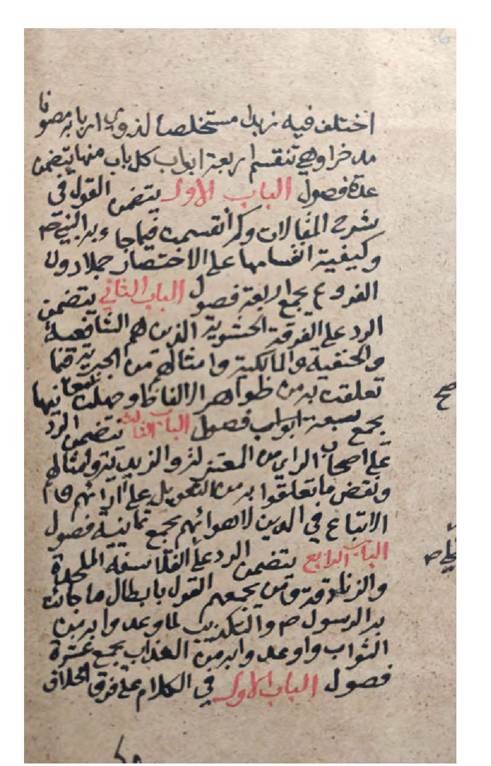
Figure 8.2 MS Alavi Bohra da'wa collection (A), Baroda, fol. 2a
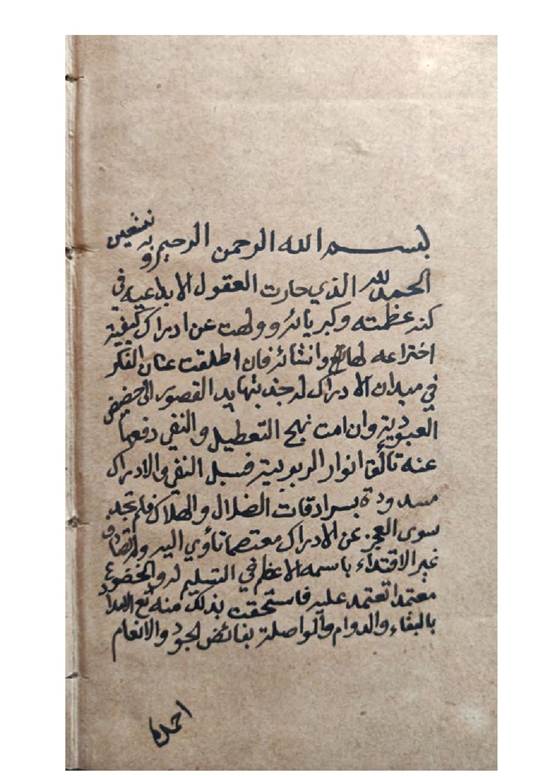
Figure 8.1 MS Alavi Bohra da'wa collection (A), Baroda, fol. lb
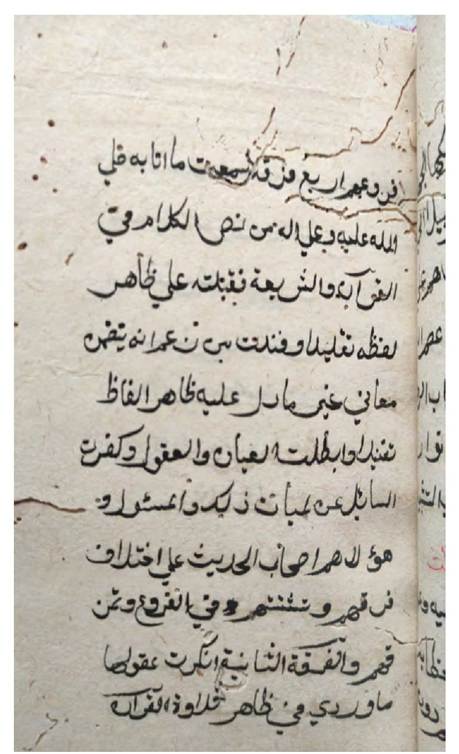
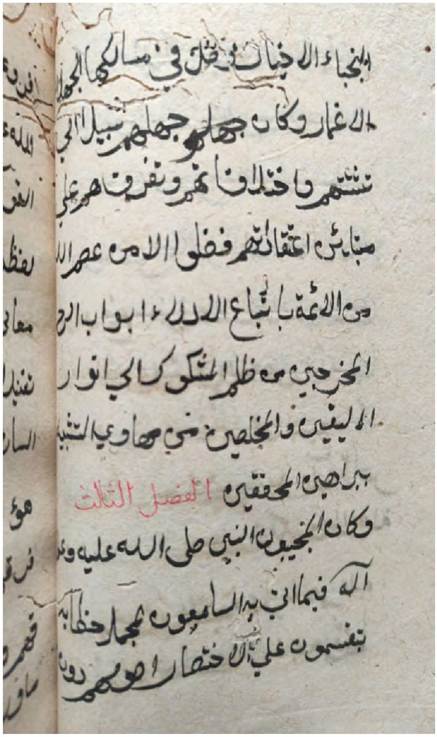
More on the topic Introduction:
- 1 Introduction
- Introduction
- Introduction
- 19 Introduction
- Introduction
- Introduction
- INTRODUCTION
- Introduction
- Introduction
- Introduction
- Introduction
- Introduction: Hegel, Marx and the Dialectic
- INTRODUCTION: OVERVIEW OF COMPLICATIONS ASSOCIATED WITH HIV THERAPY
- Introduction
- Introduction
- Introduction
- Introduction
- Introduction
- INTRODUCTION