Summary
[1] The First Chapter: Deviated Sects and Nature of their Schism
The central focus of this chapter is to establish the religious authority of the Imams. The author, 'Ali b. Muhammad b.
al-Walid, introduces Imams as the custodians of religion, inheritors of Prophet’s knowledge and rightful interpreters of the esoteric and allegorical meanings of the Qur’an. Abandoning them was, he argues, the reason that Muslims became divided into different sects - each one construing shari'a according to their whimsical interpretations. In this respect, it neatly resembles the discussion of hujjiyyat qawl al-imam (Fath al-bab, passages [37-38]), hujjiyyat ijma' al-'itra (Qantara, passage [4]) among other topics concerning hujjiyyat (legal force) that are typically discussed in the works of usul. The overarching style and structure of argumentation, though, as will be demonstrated below, is theological and not usuli (legal theoretical) in nature. In other words, the author is attempting to construct a theological, rather than a jurisprudential argument. Nonetheless, we can read the Mukhtasar with a view to uncovering Isma'ili legal theory, for the chapter elaborates topics, such as legal authority, methods of interpreting texts and the like, that are of direct interest to usul.This chapter is divided into four sections [1.1-1.4].
The first section [1.1] aims to define the doctrine of prophethood and the role prophets play not only in preaching but also in interpreting the shari'a. In this section, 'Ali b. Muhammad addresses three issues: the need for the prophetic institution [1.1.1], the mission of the prophets
[1.1.2] and the characteristics of their divine message [1.1.3]. The arguments are presented succinctly. Unlike his early Isma'ili predecessors, our author does not offer any philosophical reasoning.18 The rhetorical nature of the arguments suggests that this work was composed for the members of Musta'li-Tayyibi community of Yemen and India.
[1.1] Section One
In reference to the need for the prophetic institution [1.1.1], 'Ali b. Muhammad builds his argument on three premises. First, human beings are inherently deficient in their comprehension of God. It is self-evident, the author argues, that the creator cannot be conceived by his creation. Second, the benevolent God has chosen human beings for His divine guidance. Third, unlike animals, human beings are not born with innate knowledge/behaviours that could protect them from evil. To support this premise, the author cites the Qur’anic verse: “It is God who brought you forth from your mothers’ wombs knowing nothing, and gave you hearing and sight and minds, so that you might be thankful.”19 The author attempts to draw a logical conclusion from these three premises; it is due to God’s over-encompassing mercy and all-embracing grace that he sends prophets. These messengers of God are entrusted with the responsibility of human guidance. Their role is to preach God’s message and invite humanity towards His path.
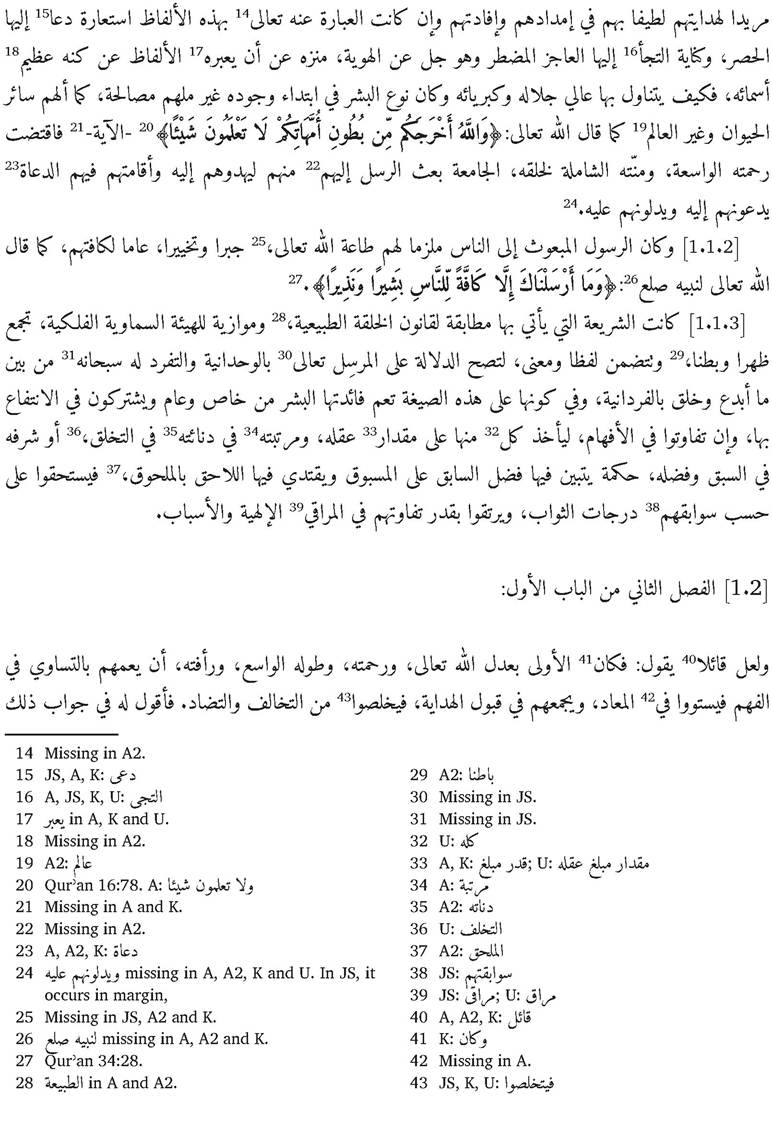
In reference to the prophetic mission, 'Ali b. Muhammad asserts [1.1.2] that the prophets are required to demand God’s subservience from every single soul - willingly or by compulsion. The following Qur’anic verse is cited to support this claim: “We have not sent you [O Prophet] but as a bringer of good tidings and a warner to all people, but most of them do not understand.”20 The Qur’an introduces Muhammad as the ‘seal of the prophets’ and hence his shari'a is expected to abrogate all previous laws and legal systems. The author is attempting to set the ground for establishing the religious authority of the imams, for they are delegated, in subsequent passages, with the same role and responsibilities as the prophets. In other words, imamate is seen as an extension to the institution of prophethood.
Towards the end of the first section, 'Ali b.
Muhammad lists four characteristics of shari'a[1.1.3] : first, it is consistent with the laws of creation; second, it is parallel to astronomical celestial arrangements; third, it contains apparent (zahr) and hidden meaning (batn); fourth, it has form (lafz) and essence (ma'na). The author neither elaborates upon these features nor offers any example to elucidate their meanings. He explains, on the contrary, the purpose of a multifaceted shari'a. It is due to the differences in the levels of understanding of the audience, the author claims, that the shari'a is multidimensional. No one should be deprived of reaping the benefits of shari'a: from those seeking its most basic understanding to the one pursuing its nuanced interpretations. The other purpose of a multifaceted shari'a, the author concludes, is to encourage believers to keep aspiring for higher levels of understanding: from apparent meaning (zahr) to hidden meaning (bain) and from reading form (lafz) to exploring its essence (ma'na). The esoteric interpretation of sacred texts is the hallmark of the Isma'ili intellectual tradition. 'Ali b. Muhammad is most likely relying on earlier Isma'ili texts when he is referring to terms such as zahr, batn, lafz and ma'na. Al-Qadi al-Nu'man (d. 363/974), for instance, composed his Hudud al-ma'rifa fi tafsir al-Qur’an wa-l-tanbih 'ala l-ta’wil, Asas al-ta’wil and Ta’wil al-da'a’im to refute those who deny that shari'a laws carry hidden and exoteric meanings. To understand what is meant by the hidden meaning of the shari'a, a few examples merit mentioning. In the Ta’wil al-da'a’im, the ruling concerning washing two hands in ablution (wudu1) is interpreted as submitting to the commands of the Imam and Hujjat.21 In another instance, the report that encourages one to take refuge to mosques during solar or lunar eclipses is interpreted as referring to taking recourse to the statements of the da'is (in the metaphor, the “mosques”) when the reports of the Imam (the “sun”) and Hujjat (the “moon”) are obscured.22 In a third example, the impermissibility of shaving one’s head in the state of ihram in hajj is interpreted as a prohibition on disclosing the secrets of the Imam.23 'Ali b.
Muhammad is most likely referring to similar allegorical interpretations when he writes about core hidden meaning of the shari'a.[1.2] Section Two
The second section [1.2] expands on the issues discussed in the first section. It revolves around the idea that human beings cannot attain salvation unless God intervenes by sending prophets and imams. In this section, 'Ali b. Muhammad engages with an imaginary interlocutor who argues against the need for a religious authority and questions why it had to be restricted to one individual (prophet or an imam). The justice, mercy, kindness and grace of God demand, the interlocutor argues, that every individual should enjoy equal share in understanding the divine guidance. This impartial treatment will ensure both universal acceptance of the divine message and equal status of the believers in the hereafter. Therefore, the solution to this problem does not
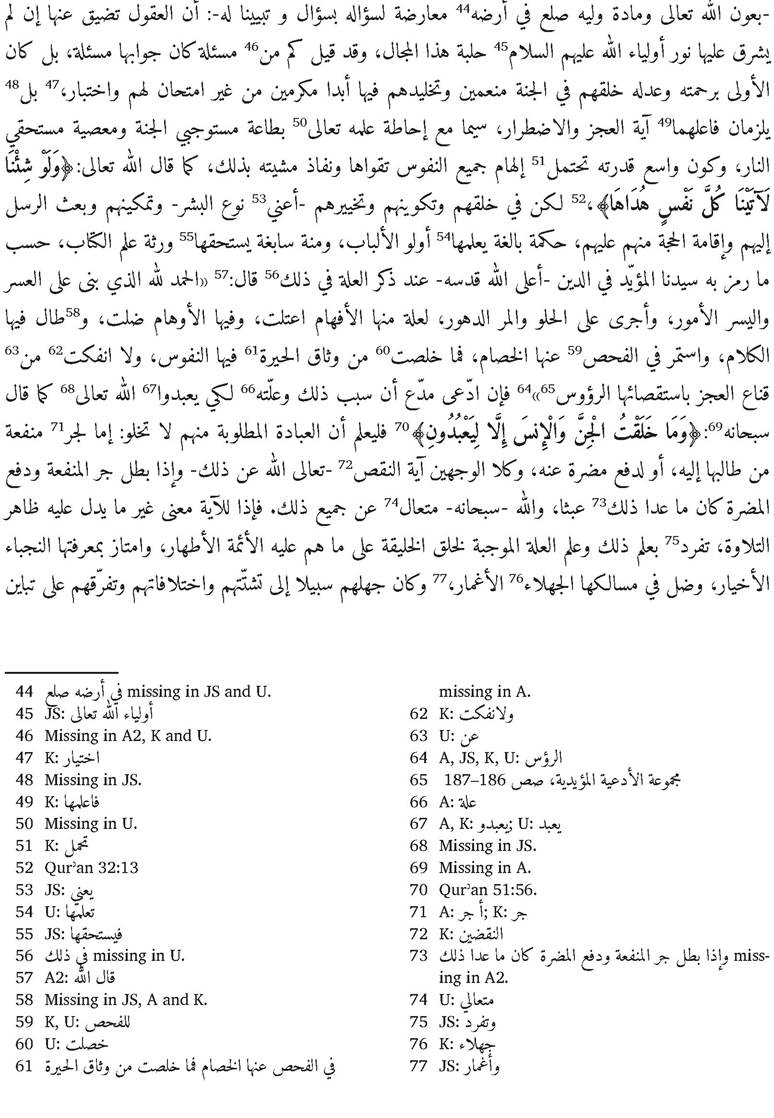
lie, the interlocutor posits, in sending many more prophets and imams (perhaps beyond that which is necessary). Rather it lies in giving equal share of understanding to each and every individual. It is more befitting to God’s justice to adopt the latter course of action, he concludes.
'Ali b. Muhammad does not engage in a detailed explanation of his position vis-à-vis this interlocutor’s objection. He rather begins by posing a counter argument justifying that ‘many times the response to a question has to be a counter-question’ (kam min mas’ala kana jawabuha massaia). It might be more befitting to God’s mercy, he counter-argues, that he granted paradise to every single soul, bestowing upon them all his blessings and honouring them all with eternity without testing them in this world at all. He then entertains a potential objection from the opponent. The opponent might argue that God’s justice and mercy demand that everyone should be gifted with equal resources, opportunities and capacities for accepting divine guidance and hence enjoying equal status in this world and the hereafter.
The author does not find such a line of argument convincing. He retreats to his previous argument by stating that if that were the case, God could have avoided creation of this world in the first place and created everyone in paradise! The problem is compounded by the fact, 'Ali b. Muhammad adds, that testing human beings runs the risk of God being perceived as incapable and incompetent of making a judgement without some sort of test - whereas his knowledge, all recognise, knows no limit: He knows who will enter paradise and whose sins will lead them to hell; his limitless power can lead everyone to the right path and his will could be executed without fail. To support his claim, the following Qur’an- ic verse is quoted: “If we had so willed, we could certainly have given every soul its guidance.”24After having presented the objections and his responses, 'Ali b. Muhammad expresses his views concerning these theological questions. Human beings are, he argues, deficient in their intellect. The broader questions of purpose of creation, institution of prophethood, purpose of revelation etc. are beyond ordinary human comprehension. The author asserts that this wisdom is only known to ‘the people of understanding’ (ulfi l-albab)25 and ‘the inheritors of the knowledge of the Book’ (warathat 'ilm al-kitab)26 - two unambiguous references to the Imams and Isma'ili da'is. To explain the limitations of ordinary human intellect, 'Ali b. Muhammad cites a passage from al-Mu’ayyad fi l-Din al-Shirazi’s Majmfi'at al-ad'iya27: “Praise be to God who designed the affairs [of this world] filled with hardship and ease and who created time engulfed in sweetness and bitterness. This complex structure is due to a reason that is not known to [our] intellect; whose understanding bewilders [our] imagination; which merits a prolonged discussion; and that upon which heretics have strived to get a grip. [It is so unfathomable that] no soul has been relieved from the bond of bewilderment and no one could hide behind the mask of incompetency and helplessness.”28
'Ali b.
Muhammad then returns to responding to another objection from an unknown respondent; this interlocutor argues that the purpose of creation is to worship God as illustrated in the verse: “I have created Jinns and men only so that they may worship Me.”29 This verse indicates, the respondent posits, that the wisdom of creation is not only comprehensible but also known to us through the Qur’an. The broader claim of the respondent is that the Qur’an could be understood without the intervention of the prophets, imams and da'is. 'Ali b. Muhammad objects to this understanding but without providing an alternative interpretation of the verse. He states that any demand of obedience is either to procure benefit (jarr manfa'a) or to avert potential harm (daf madarra) - neither of which could be conceived for God who is exalted above all limitations. One cannot argue, the author adds, that the aim of demanding worship is neither to procure benefit nor averting harm, for it might result in accusing God of engaging in a futile exercise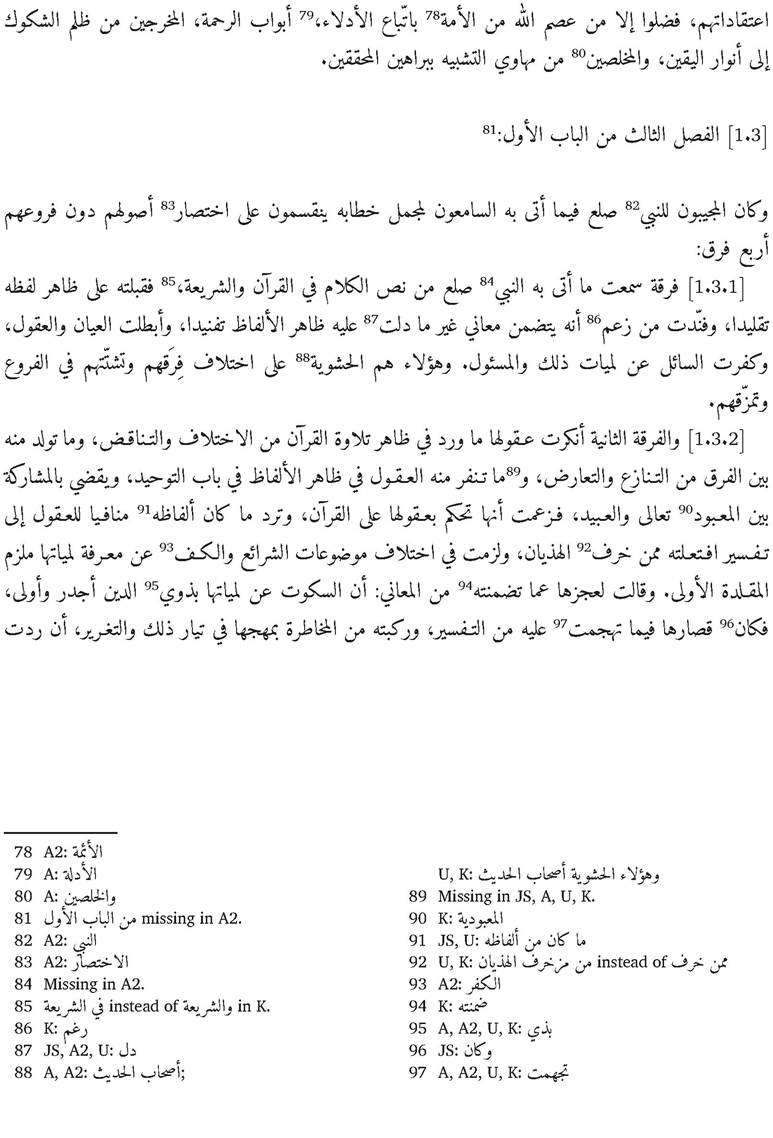
('abath) which, again, does not befit the wise God. Since God’s governance is not dictated by any selfish motives nor could he engage in a futile exercise, the verse should indicate a ‘different’ meaning than what its wordings suggest. This ‘different’ meaning, he concludes, is only understood by the pure Imams. They are the ones who possess the authentic interpretation of this verse and not the ignorant, frivolous individuals who went astray from the right path. According to the author, the misguided souls have been misled by their ignorance which has resulted in divergence, deviation and division among Muslims. He finds a solution in following the Imams whom he identifies as the “proofs”, the “gates of mercy”, “those who expel darkness of doubts and guide human beings towards the light of certainty” and “those who save believers from the pitfalls of anthropomorphism by equipping them with solid intellectual proofs”.
[1.3] Section Three
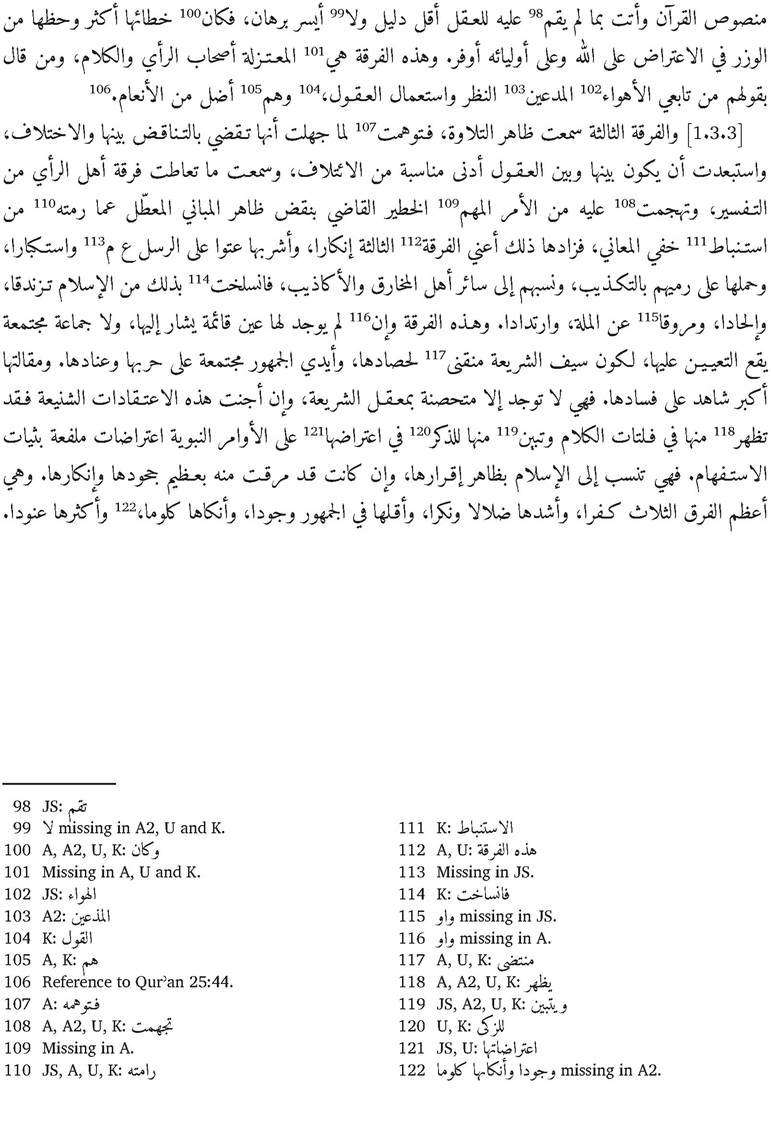
After having discussed the need for the prophetic institution (and by extension for imamate and daTship) in understanding the esoteric meanings of the scriptures, 'Ali b. Muhammad, in this section, focuses on elaborating the different approaches of interpreting a prophetic message. The author reminds the reader that these differences stem from unelaborated (mujmal) statements of the prophets. It is evident, he argues, that the unelaborated statements require ‘authentic’ explanations that can only be obtained from their ‘rightful’ representatives, i.e. the Imams (and da'is). The Muslim community is divided into sects, 'Ali b. Muhammad implies, because Muslims have failed to heed the Prophet’s appointment of the Imams. Based on the differences of their approaches and theological positions, the author divides them into four sects:
The first sect [1.3.1] consists of those who stick to the explicit meaning (nass) of the Qur’an and shari'a and accept their prima facie meanings without exercising any kind of reasoning. They vehemently reject the idea that Qur’anic verses contain layers of meaning beyond what its prima facie meaning suggests. By doing so, they discredit both their sense perceptions and intellect. They discredit sense perceptions by refusing to consider the visible textual evidence within the Qur’an and their intellect by disproving its unambiguous reasoning and judgement. They not only deny their own sense perceptions and intellect but also accuse others of disbelief due to their engagement in esoteric interpretation of the scriptures. The author identifies them as Hash- wiyyas. Though they are internally divided into several sub-groups, he adds, what binds them together is their radical literalistic approach to reading of the scriptures. Historically, the term Hashwiyya was used, as a derogatory label, by Mu'tazilites to refer to Ashab al-hadith (tradition- ists) due to their obsession with the literal interpretation of the scriptures that extended even to anthropomorphic expressions used in the Qur’an.30
The position held by the second sect [1.3.2] is at the polar opposite of the first sect. 'Ali b. Muhammad introduces them as the promoters of an extremist rationalist approach in their reading of scriptures. Their intellect, he asserts, prompts them to reject the prima facie meaning of the Qur’an, for it often leads to contradictions which, in turn, result in friction and discord among the believers. According to the author, they are particularly concerned about those verses that portray God as one possessing human characteristics. The prima facie meaning of these verses implies that certain features are shared between God and humans - an implication rejected by all doctrinal schools. 'Ali b. Muhammad does not give any example. The popular example used by the theologians concerns with the idea of visibility or invisibility of God on the Day of Judgment (i.e. the beatific vision). The verse in question is as follows: “Some faces will be resplendent on
that day (Day of Judgment) while looking toward their Lord.”31 The prima facie meaning of this verse is problematic due to its portrayal of God as possessing a body. This anthropomorphic expression, the rationalists argue, should be read in a metaphorical sense.
Given the adaptation of a synthetic approach of reason and revelation by Isma'ilis, one would expect from our author to extend his support for such rationalistic interpretation. On the contrary, he vehemently rejects it. He accuses the rationalists of excessive reliance on reasoning, so much so that they have become well-known for their altering of scriptures in favour of personal reasoning. 'Ali b. Muhammad lambasts this group whom he identifies as Mu'tazila by implying that they have taken a dangerous route by rejecting the explicit text (mansus) of the Qur’an. They profess the authority of reason which he believes is based on speculative reasoning. According to 'Ali b. Muhammad, they cannot produce the smallest indicator (aqall dalU) or slightest proof (aysar burhan) to buttress their claim. Their mistakes are manifold and they have accumulated undue burdens by entering the realm of God and his chosen ones (Imams). Our author asserts that the flagbearers of the proponents of speculative reasoning are Mu'tazilites. There are others, he adds but without disclosing their identity, who fit in the same category due to their obsession with the rationalistic approach. The author concludes that they (i.e. Mu'tazilites and other like-minded groups) are worse and misguided than the cattle.32
It should be noted, as we shall see below, that the rationalists are not critiqued for adopting metaphorical interpretations of the verses containing anthropomorphic descriptions of God, for Isma'ilis hold the same position, rather for indulging in a task (i.e. the interpretation of the divine scriptures) for which they were not authorised. This authority, according to our author, solely lies with the prophets, Imams and da'is.
The third sect [1.3.3] comprises those who see revelation and reason at polar opposites. According to them, 'Ali b. Muhammad explains, there is not the slightest harmony (adna munasaba) between them. According to the author, they have been misled by the apparent reading of the Qur’an (without seeking the authentic interpretations from the Imams). In an enterprise to reconcile between the judgment of their reason and the apparent meaning of the Qur’anic verses, 'Ali b. Muhammad explains, they attempted to attach themselves to the interpretations offered by the second group (i.e. the Mu'tazilites and their associates). This too did not satisfy their curiosity, but rather it resulted in further confusion. This is because, the author deliberates, the rationalists ignored the evident text of the Qur’an and relied on their obscure personal independent reasoning. 'Ali b. Muhammad implies that the entire enterprise has led them to denounce faith; deny revelation; refute the teachings of the prophets; and accuse them of falsehood. Consequently, they abandoned Islam and indulged in apostasy, blasphemy and heresy.
'Ali b. Muhammad appears to struggle with identifying this group with a specific title. He justifies that there are no distinct features that characterise the proponents of such views, nor have they an organised community. He then speculates that it might be due to the fear of execution, since the shari'a has strict rulings concerning apostasy, blasphemy and heresy, such that they remain in hiding.
The author then turns to critiquing, without taking the opportunity to provide the details of his arguments, what he considers to be their corrupt belief system. Though not explicitly expressed, he argues, their thoughts creep into their words when they raise objections to scriptures. According to 'Ali b. Muhammad, they put on a false appearance of their Islam and so they are more dangerous than the first two groups due to their disbelief, misguidedness, stubbornness, perversion and obstinacy.
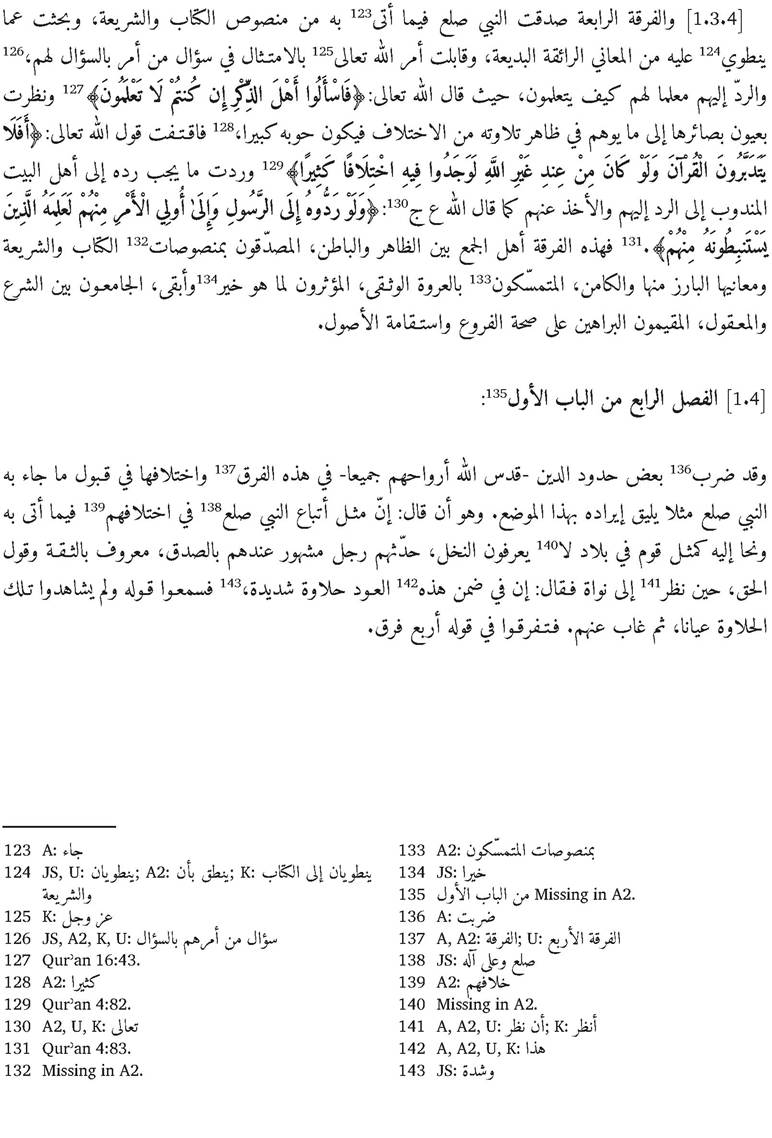
The fourth sect [1.3.4], as introduced by 'Ali b. Muhammad, has combined both esoteric (batin') and exoteric (zahir) traditions, grasped both apparent (bariz) and hidden (kamin) meanings of the Qur’an and shari'a, mastered both rational (ma'qul) and revelatory (sharc) discourses and remained firmly committed to both beliefs (usul) and practices (furO) of the religion. These characteristics, the author asserts, manifest in the ‘followers of Ahl al-bayt by which he should mean the followers of Must'ali-Tayyibi Isma'ili tradition. They submit to the religious authority of the Imams. This submission is neither blind (unlike the Hashwiyya) nor independent (unlike the Mu'tazilites) rather it is in accordance with the commands of God. In Twelver and Isma'ili Shi'i traditions two Qur’anic verse are believed to have made unambiguous reference to Ahl al- bayt: “People of Knowledge” (ahl al-dhikr)33 and “the Ones in Authority” (ulu l-amr).34 'Ali b. Muhammad invokes these two references to assert the religious authority of the “People of the House” (the Ahl al-bayt). The first verse instructs the believers to seek guidance from the “People of Knowledge”. The second verse appears to be more explicit in implying that the ultimate sources of divine guidance are the “the Ones in Authority”. The verse reads: “When news concerning peace or fear comes to them, they go about spreading it. Had they referred it to the Messenger and to “the Ones in Authority” among them, the truth of the matter would have come to the knowledge of those of them who are able to investigate.” The followers of Ahl al-bayt, the author asserts, refused to limit themselves to the superficial reading of the Qur’an that had led the other sects to contradictions and disputes. By citing the Qur’anic verse, “Do they not reflect on the Qur’an? Had it been from other than Allah, they would surely have found much discrepancy in it,”35 'Ali b. Muhammad concludes that a) Qur’an has no discrepancies and b) the apparent contradiction of the verses can be resolved by referring to the statements of the Imams.
This line of argumentation is a recurring theme in Isma'ili scholarly tradition. Al-Qadi al- Nu'man, for instance, dedicates an entire section to the differences between submission to illegitimate authorities and referral to legitimate authorities in his Ikhtilaf usul al-madhahib.36 There is an unequivocal reference, he argues, to the Imams in the verses of “the Ones in Authority” and “the People of Knowledge”. Contrary to al-Qadi al-Nu'man who not only justifies his own position but also refutes Sunni opinions that identify these phrases as reference to the authority of military commanders, rulers, religious scholars and jurists, 'Ali b. Muhammad makes no effort to elaborate them.37 This is yet another indication that suggests that the Mukhtasar al-usul is a succinct work composed for the circles of Musta'li-Tayyibi da'wa.
[1.4] Section Four
This section is perhaps the most interesting section of Chapter One. It attempts to breakdown complex ideas and theories by the means of a parable that illustrates the worldview and framework of the aforementioned four sects [1.3.1-1.3.4]. 'Ali b. Muhammad attributes this parable to a certain Isma'ili da'i (ba'd hudud al-din). It is about a community of people living in a town who had never seen a palm tree. They knew nothing about its shape, colour, fruits or leaves. Once, a reliable, trustworthy and righteous individual took the initiative of educating them about palm trees. He carried a date stone with him to the town. He gathered people around him and described the taste and texture of the fleshy fruit that engulfs the date stone. The community paid attention to what he had to say about the sweetness but could not taste the dates, since there were no palm trees in the town. After some days, the learned individual disappeared. The community split, in reference to his statements and descriptions of dates and palm trees, into four groups.
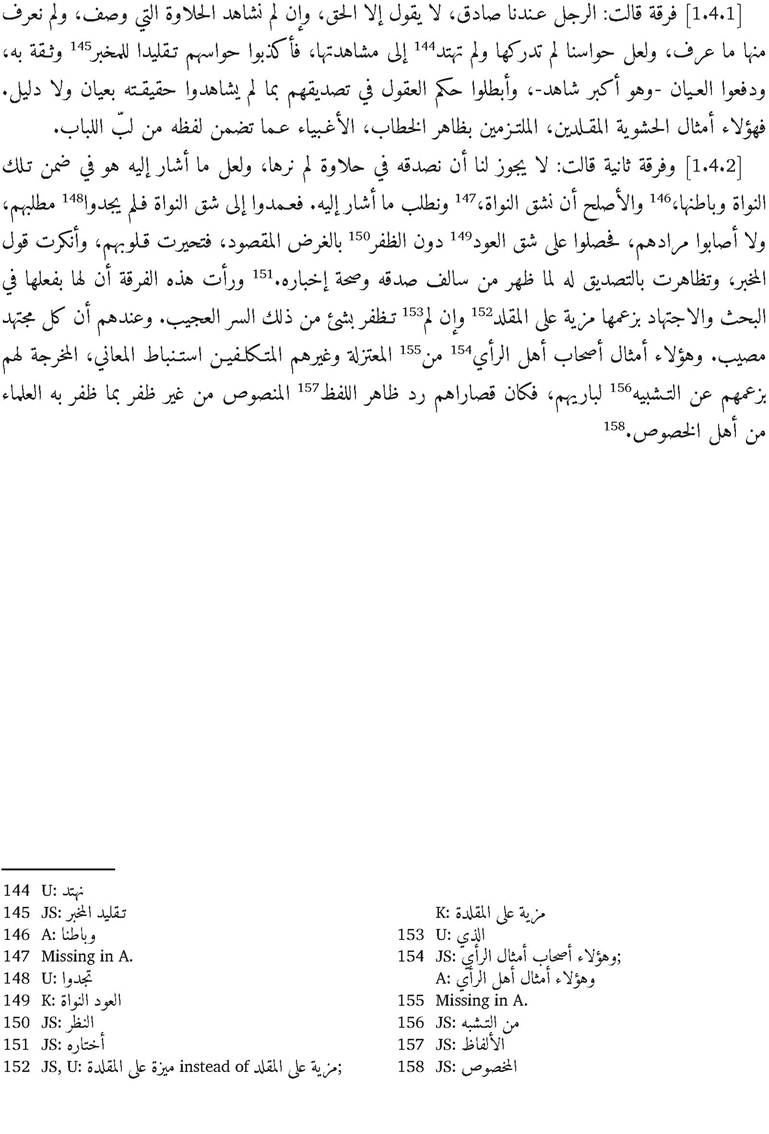
The author uses this parable to illustrate the characteristics of the four sects mentioned in Section Three [1.3]. Each of the four groups mentioned in this section corresponds to one of the sects discussed in the previous section. It is evident that the Prophet (and Imams, and then da‘is in the absence of the Prophet and Imams) are represented by the learned and reliable individual (henceforth “the messenger”) in this parable; the Muslim community is the community of the town; the palm tree corresponds to the source of the Qur’an; and the date resembles the Qur’an itself. 'Ali b. Muhammad then engages in explaining the positions of each of those four sects in light of this parable (i.e. how they reacted and responded to the message of the messenger).
The first group [1.4.1], the author introduces, acknowledged the honesty and reliability of the messenger. They displayed complete devotion to him by accepting his sayings. Despite their inability to independently verify his message, they whole-heartedly embraced it. In doing so, they ignored, 'Ali b. Muhammad implies, their own sensory perception which he calls “their best witness” (akbar shahid). Though human senses are bound by various limitations, they nonetheless play a critical role in being the first and primary means of acquiring knowledge. In our case, the first group chose to blindly follow the messenger without even seeing the things he described. They also abandoned the judgment of their intellect which dictates ‘nothing should be accepted unless one observes it or is provided with a clear evidence’. In 'Ali b. Muhammad’s schema, this group corresponds to the first sect [1.3.1 above], i.e. the Hashwiyya - the followers of sharha who commit to the apparent speech of the Qur’an but remain oblivious to its core meanings.
The second group [1.4.2] is portrayed as sceptics. They do not deem it appropriate, the author explains, to believe in something they have not observed. At the same time, they do not want to dismiss the possibility of the authenticity of the message. In order to verify the report of the messenger, they started investigating the date stone. They broke it in order to identify the source of its sweetness. This adventure resulted in breaking the date stone, on the one hand, and failing to discover the source of sweetness, on the other. According to 'Ali b. Muhammad, conducting such an experiment is tantamount to rejecting the messenger. The fact that they broke the date stone indicate their disregard for both the message and its messenger. The author is extremely suspicious about their intentions. He states that the proponents of this method might come across as accepting the message of the messenger, because of their previous encounters in which he proved to be reliable, but, in essence, they are merely paying lip service to his mission without holding any faith in it. This group, 'Ali b. Muhammad notes, claims superiority over the first group, for their attempts entail a certain level of intellectual application. Nonetheless, he adds, they too have failed to verify and comprehend the message of the messenger. 'Ali b. Muhammad then exposes their tactics for hiding their failure. They subscribe, he explains, to the doctrine of taswib which dictates every mujtahid is right (kull mujtahid musib).3S This theory of infallibilism renders a jurist immune from the consequences of his errant judgement. According to our author, the followers of this group invoke the doctrine of taswib to justify the consequences of their speculative reasoning.
This group corresponds to the second sect mentioned in Section Two [1.3.2 above]. 'Ali b. Muhammad reintroduces them here as Mu'tazilites, the partisans of personal opinions, and others who burdened themselves with interpreting verses that have anthropomorphic expressions. They attempted, he concludes, to highlight God’s absolute transcendence but ended up dismissing the explicit (al-mansus) meaning of the text without having attained the level of understanding of insightful scholars (ahl al-khusus).
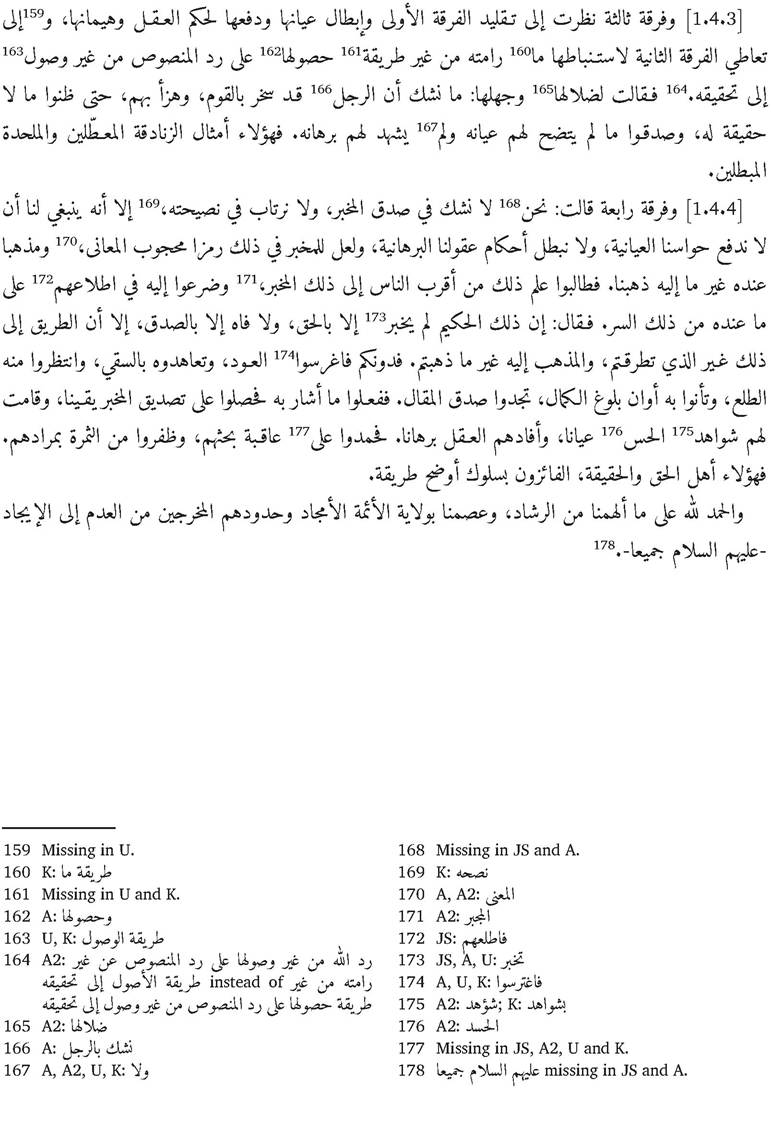
The third group [1.4.3] opposed the first group for their denial of the role of sensory perception and judgement of the intellect. They also denounced the obsession of the second group with their extra-textual interpretation of the Qur’an. The proponent of this group accuses the messenger of deceiving the community into accepting his myths and non-verifiable statements concerning dates and palm trees. The author introduces them as sceptics and heretics. The similarity between these sceptics and the followers of the third sect is that they both, contrary to the first and second groups, question the credibility of the messenger by accusing him of spreading lies and deceits.
The fourth group [1.4.4] takes, 'Ali b. Muhammad explains, a moderate approach. Unlike the third group, they do not cast doubt on the righteousness of the messenger nor on his intentions. Unlike the first group, they do not dismiss the role of their sensory perceptions, nor do they suspend the judgement of their intellect. On the contrary, they believe that the messenger must have a deep symbolic meaning beyond what the apparent meaning of his message suggests. Because the messenger has left them, they make recourse to the closest of his companions in order to seek further clarification on his statements. On the persistent requests of the community, the closest companion reveals the core message of the messenger. He relates, “the wise and learned messenger has said nothing but fact. He has uttered nothing but truth. However, the approach you have adopted to understand his message is not right. Consider planting the palm tree, making sure to water it, waiting until it blossoms and having patience until it fully develops. It is then that you will be able to verify the truth of his statements.” 'Ali b. Muhammad continues elaborating the parable by stating that the community followed the instructions of the closest companion and thus verified the truth of his message. They employed both sensory perceptions and rational faculties to attain certainty. They were appreciative of the results of their quest and enjoyed the fruit of their excursion. The author identifies them as ‘the followers of truth and truthfulness’.
'Ali b. Muhammad does not name the closest companion of the messenger, nor does he shed light on the identity of ‘the followers of truth and truthfulness’. In a Shi'i context, however, it is evident that this closest companion is meant to be 'Ali (and by extension later Imams and da'is). ‘The followers of truth and truthfulness’ should also refer to the followers of Musta'li-Tayyibi Isma'ili da'wa. Musta'li-Tayyibi Isma'ili da'wa is thus seen as the moderate path which takes both sensory perceptions and rational judgments into consideration but under the aegis of infallible Imams. The exoteric and esoteric teachings of the shari'a, in the Isma'ili worldview, must be received only from the Imams - the prerequisite of which is to subscribe to their absolute authority and to submit to their guardianship (walaya).
More on the topic Summary:
- Summary
- Summary
- Summary
- Summary
- Summary
- Summary
- Summary
- SUMMARY
- SUMMARY
- SUMMARY
- SUMMARY
- SUMMARY
- SUMMARY