One Ring, some daemons, and Jesus Christ: the non-identity (1M) of law and religion
The core methodological assumption that animates this work (one could say, taking inspiration from Tolkien’s Lord of the Rings, ‘the One to rule all its contents’) is that the Orient-Occident dialectics cannot be solved unless dealing with the couple law-religion both (a) as a culturally-oriented pair that affects the conceptual construction of our normative world and the nomos of Islam, and (b) as a topic of Orient-Occident comparative research.
If the Western representation of what-is Islam has always been affected by its own conception of law-religion, venturing to the land of Islam requires precedent awareness of how Western people practice their own affairs within their own law-religion. In fact, it is by moving from the non-identity of law-religion in the Occident and the Orient that our journey will be able to render the ‘visible’ image of the ‘aqd (reduced to a decadent Almeh in Schacht’s interpretation: 1964, p. 199) more ‘audible’ to Western observers/listeners (section 1.3.3).But how should we proceed in this direction? Are we fated to be devoured in this adventure by a Sphinx, unable to solve its riddles? Or to be intrigued by Gerome’s Almeh?
Some clues for a safe, or at least less risky, study of the Islamic contract have already been given in the Introduction. The most attentive traveller may have noted that, just before meeting Gerome’s Arab Girl, I referred to the need for a preliminary dialectical engagement with ‘what a contract is in the Western and Muslim legal traditions (as different signifying practices).’ It is this dialectical approach that allows us to investigate ‘how the interaction between law and religion in the West has represented and “codified” the ‘aqd; and why this representation does not fully shed light’ over the most distinctive qualities of the Islamic contract - certain ‘features of Muslim juristic discourse, those perhaps which are most revealing of its nature and its intentions’ (Calder, 1996, p.
979).Those hints pointed to what the ancient Greeks efficaciously summarised under the famous maxim ‘know thyself’ (gnothi seauton), inscribed in the pronaos of the Temple of Apollo in the city of Delphi. In brief, the Western explorer should, firstly, ‘know his own law-religion’ by dealing with the daemons (from the Greek daimon, ‘god-like’ entities) that dominate the Temple of Western thought, prior to investigating the meaning of the ‘aqd. We need, somehow, to take a step back from the preliminary meeting that we had with the Arab Girl at the entrance to the Oriental city. In fact, in the attempt to ‘know ourselves,’ we must radically change the starting point of our search before entering the space of Islamic revelation (Chapter 2). But worry not: we will meet again the Almeh at the beginning of Chapter 3, when we will be much more prepared to listen to her voice; she will wait patiently for us to come back.
Then, let’s assume that our journey starts from the Occident; more precisely, from a city whose inhabitants, we suppose, are mainly Christian. These people must have clear in their mind one of the most famous events in the life of Jesus: ‘And said unto them [the merchants], It is written, My house shall be called the house of prayer; but ye have made it a den of thieves’ (Matthew 21:13, King James Version). Reported in all the four canonical Gospels of the New Testament (Matthew 21:12-17; Mark 11:15-19; Luke 19:45-48; John 2:13-16), not only is The Cleansing of the Temple narrative well-known among Christian believers but it is also a common motif in Christian art. There are numerous artists - from Giotto to Scarsellino and El Greco, to name but a few - who have represented the vigorous impetus of Jesus Christ beating traders and money-changers to expel them from the Temple. Human bodies, the corpora of Christ and the merchants, are located in the same visual space, in a scene which is explicitly aimed at separating the spiritual good from the material bad: Christ casts away sinners desecrating the Temple, setting boundaries between the religious and the secular; the divine and the worldly; the sacred and the profane.
The visual power of Christ purifying the Temple by beating the merchants is a scene that may appear violent to most eyes; canonised in the Christian collective imagery, this violence becomes a warning for the observer. It is notable that the image probably has no equivalent in other religions and has certainly no counterpart in Islam: the representation of the human body, and living beings, in general, is condemned; above all, no corpus separating the religious and the secular can be found in Islamic visual art.Significantly for our reasoning, the etymology of ‘visual’ comes from the Latin visus (‘sight’) and videre (‘to see’). In the early 15th century, the term visualis pertained to the faculty of sight; at that time, a beam of light proceeding from the eye of the person to the object was believed to make vision possible. Today, in many languages derived from Latin, the ‘face’ of the person - in Italian, viso; in French, visage - continues to reflect the primacy of knowing the world by sight for the human observer.
In contrast, both the corpus and the visus are traditionally ‘foreign’ to Islamic visual art; the rare depictions of the Prophet are faceless, or the Prophet is depicted with a covered face. More precisely, to the extent to which Islamic art has reached its highest expressions through the art of calligraphy, by making visible the verbal words of the revelation, the visus, as the faculty of sight, plays a marginal role, if any, in this. It is by hearing and reciting the Word that the Message was transmitted to the Prophet, and though Him to all Muslim believers, not by looking at it, as it was in the Christian tradition, through the corpus of Jesus Christ.
Let us focus on this role of the corpus in Christian art by referring to one of the number of versions that El Greco (1541-1614) painted of Christ Cleansing the Temple. This artwork is today displayed at the National Gallery of Art, in Washington D.C. (Figure 1.1).
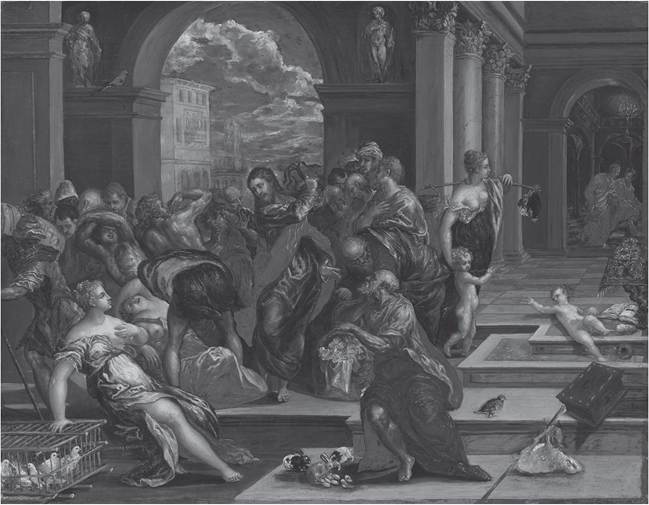
Figure 1.1 Christ Cleansing the Temple (oil on canvas by El Greco, around 1570; National Gallery of Art, Washington DC)
The website of the National Gallery highlights how in this
tempestuous scene, El Greco depicted an angry Christ...
[and] portrayed partially draped women and bare-chested men writhing and twisting to escape the blows of Christ's scourge, emphasizing the agitation of the participants and exaggerating their irreverence. The setting is one of classical grandeur, more reminiscent of an Italian Renaissance than of the sacred precincts of the Temple of Jerusalem.(NGA, 2019)
While admiring El Greco's Christ, the reader should compare this ‘classical grandeur... reminiscent of an Italian Renaissance' with the decadent atmosphere where Gerome located the Arab Girl - at the gate of her Oriental city (Figure 0.1; Introduction). The urban architectures of the two paintings may well exemplify the meaningful distance that subsists between the ‘proper body' of Western law and the ‘corrupted body' of Islamic law, where the ideal theory is corrupted by legal practice, according to Schacht's interpretation. The architecture displayed in Gerome's Arab Girl reflects a feeling of decadence just as, conversely, Jesus’s Temple transmits an idea of ‘proper order’ in a visual construction grounded on the Renaissance perspective (see later, section 1.3.3).
Furthermore, as noticed previously, the theme of the cleansing of the Temple - a visual space embedding the separation between the secular and the religious - is totally absent in Islamic visual art. This suggests that we must depart from Western law-religion - the conceptual framework underlying that separation - in order to explore the Islamic Temple of law-religion. Accordingly, the way through which we perceive our ‘body of rules’ must change for the Occident and the Orient to be put in a dialectical perspective.
With this in mind, a principle of non-identity - a conceptual category that I borrow from Roy Bhaskar: see later section 1.3.1, where the marker ‘1M,’ used in the title of this section, will find full explanation - should be embraced. This non-identity of law-religion relates, for instance, to the lack of separation between ‘secular law’ and ‘religious law’ in Islam, where the realm of fiqh al-mu‘dmaldt, the ‘jurisprudence of human interactions,’ turns out to be as lego-religious as that of fiqh al-‘ibdddt, the ‘jurisprudence of the conduct of men towards God.’ But it also implies the awareness that it is impossible to understand Islamic contract law within a conceptual Temple grounded on the dichotomy secular vs religious; Islam removes ab initio this spatial separation, and different ‘daemons’ rule trade inside the mosque.
Considering all this, how can the Islamic contract be (re-) presented to a Western audience, while Western forms of representation (the visual separation between the secular and the religious; the corpus of contract law; the primacy of the visus) are absent in Islam?
Carrying the One Ring of non-identity, between what is (re-) presentable and what is absent in the Orient, this book moves from the Christian town and its Western Temple towards the city of the ‘aqd. Its purpose is precisely to (re-) orient the reader from the signifying practices underlying Western contract law to those of Islamic law - using the ‘aqd as a medium, a vehicle of legal meaning, and a conceptual tool of discovery.
By departing from the Temple and expelling the daemons of the Western pairing of law-religion as a conceptual background, the One Ring can help us to remove some pre-assumptions in the practice of legal comparison, so as to understand how Muslim jurists and believers have practiced their trade in their own world through the ‘aqd. Accordingly, our journey will deal both with the religion of Islam (Chapter 2) and Muslim jurisprudence (Chapter 3), following an itinerary that will later contextualise the ‘aqd in the social realities of the Muslim world (Chapter 4). But, in order to carry the Ring safely, as we know from the epic of The Lord of the Rings, supportive fellowship is needed; in particular, before approaching the city of the ‘aqd, some further reflections are required about the idea of non-identity and its implications.
1.2.
More on the topic One Ring, some daemons, and Jesus Christ: the non-identity (1M) of law and religion:
- The Church of Jesus Christ of Latter-day Saints
- The One Ring of law-religion and the return to the Arab Girl (and ourselves)
- Carrying the One Ring of non-identity, Chapter 1 has endorsed The Fellowship of three great thinkers: Roy Bhaskar, Shahab Ahmed, and Marshall McLuhan. It has also subscribed to Calder’s portrayal of Islamic law as ‘a conceptual replica of social life,
- Crossing the bridge of Babel from West to East in the attempt to translate the non-identity of law-religion, we have postulated the dialectical coexistence of presence and absence, with the latter taking primacy over the former (Bhaskar, 1993, p. 5).
- Rathwa Identity and Religion
- 26 TRIBAL RELIGION AND IDENTITY POLITICS
- An absence of religion? Translating the non-identity of dm as Islamic bios
- Roman law entered medieval political reflection in the late eleventh century as the law of the universal Roman empire, an organization foretold by Old Testament prophecy as the last empire to rule the world before Apocalypse and hallowed by Christ himself who had lived under the Caesars.
- 5 MISPI, agency, identity and the reform of Islamic law in Aceh
- Last Observations on Law, Science and Religion
- “Our” Universal Peace: From Christ to Constantine
- Carrying the One Ring in the practice of trade: revelation, tradition, and reality
- Gyges' ring and the Epicurean origin of justice
- The Teachings of Jesus
- What Think Ye of Christ?