THE UMNO—ISLAMIC NGO—PAS DYNAMIC
There are many long-standing and recently formed Islamic nongovernmental organizations that share some aspects of both UMNO and PAS pro-sharia worldviews. These civil society organizations—such as ABIM (Angkatan Belia Islam Malaysia; Malaysian Islamic Youth Movement), JIM (Pertubuhan Jamaah Islah Malaysia; Malaysian Islamic Renewal Organization), the Malaysian IKRAM Organization (IKRAM),9 PUM (Persatuan Ulama Malaysia; Malaysian Ulama Association), RICOI (Research and Information Centre on Islam), MACMA (Malaysian Chinese Muslim Association), and PERMIM (Persekutuan Pertubuhan Muslim India Malaysia, Malaysian Indian Muslim Association)—engage in a wide variety of dakwah and tarbiah activities trying to enhance and spread Islamic knowledge.
Although these diverse Islamic NGOs operate with a variety of sharia models formed in their own communities of practice and sometimes in overlapping networks of activists, they are generally in support of stronger and more extensive implementation of sharia in criminal laws (including Islamic penal codes), Islamic economics, and everyday social life. However, they have a wide variety of ideas about how to arrive at the point where Malaysians would be ready for a more comprehensive operationalization of sharia laws and ethical norms. Most stress educating the Malaysian public first, Muslims and non-Muslims, about sharia and/or creating a positive ethical social environment before enacting hudud and qisas laws. These diverse organizations also promote the embodiment of sharia norms in social conduct, attire, and personal comportment. Some of them are critical of the way the Malaysian state has been moving to implement sharia economics and argue for stricter standards of sharia compliance. MACMA and PERMIM also must negotiate their Muslim identities in a society where Malay and Muslim categories are intertwined and Chinese and Indian groupings are heavily associated with non-Muslim religious identities. Furthermore, many of the Malay Muslim NGOs have not shifted away from equating Malay and Muslim identities as fully as PAS and remain committed to both Ketuanan Melayu and Ketuanan Islam. For instance, Zaid Kamaruddin, president of JIM, told me:Of course, from a principled point of view to us it is not the Ketuanan Melayu but a Muslim or Islamic system. Ours is beyond this small boundary of Malaysia, but the problem for the moment, from our point of view, is that as an umma from the world we are separated by nation-states. So the context of Ketuanan Melayu or the supremacy of the Malays is not the basis of our struggle. But they can justify it, because... according to one of the theories the Malays are the people of this area who accepted Islam. And also in the constitution it says a Malay, ideologically, it is not a racial term; Malays are defined as Muslims. So, in that case both approaches [those of UMNO and PAS] become very close, if you say that Melayu means Islam. But they [have] got to live up to it.... But we do argue technically [that] the constitution of a Malay should be Islam. So you should hold on to this correct understanding. Then there is a meeting point between what everyone says if Melayu means Islam.10
Even if they believe in the eventual transformation to an Islamic system, they still see value in having the current state led by Malay Muslims. Many members of these Islamic civil society organizations felt that the current tensions between Malaysian Muslims and non-Muslims were caused by anti-Muslim groups in Malaysia and global Christian forces unifying to attack Islam. For instance, Ustaz Zakaria, a member of ACCIN (Allied Coordinating Committee of Islamic NGOs) told me, in the aftermath of the public drama of contention discussed below, that “the IFC, or Inter-Faith Commission, was a way for non-Muslims, especially Christians, to seize power over Muslims.”11
These diverse Islamic NGOs interact with UMNO and PAS forces and sharia projects in a variety of ways.
As noted above, they often spur UMNO to attempt to move in front and lead on a number of Islamic campaigns, such as developing and regulating halal goods and services. Scholars and activists in these organizations also benefit from opportunities to fill the expanding Islamic bureaucracies and serve as government ulama and civil servants.12 They use these political and economic positions not only to advance UMNO projects but also to further their own sharia projects, as we have seen with members of Islamic NGOs playing the role of khalifah in some government-linked and -owned corporations. Many members of Islamic NGOs are also in social and organizational networks with PAS activists, participate in Islamic schools, and support the PAS-led Kelantan government programs. Some of them are recruited as members of PAS and others work together with PAS-controlled masjid and prayer hall committees giving PAS-oriented khutbah and kuliah. These civil society organizations tend to promote broad Malaysian Muslim unity and/or strengthening the global Muslim community.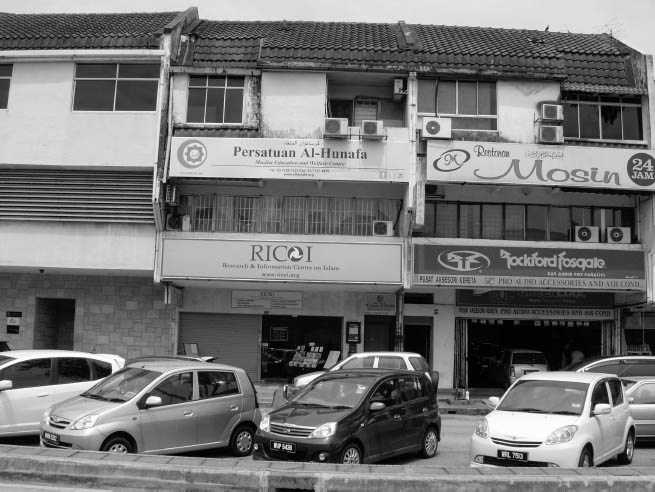
Islamic NGOs in Selangor
The collision between UMNO’s Ketuanan Melayu secular nationalist project and the PAS Ketuanan Islam extensive sharia religious project is mediated by the dakwah activism of numerous Islamic NGOs. What I would like to stress here is that these diverse Islamic NGOs play an important role in checking the UMNO-led state and PAS when they appear to be violating Islamic and/or Malay Muslim hegemony. To demonstrate this, I would like to briefly discuss two dramas of contention. The first surrounds the forming and naming of a multireligious council under the Prime Minister’s Department of the federal government. In the wake of several highly publicized and contentious conversion and child custody cases, liberal rights organizations formed an Article 11 coalition calling for religious freedom and drafted legislation for the establishment of an Inter-Faith Commission for Malaysia (ICM).13 In response, the federal government held two interreligious dialogues involving the Malaysian Consultative Council on Buddhism, Christianity, Hinduism, and Sikhism (MCCBCHS), JAKIM, and IKIM before announcing that the conditions in Malaysia did not require the “Inter-Religious Council” (Martinez 2008, 133–34).
Islamic NGOs and PAS were opposed to the call for an ICM, arguing that it was an attack on Islam and Muslim rights to practice their religion. The ACCIN coalition issued an alarmist pamphlet titled, in translation, “Islam Is Threatened: You Need to Act, Widely Distribute This Information: Abolish the IFC.” It argued that the proposal for what they labeled an “Inter-Faith Commission” was an attack on “Allah’s laws,” which must take precedence over international human rights norms created by humans: “These international norms do not differentiate between Muslims and non-Muslims. For Muslims, regulations for their lives would no longer be Islam but rather these international norms that were created by humans. Is it just hoped that Islamic teachings that contradict these international norms would be eliminated. This means that Allah would have to bow down to international norms. This destroys the religious convictions of Muslims” (ACCIN 2005, 5–6). Subsequently, opposition to an Inter-Faith Commission grew among Islamic NGOs and in the broader Muslim community. The terms “interfaith” or “interreligious” were perceived as a symbol of this organized, non-Muslim attempt, with international support, to undermine the supreme position of Islam in Malaysia. When IKIM, the Islamic think tank within the Prime Minister’s Department, restarted the process of forming a multireligious council for dialogue, one of the main issues was the name of the council. At the inaugural meeting, which I attended in 2010, the council was called the “Committee for the Promotion of Religious Understanding and Harmony” and ACCIN and the Malaysian Ulama Association were part of it. Thus, the UMNO-led state was perceived as caving in to influential non-Muslim minorities with global backing, and Islamic NGOs felt they had to check the state and bring it back to defending Islam.The second drama involves the controversy over whether the Catholic Church should be allowed to the use the word “Allah” (kalimat Allah) in its weekly publication The Herald.
The 2009 decision of the High Court that the Catholic Church had the constitutional right to use the word was met with some sporadic incidents of violence and attacks on houses of worship. The UMNO-led government filed an appeal against the High Court’s decision and mobilized corps of government- and UMNO-affiliated ulama to research and write about how kalimat Allah should only be used by Muslims. Malay rights groups and Islamic NGOs were also galvanized into action opposing the court’s decision. Many initially justified restricting Christian usage in the interest of not confusing the average Malay who may read Malay-language Catholic publications. However, PAS and PKR rejected this reasoning and publicly supported the court’s decision and the right of Christians to use the word, noting that non-Muslims have used it to refer to God in Arabic-speaking societies for a long time and continue to do so. They interpreted the drive to restrict Christian usage as an expression of Malay chauvinism. This “cosmopolitan” position, not upholding the special position of Malay Muslims, did not convince much of the Malaysian Muslim community. Most Islamic NGOs and Muslim intellectuals were persuaded by the extensive literature ulama produced arguing that kalimat Allah is uniquely connected to Tauhid (Islamic monotheism). The PAS ulama council met not long before the thirteenth general election and changed their position to be in concert with most organized groups of the Malaysian Muslim community. On October 14, 2013, the Court of Appeals unanimously ruled “against allowing the Catholic Church to use the word ‘Allah’ in its weekly publication The Herald, saying that the government did not impugn on the Church’s constitutional rights in banning the use of the word” (Malay Mail Online 2013). Thus, the swinging of Islamic NGOs in favor of the UMNO-led position checked the PAS attempt to practice its alternative, multiethnic approach and motivated them to reengage and reinterpret religious sources. This UMNO-Islamic / NGOs-PAS dynamic reinforces and reproduces the centrality and hegemony of Ketuanan Melayu and Ketuanan Islam.More on the topic THE UMNO—ISLAMIC NGO—PAS DYNAMIC:
- PAS: SHARIA ECONOMICS UNDER AN ISLAMIC STATE
- ngo J. Timm, Fabian Lorig, Ericson Holzchen and Christine Hertler
- Islamic banking emerged in Bangladesh in the mid-1980s with the establishment of the first Islamic bank in the capital city, fostering the subsequent formation of another seven full-fledged Islamic banks (IBS).[526]
- Dynamic equations
- Notions and Conditions of Controllability in a Dynamic Strategic Setting
- The dynamic of technological modernity
- Dynamic interpretation of canonical legal rules
- 3.3 DYNAMIC ENGAGEMENT
- Chapter 3 Islamic Banking and Islamic Accounting in Indonesia: History and Recent Development
- Static, Dynamic, and Traditional Sectors
- CONCEPT 10.1 Populations are dynamic entities that vary in size over time.
- Finding the Islam in Islamic art: the relationship between Islamic law and artistic practice
- A landscape is a heterogeneous area composed of a dynamic mosaic of interacting ecosystems
- Appendix 2A Literature on Transient and Dynamic Stochastic General Equilibrium (DSGE) Estimates
- Popov (1927, 1930) on Bolshevik Failure to Grasp the National Liberation Dynamic
- In view of the basic demand of Islam that Muslims should live, to the greatest possible extent, under Islamic rulers, there are many problems surrounding the survival of Muslim minorities under non- Islamic rule.
- Fluid and electrolyte composition of body is in a state of dynamic balance, regulated by various inter-related mechanisms.