Logical Pluralism
Given the centrality of logical consequence, the question immediately arises: is it possible that there are multiple specifications of the concept of logical consequence for the same language? Or when we are given a language, are we also given one, and only one, logic that goes with that language? What is at stake here is the issue of logical pluralism.
This issue could have been presented, in a somewhat more dramatic way, by asking the question: is there just one right logic, or are there many such logics? The logical monist insists that there is only one (see, e.g., Quine 1970, Priest 2006b); the logical pluralist contends that there are many (see, e.g., da Costa 1997, Bueno 2002, Beall and Restall 2006, Bueno and Shalkowski 2009). Of course, the notion of a “right logic” is not exactly transparent. But one way of making it a bit clearer is to say that the right logic is the one that provides, to borrow Stephen Read's useful phrase, “the correct description of the basis of inference” (Read 1988, 2). When we are given a logic, we are given certain inferences that are sanctioned as valid. A correct description of these inferences is one that sanctions as valid those inferences that intuitively seem to be so and does not sanction as valid those inferences that intuitively do not seem to be so. The logical pluralist insists that there are many correct descriptions of the basis of inference, whereas the monist denies that this is the case.
3.1 Logical disagreement
But is there really a disagreement between the logical monist and the logical pluralist? If the pluralist and the monist were talking about different notions of inference - in particular, different concepts of validity - there may not be any conflict between their views. Both can be perfectly right in what they assert about logic if they are not talking about the same concept.
As an illustration, suppose, for the sake of argument, that the monist has a certain conception of inference, for example, according to which the meaning of the logical constants is fixed a priori and is completely determined. On this conception, there is only one correct description of the basis of inference: the description that faithfully captures and preserves the meaning of the logical constants. Suppose, again for the sake of argument, that the pluralist understands inference in a different way: inferences are a matter of specifying certain rules that govern the behavior of the logical vocabulary, and questions of meaning do not even arise. On this understanding of inference, there is more than one correct account of the basis of inference such that any specification of the rules for the logical vocabulary will do.
In this hypothetical case, the pluralist and the monist do not seem to be talking about the same concept of validity. The monist can agree with the pluralist that given different specifications of the rules for the behavior of the “logical vocabulary,” there would be various correct accounts of the basis of inference. It is just that, on the monist's view, these rules are not really about what she takes the logical vocabulary to be, since for her the meaning of the latter is specified independently of any such rules. So, given the pluralist's rules, it becomes clear that the pluralist is not talking about the logical constants that the monist is. Thus, no disagreement emerges.
There is, however, something strange with this assessment. After all, prima facie, there does seem to be a genuine disagreement between the logical monist and the logical pluralist. One of them sees a plurality of specifications of the concept of logical consequence where the other sees none. One identifies several correct descriptions of the basis of inference; the other insists that there is only one. Moreover, they do seem to be talking about the same issue: the proper characterization of the concept of logical consequence.
To make sense of this debate as a genuine debate, both parties need to be talking about the same thing - logical consequence (or validity) - despite possible conceptual differences.3.2 Logical pluralism by cases
Recently, JC Beall and Greg Restall have offered an interesting framework in terms of which logical pluralism can be articulated, and in this framework, the debate between the pluralist and the monist becomes authentic (Beall and Restall 2006). On their view, there is only one concept of logical consequence - or validity - and both the pluralist and the monist share that concept. The disagreement between them emerges from the fact that, for the logical pluralist as opposed to the monist, the concept of validity admits different specifications, different instances, depending on the cases one considers. In fact, Beall and Restall formulate the concept of validity explicitly in terms of cases (2006, 29-31): an argument is valid if, and only if, in every case in which the premises are true, the conclusion is true as well.
But what are the cases? Cases are the particular situations in terms of which the truth of statements is assessed. For example, in classical logic, as we saw above, cases are Tarskian models. These models specify consistent and complete situations. That is, in a Tarskian model, no contradictory statement is true, and for every sentence in the language, either that sentence is true (in the model) or it is false (in the model). So, if every Tarskian model of the premises of an argument is also a Tarskian model of the argument’s conclusion, then the argument is valid. In this way, by focusing on Tarskian models, we obtain classical logic.
But if we broaden the kinds of cases we consider, we will make room for non-classical logics as well (Beall and Restall 2006). For example, if we consider inconsistent and complete situations, we allow for cases in which some contradictory statements of the form A and not-A hold. In this way, as we will see below, we obtain what are called paraconsistent logics.
If we consider consistent and incomplete situations, we allow for cases in which A or not-A may not hold, given that, at a certain stage, perhaps not every property of a given object has been specified, and thus, it is not determined whether that object has or lacks a given property.[32] In this way, we obtain what are called constructive logics. If we consider consistent, complete but non-distributive situations, we allow for cases in which conjunction (“and”) does not distribute over disjunction (“or”).[33] In this way, as we will see, we obtain what are called quantum logics.For the logical pluralist, each of this group of cases provides a perfectly acceptable specification of the concept of validity. We thus have perfectly acceptable logical consequence relations. Distinct logics then emerge. As an illustration, I will consider two examples: the cases of paraconsistent logic and of quantum logic.
3.3 Inconsistent cases and the Liar paradox
Suppose that in describing a certain situation, we stumble into inconsistency. For example, we may be trying to determine whether the following sentence is true or false:
(1) Sentence (1) is not true.
Let us assume that sentence (1) is not true. But this is precisely what is stated by the sentence. So, the latter is true. Suppose, then, that sentence (1) is true. Thus, what is stated by that sentence is the case. But what is stated is that sentence (1) is not true. So, the sentence is not true. In other words, if sentence (1) is true, then it is not true; if sentence (1) is not true, then it is true. This entails that sentence (1) is both true and not true - a contradiction. Sentence (1) is called the Liar sentence, and what we have just obtained is the Liar paradox.
How can we make sense of a situation such as this? If we use classical logic, our immediate response would be to deny that the situation described by the Liar sentence could ever arise. After all, classical logic embodies a puzzling way of dealing with inconsistency: it is trivialized by any contradiction of the form P and not-P.
That is, in classical logic, everything follows from a contradiction. Here is why:| (1) | P and not-P | Assumption. |
| (2) | P | From (1) by conjunction elimination. |
| (3) | P or Q | From (2) by disjunction introduction. |
| (4) | not-P | From (1) by conjunction elimination. |
| (5) | Q | From (3) and (4) by disjunctive syllogism. |
Given that Q is arbitrary, and that all of the inferential steps above are valid in classical logic, we conclude that, according to those logics, everything follows from a contradiction. This means that classical logic is explosive: it identifies contradiction and triviality, by allowing us to derive any sentence whatsoever from a contradiction. (This latter inference is called, rather dramatically, explosion.)
In fact, this bewildering feature of classical logic can be obtained directly from the concept of validity. As we saw, every Tarskian model of the premises of a valid argument is a Tarskian model of the argument’s conclusion. Suppose now that the premise in question is a contradiction of the form P and not-P. As we also saw, Tarskian models are consistent. So, there is no model that makes P and not-P simultaneously true. In other words, there are no models of P and not-P. Thus, there are no models of P and not-P in which the negation of the conclusion, not-Q (for an arbitrary sentence Q), is true. As a result, we conclude that (vacuously) every model of P and not-P is also a model of Q. Therefore, everything follows from a contradiction.
Given this result, it is not surprising that classical logicians avoid contradictions at all costs.
If they ever stumbled into a contradiction, such as the one expressed in the Liar sentence, they would immediately run into triviality. Thus, understandably, these logicians look for ways to block the Liar paradox.[34] The trouble is that these strategies typically involve some restriction in the expressive power of the language that is used to express the Liar sentence. For example, Tarski (1936a) introduced an influential strategy in terms of a hierarchy of formal languages, which, in turn, was grounded on the distinction between object language and meta-language. The object language is the language we are interested in studying. This language has an important limitation: it does not allow us to express claims about the truth of sentences of the object language. It is only in the metalanguage that we can formulate the concept of truth for sentences of the object language. (The meta-language, in turn, cannot express the concept of truth for its own sentences. We define the concept of truth for sentences of the meta-language in a meta-meta-language, and so on.) Since the object language does not have the resources to express the concept of truth, the Liar sentence, which depends crucially on that concept, cannot be expressed in the object language. As a result, the Liar paradox is blocked.Tarski's strategy, however, has significant costs (see Priest 2006a). In order to avoid the inconsistency that emerges from the Liar, the strategy rules out something that takes place all the time in a natural language such as English: the possibility of expressing the Liar sentence. We thus have here a trade-off between inconsistency and expressive limitation. In order to ensure the consistency of his formal languages, Tarski imposes a significant limitation on their expressive power. Moreover, Tarski's strategy also introduces a rather artificial distinction between object language and meta-language. No such distinction seems to be found in natural languages.
3.4 Inconsistent cases and paraconsistent logic
Is there a different strategy to deal with the Liar paradox? Suppose that we claim that, in the case of the Liar sentence, appearances are not deceptive after all. The argument presented above, showing that we obtain a contradiction from the Liar sentence, is valid. It does establish that the Liar sentence is both true and false. In this case, as opposed to what we would expect given classical logic, we do have a case of a true contradiction. This is precisely what the dialetheist - someone who believes in the existence of true contradictions - argues. And the Liar sentence is one of the most important examples of the creatures in whose existence the dialetheist believes (see Priest 2006a, 2006b).
Clearly, for dialetheism to get off the ground, the underlying logic cannot be classical. Otherwise, for the reasons discussed above, we would obtain a trivial system - one in which everything would be derivable. And since we cannot use a trivial system to discriminate truths from falsities, such a system is entirely useless. It is, therefore, crucial that the logic used by the dialetheist be one in which not everything follows from a contradiction. So, the argument for explosion above needs to be blocked. Luckily for the dialetheist, there are such logics, called paraconsistent logics. Minimally, a logic is paraconsistent if the inference from a contradiction to an arbitrary sentence is invalid - in other words, explosion fails.[35]
But how can explosion fail? Suppose that our paraconsistent logic admits three truth-values: true (T), false (F) and both true-and-false (T-F).[36] And consider the following truth-conditions for the logical connectives (where P and Q range over sentences):
(Neg1) “not-P” is true if, and only if, “P” is false.
(Neg2) “not-P” is false if, and only if, “P” is true.
(Dis1) “P or Q ” is true if, and only if, “P” is true or “Q” is true.
(Dis2) “P or Q” is false if, and only if, “P” is false and “Q” is false.
(Conj) “P and Q” is true if, and only if, “P” is true and “Q” is true.
(Con2) “P and Q” is false if, and only if, “P” is false or “Q” is false.
These are, of course, exactly the truth-conditions for the logical connectives of classical logic. But given that we have three truth-values, we need the two clauses for each connective. (These clauses are equivalent in classical logic, but not in Priest's paraconsistent logic LP - the Logic of Paradox.)
With these truth-conditions, it is not difficult to see how explosion is blocked. Suppose that the sentence P is both true-and-false (e.g., it is a sentence such as the Liar), and suppose that the sentence Q is false. Consider now disjunctive syllogism (the inference used in the last step of the argument for explosion discussed in the previous section):
(1) P or Q Assumption.
(2) not-P Assumption.
(3) Q From (1) and (2) by disjunctive syllogism.
Now, clearly “P or Q” is true. After all, “P”, by hypothesis, is both true-and-false - and thus, in particular, true; hence, by condition (Dis1), “P or Q” is true. Moreover, “not-P” is also true, given that “P” is both true-and-false, and hence, in particular, false; thus, by condition (Neg1), “not-P” is true. As a result, the sentences in lines (1) and (2) above are true. However, “Q ”, by hypothesis, is false. This means that disjunctive syllogism is invalid, since we moved from true premises to a false conclusion. And given that this inference is required in the derivation of explosion, we can use the same counter-example to show that the latter is invalid as well. With a paraconsistent logic, contradictions no longer entail everything. They can be tamed.
Let us now recall the concept of validity offered by the logical pluralist: in every case in which the premises are true, the conclusion is true as well. As we saw, the classical logician considers as cases consistent and complete situations (Tarskian models). The paraconsistent logician, however, countenances a broader range of cases, which now include inconsistent and complete situations, such as those invoked in the Liar sentence. When cases of this sort are invoked, some classically valid inferences, such as explosion, are violated. Paraconsistent logic then emerges.
3.5 Quantum cases and quantum logic
By broadening the range of cases, however, we have room for additional non-classical logics. Suppose that we are now reasoning about quantum phenomena. By exploring certain features of the quantum domain, we obtain a rather unexpected result. A well known principle in classical logic is the so-called distributive law, according to which:
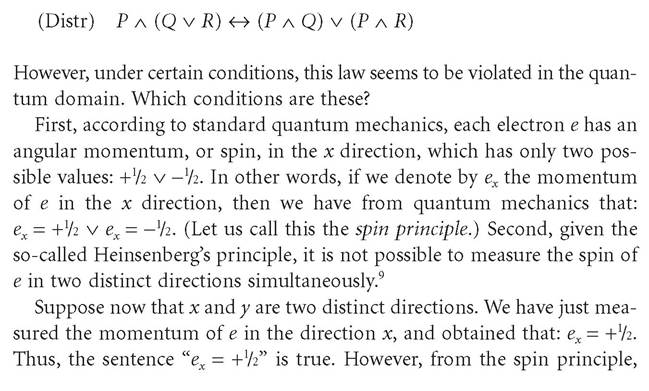
9 The measurement of the spin of an electron in one direction disturbs the spin of that electron in any other direction. Hence, we have the impossibility of measuring the spin in distinct directions at the same time.
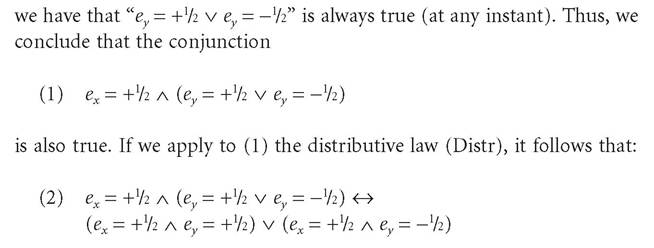
As we just saw, the left-hand side of this biconditional is true. However, given Heisenberg’s principle, it is not possible to measure simultaneously the momentum of e in two distinct directions x and y. Thus, the right-hand side of the biconditional (2) is not true. Since one side of the biconditional is true and the other false, the biconditional fails. But this biconditional is an instance of the distributive law, which therefore fails in the quantum domain. We conclude that the application of the distributive law runs into difficulties in the quantum case. This result has motivated the development of various quantum logics, which are logics in which the distributive law does not hold (see, e.g., Birkhoff and von Neumann 1936, Hughes 1989, Redei 1998).
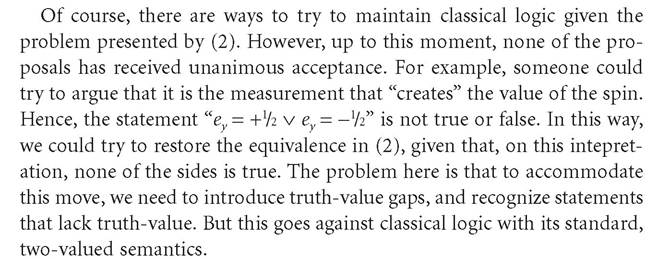
This simple example also motivates conditions in which we may revise certain logical principles on empirical grounds. This suggests that, as opposed to the way in which Tarski has articulated the model-theoretic account, we may have good reason to revise a logical principle based on empirical considerations. In fact, the a priori character of logic has been contested in some quarters for this kind of reason (see, e.g., Putnam 1968, Bueno and Colyvan 2004). The example above indicates that a particular logical principle - the distributive law - seems inadequate to reason about quantum
phenomena. After all, it leads us to infer results that violate conditions specified by quantum mechanics. As a result, Tarski's substitution requirement that was discussed above should be restricted. Depending on the domain we consider, such as the one dealing with quantum phenomena, we may conclude that certain replacements of the non-logical vocabulary are not truth-preserving, and thus are inadequate on empirical grounds. This does not mean that the substitution requirement does not hold at all. The idea is to restrict it: once a given domain is fixed, the inferences in that context are truth-preserving and do satisfy the condition of the substitution requirement. The latter simply does not hold in general.
We can now return to the concept of validity considered by the logical pluralist. What are the cases that the quantum logician entertains? Clearly, these are situations in which Heisenberg's principle and the spin principle hold. They are consistent and complete situations, in which conjunction does not distribute over disjunction. This is, of course, an unexpected result. It is formulated based on the capricious behavior of the phenomena in the quantum domain. Given that the distributive law does not seem to hold in this domain, a quantum logic can be adopted.
3.6 Pluralism about logical pluralism
Interestingly enough, there are distinct ways of understanding the logical pluralist picture. On the pluralism by cases approach just presented, there is only one concept of validity of an argument (an argument is valid if, and only if, in every case in which the premises are true, the conclusion is true as well). As we saw, what changes are the cases we consider: different cases lead to the formulation of different logics. If for classical logicians consistent and complete situations are the relevant cases, for quantum logicians, non-distributive situations need to be included, whereas para- consistent logicians emphasize the need for taking into account inconsistent situations as well.
But there is a second way of understanding logical pluralism. We can call this the pluralism by variance approach - or pluralism by domains (see, e.g., da Costa 1997, Bueno 2002, Bueno and Shalkowski 2009). On this view, there are different notions of validity, depending on the particular logical constants - that is, logical connectives and quantifiers - that are used in the specification of the concept of validity. On this understanding of logical pluralism, an argument is valid if, and only if, the conjunction of the premises and the negation of the conclusion is necessarily false.[37] If the conjunction and the negation invoked in this characterization are those from classical logic, we obtain the notion of validity from classical logic. Alternatively, if the conjunction and negation are those from paraconsistent (or quantum or some other) logic, we obtain the notion of validity from paraconsistent (or quantum or some other) logic (see Read 1988).[38]
According to the logical pluralist by variance, the debate between, for example, the classical and the paraconsistent (or quantum) logicians is a debate about what connectives need to be used in the characterization of the concept of validity. The logical monist thinks that there is only one right answer to the question about the connectives, whereas the logical pluralist thinks that there are many: different logics offer different, but also perfectly adequate, answers to this question.
Does that mean that the logical pluralist is a logical relativist? In other words, is the logical pluralist committed to the claim that all logics are equally adequate, that one is just as good as the other? Definitely not! After all, depending on the domain we consider, different logics would be appropriate - and other logics would be entirely inappropriate for such domains. As we saw above, the motivation for the development of quantum logics emerged from the inadequacy of some classically valid principles to accommodate inferences in the quantum domain. We also saw that, as opposed to paraconsistent logics, classical logic is not adequate to reason about inconsistent domains without triviality. Thus, we have here a clear emphasis on domains as the primary factor in the selection of a logic: inconsistent domains (paraconsistent logic), non-distributive domains (quantum logics), consistent and complete domains (classical logic). Hence, it is easy to see why we may call pluralism by variance pluralism by domains.
Can pluralists by domains make sense of logical disagreements? They can. What is at issue in debates about logic is the determination of the right connectives in the formulation of the concept of logical consequence. The format for that concept is the same: the impossibility of conjoining the premises and the negation of the conclusion in a valid argument. However, different instances of the concept of logical consequence emerge, depending on the connectives that are used in each particular context.
But what is the difference between cases (as used by the pluralist by cases) and domains (as invoked by the pluralist by domains)? Cases are the basic semantic structures (such as various kinds of models) that are employed to assess the truth-value of certain statements and thus to characterize various logics. Domains, in turn, are not semantic structures. They are the various kinds of things we reason about: inconsistent situations, quantum phenomena, constructive features of mathematics, and so on. These are very different things.
Not surprisingly perhaps, according to the logical pluralist by domains, logic does not have two of the traditional features that have been often associated with it. First, logic does not seem to be universal but is much more context-sensitive than is often thought. Changes in domains (e.g., from consistent to inconsistent domains, from distributive to non-distributive domains) are often associated with changes in logic (e.g., from classical to paraconsistent, from paraconsistent to quantum). Second, some of these changes in logic are motivated by empirical considerations. Again, the quantum case illustrates this situation beautifully. This suggests that logical principles need not be a priori: they can be motivated and revised on empirical grounds (see Bueno and Colyvan 2004). By not having these features, logic becomes much closer to empirical forms of inquiry, which typically are neither universal nor a priori.
These different formulations of logical pluralism highlight different ways of conceptualizing the issue of the plurality of logic. Whether we formulate the view in terms of cases or domains, logical pluralists agree that we need to make room for the plurality of logics as a crucial feature of a philosophical understanding of logic. The logical monist takes issue with this assessment, insisting that there is only one logic, which has all the elegant features that have been traditionally associated with the field (i.e., universality, formality, a priori character, and truth-preservation). Of course, the logical monist need not, but often does, identify logic with classical logic (Quine 1970 is a clear example). The challenge is then to provide an account that makes room for the perceived plurality of logics, and for the many applications of logics.
4.
More on the topic Logical Pluralism:
- Introduction
- In this essay, I explore three central issues in the philosophy of logic.
- Allhoff F.. Philosophies of the Sciences: A Guide. N.-Y.: Wiley-Blackwell,2010. — 386 p., 2010
- Bibliography
- Index
- References
- This essay provides an introduction to the philosophy of chemistry with a focus on ontological, epistemological, methodological, and ethical issues.
- Final Remarks
- A NEW DYNAMIC: RIGHTS CONSTITUTIONALISM, GLOBALIZATION AND LEGAL PLURALISM
- References