The Scientific Legitimacy of Mentalism?
1.1 The place of mental states in psychological theories and explanations
It will be useful to start the discussion of the place of mental states in psychology with an example.
Everyday experience and experimental evidence suggest that people often reason poorly about probabilistic matters. For instance, Tversky and Kahneman asked participants to read the following story:Linda is 31 years old, single, outspoken, and very bright. She majored in philosophy. As a student, she was deeply concerned with issues of discrimination and social justice, and also participated in anti-nuclear demonstrations. (1982, 92)
Participants were then asked to rank various “statements by their probabilities,” including the following three:
1. Linda is active in the feminist movement.
2. Linda is a bank teller.
3. Linda is a bank teller and is active in the feminist movement.
Remember that the conjunction axiom of probability theory states that the probability of a conjunction is always smaller than or equal to the probability of one of its conjuncts:
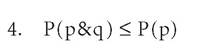
Thus, participants in Tversky and Kahneman's experiment would be mistaken to answer that it is more probable that Linda is a feminist and a bank teller than simply a bank teller. Nonetheless, 89 percent of participants judged that Linda was more likely a feminist bank teller than a bank teller, a mistake known as “the conjunction fallacy.”
Tversky and Kahneman use such mistakes to investigate the psychological mechanisms underlying (correct and incorrect) probabilistic judgments. They propose that people's probabilistic judgments result from simple psychological processes (called “heuristics”) that often lead to correct judgments,
but occasionally mislead (they are then called “biases”) - hence the name of their research program, “heuristics and biases.” Thus, according to Tversky and Kahneman, people often use a simple psychological process, called “the representativeness heuristic,” to make probability judgments.
People evaluate the probability that a is an F, according to the similarity between the description of a and the stereotype of an F. In the experiment just described, people evaluate the probability that Linda is a bank teller by comparing the description of Linda that is provided in the cover story and the stereotype of a bank teller. Because Linda is less representative of a bank teller than of a feminist bank teller, people rank (3) as more probable than (2), thereby committing the conjunction fallacy.For present purposes, what matters is that Tversky and Kahneman's account of people's probabilistic judgments is mentalistic: it involves ascribing mental states to people (viz., internal states that mediate between environmental stimuli and behavior[115]) and psychological processes (viz., processes that manipulate mental states). Consider again the representativeness heuristic. When people evaluate the probability that an individual a is an F, they retrieve a stereotype of an F (a mental state) from memory. This stereotype is compared with the information about a, a psychological process that results in a measure of how representative a is of Fs. The probability that a is an F is a monotonic function of this measure. Mentalism (viz., the appeal to mental states, psychological processes, and other psychological entities such as personality traits) is a characteristic property of the theories and explanations developed in the various subfields of psychology (e.g., social psychology, cognitive psychology, personality psychology, etc.).
Now, one might wonder whether mentalist theories are legitimate scientific theories. Mental states, psychological processes, and other psychological entities are unobservable entities, which are posited to account for behavior. Like other theoretical entities, claims to their reality should be subject to scrutiny. More importantly, mental states and psychological processes have often been associated with ontological and epistemological properties that are not scientifically correct.
Since the seventeenth century, mental states have often been associated with substance dualism - the idea that there are two substances, matter and mind. But, if mental states were distinct from physical states, it would be mysterious how they could causally interact with physical states. Furthermore, it has sometimes been argued that by introspection (the observation of one's own mental states), each of us has a privileged access to our own mental states. But, this first-person privilege seems at odds with the idea that evidence in science is public and accessible from a third-person perspective.1.2 Methodological behaviorism
In the first decades of the twentieth century, the school of psychology known as “behaviorism” or “methodological behaviorism”[116] formulated the most radical answer to the question “Can psychological entities be legitimately postulated by a scientific theory?” For behaviorists, mental states and other psychological entities had no place in psychology. Behaviorists not only contended that referring to unobservable states between environment and behavior was not required for explaining behavior, but they also argued that it was unscientific. In his influential behaviorist manifesto, John Watson, the father of behaviorism, wrote that psychology could be written without ever using “the terms consciousness, mental states, mind, content, intro- spectively verifiable, imagery, and the like.... It can be done in terms of stimulus and response, in terms of habit formation, habit integrations and the like” (1913, 166-7).
Behaviorism was a reaction against the dominant psychology of the time.[117] Much of human psychology in the second half of the nineteenth century was based on introspection. By the end of the nineteenth century, however, the nature of introspection and its value as a scientific method had become a controversial topic among introspective psychologists themselves (Caldwell 1899, Titchener 1899).
By contrast, following the lead of Edward Thorndike and Robert Yerkes, animal psychology had developed controlled and reproducible experimental designs and quantitative measuring techniques that allowed for the experimental study of numerous animal behaviors (e.g., orientation, problem solving, etc.). The disarray of introspective psychology and the successes of animal psychology paved the way for the reception of behaviorism.For Watson (1913), the rejection of mental states and other psychological entities as objects of scientific study and as scientific explanatory entities was primarily due to his rejection of introspection. In substance, Watson argues that because introspection is not a proper scientific methodology, the states to which it gives access (viz., the mental states) have no place in a scientific psychology. We will come back to this argument later.
Introspection itself was rejected on the grounds that its products were subjective and unreliable. Watson argued that far from being objective observational reports, introspective reports were influenced by psychologists’ theoretical commitments. He also noted that introspection had failed to promote any consensus among psychologists. In addition, introspection prevented the unification of psychology, since it was not used in animal psychology. Rejecting introspection could allow for the transfer of methods from animal to human psychology and for the comparison of results across disciplines.
In addition, one finds in Watson’s manifesto the following parsimony argument. Because, for Watson, (animal and human) behavior is an instinctive (i.e., inherited) or habitual (i.e., learned) reaction to measurable aspects of the environment, explaining, predicting, and manipulating behavior merely requires knowledge of the learning history of the agent and of its environment. Introspective data about mental states have no role to play for explaining, predicting, and manipulating behavior.
Although distinct behaviorist theories have been developed (e.g., by Clark Hull, B.F.
Skinner, and Edward Tolman), these theories share a common focus on the contingencies between behaviors (called “responses”) and measurable environmental conditions (called “stimuli”). Behaviorists attempted to explain why specific behaviors were produced in specific environments by looking at the history of interactions between organisms and their environment. They developed two main accounts of learning: classical conditioning and operant conditioning. Importantly, none of these accounts is mentalist: no reference is made to intervening variables between behavior and the environment.According to the theory of classical conditioning, inspired by Pavlov’s work, organisms have spontaneous responses (“unconditioned responses”) caused by environmental stimuli (“unconditioned stimuli”). When a stimulus that is not associated with any response (a “conditioned stimulus”) is repeatedly presented in association with an unconditioned stimulus, the organism ends up associating the response with the conditioned stimulus. Thus, in Pavlov's well known experiment, a sound was repeatedly played when food was presented to a dog (causing the dog to salivate) and the dog ended up salivating at the mere hearing of this sound.
The theory of operant or instrumental conditioning, developed by Thorndike and Skinner (e.g., 1938), divides behaviors into two types: responses, which are caused by identified stimuli (e.g., salivating when food is present), and operants, which are not associated with specific stimuli (e.g., pressing a lever for a rat). Focusing on operants, Skinner proposed that organisms tend to repeat operants whose strength is “reinforced.”[118] Thus, if a rat receives some food when it presses a lever, the rat will tend to press the lever again. The operant is reinforced and the strength of the operant is measured by how long the organism will press the lever at a rate higher than the base rate (i.e., the rate before reinforcement) under extinction (that is, when no reinforcer follows the operant).
While classical conditioning can explain why an organism (a human or an animal) extends a behavior that is already part of its behavioral repertoire to new contexts, operant conditioning can explain the inclusion of new, originally randomly produced behaviors in the behavioral repertoire of an organism.
Behaviorism has certainly had a lasting and, in many respects, positive influence on psychology. Modern psychology inherited its emphasis on controlled experimental procedures and quantitative, objective measures (rather than introspective reports). Classical and operant conditioning are also important properties of learning (but see Gallistel and Gibbon 2001).
Still, behaviorism was rejected in the second half of the twentieth century for four main reasons.[119] First, the explanatory scope of behaviorist theories turned out to be limited. In his influential review of Skinner's Verbal Behavior, Noam Chomsky (1959) noted that while the key notions of stimulus, reinforcer, and operant were well defined when they were applied to pigeons and rats whose behavior and environment are highly constrained by Skinnerian experimental designs (such as a Skinner box), they were poorly defined outside such a context. He concluded that when used to explain everyday (human and animal) behavior (e.g., language acquisition by children), Skinner's theoretical notions were either misapplied or a misleading paraphrase of mentalistic notions.
Second, psychologists and philosophers have come to realize that to explain people's behavioral competences, it is necessary to postulate intervening states which mediate between environment and behavior. Thus, Chomsky (1959) argued that it was impossible to explain language acquisition without considering both the environment in which learning takes place (the linguistic stimuli) and the contribution of the learner.
Third, we saw above that the rejection of mentalism was principally a consequence of the rejection of introspection. Just like behaviorists, contemporary psychologists typically deny that introspection is a valuable source of evidence about mental states and psychological processes. However, in contrast to behaviorists, they do not conclude that mental states and psychological processes are not proper explanatory entities and objects of scientific study. For contemporary psychologists, the ascription of mental states in psychological explanations is to be justified on explanatory grounds (viz., to account for behavioral competences) rather than on the basis of introspection. As a result, the unreliability and subjectivity of introspective reports do not impugn the justification of mental state ascription.
Finally, as we shall see in the next section, philosophers and psychologists developed a new characterization of mental states and psychological processes that made mentalism scientifically reputable.
1.3 The computational representational theory of mind
The limits of behaviorism show that a purely behavioral psychology is unpromising and that internal states have to be postulated to account for behavioral competences. At this juncture, it seems natural to propose that mental states are the internal states needed for a scientific psychology. This would be premature, however, for it remains to provide a scientifically satisfying account of mental states and psychological processes.
Information theory and the theory of digital computers have provided such an account (Fodor 1975, Newell and Simon 1976, Pylyshyn 1984, Marcus 2001; also, see Chapter 10 by Bechtel and Herschbach in this volume for additional detail). Mental states are thought to be representations, that is, particulars endowed with a specific content. Written or spoken sentences, maps, paintings, and road signs are representations in that sense: they represent the world as being so and so and can be thereby true or false, accurate or inaccurate. Sentences, maps, paintings, etc., have a derived content, meaning that they have a given content because people use them to represent in a given way. By contrast, mental representations have a non-derived or original content, because, on pain of regress, they cannot intentionally be used to represent. Two mental states of a given type (e.g., the beliefs that Paris is in France and that Berlin is in Germany) are distinguished by the content of their respective representations. Different types of mental states (e.g., beliefs and desires) are distinguished by their functional roles. While the belief that it is noon and the desire that it is noon are both representations that express the proposition that it is noon, they are distinguished by their functional role: beliefs and desires have different causal connections with perceptual stimuli, other mental states, and actions.
Psychological processes consist in transformations of representations. Philosophers and psychologists have proposed that these transformations are computational - hence the name “the computational representational theory of mind.” That is, in substance, these transformations are governed by rules that apply to representations in virtue of their formal properties. These rules do not apply to representations in virtue of their content, but in virtue of some non-semantic properties of the representations, in exactly the same way as numerals do not get added by pocket calculators in virtue of their meaning (the numbers they express), but in virtue of their syntactic properties (see Piccinini 2008 for complications).
The computational representational theory of mind assuages worries about the scientific legitimacy of mentalism. Digital computers show that material entities can implement computational processes manipulating representations. They also illustrate how being introspectively accessible is not an essential property of representations. Still, it is important to flag two issues raised by this theory. First, what is the relation between mental representations and brain states? Second, in virtue of what do mental representations have their content? Philosophers of mind and of psychology have extensively discussed these two issues, but for the sake of space, I will not elaborate on them in this essay (see, e.g., Fodor 1987, Stich and Warfield 1994).
2.
More on the topic The Scientific Legitimacy of Mentalism?:
- In the philosophy of probability there are two central questions we are concerned with.
- The functional aspect of the social organism