Conclusion
We started with Haslangers provocative idea that there might be forms of racial oppression with respect to which “the structures themselves, not individuals, are the problem” (Haslanger 2004: 107) and asked whether this meant that individuals acting within racist institutions are always off the hook.
The worry was that the very idea of institutional racism might force one to give up the concept of individual responsibility altogether. We have seen that it does not. Nor does the more specific idea of structural racism. Racist officers of attitude-independent E-like institutions can be held to account for their personal racism. Nonracist individuals who, owing to ideology, more or less blamelessly carry out the racist tasks of their roles in Elike institutions are still on the hook for enabling these institutions to actualize their malefic goals—for wrongdoing. Furthermore, if individual office holders of E-like institutions are not to blame for antipathy or derogation racism, it is very likely that they are to blame for indifference racism. The idea that structures are the problem, then, does not entail that individuals are altogether off the hook.Garcia is certainly right that racist individuals who apply the rules and criteria of otherwise nonracist institutions in racially discriminatory ways deserve blame for doing so. The clarity with which his account brings this out is one of its virtues. But Garcia goes too far in emphasizing individual responsibility. He proceeds from the correct normative idea that individual racists can and ought to be held to account for their racism to the dubious explanatory proposition that the ultimate explanation of racial oppression lies in the “bad attitudes” of individuals.
The main point I have tried to make in this chapter is that one can recognize the role structures play in racial oppression without letting individuals off the hook.
A secondary point is that one can recognize the moral or individual dimension of institutional racism without denying the role of structures. A tertiary point is that an adequate account of racial oppression must do justice to the way in which structures and attitudes figure in its explanation.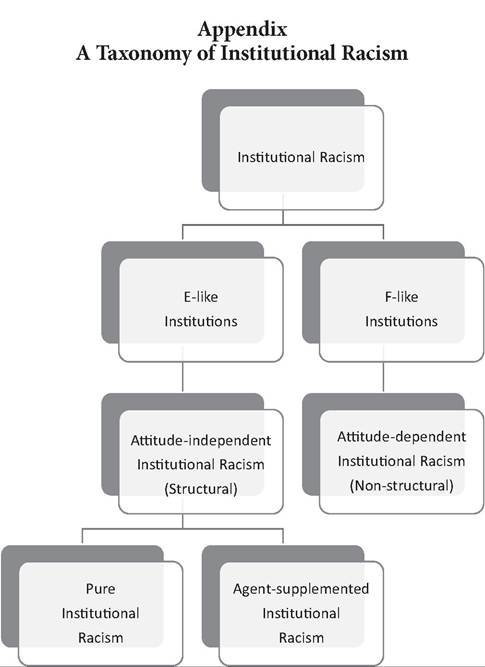
Acknowledgments
Thanks to Mary Devereaux and the editors Saba Bazargan-Forward and Deborah Perron Tollefsen for helpful comments.
Notes
1 There is no agreed-upon understanding of the terms “institutional racism,” “structural racism,” and “systematic racism.” Sometimes they are used interchangeably. Sometimes they are used to pick out different concepts. I do not propose to settle here the question concerning how these terms ought to be used generally. For the purposes of this chapter, I have chosen to take “institutional racism” as my central term, adopting a generic conception of this idea that admits of a structural and non-structural interpretation.
I take the term “institution” to refer to both particular organizations (Bellevue) and systems of organizations (the US medical system).
This conception of institutional racism satisfies Garcia's requirement that, for an institution to count as racist, its racism must originate in the racism of the agents who first produced the institution or gave it its racist form (Garcia 1996: 12). It breaks with Garcia's apparent view that for an institution to count as racist at t1, its roles must be occupied by individuals who are racist at t1. I leave open the possibility that, in an already racist context, an institution might properly be counted as racist in virtue of its negative material consequences for members of a racial group, without having been instituted or given its current form for a racist purpose. In allowing for this possibility, I follow the suggestion of Jose Jorge Mendoza.
For the notion of ideology in general see Raymond Geuss's classic The Idea of a Critical Theory.
For the idea of colorblindness as an ideology see Eduardo Bonilla-Silva's Racism without Racists and Michelle Alexander's The New Jim Crow.Everything said in this chapter about “racial groups” can be reformulated in terms of “racialized groups” or “socialraces” and consequently should be acceptable to social constructionists about race. For the notion of a “racialized group” see Lawrence Blum I’m not a Racist But.... For the notion of a “socialrace” see Michael Hardimon Rethinking Race.
For a more detailed understanding of how this operation of investing an artifact with a function or purpose works see Kirk Ludwig, From Plural to Institutional Agency: Collective Action Volume 2: 104—108. In saying that no E-like institutions' officers will be personally racist, I mean that none of them may exhibit “antipathy” or “derogation” racism, consciously or unconsciously. These forms of racism are discussed in section 35.6.
The expression “structural institutional racism” as I understand it is not pleonastic. It contrasts with “non-structural institutional racism” discussed below.
This idea is developed in section 35.6.
The obvious exception to this is Michelle Alexander (Alexander 2010: 203, 241—242).
On the notion of “false consciousness” see Geuss.
On the notion of “reactive” attitudes see PF Strawson.
The fact that institutional oppression is carried out by the agents who occupy institutional roles and the fact that, on Haslanger's view, institutions (structures) operate in agent-like ways, put pressure on her distinction between “structural oppression” and “agent oppression.” What she calls “structural oppression” appears to be agent oppression of a kind, namely a form of oppression in which the agent is an institution. It is not part of my view that institutional oppression takes place without agents who carry it out. It can thus accommodate Garcia's correct idea that “oppression is not something that merely exists or happens, but is done and is therefore done by some agents” (Garcia 2004: 39 n.2).
I am not sure that there are in fact any cases of pure institutional racism. But I think the idea is interesting and needed for theoretical completeness and making the best possible sense of the no- individual-is-to-blame thesis.
I discuss what I mean by characterizing individuals as personally racist in footnote 7 and section 35.6.
To say that individuals are blameworthy is to say that they are deserving of blame. But from the fact that an individual is deserving of blame it does not follow that it is actually appropriate to blame him. Still less does it follow that blaming agents is an effective way of combatting structural racism. It may that some individuals who are blameworthy might be better addressed in a non-blaming way. The difficult pragmatic question of how best to address individuals who are racist falls outside the scope of this chapter.
The expression “racism without racists” is perhaps most closely associated with Eduardo Bonilla-Silva, owing to his eponymous book (Bonilla-Silva 2010). Garcia suggests that the idea may be originally due to Henry Louis Gates, Jr. (Garcia 1999: 2).
I borrow the notion of racial antipathy from Lawrence Blum. The notion of racial derogation derives from his notion of racial “inferiorization” (Blum 2002).
These attitudes are of course made morally worse when they are endorsed.
Garcia has been tireless in advocating the idea that racial indifference counts as a form of racism (Garcia 1996,1999, 2004).
21 Racially indifferent individuals who are free of racial antipathy and contempt obviously do not deserve blame for racial antipathy or contempt. They do, however, deserve blame for indifference racism. Racial indifference is arguably less blameworthy than either racial antipathy or contempt but it is still morally blameworthy. Being off the hook for racial antipathy and contempt does not imply being off the hook for racism.
22 Michelle Alexander puts the point this way: “[R]acial caste systems do not require racial hostility or overt bigotry to thrive.
They need only racial indifference, as Martin Luther King Jr. warned more than forty-five years ago” (Alexander 2010: 14).23 I don't mean to suggest that Haslanger herself holds the positive view that racial oppression can be accounted for without looking at attitudes. But it is not clear that she recognizes that racial oppression cannot be accounted for without looking at attitudes. The remark she makes about wanting a “mixed approach” vis a vis what she calls “agent” and “structural” oppression suggests that she might be open to the mixed approach vis a vis structures and attitudes that I am recommending (Haslanger 2014: 107).
24 The idea of a form of institutional racism that is wholly due to the personal racism of the occupants of the institution's roles brings us to the threshold of an issue that would take us beyond the scope of the present chapter, namely, the question of the responsibilities that institutions may have. Do institutions have a responsibility to prevent their officers from behaving in a racist manner? Might a lack of institutional “will” to block racist behavior indicate the institutional analogue of individual indifference racism? Does this amount to a distinct form of institutional racism?
25 The expression “non-structural institutional oppression” is not an oxymoron. It goes with a generic conception of institutional racism that admits of both a structural and a non-structural subtype. This generic conception of institutional racism is introduced below.
26 Thus, for example, Garcia writes “My account of racism suggests a new understanding of racist behavior and its immorality. This view allows for the existence of both individual and institutional racism” (Garcia 1996: 10). Elsewhere he rebuts D'Souza's rejection of the term “institutional racism” as a “non-sense phrase,” saying “If racism is a real element in people's thinking, feelings, and behavior, there is no reason to deny it can become institutionalized” (Garcia 1999: 6).
References
Alexander, M. (2010) The New Jim Crow: Mass Incarceration in the Age of Colorblindness, New York: The New Press.
Anderson, E. (2010) The Imperative of Integration, Princeton: Princeton University Press.
Blum, L. (2002) I'm Not a Racist, But... The Moral Quandary of Race, Ithaca: Cornell University Press. Bonilla-Silva, E. (2010) Racism without Racists, 3rd ed., Plymouth: Rowman & Littlefield.
Calhoun, C. (1989) “Responsibility and Reproach,” Ethics 99, no. 2: 389-406.
Garcia, J. (1996) “Heart of Racism,” Journal of Social Philosophy, 27, no. 1: 5-45.
Garcia, J. (1999) “Philosophical Analysis and the Moral Concept of Racism,” Philosophy and Social Criticism, 25, no. 5: 1-32.
Garcia, J. (2004) “Three Sites for Racism: Social Structures,Valuing, and Vice” in (Levine, M.P and Pataki, Tamas) Racism in Mind, Ithaca:Cornell:35-55.
Geuss, R. (1981) The Idea of a Critical Theory, Cambridge: Cambridge University Press.
Glasgow, J. (2009) “Racism as Disrespect,” Ethics, 120, no. 1: 64-93.
Green, A. et al. (2013) “Implicit Bias among Physicians and its Prediction of Thrombolysis Decisions for Black and White Patients” in (LaVeist, T. and Isaac, L.) Race, Ethnicity, and Health: A Public Health Reader 2nd ed. San Francisco: Jossey-Bass.
Hardimon, M. (1994) “Role Obligations,” Journal of Philosophy, 91, no. 7: 333-363.
Hardimon, M. (2017) Rethinking Race: The Case for Deflationary Realism, Cambridge: Harvard University Press.
Hardimon, M. (2019) “Should We Narrow The Scope of ‘Racism' to Accommodate White Sensitivities?” Critical Philosophy of Race, 7 no. 2: 223-246.
Haslanger, S. (2004) “Oppressions: Racial and Other,” in (Levine, M.P. and Pataki, Tamas) Racism in Mind, Ithaca: Cornell.
Haslanger, S. (2014) “Social Structure, Narrative, and Implicit Bias” Unpublished handout.
Ludwig, K. (2017) From Plural to Institutional Agency: Collective Action Volume 2, Oxford: Oxford University Press.
Shelby, T. (2014) “Racism, Moralism, and Social Criticism” Du Bois Review 11, no.1: 57-74.
Strawson, P. (1962) “Freedom and Resentment” Proceedings of the British Academy, 48:1-25.
Williams, B. (1981) Moral Luck, Cambridge: Cambridge University Press.