Our Analytic Framework and Working Method
The articulation of the grand challenge and vision laid out above emerged from working conversations among a multidisciplinary group of economists, philosophers, political scientists, political theorists, business experts, sociologists, and legal scholars.
Atypically for such processes, we achieved significant convergence. Here it is worth saying something about our working method.The contributors to this volume all began work together with a shared conviction that political economy is a mode of intellectual analysis that distinctively aspires to unite normative commitments to empirical and positive assessments of human behavior, at both the micro and macro level, with a view to supporting the efforts of policymakers to steer a society in desirable directions. The twentieth century has offered several different frames for political economy—among them, Keynesianism and neoliberalism.
As Wendy Carlin and Sam Bowles put it,2 any given policy paradigm for political economy rests on normative foundations, attaches to those foundations an economic model, proffers some emblematic policies, and provides a vernacular vocabulary to capture them.
Our working method was similarly designed to forge linkages among normative foundations, economic models, prescriptions, and vernaculars. The goal of our conversation was to lay out what we saw as the grand challenges of political economy and justice in the twenty-first century. As we pursued that overarching question, we sought to disentangle where we were invoking values, where we were proffering empirical diagnoses, where we were beginning to identify prescriptions, and where we were pointing to institutional transformations, political pathways, or vernacular framings that would be necessary to move in the direction of the prescriptions that flowed from the conjunction of our values commitments and empirical diagnoses.
As shown in Figure I.1, we used a basic visualization to track our early conversations.Intentional use of this circle to track discussions helps make explicit all the interconnected questions in any given policy domain and provides a tool for helping a group develop answers across the different themes of values,
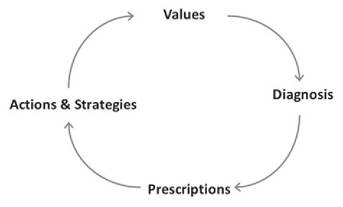
Figure I-1. The Safra Seminar Process Circle, a framework for values-based iterative policy-making.
diagnosis, prescriptions, and action strategies that align with one another. The next section of the introduction summarizes the fruits of our conversation across all four of these dimensions.
VALUES
Seven core values are especially prominent in this volume: non-domination, political equality, freedom, universal economic security, egalitarian pluralism, community, and sustainability. One of these values is negative: it picks out a feature of the social and political world we wish to avoid. The other six have both negative and positive elements: they also seek to identify prescriptive goals to guide the arguments we advance, or the institutional arrangements we propose, as we continue this project of redefining political economy.
Non-Domination
Running through the volume are several important distinctions. First, what are the possible sources of domination? We need to think of structures— including those not intentionally constructed or maintained by any individual or set of actors—as possible sources of domination. These might be exclusionary patterns or access to or ownership of social infrastructure; hierarchical organizations within the marketplace, such as firms; relations of power in markets; or forms of private property relations (to name only a few). Second, what is the relation between different forms of domination? For instance, how should we think about the relationship between monopolistic practices in markets and forms of political domination? Several contributors take the view that one inexorably produces the other and that a key principle for pursuing a just economy is an anti-monopoly principle.
Nonetheless, simple anti-monopoly cannot be an absolute value once one recognizes that markets are pervaded by power even in the absence of monopoly. Regulated monopolies or public utilities, for example, may be less susceptible to domination or exploitation than “competitive” unregulated markets; indeed, because they are monopolies they can enjoy economies of scale while public political power counteracts their market power. Also, there is a sense in which the ownership of property is intrinsically monopolistic, leading, for instance, to the inefficient allocation and use of property.Third, how high is the bar we are setting up when we seek to build our political economy on non-domination? Difference is an irreducible and even desirable feature of any society. The hard question is when and how difference becomes domination. In particular—a question for all of us to reflect on, related to the prescriptive aspect of our work—how do we design institutions that detect when difference becomes domination? And what kinds of institutions can correct for domination?3
Fourth, how should we understand the relationship between politics and economics and how does that bear on the value of non-domination (and other values)? The volume generally challenges the neoliberal commitment to the principle of “the government that governs least, governs best,” but recognizes that public shaping of the economy is itself fraught with risks of capture and leveraging of opportunities for domination. What sort of approach, then, must we take to secure the primacy of the political over the economic while yielding a just economy?
Finally, there was broad agreement that to understand domination, we should look to structures and patterns of resistance. There are a wide range of movements and groups that are themselves articulating objections to domination. They are theorizing in ‘real time' what domination means and how it can best be overcome. We might learn much about a political economy of non-domination by understanding the arguments and demands of these movements.
Several chapters in this volume tap into these insights.Political Equality
Political equality and domination are closely related. Political equality is a means for ensuring non-domination, and non-domination is also a necessary condition for a regime of political equality. Two ideas of political equality emerged in our discussion. The first was the familiar and straightforward sense of equal participation in the political processes (e.g., voting rights, party political funding). The second was somewhat subtler: equal standing in the political process or sphere. This means more than simply the effective capacity to vote. It means the ability to equally understand and leverage the political process, to have the possibility of shaping the process itself through collective action. With these two different pictures of political equality in view—one relating to formal civil and political rights, the other to a capabilities conception (cf. the work of Amartya Sen and Martha Nussbaum), we sought to address the question of what pursuit of political equality implies for political economy. Throughout the volume, contributors turn to democratic mechanisms of decision-making, including for economic decisions, as a way to ensure that a political economy reinforces rather than undermines political equality.
Freedom
Of course, freedom is closely connected both to non-domination and to political equality. Three concepts of freedom were relevant to our work: the straightforward political freedom to vote, a necessary condition for any electoral democracy; the freedom from the arbitrary power of the majority, most notably the protection of minorities, a necessary condition of a liberal democracy; and then positive freedom, which is the freedom to participate on equal terms, or “real” liberty as one participant put it. Perhaps unsurprisingly, most discussion focused on what positive freedom was and what the conditions for its effective exercise were.
While positive freedom is another way of describing political equality, the connection of the concept of freedom to markets and property brings an additional question to the fore.
What are the conditions for the exercise of effective freedom and how does this bear on political economy? For instance, what is the relationship between the ownership of property and effective freedom? Do those who own property have an unavoidable power over the freedom of those who do not? Another way of putting this might be: Is domination intrinsic to private property? What does a property regime that avoids structures of domination look like? This was a question we did not resolve and was the component of our debate on which there was the most disagreement. Nonetheless, it feeds into the next value we consider to be central to a just economy.Universal Economic Security
We do not adopt here any particular theory of justice or any particular distribution of wealth as our lodestar. But we recognize that fear of destitution— unemployment, hunger, loss of housing, illness, the loss of freedom and social standing associated with having a job and being able to sustain oneself and one's family—is among the most repressive conditions millions of people suffer at the end of the neoliberal era. Different contributors to this volume would adopt different positions on how generous this universal commitment should be, or what elements might go into a basket of the basic capabilities or needs to which there ought to be a public commitment. But regardless of the specification of the elements of economic security, discussions among the contributors evinced a shared recognition that broad-based economic insecurity is not only physically and emotionally damaging to millions but also presents a critical pathway for domination over those whose lives are precarious, reinforces tribalism that conflicts with the goal of egalitarian
10 pluralism and community, and feeds the populism that threatens political equality. For all these reasons, public commitment to and pursuit of broadbased economic security, well beyond a minimal means-tested safety net, is a necessary ingredient of a just economy and an egalitarian polity.
Egalitarian Pluralism
The ideal of egalitarian pluralism aims to ensure that people have control over their own lives, relationships, and communities. It recognizes that people value community in different ways and that they have distinct hopes and ambitions for life.
Part of the value of egalitarian pluralism is that it makes us think harder about how to pursue a just political economy. That is, it draws our attention to those who are subject to patterns of domination or injustice, to listen to their conception of community and justice, rather than impose our own. It does not assume that every well-intention proposal for action in pursuit of justice is necessarily justified by its purpose.
This implies, for instance, that we have to reevaluate other values when weighing up proposals for action—such as diversity or efficiency. We have to think about the relation between our values as we seek to enact them in the world: How should we pursue an “infrastructure of inclusion”? How should we build institutions to detect and correct for relations of domination? Egalitarian pluralism reminds us that these are not simply straightforward second-order questions whose answers follow from identifying our first-order values.
Community
The concept of community appears throughout the volume and at a number of levels: from neighborhoods, to cities, to regions, nations, and even a global community. The assumption was that each of these communities has value.
The hard question, which we say more about below, was this: At what level of community should we seek to explore and build a just political economy? On the whole, the contributors to this volume agree that the nation remains a unit of political action that was unlikely to be supplanted by others, even if it is also perfectly consistent to think about political economy at other levels of community—from the city (housing) to the globe (climate change).
But why does the nation seem an irreplaceable unit of political action to so many, including within our group? Is it simply a fact-about-the-world we
ought to reflect in our theorizing? Or is the nation a political value we hold? This is an important and unresolved question since it will guide many of the diagnostic and prescriptive aspects of the project going forward.
In particular, the hard question is: How should we think about the relationship between democracy and nationhood? In the era of modern states, does one depend on the other? This, of course, leads to further questions about borders. What are the boundaries of communities? Who gets to define them? How should we define them?
Sustainability
The climate challenge may well become the single most important challenge to human society and economy in the coming decades. No political economy developed in the early twenty-first century can be relevant if it does not commit to sustainability as a core value. While different contributors in the volume may take different perspectives regarding what sustainability requires—whether it requires or permits abandonment of growth, for instance, or requires some form of “green growth,” with or without integration into a universal jobs commitment—all these views are critically important details about which many can and do disagree. But if the past decades have taught us anything it is that the material and social environment have a carrying capacity, and no policy or politics that does not integrate a recognition and intentional pursuit of sustainability within the carrying capacity of the natural world and the social environment will lead to collapse and defeat any efforts to pursue a just economy. Note, however, that we mention not only ecological but also social sustainability and democratic sustainability, because we do not see the present crisis of democratic society as separate and distinct from decades of neoliberal policies that may have increased the wealth of various nations as a whole, but rather as a crisis of the social and democratic environment analogous to the crisis we face in the natural environment.
The seven values that defined the normative foundations of this volume do not resolve into a neat, systematic moral and political philosophy. Instead, they capture core elements of an account of well-being. Well-being, anchored in positive freedom, will depend on political equality, non-domination, and anti-monopoly efforts while sustainably delivering broad-based economic security and an experience of community in societies that simultaneously embrace pluralism and egalitarianism. Each of the chapters in this volume either lays out one of these values (the normative chapters), explores
12 emblematic policies or institutional forms that make those values concrete (the positive chapters), or makes a transit from normative to positive, linking normative foundations either to an economic model or to emblematic policies and vernacular formulations.
DIAGNOSES
If these are the values that should guide us, what are the diagnoses that we are responding to? What's gone wrong and why? In considering diagnoses, five different approaches appear in this work. Some contributors focus on macro regimes, some on dualities in domestic political economy, some on concentrations of power, some on the state, and some on uncertainty.
Macro Regimes
Following Mark Blyth, several chapters identify a shift in domestic regimes of political economy around the early to mid-1970s. The regime that emerged after the 1970s was aimed at price stability and involved impatient capital, a declining share of income to labor, and financialization. Whether our current political economy is best thought of as continuous with this regime, or whether we are, for instance, in some way in a new regime of “platform” political economy continues to be a matter of debate.
Dualities in Domestic Political Economy
A different line of attack for evaluating our current political economy focused on dualities or pairs roles that are, in some sense, in conflict with each other. These were manager versus labor, manager versus investor, and investor versus owner. All of these dualities were, in various ways, considered to be a challenge for constructing a just political economy.
These dualities prompted a number of discussion points. What kinds of dualities should we welcome as part of a just political economy? What kind of dualities should we guard against? By what criteria should we judge a particular dualism to be a threat to freedom, non-domination, or political equality? Is it simply about a balance of power, or are some dualisms of power inherently problematic?
The idea of dualisms within elites was also raised in several contexts. There was a sense that the way elites choose to divide themselves, and subsequently to highlight or attempt to make salient divisions within the broader populace, had significant consequences for political economy.
Concentrations of Power
Also captured by the dualisms laid out above is the issue of the relative power of different parties or sectors within the economy and how that balance has changed over time. Another way to analyze where we find ourselves in our current political economic moment is to focus on how labor's power has declined relative to capital and relative to managers over the last half century. The decline of power for labor has resulted in a concentration of power “in the hands of a few.” This concentration of power is at the center of our analysis.
The State
The role of the state also features prominently in this volume. Cuts to public services, the retreat of the state from various dimensions of activity, and privatization in other areas characterize our current regime of political economy. On the other hand, there are also many features of the current regime that would not be possible without a strong state—the diminishment of the power of labor, for instance. As we contemplated what the role of the state ought to be, we agreed that there should be sufficient state capacity for effective governance, but different contributors place the appropriate boundaries of state power in different places.
Uncertainty
Uncertainty is a theme that runs throughout the volume. Our diagnosis of the present conditions of political economy focused on the complexity of the problems now facing human societies—climate change, pandemics, how to organize production and protect labor in a globalized economy. The complexity of the world's economy increases the uncertainty attached to any particular process of decision-making. Consequently, we came to realize that pursuing a just political economy under present conditions must necessarily be about fair processes for managing through uncertainty and making decisions in conditions of uncertainty. The kinds of institutions required to respond to uncertainty and to enact political equality or accountability in a particular economic sphere—both may imply a certain kind of institution characterized by pragmatism. By pragmatism, here we mean an “orient-do- learn-reorient-do” cycle. One orients toward values, then chooses an action path, learning from experimentation and then taking the time to reorient before adjusting the action path.
The values we elevated to guide our work—universal well-being and economic security, positive freedom, political equality, non-domination, egalitarian pluralism, community, and sustainability—do not constitute the components of an ideal end state. Instead, they are principles to manage toward in conditions of uncertainty, and the goal of institutional design is to develop organizational forms that can steer toward these principles, iteratively over time with experimentation.
Prescriptions
But where should time and attention be spent first in developing a forward policy path for pursuit of these values with this pragmatist methodology? This volume offers a diversity of prescriptions to respond to our diagnosis about the problems stemming from concentrations of power. The authors of the different chapters have focused their own contribution to prescription in four areas: revised approaches to production; identity work; institutional design; and mechanisms of democracy.
Focus on Production
One set of prescriptions is to focus on the modes of production and interventions at that stage. Most policy interventions are focused preproduction, such as education or health care provision, or postproduction mostly in the form of economic redistribution of gains. However, we need to consider how to develop a productivist economic policy agenda that directly targets production-stage interventions. Specifically, what is produced, how is it produced, and ultimately who will be rewarded and how? Then in this vein, how does one design industrial policies that are productive and transformative socially, economically, and politically? What does the concept of political equality have to say about these production-focused policies?
Identity Work
Another approach focuses on how people's identities shape their engagement with political economy. Here the argument is that political movements and coalitions can reshape what matters to people and, in so doing, establish new goals for political economy. The argument is that if we are to succeed at installing well-being rather than growth at the center of political economy, it will require people to develop more clarity about how economic structures are shaping the lives available to them to lead.
Institutional Design and Mechanisms of Democracy
A clear prescription is a redesign of current institutions. Social infrastructure should ensure flourishing lives and allow individuals to have power over their destiny in a way currently unavailable. Some contributors have focused on the redesign of the firm, others on the redesign of democratic economic decision-making from regulation to macroeconomic policy or even on how democracies determine the boundaries of membership and therefore the parameters of labor policy. What sorts of institutions should we cultivate, what are their characteristics, and how would they be implemented? Furthermore, how would we ensure that these institutions do not reproduce the same adverse outcomes for large swaths of the population while keeping the elites permanently entrenched? There is a diversity of possible institutional forms that could be adopted as a result. How does this institutional design reflect the identity work and coalition building that appear to be critical?
action/strategy/implementation
The volume's contributors bring a diversity of action strategies to the table, to make the pivot from normative foundations and economic models to emblematic policies and a vernacular. While the full picture is not captured in this volume, some are connecting their arguments directly to policymaking, some to education and to efforts to transform the orientation of business elites, and some to social movement engagement.
Taken together, however, the pieces in the volume collectively offer a theory of change by identifying the set of blockages that stand in the way of successful iteration and experimentation guided by new principles. Conventional metrics of GDP and quarterly earnings routinely reproduce an economy steering in one direction only. Politics organized around siloed identities (race, class, party, geography, etc.) rather than intersectional identities traps people in forms of the economy as we know it. The structure of the labor market is badly entangled in global politics around migration. Bureaucratic and technocratic autopilot blocks creative institutional design and policy development. And a failure of policymakers to revisit first principles leads to continued use of old policy paradigms that no longer fit contemporary realities. The coronavirus pandemic has knocked many of these blockages out of the way. In that regard, it is an opportune moment for energetic forward movement in the direction of a more just political economy.
More on the topic Our Analytic Framework and Working Method:
- Building a GoodJobs Economy
- THE ANALYTIC AND SYNTHETIC POWERS
- LOOKING OUTSIDE THE PM STANDARDS WORLD: THE LOGICAL FRAMEWORK APPROACH
- PROPOSING A COMPREHENSIVE INVESTMENT ANALYSIS METHOD
- The STEHD framework
- Salient Features of the Legal Framework for the BPO
- Contributors
- DATA AND METHODOLOGY
- Antimilitarism and Working for Peace in the 1920s and 1930s
- Gender Working Group