Aural Hematoma
Aural hematomas can form within (intrachondrally) or along (subparachondrally) the cartilage of the pinna. They are considered more common in pendulous-eared breeds, but any dog or cat can be affected.
There is no sex predilection, but affected dogs are usually middle-aged or older.Clinically, aural hematomas result in large fluctuant swellings of various sizes, but usually they affect most of the ear pinna above the anthelix. During the first days, the swelling is warm to hot to the touch, and the overlying skin is erythematous. The animal is greatly bothered by the increased weight of the ear and sometimes seems
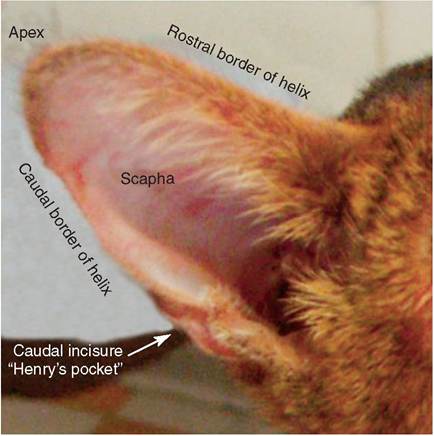
Figure 12-1
Right pinna of a cat, concave surface.
to experience pain. Aspiration fluid obtained within hours of hematoma formation is sero-hemorrhagic and usually rich in fibrin. The presence of fibrin can prevent aspiration of any fluid later in the disease. The normal evolution of a hematoma is resorption of the fluid and healing. Fibrosis is always a major feature of the aural hematoma healing process, especially if left untreated. The pinna becomes thick, hard, and permanently distorted as the fibrosis in the wound contracts. Because aural hematoma is rarely seen in dogs and cats with major trauma to their pinna, minor ear trauma and/or pruritus is more likely a precipitating factor than a primary cause. Most studies reveal the following:1
• Trauma seems a precipitating factor rather than an underlying factor in aural hematoma.
• Aural hematoma is an uncommon finding in chronic skin diseases.
• Many dogs affected with aural hematoma do not have signs of any concurrent auricular, cutaneous, or systemic disease.
In one study, results were in favor of an autoimmune cause.2 Joyce and Day could not confirm these results, even though they did find histopathologic evidence of cartilage degeneration associated with fibrovascular granulation tissue filling the cartilage defect.1 They presumed that their samples (incisional biopsies of affected pinna) reflected the end process of cartilage degeneration that might have been caused by the mediators released by macrophages earlier in the process. These considerations are in favor of a process, most probably immune-mediated, that began several weeks before the aural hematoma was observed by the owner.
Diagnosis of aural hematoma is usually straightforward and is based on history, clinical presentation, and fluid collection. Because the disease is self-limiting and heals spontaneously, some owners may choose not to treat their animal. Nevertheless, the hematoma greatly bothers the animal. Cosmetic considerations are also in favor of surgical treatment.Several surgical techniques have been described. Fluid drainage (aspiration, indwelling drain, partial or whole-length incision) and flushing are effective in relieving the animal but usually result in post-treatment deformity of the ear pinna. Griffin found that surgical procedures aiming at prevention of immediate relapse by compression (without necrosis) and at restoration of the pinna’s initial shape and carriage are the most cosmetically effective and have the least recurrences.3 This can be achieved by several techniques. The most commonly used are multiple mattress sutures placed after incision or multiple punch holes made through the skin (see Chapter 19). Mattress sutures may also be placed through a soft but rigid device (several types are marketed that usually contain foam).
Because the healing of aural hematomas is highly fibrotic, glucosteroids are flushed into the hematoma cavity. They are also given orally with antibiotics, at least until the sutures are removed and the incision has healed.2 Even though trauma is probably only a precipitating factor, it should be avoided as much as possible to prevent relapses. It is mandatory to identify and correct the cause. Otitis externa and pinnal skin diseases are most commonly encountered (Figure 12-2).6
More on the topic Aural Hematoma:
- Laser Polypectomy (Aural Tumor Removal)
- Intracerebral, Subarachnoid Hemorrhages and Subdural Hematoma
- Most skin diseases may affect the pinna in dogs and cats, but other parts of the body can also be involved.
- SKIN
- Acute Spinal Cord Dysfunction
- Content
- Boon Andrew. The Ethics and Conduct of Lawyers in England and Wales. Hart Publishing,1999. — 808 p., 1999
- Griffiths-Baker Janine. Serving Two Masters: Conflicts of Interest in the Modern Law Firm. Hart Publishing,2002. — 227 p., 2002
- Grisso T.. Evaluating Competencies: Forensic Assessments and Instruments. 2nd edition. — Springer,2002. — 564 p., 2002
- Luban David. Legal Ethics and Human Dignity. Cambridge University Press,2007. — 350 p., 2007
- Ayupova Z.K.. Theory of state and law: textbook. - Almaty: Kazakh University,2015. - 192 pages., 2015
- Allen Danielle, Benkler Yochai et al. (eds.). A Political Economy of Justice. The University of Chicago Press,2022. — 416 p., 2022
- Barnes Rudolph C.. Military Legitimacy: Might and Right in the New Millennium.Frank Cass,1996. — 198 p., 1996