A Brief History of Cattle Movements in Africa
Animal population movements are known to be important in the spread of infectious diseases (Fevre et al. 2006). Disease dynamics are a function of host-population characteristics and dynamics, and within this context, pathogens are “hitchhikers” on these waves of activities and events that occur in animal populations (Muwonge et al.
2016). Animal population movements are known to be important in the spread of infectious diseases (Fevre et al. 2006). It is therefore critical to analyze the drivers, numbers, direction of movement, and associated disease risks over time in relation to changing environmental factors.8.2.1 Ancient Cattle Movements
Archaeological findings from the neolithic time indicate that hunter-gatherers in the Nilo-Saharan communities that occupied the dry grasslands of Northern Africa about 6000 years ago also started practicing agriculture. The Mande and Omotic people, a century later, also domesticated a number of species such as cattle, chickens, dogs, sheep, goats, and camels (Clark and Brandt 1984; Diamond 1999; Christopher
2002).
The earliest eastern and western ethnic migration of the Bantu in Africa started about 4000 years ago. This migration saw them leave their homeland in Western Africa, from where they moved through Central Africa to Eastern Africa and then
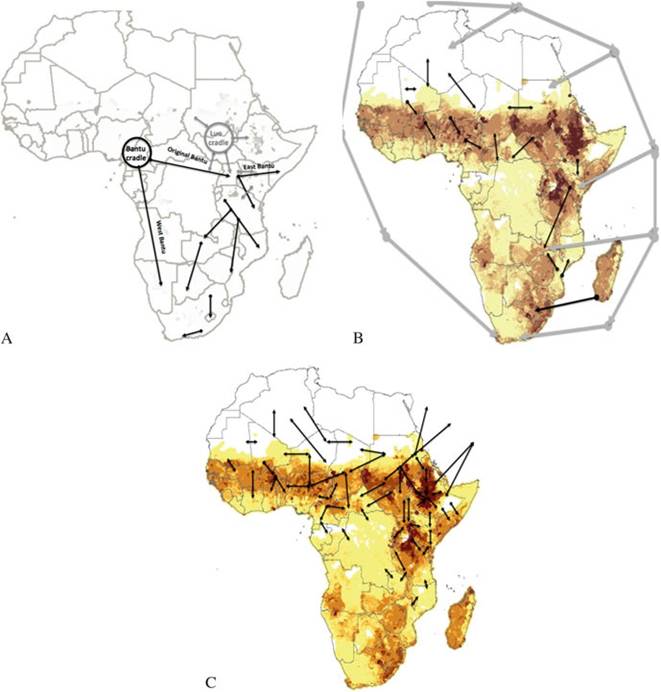
Fig. 8.1 Precolonial and ancient animal movements. Map a shows the great Bantu and Luo migration with their livestock from their homeland in Southern Cameroon and Sudan (~2000-1000 BC), respectively. Maps b and c represent the livestock movement in the colonial and postcolonial era. The thick gray arrows in b show the routes of exotic cattle breed introduction. The color gradient represents the cattle population density reflected in Fig. 8.3
into Southern Africa (Adler et al.
2007). Since this great migration occurred after the domestication of animals, it is reasonable to assume that they took their livestock with them. This notion was supported by language cognates associated with livestock in the eastern and southern Bantu, which suggest that they had livestock in their settlements following migration (Fig. 8.1) (Barbieri et al. 2014; Castri et al.2009).
The Bantu was not the only ethnic group in Africa that migrated as, a century later, the cattle-keeping Luo ethnic group started their migration from Southern Sudan into Uganda in the south, westward to the Congo, and eastward into Ethiopia and Kenya (Fig. 8.1) (Clark and Brandt 1984). This phase in the history of humanity (human settlement, livestock domestication, and agricultural development) is reported to have led to a surge in zoonotic and crowd-related diseases (Perry et al.
2011).
The Greeks and Romans, during the classical antiquity era, exerted the earliest foreign influence on the continent when they entered the Mediterranean North African region. The Arabs later followed them during the seventh century and extended their occupation to Madagascar (Boardman 1965). At that time, the European presence was limited to inhabited islands like the Cape Verde Islands (Khapoya 2012), and they only ventured into the interior of the continent during the nineteenth century. Prior to the arrival of the Europeans, most African societies were organized into Kingdoms or Chiefdoms in which agriculture and animal husbandry provided an integral part of household income, and cattle were used as payment for dowry (Goody 1976; Olson 1996).
8.2.2 Introduction of Exotic Cattle Breeds into Africa
The arrival of the Europeans in Africa initiated the second wave of animal movement across the continent (Fig. 8.1). This event linked the livestock of inland Africa to those of the European cattle-breeding societies that at the time were developing new breeds of cattle (Maki-Tanila et al. 2010).
Some of the African countries, such as South Africa, established breeding societies by 1910 that served as “conduits” through which exotic genetic material was introduced into Africa. In addition to developing local breeds such as the Afrikaner and Bonsmara, these societies also imported exotic breeding bulls of breeds such as the Limousin, Charolais, Angus, Guernsey, Hereford, and Brahman from France, the United Kingdom, and the United States (Afrikaner 2009; Stackyard 2009). The importation of bulls and heifers continues to date with the most prominent being the recent importation of Romagnola bulls into South Africa from Italy (Armando 1995). This influx of European cattle breeds was not limited to South Africa, but they were also imported into Kenya, Zambia, Uganda, and Zimbabwe, the animals mostly originating from the United Kingdom and France (Taneja 1999; Hansard and Harrison 1958; Bothar2008). African breeds such as the Boran from East Africa were also brought to Southern Africa for breeding purposes (Fratkin 2001; Esther 2012).
8.2.3 Commercial Cattle Markets
Colonial times also saw the growth and establishment of commercial markets for cattle and their products. In South Africa, thousands of animals were herded from Pondoland to be sold in Pietermaritzburg, driven by the emerging hides industry in the 1860s (Bienart 1989). This was also the time when rinderpest was decimating cattle populations on the continent. In East Africa, up to 95% of the cattle population was lost and led to the great Ethiopian famine at the end of the century (African Union 2010; Tambi et al. 1999). This population bottleneck not only changed the structure of the cattle population on a continental level but also opened up new cattle trade routes in a bid to continue satisfying the needs of the hides industry (Anon 1858; McKenna 2011). The outbreak of rinderpest in Southern Africa later led to the importation of animals into the then Natal Province in South Africa from Madagascar.
These new introductions likely also occurred in the rest of Africa where the need for cattle products both at subsistence and commercial levels caused an influx of local cattle breeds into new territories in a bid to replace the lost cattle. Epidemics of other diseases in livestock, whether caused by introduced conditions such as CBPP (contagious bovine pleuropneumonia), or indigenous pathogens such as anthrax caused by Bacillus anthracis, and the tsetse fly-transmitted protozoa further contributed to the bottleneck in the growing African cattle population (Zeleza 1993).8.2.4 Transhumant Cattle Movements
Natural seasonal changes in Africa cause the cyclical transhumant movement of people and their animals in search of pastures and water (Fig. 8.1). These activities predated the colonial era and still exist to date. For example, the Sahel-West African transhumant movement constitutes a giant carousel in which cattle move from as far west as Mali to Cameroon and the Central African Republic (Cour 2001; SWAC
2007). Although the existence of this carousel predates the colonial era, it is reasonable to assume that the colonial boundaries that were established had an influence on the volume, direction, and duration of these human and animal movements (Huillery 2009). Similarly, in Eastern Africa, cattle movements are linked to the movement of pastoral ethnic groups in the Turkana, Karamoja, and Borana regions, respectively, of Kenya, Uganda, and Ethiopia (Fig. 8.1) (Fratkin 2001; Homewood et al. 2012). These, too, predate the colonial era, but their movement has been greatly reduced by the current human population explosion and urbanization.
More on the topic A Brief History of Cattle Movements in Africa:
- BTB Control in Cattle in South Africa
- The striking display of power in the ‘scramble for Africa’ and the ‘scramble for Asia’ remains one of the most unusual chapters in world history.
- The years around 1850 represented a watershed in American religious history, for they marked the onset of a series of waves of immigration from Asia, Africa, Latin America, Europe, and the Middle East
- The Size and Distribution of the Movements
- 8.3 Bovine Tuberculosis in African Cattle Populations
- Introduction: Prevalence of Paratuberculosis in Cattle
- Cattle Movement Networks in Uganda
- Vaughn Marc M.. The History of Ukraine and Russia: The Tangled History That Led to Crisis. History Demystified,2022. — 164 p., 2022
- Bovine Tuberculosis (BTB) in Cattle in Zambia
- Evidence for Disease Susceptibility Differences in Cattle
- Africa, West Africa
- What are the Causes of these Movements?
- Prevalence of BTB in Cattle Herds in Nigeria