GENERAL INTRODUCTION
The Phylum Arthropoda includes the insects (Class Insecta), spiders, scorpions, mites and ticks (Class Arachnida), centipedes and millipedes (Class Myriapoda), and crabs, shrimp, lobsters, pill bugs, and so on (Class Crustacea); this chapter focuses mainly on the parasitic insects, mites, and ticks that cause diseases of terrestrial vertebrates, and the field of medical (or veterinary) entomology includes the study of these organisms.
Although all wild animals are considered wildlife in the broad sense, this chapter covers only the diseases of terrestrial vertebrates; that is, we specifically address those diseases caused by arthropods and not the diseases of wild arthropods. It is important to remember that arthropods comprise most of the biodiversity on Earth, and they affect wildlife (and humans for that matter) through a myriad of direct and indirect relationships. Although our focus is on disease, many species are essential to the relative stability of the planet's ecosystems and only a small percentage of arthropods directly cause problems for vertebrates (Gullan and Cranston 2005, Capinera 2010).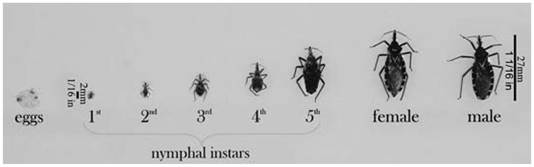
FIGURE 5.1 Life cycles of insects with hemimetabolous (incomplete) metamorphosis involve eggs, a number of nymphal stages, and sexual adults; the stages of triatomine bugs that transmit Chagas disease in the Americas are shown as an example (Courtesy of Centers for Disease Control and Prevention's Division of Parasitic Diseases and Malaria, www.dpd.cdc.gov/dpdx).
More on the topic GENERAL INTRODUCTION:
- General Introduction
- General Introduction: Violence in World History
- General
- GENERAL PRINCIPLES OF MANAGEMENT
- SECTION C THE COSSACK GENERAL ASSEMBLY
- The General and the Woman Pharaoh
- General surveys and sources
- 1 Relevance of the General Law
- General surveys
- GENERAL CONSIDERATIONS
- General Care of the Hospitalized Patient
- 1 The General Development Order (‘GDO’)
- The general concept of structure