Generation of a nerve impulse
Nerve impulses transmitted along axons and dendrites can be considered to be electrical phenomena. An impulse changes the electrical charge of the neuron by altering the relationship between the negative charge of the cell contents and the positive charge of the cell membrane.
This results from a change in the permeability of the cell membrane to sodium and potassium ions, causing an exchange of ions between the inside and the outside of the neuron (Fig. 5.41.For a short time after the impulse has passed, the nerve Iibre becomes refractive, i.c. it cannot be reactivated by another impulse until the permeability of the cell membrane returns to normal. This ensures that the Ilow of impulses travels only in one direction.
A nerve impulse is an all-or-nothing phenomenon - the nerve is either stimulated or it is not: there is no gradation of impulse. A particular neuron will always transmit with the same power or the same speed. The different effects of the nervous system depend on:
The IiiiinlHT of nerve impulses transmitted per second - a weak stimulus produces few impulses at long intervals, while a strong stimulus produces rapid impulses at shorter intervals
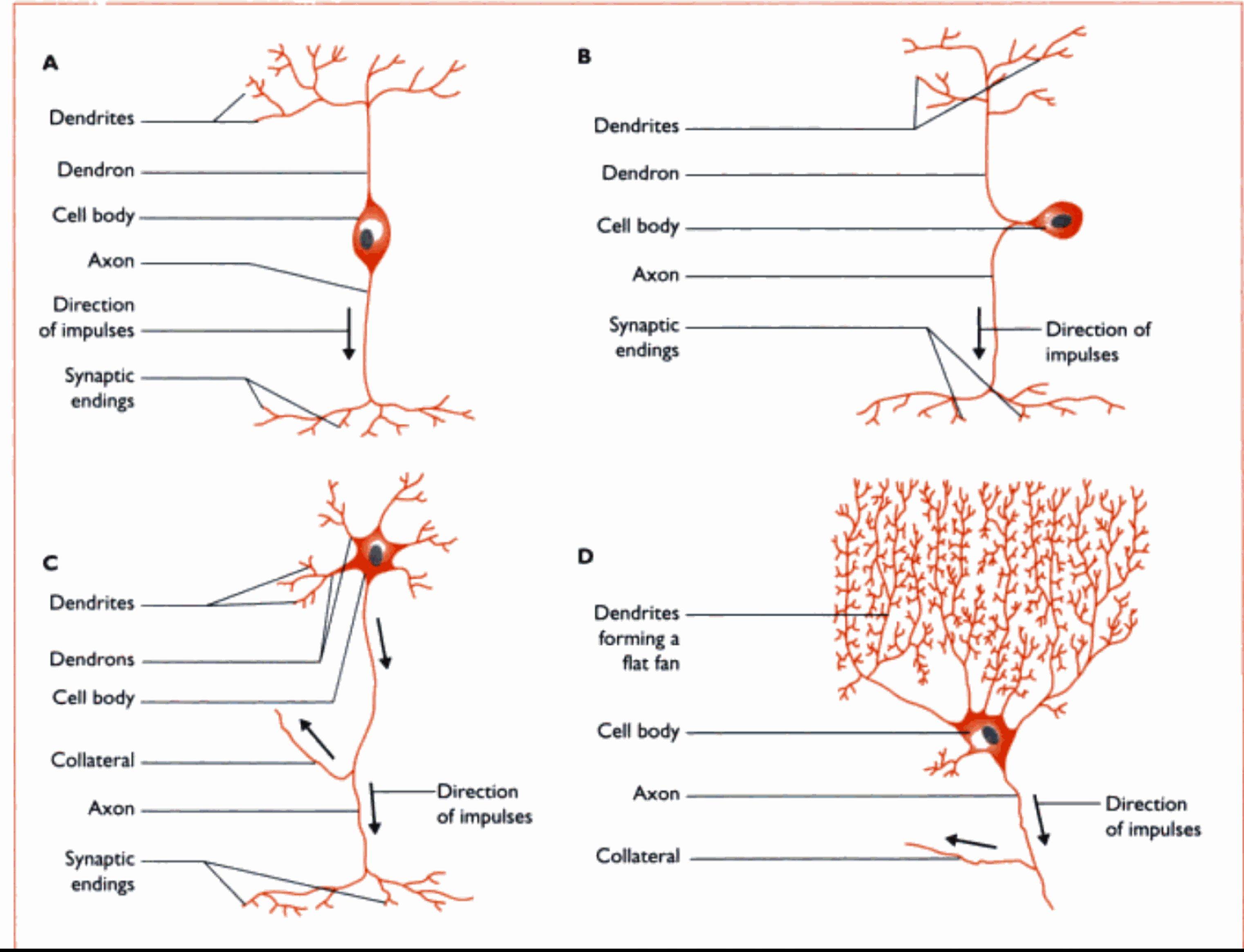
Fig. 5.2 The variation n shape of neurons, A Bipolar neuron B Pseudounipolar neuron, e g. a sensory neuron C Multipoiar neuron, eg, a motor neuron. D Multipoldr neuron, e g, Plirkinje cell from the cerebellum of the bran.

Fig. 5.3 The structure of a synapse.
The Iiurtibrr of neurons activated by a single stimulus - a strong stimulus produces activity in a large number of neurons and vice versa The type of neuron stimulated - some have an excitatory effect while others have an inhibitory effect.