Livestock Resources and Husbandry
In Africa, Ethiopia has the largest number of livestock, comprising 52.1 million cattle, 24.2 million sheep, 22.6 million goats, and about 1.0 million camels (Fig. 14.1) (CSA 2012).
These numbers are expected to increase substantially during the course of the next 10 years (Leta and Mesele 2014). This creates a major problem since the parallel increase in the numbers of the human population will put more pressure on the available grazing and arable lands, thus further limiting its availability and the ability of farmers to sustain their livestock.Livestock are unevenly distributed throughout the country, and there are also regional variations in the distribution of the various livestock species. Larger livestock concentrations (per km2) occur in the central and northern highland regions because of its more favorable climatic and ecological characteristics (Fig. 14.2). Depending on the form of land use, its geographic location and features,
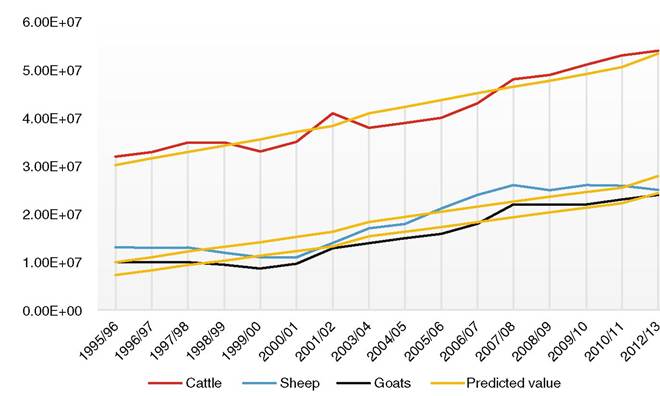
Fig. 14.1 Population growth of cattle, sheep, and goats in Ethiopia (Leta and Mesele 2014)
and the lifestyle of the population, livestock husbandry practices in Ethiopia are categorized as:
Mixed farming which is a subsistence, mixed crop-livestock system, commonly practiced in the central highland regions. Cattle are the predominant species, with relatively large numbers of oxen used for traction on crop fields.
Intensive farming practices such as in dairy (pure or cross-bred) farms in urban and peri-urban areas, or feedlots (fattening zebu cattle for local and export markets), and state-owned breeding centers where selected indigenous breeds are maintained for breed evaluation and for cross-breeding purposes.
Pastoral/agropastoral farming is common in marginal, lowland areas such as in Borana, Somali, and Afar regions. Livestock kept in communally owned natural grazing ranges are at times driven far from settlements in search of good pastures and surface water. Cattle are the dominant species in this system in association with small ruminants and camels.
14.3
More on the topic Livestock Resources and Husbandry:
- Case C: Certificate of Bad Husbandry
- 3 Obligations as to Husbandry
- Investing in Livestock
- 2 Husbandry and estate management: statutory standards
- Geography, Demography, and Livestock Systems in Uganda
- Animal Husbandry
- Other Mycobacterial Infections in Livestock and Wildlife in Tanzania
- Chapter 19 BTB Control Strategies in Livestock and Wildlife in South Africa
- The livestock epidemic of 1847 and harvest failure of 1848 were less severe than the Great Drought of 1832-4.
- The combination of isolation from markets and state authority and a sparsely populated, arid, grassland environment led Orthodox state peasants in the Molochna River Basin to adopt a subsistence economy that emphasized animal husbandry and gardening.
- Systems with two or more resources
- Competitors may coexist if they use resources differently