Other Enteric Protozoa
The above-mentioned protozoa, under the best of circumstances, are marginally pathogenic. Other common hamster enteric microfauna include Chilomastix sp., Monocercomonoides sp., Octomitus sp., Tritrichomonas sp., and Entamoeba muris, among others.
Other than the thrill of discovery by the enthusiastic observer, these protozoa have no significance.Helminth Infestations Pinworm Infestations
Syrian hamsters are remarkably susceptible to pinworm infestations originating from a number of other rodent host species. These include Syphacia criceti, Syphacia peromysci, Syphacia stroma; the mouse and rat pinworms Syphacia obvelata, S. muris, and Aspiculuris tetraptera; and the gerbil pinwom Dentostomella translucida. Syphacia mesocriceti may be the only pinworm species that is native to hamsters. Concomitant infections are common in pet hamsters. Notably, there is host species preference of various pinworms between those of mice and rats and those of mice and gerbils, but hamsters appear to be universally susceptible to them all. Parasitism with pinworms has not been reported to result in any clinical disease among hamsters. Differential speciation can be achieved by morphology of ova upon fecal floatation and perianal tape specimens, or morphology of adult nematodes in the intestine at necropsy (see Burr, et al. 2012).
Trichosomoides nasalis Infestation
A number of reports have documented infestation of the nasal cavity of hamsters with T. nasalis. Involvement of laboratory hamsters was documented several decades ago, but sporadic cases are likely to be observed in pet hamsters. The primary hosts for this nematode are other wild rodents. Double-operculated ova in feces are diagnostic, but must be differentiated from equally rare Capillaria spp.
Tapeworm Infestations
Hamsters, like other rodents, have been found with liver cysts of Cysticercus fasciolaris, the intermediate stage of Taenia taeniaeformis, a tapeworm of cats. Infestation is incurred by contamination of food with feces from the definitive hosts.
Hamsters may be hosts to 3 tapeworms of the family Hymenolepidae, including Hymenolepis diminuta, Rodentolepis microstoma, and Rodentolepis nana (the dwarf tapeworm). In the past, infestations with H. diminuta and R. nana were relatively common in hamsters, and R. nana continues to be common in pet hamsters. Rodentolepis microstoma and R. nana adults are usually found in the lower small intestine, whereas H. diminuta adults tend to reside in the upper small intestine. Unless there is a heavy infestation, hamsters do not show clinical signs. All 3 of these tapeworms may utilize arthropod intermediate hosts (indirect life cycle), but R. nana may also complete a direct life cycle within its mammalian host, thereby posing a higher zoonotic risk of transmission to human contacts. Rodentolepis nana is the most common human tapeworm worldwide, but laboratory rodents (mice, rats, and hamsters) have been found to be resistant to infection with human isolates of R. nana. Diagnosis is made by identification of the eggs in fecal samples or in crush preparations, by demonstration of the adult worms at necropsy, or on histological examination. Rodentolepis nana adults are relatively small (Fig. 3.23), whereas H. diminuta and R. microstoma adults are considerably larger (Fig. 3.24).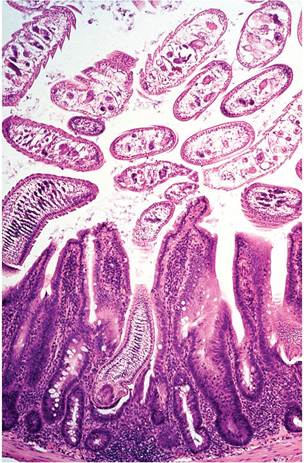
FIG. 3.23. Small intestine from a hamster infested with Rodentolepis nana. Note the small size of the adult tapeworms relative to the size of villi.

FIG. 3.24. Small intestine from another animal infested with Hymenolepis diminuta. Note the large size of the adult parasite in relation to the intestinal villi (versus R. nana).